
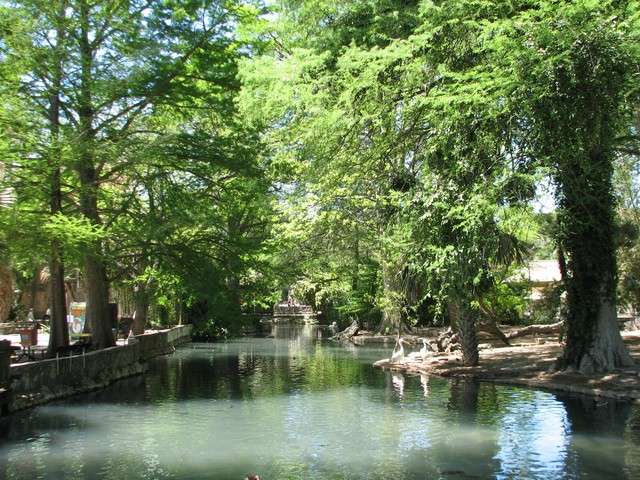
San Antonio certainly has a zoo, but not much of an aquarium. It is located a few miles North of downtown. Its layout is a convoluted one, scattered with a wide variety of exhibit styles and both geographic and zoological organized areas with plenty of misplaced confusing exceptions. My review will skip around the property in an attempt to describe groupings of exhibits by type, but note that many of these are my own and not official named areas. There are 3 exhibit complexes that can be described as geographically organized, with one of them being truly immersive. There are also 2 that are zoologically organized outdoor complexes. 3 areas dominated by outdoor yards with slight zoological tendencies are also identified, as well as 4 small indoor zoologically organized exhibit houses. Finally, 1 complex can be considered a slight biome-organized one. One unique aspect of this zoo is that there are no rides! More remarkable however is the fact that one entire edge of the property is contained by tall cliff faces from a former rock quarry that are used as the containment for many of the open yards. Topping the cliffs are low forests of native oaks and pecan and shrubs. The native light yellow stone is further used for most of the masonry walls and railings and moats on the grounds, as well as natural rock outcroppings inside exhibits; in addition, simulated rockwork in some cases is often matched to look like existing. This extensive common material use helps tie together the many disparate elements of the exhibits and facility. In addition, an extensive system of waterways shaded by large trees in the lower portion of the site helps to soften all the stone and creates a setting that is sometimes more memorable than the exhibit enclosures.
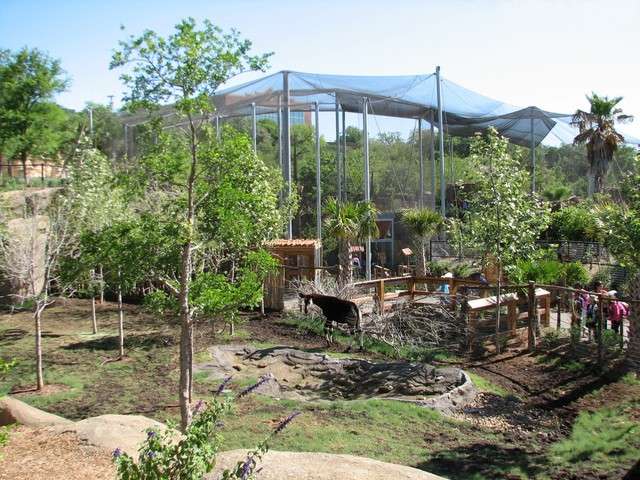
Africa Live is a geographically organized exhibit complex that is by far the newest, most successful, and immersive part of the zoo. It begins with an exhibit building that is a contemporary stucco exterior, with its entrance façade featuring a tall rocky waterfall and continental shaped entry signs. Once inside, several exhibit viewing rooms are experienced with rocky walls set with simulated bone and fossil fragments and exposed roots; above this is a dark open ceiling with exposed twisting ducts that abstractly represent large roots. Graphics are printed on canvas banners suspended between rustic timber columns. A medium wall aquarium is seen first with fish from Lake Tanganyika. This faces the first of two large viewing rooms with three curved panels each for above-and-underwater views of the Nile hippopotamus exhibit, a nice long outdoor habitat only viewed from the building interior. Although its dry land area is typically small, it is an above-average exhibit for its type. A separate hallway is darker and has many exhibits, beginning with a long rocky aquarium titled Aliens in the Water for introduced species. Next are 4 small wall exhibits set in the rocks for African lungfish, emperor scorpion, African bullfrog, and giant African millipede. Then a long exhibit with underwater viewing is seen for dwarf crocodile and mud turtle, then a nice cave with large trunks and a pool for African rock python. 3 small wall exhibits follow, for gaboon and rhino vipers, green mamba, and banded Egyptian cobra. There is also a small room behind glass for African palm civet, a rarely exhibited species, although it is cramped. The final indoor viewing is for an outdoor exhibit of Nile crocodile that features underwater viewing and a unique simulated mud cave with a nest and small windows into the exhibit. After exiting the building, another viewing window of the croc exhibit starts the fine large tall aviary with a rocky passage that opens up into a streamside loop. A waterfall and rocky backdrop forms a few of its sides and it is filled with buff-crested bustard, sacred ibis, Hottentot teal, Kenyan crested guineafowl, green turaco, taveta golden weaver, cattle egret, rose-ringed parakeet, speckled mousebird, Madagascar partridge, hammerkop, Hadada ibis, black crake, triangular spotted pigeon, European wood pigeon, emerald starling, golden-breasted starling, Congo peafowl, Namaqua dove, Abdims stork, green wood hoopoe, blue-breasted kingfisher, red and yellow barbet, amethyst starling, superb starling, blue-bellied roller, and racquet-tailed roller. One side of the aviary is a separate netted enclosure with a few glass viewing alcoves into a different nice exhibit filled with tall simulated tree climbing structures for Angolan colobus and Wolfs guenon. After exiting the aviary is a large okapi yard surrounded by rocks and filled with trees; unfortunately, a few too many styles of railing and fence were chosen for the front viewing area. It has a shelter in front with what looks like a controlled contact demonstration pen as well. Then the path enters the kopje-themed area, with a small rocky exhibit behind glass that is currently empty and is supposed to receive either dwarf mongoose or meerkat. Slightly towering above this is a scenic grouping of termite mounds that form a cave; once it is entered, an entire exhibit of overscaled termite statues and tunnels with excellent graphics effectively illustrates a colony. There are also two viewing windows into the adjacent fine African wild dog yard which is also viewed from behind glass further along the path edged with boulder forms. Their exhibit is fairly roomy, has a pond, and is contained by more boulder forms. Two more small rocky exhibits complete the complex, viewed behind glass and enclosed with top netting: one for Lady Ross’ turaco and white-bellied bustard, and one for rock hyrax. Suddenly, the rocks end, an ugly view of the water filtration equipment in a shelter is seen, and the path rejoins an older one in front of the weak Asian elephant exhibit in an area that is clearly waiting for design and construction of a possible next phase. Perched above the kopje area is an outdoor terrace dining area for Baraza Café, and further along a walkway circles around the complex with a nice view over the okapi exhibit and aviary and monkey exhibit. On this walkway is also an upper entrance to a viewing deck inside the aviary. This complex is well-designed, features easy viewing for most of its exhibits, and is a much-needed boost to the quality of the zoo’s design.
Okapi Exhibit with Aviary and Angolan Colobus and Wolf's Guenon Exhibit in background, in Africa Live:
One smaller geographic complex is Africa’s Rift Valley with 10 exhibits. It is reached beyond several of the African hoofstock exhibits described later so it might be considered part of a larger African area (and Africa Live is not far away) but it is different in style and scale. It begins with a small netted enclosure for crowned hornbill, and then a nice grassy and shaded open yard for cheetah. As the site rises to an upper area, there are small rocky yards for crested porcupine, Kirks dik-dik, and an empty one. There are also three aviaries, one for bataleur eagle and two medium sized hillside walkthrough netted ones. The larger of the two is Forest Trail and contains East African crowned crane, rose-ringed parakeet, cattle egret, Abdim’s stork, painted stork, Kenya crested guineafowl, African spur-winged plover, little blue heron, sacred ibis, speckled pigeon, and Madagascar partridge. African Thicket is the smaller of the two and has speckled pigeon, gold coast turaco, Jardines parrot, and red-bellied parrot on a nice steep hillside trail. There is also a small average cage for black-footed cat. This complex is crowned by Treetop Lookout, a woodsy shelter perched above the pleasant path and trees, completing a nice little exhibit cluster.
Amazonia is another geographically organized exhibit complex, composed of about 20 exhibits in a scattered area that does little to emulate the Amazon. Its enclosures are a varied assortment of cages with just two open yards, and a few very small houses for interior exhibits. All of this is in a shaded area of oaks and pecan; it is an average pleasant area but its exhibits mostly do not match its nice collection. The star of the complex is the waterway that flows through it; along this is a roomy yard for capybara, a rocky elevated enclosure for jaguar with a viewing cave passageway, and a large walk-in aviary that surrounds a section of it. The aviary is entered to a viewing deck adjacent to the jaguar; the cats can survey the aviary through mesh, a nice active feature for them as well as being well above surrounding walkways. The aviary contains giant anteater on its far bank, as well as scarlet ibis, boat-billed heron, 3 macaw species, sun conure, green oropendula, purplish jay, ringed teal, white-crowned pigeon, sun bittern, and Peruvian pigeon – I imagine that the size of this aviary allows for many other species from their fantastic collection too. Another large aviary is a rectangular cage for Andean condor, and attached to one side is a smaller one for seriema. There are also a few average netted enclosures for ocelot, white-faced saki, black-handed spider monkey, and white-throated capuchin monkey. There are also about 7 smaller below-average cages for pied, cotton-top, and golden lion tamarins (as well as one for Prevosts squirrel, whoops!). A small open yard with a pond for dwarf caiman adjoins a small interior exhibit building with 3 small behind-glass rooms for kinkajou, short-tailed fruit bat, and Linnes two-toed sloth with nine-banded armadillo. Finally, a separate small building has a nice exhibit with underwater viewing for anaconda.
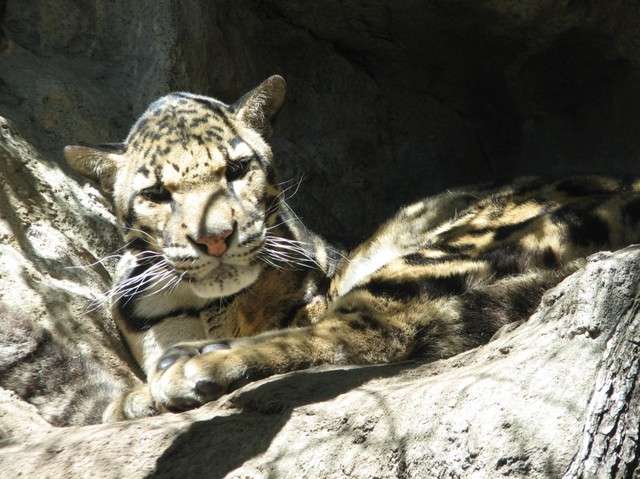
Cat Grotto (originally opened as Cliffside Grottos in 1985) is a cave-like passageway of small rocky exhibits with multiple viewing windows that is a nice intimate viewing experience. This complex can be considered one of the two zoologically organized rocky outdoor clusters, although it is not dominated by cat species anymore. While none of the exhibits are roomy or impressive, they are rather immersive. The slightly larger ones are covered with hidden mesh and include fishing cat, fossa, clouded leopard, and red ruffed lemur. Smaller caves are for Prevosts squirrel, elephant tree shrew, and black-footed cat. There is also a small rocky aviary for guira cuckoo and ring-tailed and silver teals, and an open yard for macaw perches. The passageway is interrupted by the main walkway, then continues into a matching viewing cave for the jaguar exhibit in Amazonia previously mentioned. Also adjacent to this is a much older average rectangular masonry-and-cage exhibit for black leopard that is not easily categorized elsewhere.
Clouded Leopard in Cat Grotto:
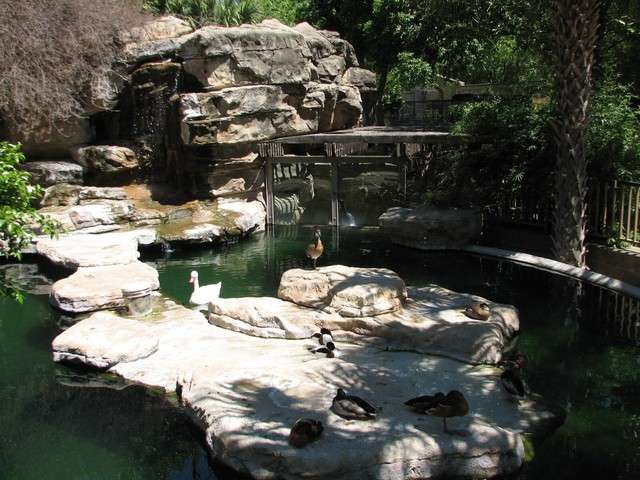
The other small rocky cluster of zoological outdoor exhibits was for otters; three small matching rocky exhibit yards with curving ramps around them and an underwater viewing shelter are centered on a waterfall-draped outcrop. It is a nice complex, but two of the exhibits were empty and unsigned when I visited (probably getting ready to receive new otters?). The other exhibit is occupied by Coscoroba swan.
Coscoroba Swan Exhibit:
One of the three areas that is dominated by open yard exhibits is an unnamed area to the left of the entrance, a half-loop with a hodge-podge of exhibits, most of which take advantage of the high exposed natural rock faces crowned with vegetation that form the undulating Western edge of the zoo. The quarry-like backdrop is used as the back edge of the exhibits, while matching rock and simulated rock is constructed to form the sides and moat fronts. This is an area of mostly primates and bears; there are three average exhibits for spectacled, American black, and grizzly bears. Two smaller grotto-like habitats are nearby, for black-and-white ruffed lemur and an empty one that looks like it is set up for a similar species. These are mostly unshaded hot pits that appear to have originally been for canids or similar, either way they are poor. There is also a flamingo exhibit with a steel cage structure over it, the covering having been removed, so it was probably once a feline or similar exhibit. One yard has a small building built in front and is viewed through glass; this is the decent Komodo dragon exhibit and it has a small interior viewing area of their bedroom and an adjoining small glass room for reticulated python. Two other rock backdrop yards are nearby with wire coverings – one is an average large exhibit for Francois langur, the other a nice roomy exhibit for white-cheeked gibbon and Reeves muntjac and Asian small-clawed otter that is the best in this area. A koi pond and a cluster of about 5 small monkey cages round out the unfocused selection, for Wolfs guenon, golden-bellied mangabey, and black mangabey.
Another area of open yard exhibits is the largest and is also unnamed, dominated by a cluster of African exhibits in one area and a cluster of Australian exhibits in another so that it is not entirely random; hoofstock slightly predominate. Again, many of the yards are contained by the quarry-like cliffs, which provide a memorable backdrop to otherwise small-to-average sized but mostly bare exhibits for Asian elephant, an African savanna (giraffe, topi(yay!), ostrich, marabou stork, white-backed vulture, crowned crane), black rhino, white rhino (the rhino yards appear to be about 5 spaces with flexible configurations), okapi, addax, African lion, Sumatran tiger, spotted hyena, crested porcupine, Nubian ibex, and secretary bird. In addition, the Australian cluster has a few exhibits against the cliff-like yards for Parma wallaby and yellow-footed rock wallaby and a nice medium size walkthrough aviary that includes Eastern rosella, cockatiel, chestnut teal, Australian shelduck, New Guinea masked plover, mynah, emerald dove, crowned pigeon, Australian crested pigeon, pied imperial pigeon, and zebra dove. Continuing this small geographic area is a medium size walkthrough aviary for feeding lories, a small Goodfellows tree kangaroo yard, an Outback exhibit with bright red earth (emu, red kangaroo, and parma wallaby) and two medium yards for cassowary. They are part of a circle of smaller walled yards for spekes gazelle, red river hog, Reeves muntjac, yellow-backed duiker, blue duiker, and babirusa.
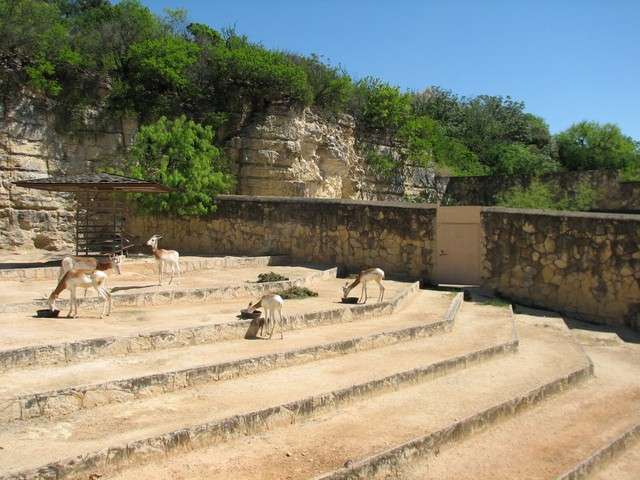
Dama Gazelle Exhibit:
Another area dominated by open yards is the furthest area of the zoo from the entrance, and is primarily bird exhibits (and some crocodilians and turtles) from the excellent collection. This is the largest area of birds, but there are plenty of others scattered around too. The zoo website lists 220 species in the collection! There is a large waterfowl lake shaded by bald cypress and overlooked by the Riverview Restaurant, and a Wetlands exhibit with a boardwalk through more cypress and a large attractive pond for tomistoma. In the middle of all this are two ugly walled yards for Malayan and Brazilian tapir; they have rotating access to a decent pool, the water from which spills across a stepping stone walkway for visitors at its edge and into a large shallow pond for fish and alligator snapping turtle. Cranes of the World features 4 medium sized yards dominated by a connecting waterway for species including Manchurian and whooping crane. Then there is a large central oval with 15 small-to-medium sized yards with masonry walls between and waterways in front; these mostly feature waterfowl like magpie goose and black-necked swan as well as two flamingo exhibits. Several of the yards also contain turtles and crocodilians including American alligator, Orinoco crocodile, and a mixed exhibit of gavial and wattled crane. There is a sign here that identifies the fish that are teeming in many of the waterways, including Texas cichlid, green sunfish, guppy, channel catfish, carp, green sailfin molly, green swordtail, largemouth bass, Mexican tetra, mesquite fish, plecostomus, spotted gar, tilapia, and koi. Most of the bird yards are fairly attractive and average size, but there are also 5 small cage rows of other birds in the area that are below average in size and attractiveness, totaling about 45 exhibits; one is mostly for the parrot family, while another has 4 exhibits of birds of paradise. Finally, there is also the Bird House, a round building with a free-flight lobby centered on a planted landscape beneath a round skylight cupola; along the walls around the central space are about 10 average smaller room exhibits behind glass with painted backdrops and natural lighting above. The species in the free-flight portion are blue tanager, amethyst starling, red bishop, cinnamon warbling-finch, mountain peacock pheasant, crested wood partridge, red-crested finch, sun bittern, blue-capped cordon-bleu, shama thrush, and Hottentot teal. Some of the glass exhibits include one for Inca tern and black crake and others; an Australian one for tawny frogmouth and metallic starling and others; an African savanna with paradise whydah, red bishop, orange-cheeked waxbill, golden-breasted starling, Egyptian plover, and Taveta golden weaver; and a tropical forest floor one featuring the very rare Guam rail oddly paired with Nicobar pigeon and red capped cardinal! The Bird House is pleasant, but like most of the bird area, it does not do justice to the justifiably proud collection.
Waterfowl lake:
Several other small indoor exhibit houses are scattered around the zoo and focus on zoological organization. The Reptile House is a low masonry building with a rectangular hallway layout inside, with about 60 wall exhibits behind glass, most of which are small. It is a nice collection, with a few slightly larger exhibits; these include one for young tomistoma (the adult exhibit is far larger and located in the outdoor Wetlands exhibit), one for common ameiva, several python, and a desert exhibit for Texas tortoise, desert iguana, chuckwalla, and Mexican whiptail lizard. Other inhabitants of smaller exhibits that I do not remember seeing elsewhere include habu, blue mountain swift, Cuviers Madagascar swift, Caatinga lancehead, Turanian viper, and broad-banded copperhead. The zoo website lists 130 species of reptiles, so probably only a little over half are actually in the Reptile House. Nearby is the Aquarium, another small old building with a square layout and about 16 small wall tanks, the largest of which is one for small bonnethead shark. The exhibits are mostly standard, housed behind what must be the world’s ugliest antique aquarium entrance decorated with shells. I did not note most of the species, but there was a whopping alligator snapping turtle (the unlucky one compared to the very large pond for another one near the Wetlands exhibit). There is also a small wood building with a few rooms called TOADally with about 16 average small wall exhibits for amphibians. A less permanent house is a quonset greenhouse for Butterflies.
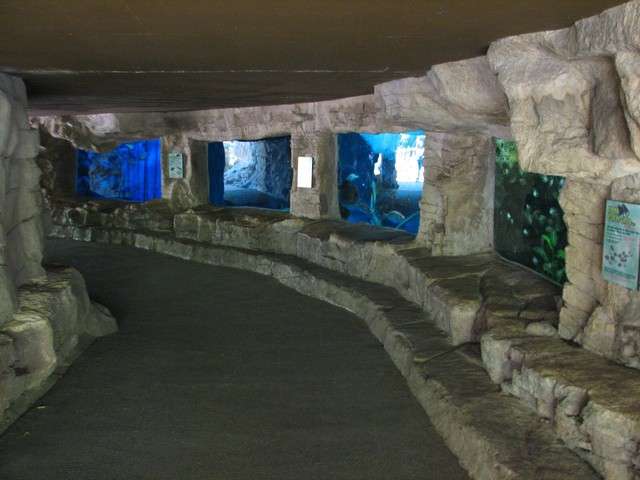
The children’s zoo is nice and is designed for those under 5, called Tiny Tot Nature Spot. It is actually roomy and well-designed, scattered with play features and about 16 animal habitats in several vague biome-themed zones. It has a single entry through an arbor, with simulated lily pads for crossing on each side. The Riverbank area begins with a long open habitat for flamingo (this is exhibit #4 at this zoo!) and leads to a beach and shallow swimming pond for kids; nearby is an average glass-railing yard for Aldabra tortoise. Tropical Waters is a rocky outcrop that matches much of the native rock; a waterfall spills over a ledge above an open cave with a nice native Texas fish tank containing longear sunfish, channel catfish, common carp, Florida bass, green sunfish, spotted gar, bluegill, and black crappie. A separate darker cave in the same facility has three more scenic freshwater tanks for actual tropical species: a medium one for fish (unnoted); a larger one for red pacu, tiger shovelnose catfish, ripsaw catfish, red tailed catfish, and leporinus; and a medium one for giant gourami, gold tinfoil barb, bala shark, and tinfoil barb. There is also an area called My Backyard for domestic-centered activities and a very small barn with three domestic pens. Discovery House is a small modern building with a courtyard, play room, and two exhibit rooms. One of these has a terrarium and fishtank, as well as a simulated stream in the middle for playing with fishing rods; the stream appears to emerge from one of the walls which is composed of a window with a partial underwater view of a small turtle pond outside. The other room has a rocky centerpiece with three small terrariums and exhibits about life underground; a crawl tunnel extends out from the glass wall on one side into a nice low rocky-walled prairie dog exhibit outside, that can also be viewed from portholes around its perimeter. Three more areas are at the back of the layout, including Maze, Campground, and Go Wild – they are mostly garden play areas, one with an open turtle and fish pond. Tropics is a small complex with a sloth statue to play on and 2 small glass-walled outdoor exhibits for squirrel monkey and coati.
Tropical Waters in Tiny Tot Nature Spot:
Although it is devoid of many noteworthy exhibits, its unique setting and fairly complete breadth of collection punctuated by a fantastic bird collection makes the San Antonio Zoo and Aquarium a worthwhile visit. I rank it at number 30 of the 50 zoo facilities I have visited, with its small aquarium building at number 36 of 40. Africa Live is number 47 of my top 50 list of themed exhibit complexes (which is still good), while none of the individual exhibits make my top lists. Adult admission is $10, underpriced by a buck or two. I have posted additional pictures in the gallery.
Africa Live is a geographically organized exhibit complex that is by far the newest, most successful, and immersive part of the zoo. It begins with an exhibit building that is a contemporary stucco exterior, with its entrance façade featuring a tall rocky waterfall and continental shaped entry signs. Once inside, several exhibit viewing rooms are experienced with rocky walls set with simulated bone and fossil fragments and exposed roots; above this is a dark open ceiling with exposed twisting ducts that abstractly represent large roots. Graphics are printed on canvas banners suspended between rustic timber columns. A medium wall aquarium is seen first with fish from Lake Tanganyika. This faces the first of two large viewing rooms with three curved panels each for above-and-underwater views of the Nile hippopotamus exhibit, a nice long outdoor habitat only viewed from the building interior. Although its dry land area is typically small, it is an above-average exhibit for its type. A separate hallway is darker and has many exhibits, beginning with a long rocky aquarium titled Aliens in the Water for introduced species. Next are 4 small wall exhibits set in the rocks for African lungfish, emperor scorpion, African bullfrog, and giant African millipede. Then a long exhibit with underwater viewing is seen for dwarf crocodile and mud turtle, then a nice cave with large trunks and a pool for African rock python. 3 small wall exhibits follow, for gaboon and rhino vipers, green mamba, and banded Egyptian cobra. There is also a small room behind glass for African palm civet, a rarely exhibited species, although it is cramped. The final indoor viewing is for an outdoor exhibit of Nile crocodile that features underwater viewing and a unique simulated mud cave with a nest and small windows into the exhibit. After exiting the building, another viewing window of the croc exhibit starts the fine large tall aviary with a rocky passage that opens up into a streamside loop. A waterfall and rocky backdrop forms a few of its sides and it is filled with buff-crested bustard, sacred ibis, Hottentot teal, Kenyan crested guineafowl, green turaco, taveta golden weaver, cattle egret, rose-ringed parakeet, speckled mousebird, Madagascar partridge, hammerkop, Hadada ibis, black crake, triangular spotted pigeon, European wood pigeon, emerald starling, golden-breasted starling, Congo peafowl, Namaqua dove, Abdims stork, green wood hoopoe, blue-breasted kingfisher, red and yellow barbet, amethyst starling, superb starling, blue-bellied roller, and racquet-tailed roller. One side of the aviary is a separate netted enclosure with a few glass viewing alcoves into a different nice exhibit filled with tall simulated tree climbing structures for Angolan colobus and Wolfs guenon. After exiting the aviary is a large okapi yard surrounded by rocks and filled with trees; unfortunately, a few too many styles of railing and fence were chosen for the front viewing area. It has a shelter in front with what looks like a controlled contact demonstration pen as well. Then the path enters the kopje-themed area, with a small rocky exhibit behind glass that is currently empty and is supposed to receive either dwarf mongoose or meerkat. Slightly towering above this is a scenic grouping of termite mounds that form a cave; once it is entered, an entire exhibit of overscaled termite statues and tunnels with excellent graphics effectively illustrates a colony. There are also two viewing windows into the adjacent fine African wild dog yard which is also viewed from behind glass further along the path edged with boulder forms. Their exhibit is fairly roomy, has a pond, and is contained by more boulder forms. Two more small rocky exhibits complete the complex, viewed behind glass and enclosed with top netting: one for Lady Ross’ turaco and white-bellied bustard, and one for rock hyrax. Suddenly, the rocks end, an ugly view of the water filtration equipment in a shelter is seen, and the path rejoins an older one in front of the weak Asian elephant exhibit in an area that is clearly waiting for design and construction of a possible next phase. Perched above the kopje area is an outdoor terrace dining area for Baraza Café, and further along a walkway circles around the complex with a nice view over the okapi exhibit and aviary and monkey exhibit. On this walkway is also an upper entrance to a viewing deck inside the aviary. This complex is well-designed, features easy viewing for most of its exhibits, and is a much-needed boost to the quality of the zoo’s design.
Okapi Exhibit with Aviary and Angolan Colobus and Wolf's Guenon Exhibit in background, in Africa Live:

One smaller geographic complex is Africa’s Rift Valley with 10 exhibits. It is reached beyond several of the African hoofstock exhibits described later so it might be considered part of a larger African area (and Africa Live is not far away) but it is different in style and scale. It begins with a small netted enclosure for crowned hornbill, and then a nice grassy and shaded open yard for cheetah. As the site rises to an upper area, there are small rocky yards for crested porcupine, Kirks dik-dik, and an empty one. There are also three aviaries, one for bataleur eagle and two medium sized hillside walkthrough netted ones. The larger of the two is Forest Trail and contains East African crowned crane, rose-ringed parakeet, cattle egret, Abdim’s stork, painted stork, Kenya crested guineafowl, African spur-winged plover, little blue heron, sacred ibis, speckled pigeon, and Madagascar partridge. African Thicket is the smaller of the two and has speckled pigeon, gold coast turaco, Jardines parrot, and red-bellied parrot on a nice steep hillside trail. There is also a small average cage for black-footed cat. This complex is crowned by Treetop Lookout, a woodsy shelter perched above the pleasant path and trees, completing a nice little exhibit cluster.
Amazonia is another geographically organized exhibit complex, composed of about 20 exhibits in a scattered area that does little to emulate the Amazon. Its enclosures are a varied assortment of cages with just two open yards, and a few very small houses for interior exhibits. All of this is in a shaded area of oaks and pecan; it is an average pleasant area but its exhibits mostly do not match its nice collection. The star of the complex is the waterway that flows through it; along this is a roomy yard for capybara, a rocky elevated enclosure for jaguar with a viewing cave passageway, and a large walk-in aviary that surrounds a section of it. The aviary is entered to a viewing deck adjacent to the jaguar; the cats can survey the aviary through mesh, a nice active feature for them as well as being well above surrounding walkways. The aviary contains giant anteater on its far bank, as well as scarlet ibis, boat-billed heron, 3 macaw species, sun conure, green oropendula, purplish jay, ringed teal, white-crowned pigeon, sun bittern, and Peruvian pigeon – I imagine that the size of this aviary allows for many other species from their fantastic collection too. Another large aviary is a rectangular cage for Andean condor, and attached to one side is a smaller one for seriema. There are also a few average netted enclosures for ocelot, white-faced saki, black-handed spider monkey, and white-throated capuchin monkey. There are also about 7 smaller below-average cages for pied, cotton-top, and golden lion tamarins (as well as one for Prevosts squirrel, whoops!). A small open yard with a pond for dwarf caiman adjoins a small interior exhibit building with 3 small behind-glass rooms for kinkajou, short-tailed fruit bat, and Linnes two-toed sloth with nine-banded armadillo. Finally, a separate small building has a nice exhibit with underwater viewing for anaconda.
Cat Grotto (originally opened as Cliffside Grottos in 1985) is a cave-like passageway of small rocky exhibits with multiple viewing windows that is a nice intimate viewing experience. This complex can be considered one of the two zoologically organized rocky outdoor clusters, although it is not dominated by cat species anymore. While none of the exhibits are roomy or impressive, they are rather immersive. The slightly larger ones are covered with hidden mesh and include fishing cat, fossa, clouded leopard, and red ruffed lemur. Smaller caves are for Prevosts squirrel, elephant tree shrew, and black-footed cat. There is also a small rocky aviary for guira cuckoo and ring-tailed and silver teals, and an open yard for macaw perches. The passageway is interrupted by the main walkway, then continues into a matching viewing cave for the jaguar exhibit in Amazonia previously mentioned. Also adjacent to this is a much older average rectangular masonry-and-cage exhibit for black leopard that is not easily categorized elsewhere.
Clouded Leopard in Cat Grotto:

The other small rocky cluster of zoological outdoor exhibits was for otters; three small matching rocky exhibit yards with curving ramps around them and an underwater viewing shelter are centered on a waterfall-draped outcrop. It is a nice complex, but two of the exhibits were empty and unsigned when I visited (probably getting ready to receive new otters?). The other exhibit is occupied by Coscoroba swan.
Coscoroba Swan Exhibit:

One of the three areas that is dominated by open yard exhibits is an unnamed area to the left of the entrance, a half-loop with a hodge-podge of exhibits, most of which take advantage of the high exposed natural rock faces crowned with vegetation that form the undulating Western edge of the zoo. The quarry-like backdrop is used as the back edge of the exhibits, while matching rock and simulated rock is constructed to form the sides and moat fronts. This is an area of mostly primates and bears; there are three average exhibits for spectacled, American black, and grizzly bears. Two smaller grotto-like habitats are nearby, for black-and-white ruffed lemur and an empty one that looks like it is set up for a similar species. These are mostly unshaded hot pits that appear to have originally been for canids or similar, either way they are poor. There is also a flamingo exhibit with a steel cage structure over it, the covering having been removed, so it was probably once a feline or similar exhibit. One yard has a small building built in front and is viewed through glass; this is the decent Komodo dragon exhibit and it has a small interior viewing area of their bedroom and an adjoining small glass room for reticulated python. Two other rock backdrop yards are nearby with wire coverings – one is an average large exhibit for Francois langur, the other a nice roomy exhibit for white-cheeked gibbon and Reeves muntjac and Asian small-clawed otter that is the best in this area. A koi pond and a cluster of about 5 small monkey cages round out the unfocused selection, for Wolfs guenon, golden-bellied mangabey, and black mangabey.
Another area of open yard exhibits is the largest and is also unnamed, dominated by a cluster of African exhibits in one area and a cluster of Australian exhibits in another so that it is not entirely random; hoofstock slightly predominate. Again, many of the yards are contained by the quarry-like cliffs, which provide a memorable backdrop to otherwise small-to-average sized but mostly bare exhibits for Asian elephant, an African savanna (giraffe, topi(yay!), ostrich, marabou stork, white-backed vulture, crowned crane), black rhino, white rhino (the rhino yards appear to be about 5 spaces with flexible configurations), okapi, addax, African lion, Sumatran tiger, spotted hyena, crested porcupine, Nubian ibex, and secretary bird. In addition, the Australian cluster has a few exhibits against the cliff-like yards for Parma wallaby and yellow-footed rock wallaby and a nice medium size walkthrough aviary that includes Eastern rosella, cockatiel, chestnut teal, Australian shelduck, New Guinea masked plover, mynah, emerald dove, crowned pigeon, Australian crested pigeon, pied imperial pigeon, and zebra dove. Continuing this small geographic area is a medium size walkthrough aviary for feeding lories, a small Goodfellows tree kangaroo yard, an Outback exhibit with bright red earth (emu, red kangaroo, and parma wallaby) and two medium yards for cassowary. They are part of a circle of smaller walled yards for spekes gazelle, red river hog, Reeves muntjac, yellow-backed duiker, blue duiker, and babirusa.
Dama Gazelle Exhibit:

Another area dominated by open yards is the furthest area of the zoo from the entrance, and is primarily bird exhibits (and some crocodilians and turtles) from the excellent collection. This is the largest area of birds, but there are plenty of others scattered around too. The zoo website lists 220 species in the collection! There is a large waterfowl lake shaded by bald cypress and overlooked by the Riverview Restaurant, and a Wetlands exhibit with a boardwalk through more cypress and a large attractive pond for tomistoma. In the middle of all this are two ugly walled yards for Malayan and Brazilian tapir; they have rotating access to a decent pool, the water from which spills across a stepping stone walkway for visitors at its edge and into a large shallow pond for fish and alligator snapping turtle. Cranes of the World features 4 medium sized yards dominated by a connecting waterway for species including Manchurian and whooping crane. Then there is a large central oval with 15 small-to-medium sized yards with masonry walls between and waterways in front; these mostly feature waterfowl like magpie goose and black-necked swan as well as two flamingo exhibits. Several of the yards also contain turtles and crocodilians including American alligator, Orinoco crocodile, and a mixed exhibit of gavial and wattled crane. There is a sign here that identifies the fish that are teeming in many of the waterways, including Texas cichlid, green sunfish, guppy, channel catfish, carp, green sailfin molly, green swordtail, largemouth bass, Mexican tetra, mesquite fish, plecostomus, spotted gar, tilapia, and koi. Most of the bird yards are fairly attractive and average size, but there are also 5 small cage rows of other birds in the area that are below average in size and attractiveness, totaling about 45 exhibits; one is mostly for the parrot family, while another has 4 exhibits of birds of paradise. Finally, there is also the Bird House, a round building with a free-flight lobby centered on a planted landscape beneath a round skylight cupola; along the walls around the central space are about 10 average smaller room exhibits behind glass with painted backdrops and natural lighting above. The species in the free-flight portion are blue tanager, amethyst starling, red bishop, cinnamon warbling-finch, mountain peacock pheasant, crested wood partridge, red-crested finch, sun bittern, blue-capped cordon-bleu, shama thrush, and Hottentot teal. Some of the glass exhibits include one for Inca tern and black crake and others; an Australian one for tawny frogmouth and metallic starling and others; an African savanna with paradise whydah, red bishop, orange-cheeked waxbill, golden-breasted starling, Egyptian plover, and Taveta golden weaver; and a tropical forest floor one featuring the very rare Guam rail oddly paired with Nicobar pigeon and red capped cardinal! The Bird House is pleasant, but like most of the bird area, it does not do justice to the justifiably proud collection.
Waterfowl lake:

Several other small indoor exhibit houses are scattered around the zoo and focus on zoological organization. The Reptile House is a low masonry building with a rectangular hallway layout inside, with about 60 wall exhibits behind glass, most of which are small. It is a nice collection, with a few slightly larger exhibits; these include one for young tomistoma (the adult exhibit is far larger and located in the outdoor Wetlands exhibit), one for common ameiva, several python, and a desert exhibit for Texas tortoise, desert iguana, chuckwalla, and Mexican whiptail lizard. Other inhabitants of smaller exhibits that I do not remember seeing elsewhere include habu, blue mountain swift, Cuviers Madagascar swift, Caatinga lancehead, Turanian viper, and broad-banded copperhead. The zoo website lists 130 species of reptiles, so probably only a little over half are actually in the Reptile House. Nearby is the Aquarium, another small old building with a square layout and about 16 small wall tanks, the largest of which is one for small bonnethead shark. The exhibits are mostly standard, housed behind what must be the world’s ugliest antique aquarium entrance decorated with shells. I did not note most of the species, but there was a whopping alligator snapping turtle (the unlucky one compared to the very large pond for another one near the Wetlands exhibit). There is also a small wood building with a few rooms called TOADally with about 16 average small wall exhibits for amphibians. A less permanent house is a quonset greenhouse for Butterflies.
The children’s zoo is nice and is designed for those under 5, called Tiny Tot Nature Spot. It is actually roomy and well-designed, scattered with play features and about 16 animal habitats in several vague biome-themed zones. It has a single entry through an arbor, with simulated lily pads for crossing on each side. The Riverbank area begins with a long open habitat for flamingo (this is exhibit #4 at this zoo!) and leads to a beach and shallow swimming pond for kids; nearby is an average glass-railing yard for Aldabra tortoise. Tropical Waters is a rocky outcrop that matches much of the native rock; a waterfall spills over a ledge above an open cave with a nice native Texas fish tank containing longear sunfish, channel catfish, common carp, Florida bass, green sunfish, spotted gar, bluegill, and black crappie. A separate darker cave in the same facility has three more scenic freshwater tanks for actual tropical species: a medium one for fish (unnoted); a larger one for red pacu, tiger shovelnose catfish, ripsaw catfish, red tailed catfish, and leporinus; and a medium one for giant gourami, gold tinfoil barb, bala shark, and tinfoil barb. There is also an area called My Backyard for domestic-centered activities and a very small barn with three domestic pens. Discovery House is a small modern building with a courtyard, play room, and two exhibit rooms. One of these has a terrarium and fishtank, as well as a simulated stream in the middle for playing with fishing rods; the stream appears to emerge from one of the walls which is composed of a window with a partial underwater view of a small turtle pond outside. The other room has a rocky centerpiece with three small terrariums and exhibits about life underground; a crawl tunnel extends out from the glass wall on one side into a nice low rocky-walled prairie dog exhibit outside, that can also be viewed from portholes around its perimeter. Three more areas are at the back of the layout, including Maze, Campground, and Go Wild – they are mostly garden play areas, one with an open turtle and fish pond. Tropics is a small complex with a sloth statue to play on and 2 small glass-walled outdoor exhibits for squirrel monkey and coati.
Tropical Waters in Tiny Tot Nature Spot:

Although it is devoid of many noteworthy exhibits, its unique setting and fairly complete breadth of collection punctuated by a fantastic bird collection makes the San Antonio Zoo and Aquarium a worthwhile visit. I rank it at number 30 of the 50 zoo facilities I have visited, with its small aquarium building at number 36 of 40. Africa Live is number 47 of my top 50 list of themed exhibit complexes (which is still good), while none of the individual exhibits make my top lists. Adult admission is $10, underpriced by a buck or two. I have posted additional pictures in the gallery.


