Sardinian Wildlife Alliance (SWA)

Mickey

Well-Known Member
5+ year member
The Sardinian Wildlife Alliance (or SWA) is a fictional project of mine,
it's a mainly zoological society that works for the conservations of species all over the world, with many in and ex situ on-going projects.

The society owns 5 facilities all over the island of Sardinia, in Italy, these are: Zoo of Sardinia, Sardinia Safari Park, Sardinia Wildlife Park, Aquarium of Sardinia and the Sardinia Research Facility for Marine Wildlife.

The first one is similar to a city zoo, similar to Prague if you may, with some raritites and most of it in indoor habitats and most of its residents fit in few buildings;

The second one focuses on megafauna and famous and easy-to-care-for animals, featuring the classic rides within animal's enclosures;

The third one is similar to a tierpark, with mostly natural landscaped enclosures and few cement and rock work as it has possibly the least amount of theming going on in all of the facilities;

the aquarium is pretty big, focusing on, as you would expect, aquatic life both of fresh and salt water and counts the most species out of all of the facilities;

The last facility is a close number booking only experience, as the animals in it are heavily studied and looked after, with ideal conditions and less disturbance as possible, it's also a rescue center for the marine wildlife around the island.

As I introduced the project earlier, I underlined the fact that it is a fictional society, but I tried to make it verisimilar to reality as much as possible, so if you have critiques about species or how said species came in the care of the society, blame it entirely on how I came up with them or, if either you do not care about the "lore" of the zoos or do not care about realism simlpy because it is unachievable by the majority of the people in this part of the forum and just want to read about an hypothetical collection, ignore it.

I should also mention that the facilities are destined only to grow, never to phase animals, so if your favorite animal is not on the list, it may come in the future.

The first map and description of the zoo will come soon! Stay tuned...
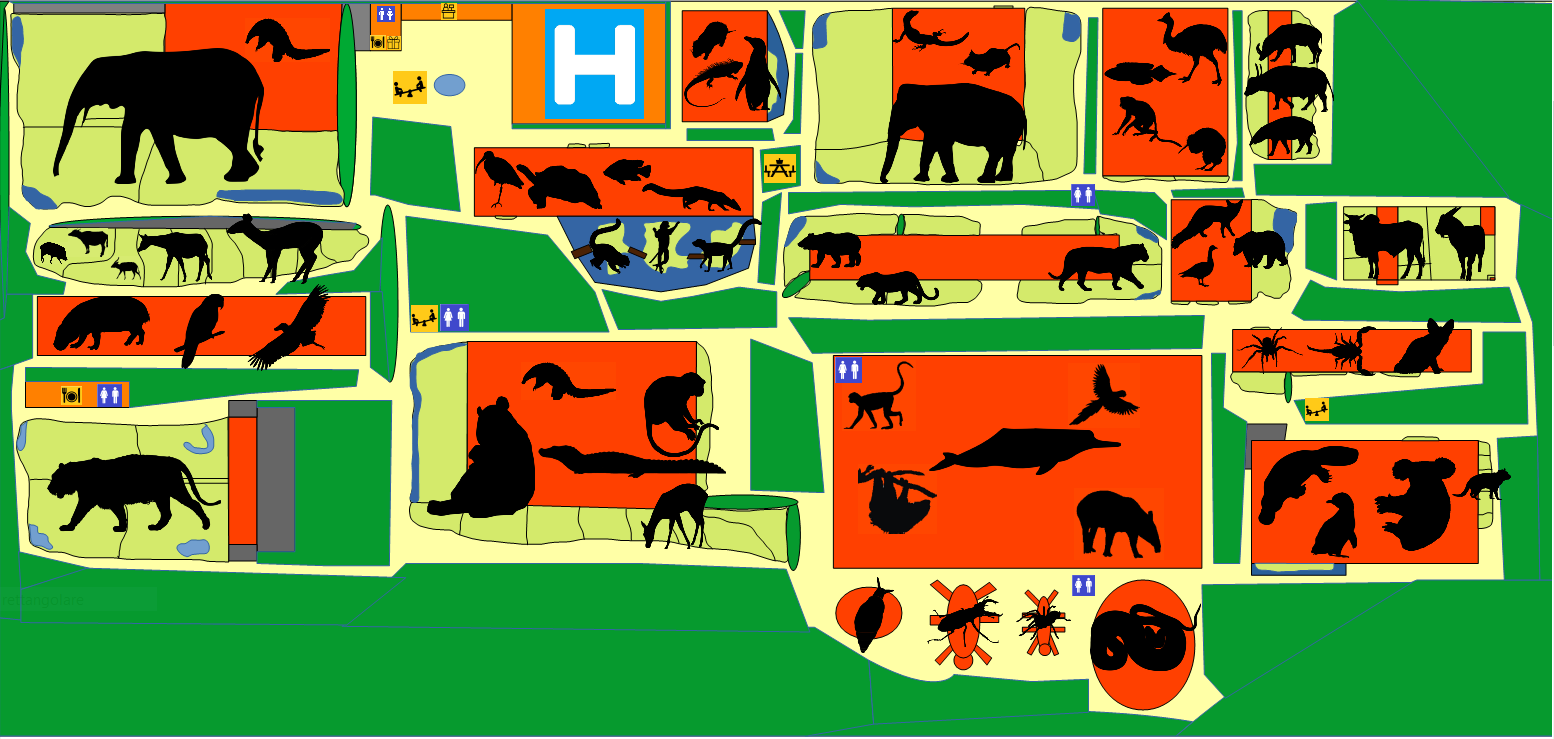
 
Here we are with the map of the first facility we're going to explore, the Zoo of Sardinia:

Legend:
Lime green= enclosure
Red= animal house
Orange= amenity/visitors' building
Grey= staff zone, off limits
Dark blue= water
Dark green= natural landscape

The exhibits in which the zoo is divided in are:

Congolese Adventure: the attraction focuses on the congolese fauna and animals of the Countries nearby that touch the greatest rainforest of Africa;

Expedition Islanders: this attraction exhibits animals from different islands of the different continents;

Panda Research Center: two buildings, one visitable and the other not, that showcase the giant panda and critically endangered animals from China and South East Asia countries;

Desert House: a single building that showcases creatures from different hot deserts;

Amazonia: a single great grenhouse that houses threatened animals from the Amazon and nearby rainforests, it differes from other similar attractions purely because instead of showcasing any common animal (found also in the pet trade) from the Amazon it actually showcases only threatened ones;

Marsupials Care Center: an Australian-themed attraction which features the iconic mammals of the continent as well as other non-marsupial species;

Vivariums Alley: 4 buildings showcasing small critters;

Farm: the classic children's attraction to satisfy their need to pet something all day.

In the next reply we'll go over the entrance complex and Congolese Adventure.
 
Last edited:
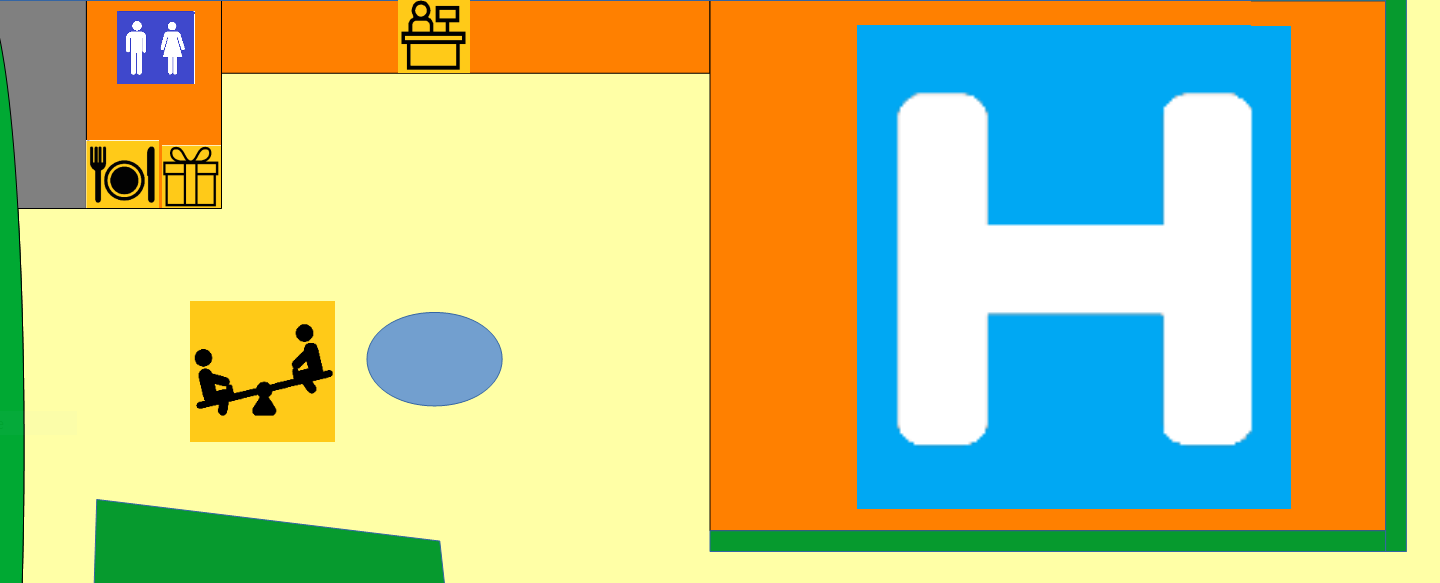
The entrance complex is composed of the entrance of the zoo, the zoo's biggest retaurant and its bathrooms, the gift shop, a playground, a fountain with the statue of Saint Francis of Assisi, patron of animals and 'ecology', and the zoo's hospital and offices (the last two are of course off limits and the hospital is visitable only if a private tour is booked).

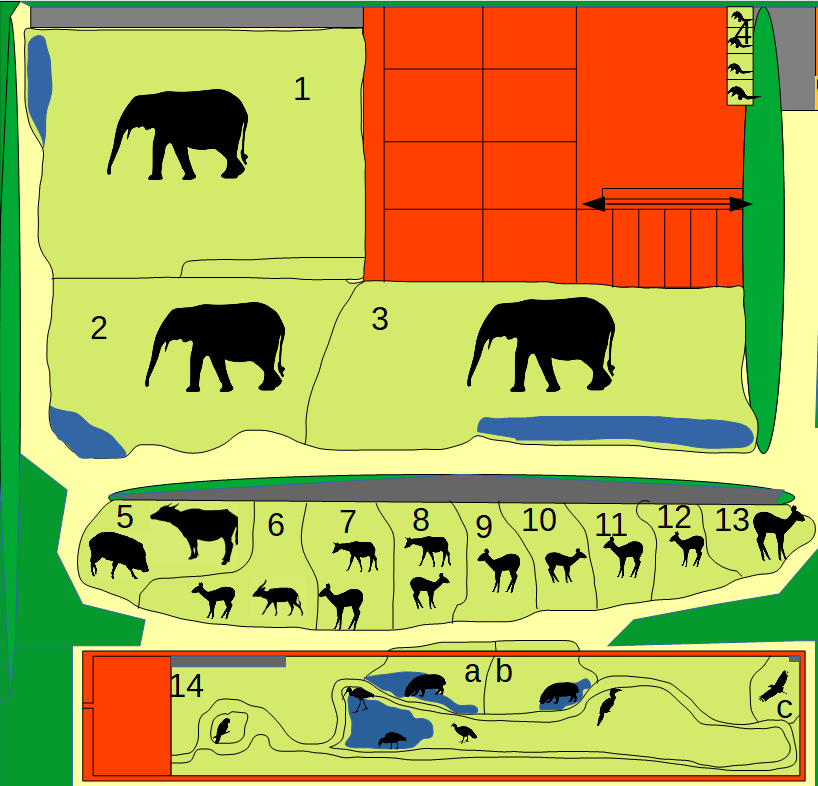
Moving on to the animal part, here is the map of Congolese Adventure:
(Note that in this part of the zoo the dark green ovals are artificial mountains of around 30m of height.)
Encloures n.(1), (2) and (3) are the 3 yards of a herd of 4.6 African Forest Elephant Loxodonta cyclotis, all of them being several acres, the smallest one being one and a half and the biggest 3 acres; yard n.1 is the territory of 3 unrelated young males, yard n. 2 is home to the zoo's current bull, and yard n. 3 is the cow yard.
All of the yards have 'vegetation islands', fenced and slightly elevated terraces where the vegetation is kept secure from the animals to preserve it and for the animals' welfare, as they like to hide behind them to escape visitors. The enclosures also feature several ponds to meet the need of the animals to cool off during hot days or when they feel like playing in it, as well as dirt plains, where they like to play in the dirt or mud depending on wether the plain is wet or not.
All of the individuals have different origins: the male comes from Japan, the females from a safari park in Namibia and the young males were donated from a circus that was about to shot them because it couldn't afford to feed the animals.
Enclosures lookalike:
Part of the elephant enclosure. - ZooChat
Asian Elephant Enclosure - ZooChat
Sumatran Elephant Enclosure - ZooChat

part-of-the-elephant-enclosure.545810

asian-elephant-enclosure.540126

The Elephant House and Museum is visitable every season of the year but since the elephants are visible through glass windows, they're covered during the warmer months to give the animal additional privacy; in this house, the big rectangle is the Museum of the Elephant, where the evolution and conservation of the Order Proboscidea are displayed for everyone to learn about it.
It's also here that you can see in the enclosure n.(4) 2.2 White-Bellied Pangolin Phataginus tricuspis that came from North America; the enclosure is divided in 4 lushly vegetated indoor spaces, while their outdoor is not visible by the public, and each individual has its own space but during the breeding season, where the couples can get in touch and hopefully mate.
Enclosures lookalike:
Fishing Cat Trail - Common Palm Civet and Sunda Pangolin exhibit - ZooChat

fishing-cat-trail-common-palm-civet-and-sunda-pangolin-exhibit.501271

Moving on from the Elephant House, we have the hoofstock yards, hidden behind one of the fake mountains, where inside of it you can find the stables; all of these enclosures are designed to accomodate shy animals, thus most of their surface is covered in short plants and shaded to make sure the animals can escape visitors and heat when needed.
Enclosure n.(5) houses a breeding herd of 1.4 African Forest Buffalo Syncerus caffer nanus and a bachelor herd of 3.0 Red River Hog Potamochoerus porcus, all of which go along just fine.
Enclosure lookalike:
Red Forest Buffalo / Red River Hog - ZooChat

red-forest-buffalo-red-river-hog.544086

Next enclosure (6) is home to 1.0 Western Bongo Tragelaphus eurycerus eurycerus and 1.1 Red Forest Duiker Cephalophus natalensis; the bongo has an interesting story behind, it was seized from a mafia man that didn't report the animal to authorities and during the investigation it was found that it was a smuggled specimen from Africa, and since the origin of the animal is unkown it's impossible to send it back to its Country of origin and so it will have to stay in captivity until some light clarifies the case, but there's a pair of duikers to keep him company while we wait.
Enclosure lookalike:
Kilimanjaro Safaris- Little Ituri Forest Exhibit - ZooChat

kilimanjaro-safaris-little-ituri-forest-exhibit.590646

Enclosures n.(7) and (8) are two enclosures for 1.1 Okapi Okapia johnstoni, the male in the n.7 andthe female in n.8 and both of them house a pair (2.2) of Yellow-Backed Duiker Cephalophus silvicultor, the male and female Okapi are enclosed together during the breeding season and the duikers subsequentially transferred in one of the other enclosure.
Enclosure lookalike:
Okapi Enclosure (Okapia Johnstonii) - ZooChat
Okapi enclosure - ZooChat

okapi-enclosure-okapia-johnstonii.587697

Time for the rarities of the zoo, paddocks n.(9), (10) and (11) all house each a pair (3.3)of Jentink's Duiker Cephalophus jentinki, despite not being from Congo, they live in one of the rainforests of Africa and occupy a nice similar to those of its realtives, reason why they're displayed here; they were offered by a sanctuary that rescues the animal in its native range and the zoo is the coordinator of the EEP of this species.
Enclosures lookalike (much bigger):
Jentink's Duiker Exhibit - ZooChat

jentinks-duiker-exhibit.135156

The last yards, (12) and (13) house each one a pair (2.2) of Zebra Duiker Cephalophus zebra, which came from the same sanctuary as the Jentink's species and are exhibited for the same reason.
Enclosure lookalike:
Edge of Africa - Western blue duiker enclosure 140921 - ZooChat

Moving on to the last part of our Adventure, the walkthrough greenhouse is our last stop, it houses a very little number of species as of now, but the collection is planned to grow.
As you enter, you are invited to test your knowledge in a large indoor mus about the rainforests and Mountain Gorillas, which the zoo supports in the wild, but there are plans to introduce a troop in captivity in this very facility.
After you finished your playtime, you can enter the real greenhouse (14) with a ground-level view of the attraction, in which the free-range species are:
5.5 Congo Grey Parrot Psittacus erithacus
4.10 Egyptian Goose Alopochen aegyptiaca
7.7 African Sacred Ibis Threskiornis aethiopicus
2.2 Silvery-Cheeked Hornbill Bycanistes brevis
4.8 Vulturine Guineafowl Acryllium vulturinum
They all live in the greenhouse but before the night they're recalled by the keepers in their night quarters (in grey), so that no fatality or unwanted behavior against any of the other inhabitants is committed.
There are, as of now, only 3 enclosures that are not traversable by guests, which are (14.a), (14.b) and (14.c), the first two are the indoor and outdoor enclosures of 1.1 Pigmy Hippopotamus Choeropsis liberiensis (of which night quarters are inside the walls, spreading i length rather than in width), that live in a lushy indoor habitat as well and have plenty of space to retreat, as well as their ponds, non viewable from under them; despite not being from Congo like the two species of duikers, this is the only place in the park that the society could accomodate for them.
The last enclosure is a netted aviary for the loudest residents of the greenhouse, 1.1 Shoebill Balaeniceps rex who have as well their night quarters in the back of the enclosure, out of the eyes of most visitors.
Inside the greenhouse:
Walled Garden - Tropical House 280222 - ZooChat
Tropical House 050816 - ZooChat
Waterfowls pond: Pond seen from new adventure route, 2022-07-03 - ZooChat
Hippo outdoor habitat:
Tropical house - ZooChat
tropical-house.572541

About 6 guards of the park patrol this greenhouse, in addtion to the many cameras, to ensure none of the visitors molest the animals or feed them.

This is all for our first attraction, I hope you liked it, next up is Expedition Islanders! Stay tuned...
 
Back
Top