Search for Lost Birds

Thomas

Well-Known Member
5+ year member
Around the world, more than 130 species of birds, or about one percent, are considered “lost.” At least a decade has passed since each of these species were last confirmed by photographs, sound recordings, or physical documentation.

To identify, promote, and rediscover these species, American Bird Conservancy (ABC) has partnered with Re:wild and BirdLife International to form a global initiative. Launched in 2021, the Search for Lost Birds supports field expeditions with local partners to seek lost birds and, when rediscovered, to protect these birds and their habitats. This expanded, global effort builds upon the groundwork that ABC laid back in 2016.

For decades now, ABC and its partners have worked together to conserve birds that were formerly lost, such as the Blue-eyed Ground Dove (rediscovered in 2015), Long-whiskered Owlet (2002), Kaempfer's Woodpecker (2006), Indigo-winged Parrot (2002), Stresemann's Bristlefront (1995), Antioquia Brushfinch (2018), Pale-headed Brushfinch (1998), and Cherry-throated Tanager (1998).

Why Search for Lost Birds?
If you don't know where something is, or even whether it exists, it's very difficult to directly safeguard it. The same holds true for lost birds. Our expeditions work with local partners to provide conservationists with the key to unlocking protection efforts for these species. For all the species listed above, rediscovery was the critical first step toward permanent protection measures.

Further, by identifying lost birds in a timely fashion, our approach provides an early-warning system for these species. Finding lost birds can mean the difference between saving them and losing them forever. Tragically, for some lost birds, like the Cryptic Treehunter, Alagoas Foliage-Gleaner, and Po‘o-uli, it was already too late. All three species are considered to have gone extinct this century.
 
Lost and Found
The following case studies illustrate how a series of steps can ultimately lead from rediscovery to recovery:

Black-browed Babbler – Prior to its stunning rediscovery in southern Borneo (2020), only a single specimen was known, collected at some unspecified point during the 1840s (more than 170 years prior). Aided in part by a follow-up grant from the Search for Lost Birds (2021), a team of Indonesian researchers described its preferred habitat, mapped out its expected distribution, and assessed its conservation status. Catch a glimpse of this rare bird here.

Antioquia Brushfinch — In 2018, a group of Colombian researchers rediscovered this elusive Andean species 47 years after the only dated specimen. With ABC's support, local researchers, Corporación SalvaMontes, Corporación Neotropical Innovation, Fundación Guanacas, and others found new locales, protected roughly 1500 acres (including an 880-acre reserve dedicated to the brushfinch!), and explored silvopastoral techniques that benefit both birds and farmers. It is estimated that there are currently about 100 individuals of this Critically Endangered bird. For more details, click here.

Indigo-winged Parrot — High in the Colombian Andes, this colorful parrot had remained cloaked in the clouds for nearly a century (91 years), until an expedition led by Fundación ProAves and funded by ABC confirmed its existence in 2002. Since then, a joint effort by ProAves, ABC, and partners has spearheaded its recovery, including a 356-acre expansion of a key reserve, just two years after the reserve had been established. With concerted conservation efforts like these, this rare parrot has increased over the last two decades to an estimated ~400 individuals today.

Recent Rediscoveries
Since 2021, the Search for Lost Birds has supported ten projects to search for lost birds or assist with follow-up conservation efforts for recently rediscovered species (like the Black-browed Babbler above). Here's a quick tour of some highlights:

Recent Rediscoveries
Since 2021, the Search for Lost Birds has supported ten projects to search for lost birds or assist with follow-up conservation efforts for recently rediscovered species (like the Black-browed Babbler above). Here's a quick tour of some highlights:

Black-naped Pheasant-Pigeon — After 126 years since the last record, this striking terrestrial pigeon was rediscovered in a remote region of Papua New Guinea in 2022. With their superior knowledge of the forest, local hunters provided the crucial breakthrough, recognizing this bird and ultimately guiding the team straight to their quarry.

Santa Marta Sabrewing — On the heels of a thrilling rediscovery in 2022, the Search for Lost Birds provided SELVA with a follow-up grant to continue unraveling the details of this Critically Endangered bird. With ABC's help, their work is still ongoing in the Santa Marta Mountains of Colombia.

Dusky Tetraka — This bird was a long-standing mystery in Madagascar. A critical piece of the puzzle fell into place in 2022 and 2023, when this warbler-like bird was found, photographed, and audio-recorded at two separate locations. With this pivotal information in hand, researchers hope future surveys will uncover this bird at even more locations.

Links to the sites:

The Search for Lost Birds.

Home
 
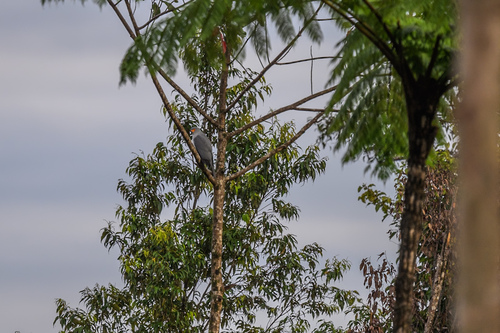
The New Britain Goshawk has been rediscovered and Photographed in March 2024.
New Britain Goshawk

medium.jpg
 
From the Website.

Birds Found since 2022!

When we first launched the list of Lost Birds in 2022, 135 bird species around the world met our definition to be lost species. This meant that none of these birds had a documented record (photo, audio recording, or genetic sample) that we could find that was more recent than 2011. In the two years since 2022, an incredible 14 species (just over 10%!) of those lost bird species have been found:

1. Black-naped Pheasant-pigeon – photographed by Doka Nason in September 2022 after being lost for 126 years.

2. Santa Marta Sabrewing – photographed in July 2022 by Yurgen Vega after being lost for 76 years.

3. New Britain Goshawk – photographed in March 2024 by Tom Vierus on iNaturalist after being lost for 55 years.

4. Manus Dwarf-Kingfisher – photographed in October 2022 by Lorand Szucs on Flickr after being lost for 20 years.

5. Togo Yellow-billed Barbet – photographed by Don MacGillivray of Birding Africa in January 2022 after being lost for 11 years.

6. White-tailed Tityra – photographed by Bradley Davis of Agami Nature Tours in September 2022 after being lost for 193 years (wow!!).

7. Bismarck Honeyeater – photographed in October 2023 by Charles Davies on eBird after being lost for 44 years.

8. Mayr’s Honeyeater – photographed in July 2023 by the Expedition Cyclops team after being lost for 15 years.

9. Mussau Triller – photographed in June 2024 by Joshua Bergmark of Ornis Birding Expeditions after being lost for 45 years.

10. Yellow-crested Helmetshrike – photographed in December 2023 by Mike Harvey and Matt Brady after being lost for 16 years.

11. Long-billed Bush Warbler – photographed in June 2022 by James Eaton after being lost for 45 years.

12. Rusty Thicketbird – photographed in October 2023 by Cagan Sekercioglu on eBird after being lost for 14 years.

13. Dusky Tetraka – photographed in December 2022 by Armand Benjara and Yverlin Pruvot after being lost for 23 years.

14. Kangean Tit-Babbler – photographed in June 2023 by Alex Berryman and Cameron Rutt after being lost for 13 years.
 
Updates to Species and Last Documented Dates

In addition to rediscoveries, we have received fantastic information over the past two years from researchers around the world helping to update and improve the Lost Birds List. This has included revisions to the last documented records for a number of species. For example, Nick Ortiz tracked down a published photo of Sassi’s Greenbul from 1996 that we had missed and connected with Françoise Dowsett-Lemaire who shared a recording of Grauer’s Cuckooshrike from 1997 (ten years later than our previous date of 1987). We describe these updates in the Last Documented sections of the species profiles.

For two Lost Birds, the Carrizal Seedeater and Jambandu Indigobird, people have shared records that occurred between 2011 and 2021, meaning that neither of the species should have been on the list at all! The seedeater, it turns out, was never a Lost Bird, while the indigobird was lost for a brief period before the time frame of the Lost Birds List (which only track rediscoveries after 2022). Both of these species have now been removed from the Lost Birds List.

1. Carrizal Seedeater – we listed the last documented record of this Venezuelan endemic as 2009, but Carlos Valeris kindly shared a series of excellent photographs by Igor Castillo/Proyecto AmaurospizaVE made in 2016. The species was also photographed on multiple occasions in 2024.

2. Jambandu Indigobird –we listed the last documented record of this species as 2008. Michael Mills of Birding Africa, however, recorded and photographed the species in Sierra Leone in 2021 and helpfully shared his records of the species.
 
Taxonomic Changes since 2022

The Lost Birds List is also affected by updates to global avian taxonomic assessments (i.e., what does or does not count as a species). The Search for Lost Birds follows both the HBW/BirdLife Taxonomic Checklist and the eBird/Clements Checklist. To qualify as a Lost Bird, a bird needs to be considered a species by one or both of these lists. In the taxonomic revisions since 2022, two birds that were considered to be a species in 2022 have been ‘lumped’ and are now subspecies by both the HBW/BirdLife Taxonomic Checklist and the eBird/Clements Checklist.

1. Plain-backed Kingfisher – This kingfisher was previously considered a distinct species by only the HBW/BirdLife Taxonomic Checklist but in version 8.1 of that list, published in 2023, it was lumped as a subspecies of the more widespread and commonly-documented Scaly-breasted Kingfisher, thus making the two checklists that we follow congruent. It now appears on the Lost Birds List as: Scaly-breasted Kingfisher (Plain-backed).

2. Upemba Masked Weaver – Like the kingfisher, this weaver was previously considered a species by the HBW/BirdLife Taxonomic Checklist and a subspecies in the eBird/Clements Checklist, but was changed to be a subspecies in version 8.1 of the HBW/BirdLife Taxonomic Checklist. The weaver now appears on the Lost Birds List as: Katanga Masked Weaver (Upemba).
 
New additions to the Lost Birds list

In addition to Lost Birds found since 2022, a number of birds have also newly qualified as lost. These are species whose most recent documented records (that we have been able to find) were either in 2012 or in 2013. We identified nine birds that meet this criterion as new additions to the Lost Birds List. As always, please let us know if you are aware of more recent records of these species!

Until then, here are the nine new additions to the List of Lost Birds for 2024:

1. Schlegel’s Francolin – A poorly-known species that occurs from central Cameroon to western South Sudan. The most recent documentation we found is from 2012.

2. Tooth-billed Pigeon – Endemic to Samoa, this spectacular pigeon is often referred to as the ‘little Dodo’ and is Critically Endangered. A photograph of a juvenile taken in December 2013 is the most recent photographic record that we are aware of. Since there is a lot of uncertainty over how to distinguish the calls of this species from other pigeons in Samoa, purported recent audio recordings are apparently insufficient evidence of documentation.

3. Mayr’s Swiftlet – Found on the islands of New Ireland, Bougainville (maybe), and Guadalcanal in Papua New Guinea and the Solomon Islands, the taxonomy of Mayr’s Swiftlet is unclear and it may prove not to be a species at all. Until its taxonomic status is definitively resolved, however, the most recent records are either photographs taken in 2013 or, with more certainty, a specimen collected in 1962.

4. Bismarck Kingfisher – A beautiful species endemic to the islands of New Britain and New Ireland, Papua New Guinea. The most recent documented record appears to be photos taken in 2012.

5. Sira Barbet – Found only in the Sira mountains of central Peru. There most recent documented record appears to be photos from 2013.

6. Peruvian Solitaire – Like the Sira Barbet, this species is found in a isolated mountains of Central Peru. Also like the barbet, the last documented appear to be photographs from 2013. In the eBird/Clements Checklist it appears Rufous-brown Solitaire (Peruvian).

7. Northern Catbird – Found in the foothills of northeastern New Guinea. The most recent records we can find of this catbird are sound recordings from 2012. Northern Catbird is considered a subspecies of Black-eared Catbird by the HBW/BirdLife Taxonomic Checklist and so does not have a Red List evaluation.

8. New Ireland Friarbird – Endemic to the island of New Ireland, Papua New Guinea, the last documented records we found are from 2012.

9. Unicolored Thrush – A shy and poorly-known thrush endemic to forests along rivers in northern Bolivia. The most recent documented records we found are sound recordings from 2013.
 
How many lost birds are there now?

From the initial 135 species in 2022, 16 have either been found or removed while nine have been added leaving the total number on the Lost Birds List as of July 2024 at 128. As mentioned above, two of these are now subspecies meaning the current total is 126 Lost Bird Species.

How will updates to the Lost Birds list work going forward?

Moving ahead, we plan to start updating the List of Lost Birds annually in the first quarter of each year. This means that the Lost Bird list will have versions in 2022 (v1), 2024 (v2), 2025 (v3), 2026 (v4) etc., with annual updates published each year (sorry we missed you 2023!). So, enjoy the enjoy the 2024 list while you can, because v3 in 2025 should be on its way in the not too distant future!

Finally, we want to mention a huge thank you to everyone who helped with sharing information and reviewing records for this list update, specifically Marshall Iliff, Bob Schmieder, Eric Woehler, Carlos Valeris, Josh Bergmark, Mathieu Franzkeit, Michael Mills, Gabriel Jamie, Adrian Constantino, Rob Hutchinson, Françoise Dowsett-Lemaire, Nick Ortiz, Paul Scofield, Russell Cannings, Tjalle Boorsma, Jacob Wijpkema, Bennett Hennessey, Guy Dutson, and Iain Woxvold.

As always, we really appreciate the help and feedback in correcting mistakes and keeping us up-to-date on rediscoveries. Please keep these coming with comments through the Get in Touch page!
 
Back
Top