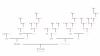
@dt644, thanks for your comments and the detailed family tree for Amur leopards Gangsan and Maehwa. Looking at the tree Gangsan had some genes from the Pyongyang Zoo pure-bred pair and Maehwa 2 links to the Leipzig Zoo pure-bred pair.
But TBH the Amur leopard EEP these days tries to breed only from Amur leopards with less than 41% coefficient from Frankfurt\Center Hill No. 2 genetic input (they might have upped it more in th last decade, unsure) and has sought to increase the founder representation from the wild caught and pure-bred Amur leopard in the program.
I would also be interested in your Amur tiger family tree!
The story of the Amur tiger at the Seoul Zoo is quite complicated. First of all, the number of Amur tigers at the Korean zoo after liberation from Japan was very small, with only three at the Korean zoo before the Seoul Zoo secured 5 amur tigers.
In 1963, Changgyungwon purchased a male amur tiger named 'Bengari' from a circus from Taiwan, and in 1971, Dalseong Park in Daegu was donated a pair of tigers from Japan by a civic group, but they all failed to leave their descendants behind.
When Seoul Grand Park opened in 1984, there were only Southern tigers from Changgyeongwon. However, the Seoul Zoo had a desire to have a "Korean tiger," and moreover, they had a strong desire to show Korean tigers to foreign tourists during the 1988 Seoul Olympics. Therefore, the Korean government even attempted to secure the Amur tigers through the Soviet Union, which was a hostile relationship at the time, it was failed.
Eventually, the Minnesota Korean Association and Lotte Group Chairman Shin Kyuk-ho donated the Amur tiger from the U.S. zoo to the Seoul Zoo. These are the ancestors of the many amur tigers in today's Korean zoos, and detailed information on them is as follows.
Donated by Minnesota Korean Association
Donated by Shin Kyuk-ho
- STB 2538 ♂
- STB 2572 ♂
- STB 2583 ♀
After getting this five Amur tigers, the zoo handed over the existing tigers to Everland and Dalseong Park and focused on breeding amur tiger. STB 2538 was named 'Hodori' at the Seoul Zoo, this name was same name as the tiger mascot for the 1988 Seoul Olympics. Therefore, I think the Seoul Zoo would have especially cared for STB 2538, but this STB 2538's bloodline has caused a big problem.
The Seoul Zoo increased the number of tigers by breeding the five tigers it had initially acquired and their descendants without bringing in additional Amur tigers or exchanging them with overseas zoos. So there was incest between the siblings, male STB 4660 and female STB 3621, which son and daughter of STB 2538 and STB 2583. And in 1999 and 2000, two white tiger female was born between STB 4660 and STB 3621.
The name of the white tiger born in 1999 was 'Vera', and the name of the white tiger born in 2000 was 'Hite'. Seoul Zoo promoted them as 'White Amur Tigers' based on the fact that all of their amur tigers were registered in the Amur Tiger Studbook. And Vera was given a studbook number of STB 4662. (I don't know Hite's studbook number, but probably given it.)
However, the correction eventually occurred, and the North American Regional Amer Tiger Studbook stated STB 1915, the mother of STB 2538, as a hybrid.
Until now, all zoos in Korea have received Amur tigers from Seoul Zoo, but Everland was different. Everland imported three Amur tigers from an American zoo in 1987, and the information on the tigers it imported is as follows.
- STB 1992 ♀
- STB 2888 ♀
- STB 2961 ♂
Like the Seoul Zoo, Everland increased the number of Amur tigers with the inbreeding of those three and their descendants, the only male of which, STB 2961, was a problem. I checked at last year, STB 2961 was the nephew of STB 2538. Therefore, STB 2961 was the grandson of STB 1915.
As I said earlier, Everland's Amur Tiger, STB 4746 'Taegeuk', was used to map the Amur Tiger genome. And, STB 4743 was the grandson of STB 2961, and great-grandson of STB 1915. It may not have been intended by Everland, but it was such a terrible coincidence. I posted this shocking story on my personal blog last year, and I also confirmed a few months ago that Everland had circulated my blog post to the company's internal mail. Maybe Everland was also embarrassed.
To count the numbers of pure Amur tigers in Korean zoos, male 'Rostov,' and female 'Penza' donated by the Russian government in 2011, and male 'Joseph,' imported by Zilln Zoo in 2017. And including their cubs, there are a total of 11 pure amur tigers in korean zoos today.
Everland brought in additional Amur tigers from China, probably they not have Studbook numbers. And the Korean public zoos still have the descendants of the first five tigers of the Seoul Zoo, all of them are closely family, so many of them has genetic diseases such as crossed-eyes.
Since the Seoul Zoo recognized the hybrid and inbreed problems of the first five tigers, they has neutered all of the 5 tiger's descendants at the Seoul Zoo so that the descendants of the five tigers can no longer reproduce, but other zoos have not care about this problem. As mentioned earlier, almost all Korean zoos are insensitive to species conservation and inbreed problem.