Shoebill Crane -- in Connecticut?!

JZinCT

New Member
I was sitting outdoors on my back patio with two others, just relaxing, when I looked up at the big oak tree nearest to where I sat and saw something my eyes couldn't process. It was a large animal/bird sitting on a big branch not 30 feet from where we were sitting. I asked the others, "what the heck is that?" There was a huge bird with a beak that looked like a shoebox with a hook on the end of it, sitting there on the branch. I looked down to pick up my phone to take a picture of it. Just as I leaned down, It took off into the air and those with me said it was huge with long legs.

After googling bird species, I found a photo of a Shoebill Crane that looked exactly like what we saw. I called the state Audubon Society to notify them of the sighting. The man who answered the phone seemed unbelieving. He said it must have escaped from a zoo. There's only one zoo in the state, so I called them and left a message. I don't think this came from the zoo there. If this bird is not an escapee from a zoo, how in the heck did it get to the US?

Here are photos that I grabbed online of the Shoebill Crane. It's an African species of crane. I have no idea if there are any zoos within 100 miles of me, including the Bronx Zoo in New York, that has a Shoebill Crane.
images
images
 
I was sitting outdoors on my back patio with two others, just relaxing, when I looked up at the big oak tree nearest to where I sat and saw something my eyes couldn't process. It was a large animal/bird sitting on a big branch not 30 feet from where we were sitting. I asked the others, "what the heck is that?" There was a huge bird with a beak that looked like a shoebox with a hook on the end of it, sitting there on the branch. I looked down to pick up my phone to take a picture of it. Just as I leaned down, It took off into the air and those with me said it was huge with long legs.

After googling bird species, I found a photo of a Shoebill Crane that looked exactly like what we saw. I called the state Audubon Society to notify them of the sighting. The man who answered the phone seemed unbelieving. He said it must have escaped from a zoo. There's only one zoo in the state, so I called them and left a message. I don't think this came from the zoo there. If this bird is not an escapee from a zoo, how in the heck did it get to the US?

Here are photos that I grabbed online of the Shoebill Crane. It's an African species of crane. I have no idea if there are any zoos within 100 miles of me, including the Bronx Zoo in New York, that has a Shoebill Crane.
images
images
Are you sure that it was a shoebill? Could it of been a heron like a blue or night heron?
 
Are you sure that it was a shoebill? Could it of been a heron like a blue or night heron?
Absolutely sure, at least the three of us that saw it and looked at photos online said it was the exact same bird. It was that huge-hooked bill, it was like nothing I've ever seen.
 
There's absolutely zero chance what you saw was a shoebill. There are only two facilities in the US that house shoebills, one in Texas and one in Florida, so that was definitely not an escapee from your local zoo either.

Also worth noting that shoebills are not cranes. They are colloquially known as shoebill storks, but are actually are an entirely separate family all their own.
 
There's absolutely zero chance what you saw was a shoebill. There are only two facilities in the US that house shoebills, one in Texas and one in Florida, so that was definitely not an escapee from your local zoo either.

Also worth noting that shoebills are not cranes. They are colloquially known as shoebill storks, but are actually are an entirely separate family all their own.
Well, all I can report is what we saw, and it looked exactly like the photos online.
 
Well, all I can report is what we saw, and it looked exactly like the photos online.
I don't mean to sound so dismissive, but please understand that an actual shoebill appearing in this part of the world would make national news. If a report comes out in a few days about a shoebill miraculously ending up 6,000+ miles outside of its native range and 1,200+ miles from the nearest US holder, I will gladly eat my words.
 
The only possibilities I could could think of would be a trafficked animal or an escapee from a previously unknown private breeder.
 
8uso5j.jpg

But yes.... there is no way whatsoever that you saw a wild shoebill in Connecticut :p nor is it likely whatsoever that a wild vagrant would pop up anywhere else in North America.

 

Attachments

  • 8uso5j.jpg
    8uso5j.jpg
    72.4 KB · Views: 260
Yeah, without any pictures or some sort of proof, it's nearly impossible for any of us to accept that you saw a Shoebill out in the wild in Connecticut. It's much more likely that you are misidentifying some native bird, maybe a large bird-of-prey or a heron (trust me, I have my fair share of misidentifying animals). The fact that you saw it perched up on a tree also makes a Shoebill unlikely, as that is uncharacteristic for these species.

Also, I can personally confirm the Bronx Zoo has no Shoebills from a recent visit.

Also yes, Shoebills are not cranes (nor are they storks for that matter). They are actually most closely related to herons, pelicans, and ibises, but belong to their own taxonomic family.
 
Yeah, without any pictures or some sort of proof, it's nearly impossible for any of us to accept that you saw a Shoebill out in the wild in Connecticut. It's much more likely that you are misidentifying some native bird, maybe a large bird-of-prey or a heron (trust me, I have my fair share of misidentifying animals). The fact that you saw it perched up on a tree also makes a Shoebill unlikely, as that is uncharacteristic for these species.

Also, I can personally confirm the Bronx Zoo has no Shoebills from a recent visit.

Also yes, Shoebills are not cranes (nor are they storks for that matter). They are actually most closely related to herons, pelicans, and ibises, but belong to their own taxonomic family.
Only zoos to have shoebills are in the south.
 
Are Shoebills even capable to perching in trees? I think the very fact that you saw the bird perched on a branch already proves it's not a Shoebill, to speak nothing of the impossibility of one occurring in Connecticut.

Was it brightly colored? You might want to look into Loftwings. :rolleyes: That's probably more likely to be honest.
 
Last edited:
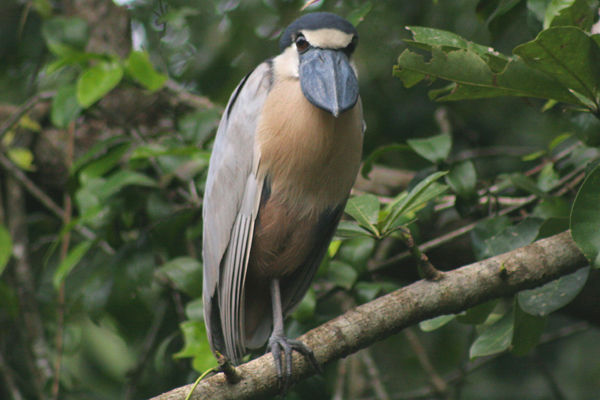
While a Boat-billed Heron is infinitely more likely than a Shoebill, the chances of that are extremely low. One has never been recorded in the US at all, and while an escapee is theoretically possible it is highly unlikely. If this user is truly genuine (and not a troll), I would suggest they almost certainly saw one of the herons native to Connecticut. Most likely either Great Blue Heron or Black-crowned Night Heron. I suppose Green Heron is also a possibility, though that seems less likely.

As a birder who is frequently given descriptions of birds from nonbirders and tries to identify them, I know that people not familiar with birds are terrible at giving descriptions of birds they saw and field marks are often imagined. For example, one person told me they saw a bird that looked "exactly like a male cardinal but yellow". The bird turned out to be a Cedar Waxwing.
 
While a Boat-billed Heron is infinitely more likely than a Shoebill, the chances of that are extremely low. One has never been recorded in the US at all, and while an escapee is theoretically possible it is highly unlikely
While I agree a boat-billed heron is incredibly unlikely, I'm surprised there's never been a sighting of a vagrant in the US. They're common in Belize, so it seems likely that one would've gotten swept up in the flyway or in a tropical storm and end up in Florida or Louisiana at some point.
If this user is truly genuine (and not a troll), I would suggest they almost certainly saw one of the herons native to Connecticut. Most likely either Great Blue Heron or Black-crowned Night Heron. I suppose Green Heron is also a possibility, though that seems less likely.
Yeah, a heron does seem like the most likely option. I wouldn't discount the possibility it was a little blue heron, however- as the little blues are single-colored to match the shoebill. The only non-heron I'd even entertain the possibility of is a glossy ibis, which are common along the Connecticut coast in summer months.

As a birder who is frequently given descriptions of birds from nonbirders and tries to identify them, I know that people not familiar with birds are terrible at giving descriptions of birds they saw and field marks are often imagined. For example, one person told me they saw a bird that looked "exactly like a male cardinal but yellow". The bird turned out to be a Cedar Waxwing

I mean, to be fair, there are some notable similarities between the waxwing and cardinal that makes this an understandable description from a non-bird person, namely the yellow crest on their head. Just look at any of the threads discussing zoo misidentifications to see some much more outlandish ones!

And seeing as I've heard an emu referred to as a "big duck", I suppose this misidentification could be much more outlandish than we'd think possible.
 
While I agree a boat-billed heron is incredibly unlikely, I'm surprised there's never been a sighting of a vagrant in the US. They're common in Belize, so it seems likely that one would've gotten swept up in the flyway or in a tropical storm and end up in Florida or Louisiana at some point.

Yeah, a heron does seem like the most likely option. I wouldn't discount the possibility it was a little blue heron, however- as the little blues are single-colored to match the shoebill. The only non-heron I'd even entertain the possibility of is a glossy ibis, which are common along the Connecticut coast in summer months.


I mean, to be fair, there are some notable similarities between the waxwing and cardinal that makes this an understandable description from a non-bird person, namely the yellow crest on their head. Just look at any of the threads discussing zoo misidentifications to see some much more outlandish ones!

And seeing as I've heard an emu referred to as a "big duck", I suppose this misidentification could be much more outlandish than we'd think possible.
I didn't realize that Little Blue Herons occurred in Pennsylvania! I suppose that's on the table too, then.

Boat-billed Herons have been recorded in Mexico within 100 miles of the Texas border, so it's definitely on the table for a possible vagrant to the US (though I'm sure not to Pennsylvania). I wouldn't be surprised if they've shown up along the Rio Grande before, undetected due to their secretive nature and the general inaccessibility of the mostly private lands there.

As far as misidentifications go, I once heard someone at a zoo correct someone for calling a Black-and-white Ruffed Lemur a lemur. What was it, you may ask? Easy, a lizard. :confused:
 
Back
Top