I believe these signs are very important to help visitors develop an appreciation for animals. The average person is more likely to care about an animal if it is more like them- hence the disproportionate amount of attention great apes and other charismatic megafauna recieve. As a zoo volunteer over the past four years, I can attest that the questions I am asked most often are about the individual animals- not the species as a whole. They want to know what Pabu the red panda's favorite food is, not what red pandas eat in the wild. I think that if zoos put these signs at more Exhibits IN ADDITION TO informational signs, it would draw more attention to the animals and help generate interest, particularly for animals with distinct personalities or animals in large groups.
You are using an out of date browser. It may not display this or other websites correctly.
You should upgrade or use an alternative browser.
You should upgrade or use an alternative browser.
Signage in zoos on individual animals
- Thread starter Onychorhynchus coronatus
- Start date

Onychorhynchus coronatus
Well-Known Member
I believe these signs are very important to help visitors develop an appreciation for animals. The average person is more likely to care about an animal if it is more like them- hence the disproportionate amount of attention great apes and other charismatic megafauna recieve. As a zoo volunteer over the past four years, I can attest that the questions I am asked most often are about the individual animals- not the species as a whole. They want to know what Pabu the red panda's favorite food is, not what red pandas eat in the wild. I think that if zoos put these signs at more Exhibits IN ADDITION TO informational signs, it would draw more attention to the animals and help generate interest, particularly for animals with distinct personalities or animals in large groups.
Yes, I have come to the same conclusion as you Neil, I think that identification with an individual animal is usually far easier than on a species level which becomes far more of an abstraction for most people.
I'm a conservationist and so I care about populations of species more than individuals and yet even so the stories of individual animals like for example the bat in the video interest and engage with a different part of myself
If you don't mind me asking where do you volunteer and do visitors often ask questions about the individual animals of species that would not be classed as megafauna or ABC's ?

You beat me to it! Just about to post this one before I saw it.Philadelphia:
View attachment 471964
I volunteer at the Capron Park Zoo in Attleboro, MA, and it is a little difficult for me to answer the second part of your question based on our collection because it definitely varies. I definitely get asked about the lions, amur leopard, and red pandas, as well as the north american river otters (our individuals like to climb trees, so...), debrazza monkeys, serval (we have a three-legged individual), and some of the more charismatic individuals of other species. I don't typically get asked specific questions about traditionally sedentary animals (with the exception being the lions of course) or specific birds in our Rainforest Aviary (with the exception of the since-removed red crested turaco that would land on people's heads.). I also did a lot of animal encounters with Ambassador animals (this has been stopped due to covid) and very often I get asked questions about the individual animal I am holding, whether it be a snake, hingeback tortoise, silver fox rabbit, or any other animals in our ambassador program.Yes, I have come to the same conclusion as you Neil, I think that identification with an individual animal is usually far easier than on a species level which becomes far more of an abstraction for most people.
I'm a conservationist and so I care about populations of species more than individuals and yet even so the stories of individual animals like for example the bat in the video interest and engage with a different part of myself
If you don't mind me asking where do you volunteer and do visitors often ask questions about the individual animals of species that would not be classed as megafauna or ABC's ?
Onychorhynchus coronatus
Well-Known Member
You beat me to it! Just about to post this one before I saw it.
Somehow this one slipped my mind but yes it was a brilliant example @TinoPup , I love how the signs give the identifying markings of the otters it is such a cool way of educating visitors.
Onychorhynchus coronatus
Well-Known Member
Frankly, I could never actually recognize individual animals from such signs.Many are done more for looks than usefulness.
Well I think it just takes a bit of practice to identify individuals, with some species it is more their gait or characters and others have distinguishing marks.
That said some of the signs of great apes that I posted earlier are easy to follow and I don't see how anyone could fail to identify some of those individuals.
Again, I suppose it comes down to how "usefulness" is defined, personally I would say that anything that promotes visitor education and a connection / identification with an animal or species is very useful.
Onychorhynchus coronatus
Well-Known Member
I volunteer at the Capron Park Zoo in Attleboro, MA, and it is a little difficult for me to answer the second part of your question based on our collection because it definitely varies. I definitely get asked about the lions, amur leopard, and red pandas, as well as the north american river otters (our individuals like to climb trees, so...), debrazza monkeys, serval (we have a three-legged individual), and some of the more charismatic individuals of other species. I don't typically get asked specific questions about traditionally sedentary animals (with the exception being the lions of course) or specific birds in our Rainforest Aviary (with the exception of the since-removed red crested turaco that would land on people's heads.). I also did a lot of animal encounters with Ambassador animals (this has been stopped due to covid) and very often I get asked questions about the individual animal I am holding, whether it be a snake, hingeback tortoise, silver fox rabbit, or any other animals in our ambassador program.
Thank you for giving a bit more information on your work @Neil chace , much appreciated !
That is interesting so it seems that most of the visitor questions are directed towards individuals of the more traditionally charismatic larger and smaller species.
A couple of questions, do you see there being potential at zoos to promote visitor interest in less traditionally "charismatic" species through signs or talks that communicate more about individual animals?
Are there callitrichids kept at Capron Park zoo by any chance ?
Onychorhynchus coronatus
Well-Known Member
@Neil chace Just had a quick glance through the Capron park zoo gallery and found an example of this kind of signage for their sloth bears:

Photo credits to @blospz.
Photo credits to @blospz.
Onychorhynchus coronatus
Well-Known Member
Some more examples:
Black rhino family tree at the Magdeburg zoo:

Polar bear family tree at the Brookfield zoo:

White rhino family tree at ZSL Whipsnade zoo:

Ringtailed lemur family tree at Wildplace zoo :

Gorila family tree at Chessington zoo :

Gelada family tree at Colchester zoo:

Panda and Mexican wolf family trees at Chapultepec zoo:


Colobus monkey family tree at Twycross zoo:

Gentoo penguin name chart at Akvariet Bergen:

Newborn Malayan tapir name sign at Antwerp zoo :

Interesting sign at Port Lympne zoo of their Malayan tapir Kingnut and seed dispersal:

Rather minimalistic name signs for the drills and tigers at Port Lympne zoo:


Photo credits to @MagpieGoose, @Zambar, @Dianamonkey, @MeiLover, @Mathew , @zoogiraffe, @gentle lemur, @Nisha, @vogelcommando and @carlos55.
Black rhino family tree at the Magdeburg zoo:
Polar bear family tree at the Brookfield zoo:
White rhino family tree at ZSL Whipsnade zoo:
Ringtailed lemur family tree at Wildplace zoo :
Gorila family tree at Chessington zoo :
Gelada family tree at Colchester zoo:
Panda and Mexican wolf family trees at Chapultepec zoo:
Colobus monkey family tree at Twycross zoo:
Gentoo penguin name chart at Akvariet Bergen:
Newborn Malayan tapir name sign at Antwerp zoo :
Interesting sign at Port Lympne zoo of their Malayan tapir Kingnut and seed dispersal:
Rather minimalistic name signs for the drills and tigers at Port Lympne zoo:
Photo credits to @MagpieGoose, @Zambar, @Dianamonkey, @MeiLover, @Mathew , @zoogiraffe, @gentle lemur, @Nisha, @vogelcommando and @carlos55.
Last edited:
Onychorhynchus coronatus
Well-Known Member
Howletts zoo seem to do well with these kinds of displays if a little minimalistically at times.
Elephant ID sign at Howletts:

Pallas cat name sign:

Gorilla name signs:

Fishing cat name signs :

Serval name signs:

Photo credit to @FunkyGibbon, @zoogiraffe, @Bele, @Arizona Docent and @Maguari.
Elephant ID sign at Howletts:
Pallas cat name sign:
Gorilla name signs:
Fishing cat name signs :
Serval name signs:
Photo credit to @FunkyGibbon, @zoogiraffe, @Bele, @Arizona Docent and @Maguari.
Onychorhynchus coronatus
Well-Known Member
Can anyone think of any signage of this kind at a zoo that is not on a species that is typically considered to be "charismatic" ?
Onychorhynchus coronatus
Well-Known Member
Interesting signage and sculpture of "Rajang" the orangutang at Colchester zoo :

Photo credit to @MagpieGoose
Photo credit to @MagpieGoose
I think all auxillary/extra information/recognition signs about individual animals are very beneficial- they help stimulate further interest/observation among average zoo visiting public. To anyone who says they aren't 'useful' or can't identify animals from them, I would say 'try harder'. IMO anything that stimulates further interest and powers of observation can only be a good thing. The only downside is that unless maintained regularly- which can be costly of course- they can quickly become outdated and therefore misleading or more difficult to interpret-but that can be said about any form of zoo signage. For example Howletts/Port Lympne go to good lengths to individualise many of their species, even things like lesser primates and small cats. But sometimes these are well out of date as animals move around or the situation changes and the sign doesn't get changed. And I saw a big more general information sign there my last visit saying they had the 'only pair of breeding Drills in the UK'- a bit out of date (by about 10 years I think) given nowadays they themselves have a multi-female group of around twelve animals + several other UK zoos have since aquired and bred them...
Last edited:
This sign is near our Sloth Bear Exhibit, and pays homage to Amy and Goof- the pair of Sloth bears that lived at the zoo from the early 90s until their deaths. When they died, Vicki (their grand-cub) came to the zoo and is the current Bear living in the same exhibit.@Neil chace Just had a quick glance through the Capron park zoo gallery and found an example of this kind of signage for their sloth bears:
Photo credits to @blospz.
Our zoo has a single, elderly golden lion tamarin (its lifelong partner passed away a year or two ago). Based on the rather awkward location of his Exhibit, it's not very common for us volunteers to do any interpretations at it, although when we had two they were rather popular amongst visitors. As for less charismatic species, I think there definitely is some potential to talk about individuals through either signs or interpretation, especially when it comes to reptiles and other animals traditionally viewed as less interesting to the average person. One other animal that it tends to be good to talk about the individual is our Sumatran water monitor, as people tend to be impressed by the impressive size of the lizard. There is also a lot of potential for this when it comes to animal ambassadors- which traditionally are less charismatic species.Thank you for giving a bit more information on your work @Neil chace , much appreciated !
That is interesting so it seems that most of the visitor questions are directed towards individuals of the more traditionally charismatic larger and smaller species.
A couple of questions, do you see there being potential at zoos to promote visitor interest in less traditionally "charismatic" species through signs or talks that communicate more about individual animals?
Are there callitrichids kept at Capron Park zoo by any chance ?
Onychorhynchus coronatus
Well-Known Member
I think all auxillary/extra information/recognition signs about individual animals are very beneficial- they help stimulate further interest/observation among average zoo visiting public. To anyone who says they aren't 'useful' or can't identify animals from them, I would say 'try harder'. IMO anything that stimulates further interest and powers of observation can only be a good thing. The only downside is that unless maintained regularly- which can be costly of course- they can quickly become outdated and therefore misleading or more difficult to interpret-but that can be said about any form of zoo signage. For example Howletts/Port Lympne go to good lengths to individualise many of their species, even things like lesser primates and small cats. But sometimes these are well out of date as animals move around or the situation changes and the sign doesn't get changed. And I saw a big more general information sign there my last visit saying they had the 'only pair of breeding Drills in the UK'- a bit out of date (by about 10 years I think) given nowadays they themselves have a multi-female group of around twelve animals + several other UK zoos have since aquired and bred them...
Yes, I totally agree with you @Pertinax, I think it is most definitely useful to have this kind of signage and I do think it stimulates further interest and of course emotional connections in the visiting public towards the animals on display.
I agree that the situation can change rapidly in a zoo with animals passing away or being moved around between collections but I do think zoos should make the effort to highlight the characters and names of their resident animals and particularly if these are long-term ones that have little chance of being moved elsewhere.
Its interesting that you brought the subject of the Aspinall parks up and I think they are a good example of doing this well and on a low budget. Judging from the pictures I've seen the parks seem have those minimalistic little white wooden name signs and of course they are "no thrills" but they definitely do the trick in terms of putting a name to an animal and on a budger too.
Onychorhynchus coronatus
Well-Known Member
Our zoo has a single, elderly golden lion tamarin (its lifelong partner passed away a year or two ago). Based on the rather awkward location of his Exhibit, it's not very common for us volunteers to do any interpretations at it, although when we had two they were rather popular amongst visitors. As for less charismatic species, I think there definitely is some potential to talk about individuals through either signs or interpretation, especially when it comes to reptiles and other animals traditionally viewed as less interesting to the average person. One other animal that it tends to be good to talk about the individual is our Sumatran water monitor, as people tend to be impressed by the impressive size of the lizard. There is also a lot of potential for this when it comes to animal ambassadors- which traditionally are less charismatic species.
Thank you for your reply @Neil chace !
Interesting to hear that as from what I've observed golden lion tamarins do have as much potential as much larger orangutangs to become popular among the public and in spite of their small size.
Also, very interesting to hear about the water monitor that you mention and I totally agree that it proves that there is potential to highlight the less traditionally "charismatic" species and including those which are not often associated with the public as having "personalities" like reptiles for example.
Believe it or not, the animal that we have I personally feel the most "connected" to and like the personality most of is actually a Bell's Hingeback Tortoise named Bill we use in educational programs. He can be a pain to do programs with because during programs is the only time he ever urinates, but when cleaning our herp room I would often gate off the door and let him walk around the room and he would always go as close to me as possible, often times sitting on my shoes. While many people do not think of tortoises as their thought of a charismatic species, I wholeheartedly disagree and consider Bill to be more charismatic than any elephant or giraffe ever could be.Thank you for your reply @Neil chace !
Interesting to hear that as from what I've observed golden lion tamarins do have as much potential as much larger orangutangs to become popular among the public and in spite of their small size.
Also, very interesting to hear about the water monitor that you mention and I totally agree that it proves that there is potential to highlight the less traditionally "charismatic" species and including those which are not often associated with the public as having "personalities" like reptiles for example.
If you want to see an example of a zoo making callitrichids being a main attraction look at the Buttonwood Park Zoo. Their relatively recent addition of a Rainforest exhibit gave the zoo its first primates- six small, neotropical species, 5 of which being callitrichids. As long as callitrichids are active, which can be a problem with some more skittish individuals, and the Exhibits include natural light (golden lions in particular lose a lot of their impressiveness when you remove natural light- their fur loses its bright orange color.), they can be extraordinarily popular amongst guests- at least when they aren't overshadowed by other primates.Thank you for your reply @Neil chace !
Interesting to hear that as from what I've observed golden lion tamarins do have as much potential as much larger orangutangs to become popular among the public and in spite of their small size.
Also, very interesting to hear about the water monitor that you mention and I totally agree that it proves that there is potential to highlight the less traditionally "charismatic" species and including those which are not often associated with the public as having "personalities" like reptiles for example.

This thread reminded me of this large notice beside the 'Palace of the Apes' atPort Lympne, about the story of Djala the silverback gorilla.
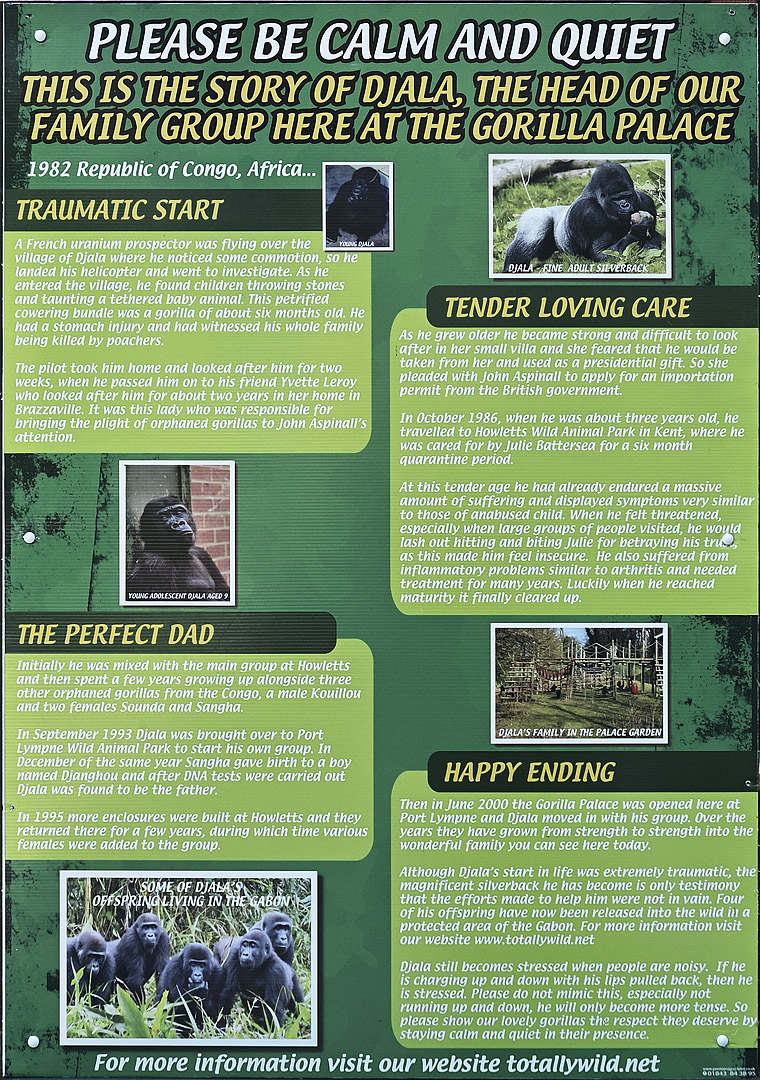 Djala and most of his family group were repatriated to Gabon some years ago. As far as I know he still lives in the wild, but most of the others did not survive (but that's a different story).