Signage in zoos on individual animals

Last example from Paignton (I'd been looking for something else in my old photos!). This one from 2014 is about the Mandrills and gave 3 regulars who should have known better hours of fun. Three babies were born within 2 years after this sign went up but it didn't change. We knew the name of the 'New baby' so until we discovered the names of the others, we called them New, Newer and Newest. We still call the youngest one 'Newest' as it's sometimes easier than trying to remember his real name ;) The sign is no longer there and hasn't been replaced with an updated version:
Mandrill signage, 2014 - ZooChat
 
More individual animal signs that I've found.

Scottish wildcat information sign with details about the individual cats at Cote brook shire horse center, UK:
full

This sign would currently fail a Zoo Inspection in the UK - unless there are others on the enclosure giving the required information that is missing, such as scientific name, conservation status etc.
 
The most memorable 'individual' sign I can remember was at Kilverstone in the UK, where the only sign on an American Bison paddock just listed 'Pudding Bison' and 'Wash Bison' as the two animals.
Lady Fisher was indeed the master of the pet-name, so beloved by many people on here!
 
This sign would currently fail a Zoo Inspection in the UK - unless there are others on the enclosure giving the required information that is missing, such as scientific name, conservation status etc.

Yes, it is lacking this important information, what I found interesting about it was that given this was in a British collection it draws attention to an endemic and endangered native subspecies.

However, I agree that what is the point if it doesn't draw attention to the conservation status ?

The most memorable 'individual' sign I can remember was at Kilverstone in the UK, where the only sign on an American Bison paddock just listed 'Pudding Bison' and 'Wash Bison' as the two animals.
Lady Fisher was indeed the master of the pet-name, so beloved by many people on here!

Not very keen on that kind of signage.

Wouldn't say that I love the display of pet names of animals kept in zoos but I can see how if done correctly and tastefully this can be strategically useful in enhancing an interest and connection with the species in the visiting public.
 
These are some interesting examples @Gigit and thanks for uploading and sharing them !

I particularly like the Asiatic lion example but I must admit I think I would struggle to identify some of these individuals.

"Duchess" the elephant has now passed away hasn't she ?

The mandrill sign is great too, though it is odd how they added the unnamed newborn , particularly considering the cost of changing the signage.

full

full

full

full
 
Some signs from my photos in the Gallery.
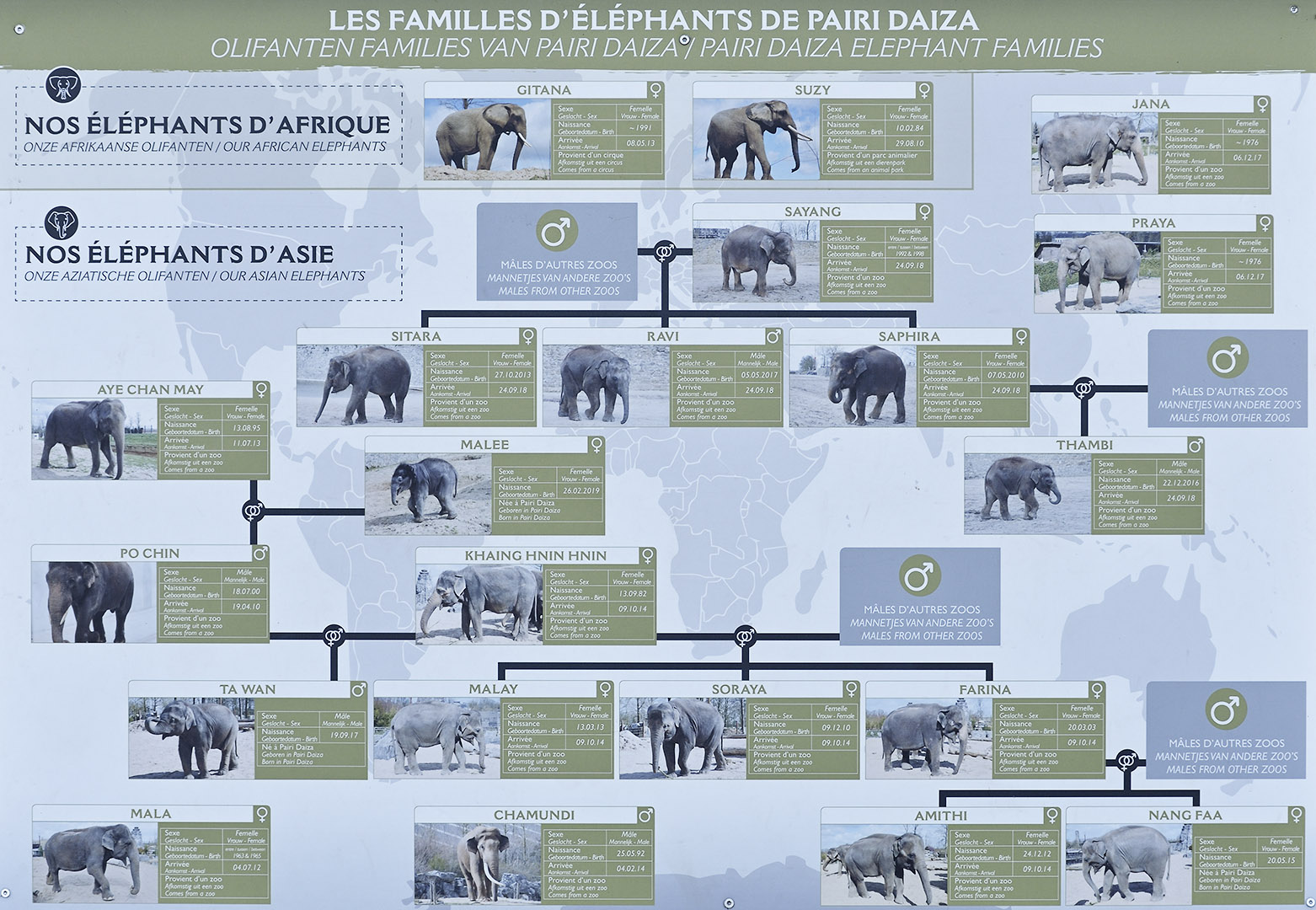
This is the sign listing the African and Asian elephants in the herd at Pairi Daiza. It is not particularly useful for identifying all the individuals, because the animals are split between at least 3 paddocks (one of which is enormous) and some of the younger ones are taken down to the lake to bathe.
Elephant recognition and relationships poster by gentle lemur posted 8 Nov 2019 at 6:14 PM

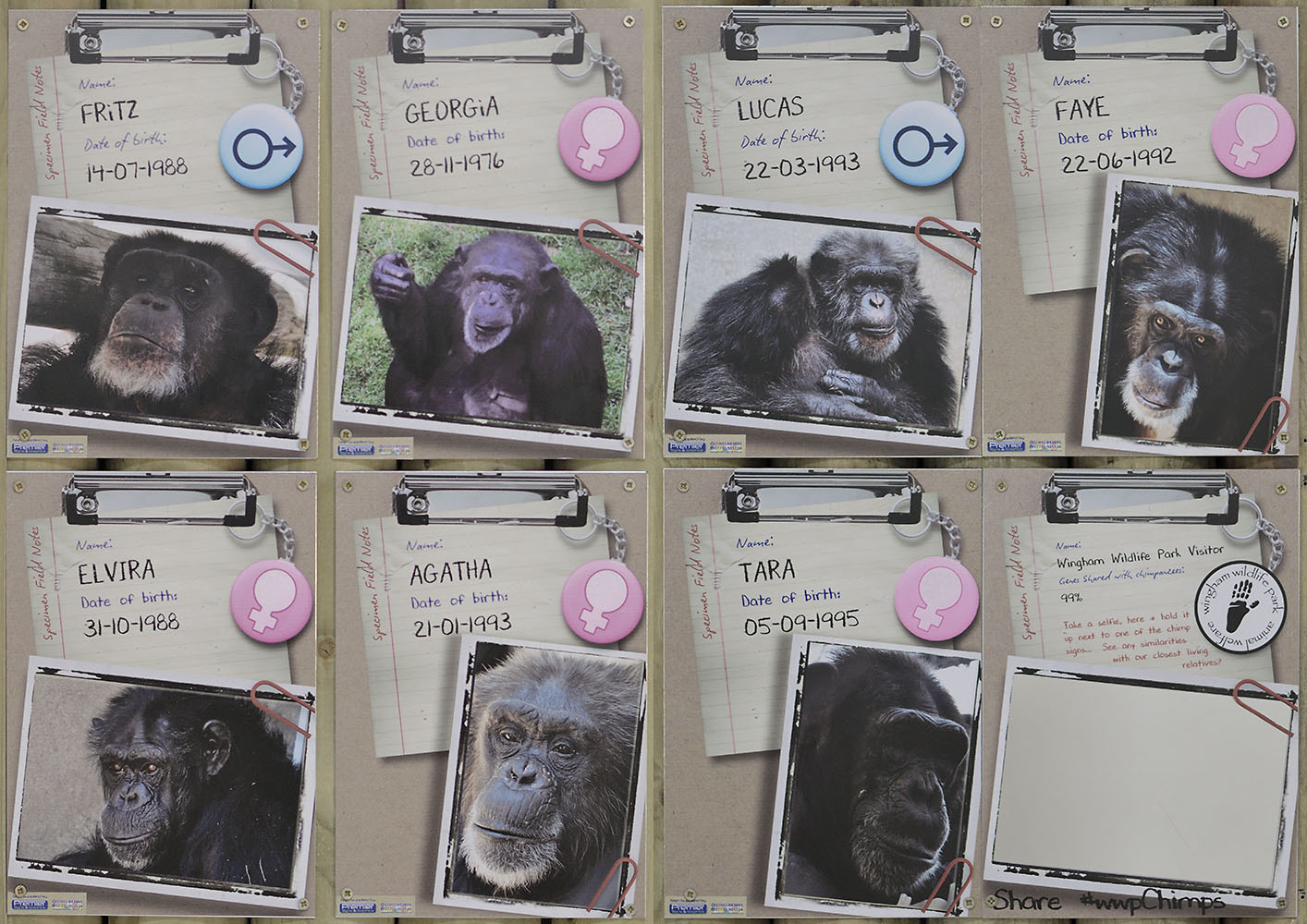
The chimp recognition signs inside the house at Wingham.

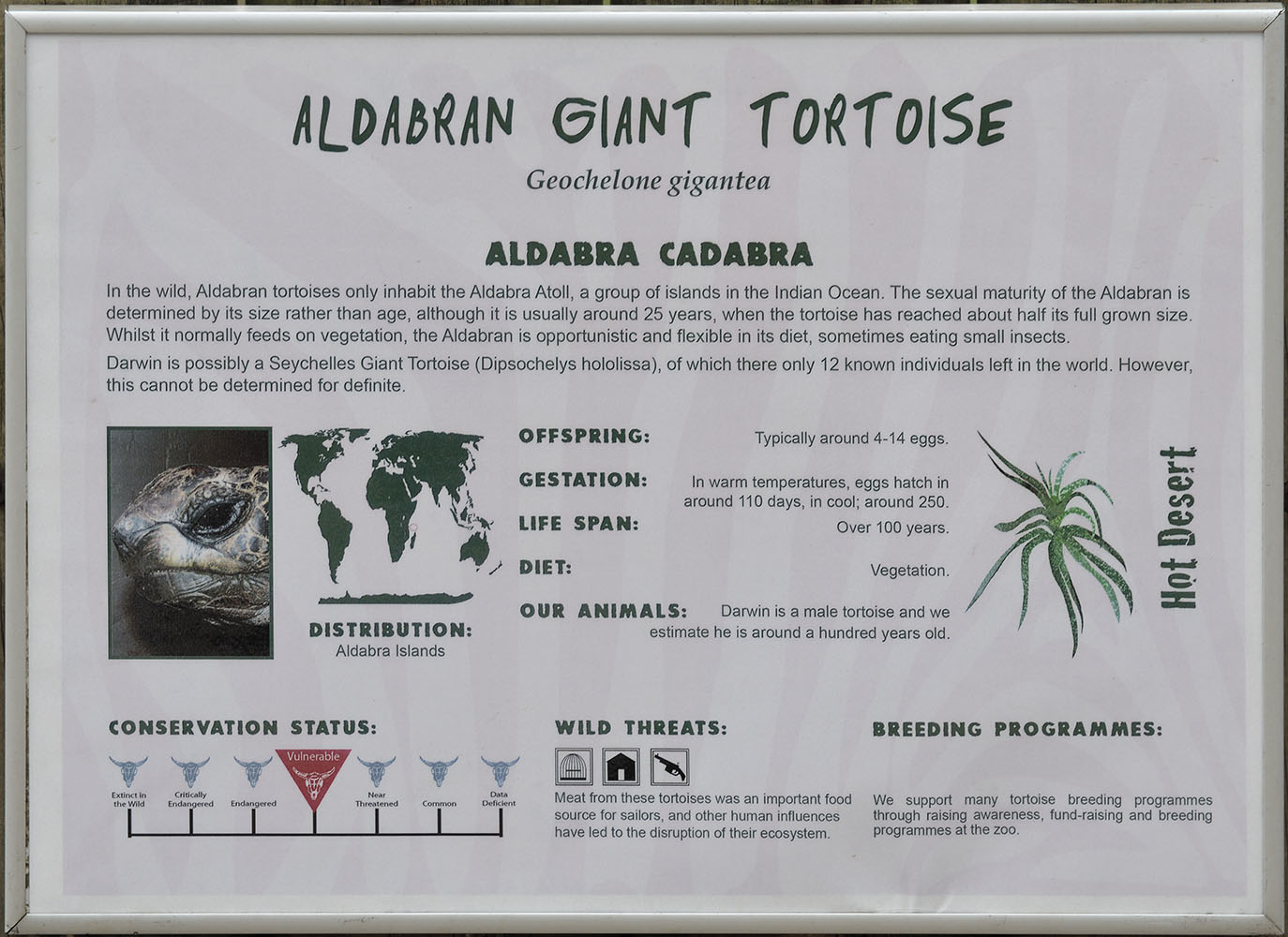
The label for the giant tortoises at Blackpool, which mentions the question of whether the big male 'Darwin' might be a Seychelles giant tortoise, whereas the smaller female is definitely from Albdabra.
 
Some signs from my photos in the Gallery.
This is the sign listing the African and Asian elephants in the herd at Pairi Daiza. It is not particularly useful for identifying all the individuals, because the animals are split between at least 3 paddocks (one of which is enormous) and some of the younger ones are taken down to the lake to bathe.
Elephant recognition and relationships poster by gentle lemur posted 8 Nov 2019 at 6:14 PM

The chimp recognition signs inside the house at Wingham.

The label for the giant tortoises at Blackpool, which mentions the question of whether the big male 'Darwin' might be a Seychelles giant tortoise, whereas the smaller female is definitely from Albdabra.

Thank you for sharing @gentle lemur !

Apart from the obvious differences between the two elephant species, ages and size differences of males and females I am not sure I would be any good at recognizing these individual elephants in the Pairi Daiza example.

Not so keen on the name of the tortoise but I have to say that I do think it is great that its name is mentioned in the signage. Hopefully it makes a species that isn't traditionally seen of as charismatic by visitors a little more interesting.
 
@Gigit Also quite interesting to note that with the exception of the elephant the names given to the tigers and mandrills are from Indonesia and West or Central Africa respectively which is a nice touch IMO.
 
Some more primate signs.

Signage with information on "Spock" the Sulawesi crested macaque and "Maude" the gray cheeked mangabey at the Smithsonian National zoo:

full

Sign at Overloon zoo which explains the history of female spider monkeys that were rescued from the illegal pet trade:
full

Not too sure what it says but a sign about a capuchin monkey called "Dizzy" at Stitching AAP:
full

Sign for "Lucjan" the capuchin monkey at Poznan zoo :
full


@BeardsleyZooFan, @ThylacineAlive, @KevinB, @vogelcommando.
 
Last edited:
I am not sure I would be any good at recognizing these individual elephants in the Pairi Daiza example

The problem at PD, as GL mentioned, is that they have so many elephants, and not all are together or necessarily visible all the time, as some live in a huge paddock, that individual recognition is defeated by the sheer size of their herd. If it was half a dozen Elephants, such as at Chester or Whipsnade, then it is far more realistic. But its still an impressive display of information.
 
Paignton again: maybe it's cruel to draw attention to this temporary sign about a black rhino again, but the guilty parties have long gone! It does demonstrate the need for proof reading:
Sign about Black Rhino, Manyara. 3 April 2013 - ZooChat
I agree about the need for proof reading. Marketing teams can spend a fortune on signs and advertising, but can't be bothered to check their information is valid. There are people in zoos who know more about animals than the marketing team. I have seen posters advertising animals that a zoo doesn't have. For example, a zoo map shows a three-toed sloth while the zoo has two-toed sloths.
 
@Gigit Also quite interesting to note that with the exception of the elephant the names given to the tigers and mandrills are from Indonesia and West or Central Africa respectively which is a nice touch IMO.
Yes, I think this theme applies to most of the mammals at Paignton. African elephant, Duchess, was born in 1970 and spent part of her life in a circus so her name was of that time and those circumstances. She died in 2019.
The mandrill sign and the permanent indoor orangutan sign (which I haven't been able to find and the zoo is currently closed so I can't take another photo) demonstrate the downside of identifying individuals of a breeding/changing group. Unless the sign is kept up to date it can lead to confusion and mis-identification by visitors. It's probably debatable whether that matters in the great scheme of things, although people like me really do want to know! Producing an elaborate, expensive sign seems like a waste of effort. Better to have one that can be easily altered or just cheaply replaced?
 
Unless the sign is kept up to date it can lead to confusion and mis-identification by visitors. It's probably debatable whether that matters in the great scheme of things, although people like me really do want to know! Producing an elaborate, expensive sign seems like a waste of effort. Better to have one that can be easily altered or just cheaply replaced?

Absolutely, expensive and elaborate signs unless for a particularly long lived species are almost certainly a waste but as you say, I do think it can be done well on the cheap and fullfill both categories.
 
The problem at PD, as GL mentioned, is that they have so many elephants, and not all are together or necessarily visible all the time, as some live in a huge paddock, that individual recognition is defeated by the sheer size of their herd. If it was half a dozen Elephants, such as at Chester or Whipsnade, then it is far more realistic. But its still an impressive display of information.

I see what you mean, I personally wouldn't be able to identify all of the individuals in a sizeable herd but if it was a couple of elephants then maybe I could.
 
I agree about the need for proof reading. Marketing teams can spend a fortune on signs and advertising, but can't be bothered to check their information is valid. There are people in zoos who know more about animals than the marketing team. I have seen posters advertising animals that a zoo doesn't have. For example, a zoo map shows a three-toed sloth while the zoo has two-toed sloths.

Yes, agree with you on this @Dassie rat , I've seen these kind of errors too and I suspect that these occurred for the same reason.

Isn't this just proof of lack of inter-displinary communication and the contrasting priorities of the modern commercially driven zoo ?
 
Back
Top