Smithsonian National Zoo Smithsonian National Zoo News 2016

On Aug 2 the outdoor flight aviary by the Bird House will close as part of ongoing renovations to the Bird House exhibit.

Emergency Message - National Zoo

CONSERVATION NATION

Welcome to Conservation Nation, a new way to do what you love and raise funds for wildlife conservation. It's easy and fun! Set up your fundraising page today and become an ambassador for wildlife conservation. Whatever you do—celebrate a birthday, run a 5K, setup a lemonade stand, or fundraise in your community—we'll provide the support, and you'll save species.

Join Conservation Nation today by contributing to Smithsonian Conservation Biology Institute scientists' anti-poaching efforts in Myanmar. Every donation makes a difference for Asian elephants

ABOUT THIS CAMPAIGN

Elephant populations in Asia have been critically reduced by 70 percent because of habitat loss, conflicts with farmers, illegal capture, and poaching. Scattered across the continent, it is estimated that fewer than 35,000 Asian elephants remain in the wild. Perhaps nowhere in the world is there more need for elephant conservation than in Myanmar—a country where Smithsonian's National Zoo and Conservation Biology Institute research has shown that poaching is on the rise. But there is hope. Smithsonian scientists have found that one of the best ways to monitor and protect Asian elephants in Myanmar, and destroy poaching networks, is through satellite tracking collars. These tracking collars establish a real-time tracking system that can detect when elephants change their movement patterns or when poaching occurs. With this information scientists can develop anti-poaching initiatives with the goal of reducing and preventing further poaching in Myanmar.

With your help, Conservation Nation can fund the purchase of five satellite tracking collars which cost $4,000 each. It may seem like a large number, but it's a small price to pay for elephant conservation.

Join Conservation Nation today by contributing to Smithsonian Conservation Biology Institute scientists' anti-poaching efforts in Myanmar. Every donation makes a difference for Asian elephants.

Conservation Nation | A Friends of the National Zoo Initiative
 
A black footed ferret named Digger is the newest resident at the small mammal house. He will live with the zoos resident black footed ferret Dusty.

7c86d813f27b441689bb34168dc60c84.png
 
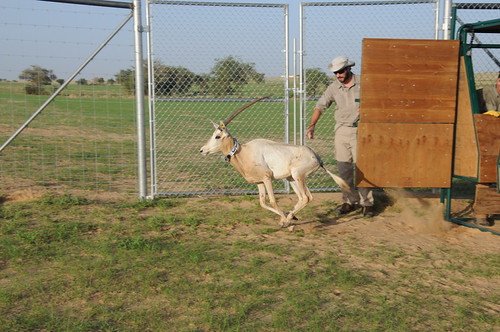
Extinct-in-the-wild antelope return to the grasslands of Chad


28613977280_27c8751380.jpg


Thirty years after the scimitar-horned oyrx were driven to extinction, the desert antelope will return to the last-known place it existed: Chad's Sahelian grasslands. The reintroduction--the culmination of decades of work--is being led by the Environment Agency-Abu Dhabi (EAD), the government of Chad and their implementing partner, the Sahara Conservation Fund. The Smithsonian Conservation Biology Institute (SCBI) and Zoological Society of London are leading post-release satelite-tracking efforts that will result in the collection of one of the most comprehensive datasets for any wildlife species returned to its native habitat.

"This is an epic homecoming for this majestic species and a significant step forward for wildlife conservation," said Steve Monfort, the John and Adrienne Mars director of SCBI. "Every conservationist aspires to ensure that wildlife thrive in their natural environment. This project was designed to ultimately give scimitar-horned oryx that chance, while also helping restore this grasslands ecosystem and to inspire and inform similar reintroduction efforts for other species."

In July, SCBI postdoc Jared Stabach traveled to Chad where he helped fit 21 of 23 scimitar-horned oryx with GPS collars (two individuals were too young for collars but will return to the wild with the herd). Twice a day, Stabach and team will receive the position of every animal collared. Based on these coordinates, field staff will monitor the population. Overall the data will tell scientists where the oryx go seasonally, how far they travel, whether they stay together or disperse into different social groups, and even if a poacher has taken an animal.

"This dataset is gold to any conservation researcher," Stabach said. "We know so little about this species in the wild and the data we're collecting will tell us where these animals are--and what's going on with them--in near real-time over a number of years. We're essentially opening up a window that will help us understand how and why individuals move across the landscape and allow us to monitor each individual in a way that was never before possible."

The GPS collars are programmed to turn on and off at specific times, enabling scientists to monitor animal movements and compare them with landmarks in the environment--from shade trees to water sources to specific kinds of vegetation they like to eat. The collars also report the temperature and the animal's activity. An accelerometer in the collar can pinpoint an animal's movement in three directions; as an animal moves its head left to right or up and down, the accelerometer captures this information. SCBI scientists will use this data to assess behaviors, including the amount of time an animal spends eating or avoiding predators. The collars are equipped with a drop-off mechanism that allows scientists to remove the collars without recapturing the animal. This also ensures the animal will not wear the collar for its entire life span.
The project aims to build a self-sustaining population by releasing 500 wild oryx over the next five years. The released animals come from EAD's "world herd" of oryx, including animals raised in human care from the United States, Europe and United Arab Emirates. A few of the females set for release may also be pregnant, Stabach said.

"If a few calves are born soon after the release, they may imprint on the release site and return periodically," Stabach said, adding that the team on the ground will provide water at the site during especially dry periods, which may also help to imprint the herd to the location. "It would be a momentous occasion--the first oryx born on native soil in decades."
Climate change and human encroachment are among the primary threats to the antelope, which were also hunted to extinction and killed during times of civil unrest in Chad and neighboring regions. They were once widely distributed across the Sahel, from Senegal to Sudan. By releasing the oryx into their native habitat during the rainy season when better resources are available, giving them time to acclimate to the new climate in a large fenced area and hiring rangers to patrol the reserve--project partners are hopeful the animals will now have a better chance at survival.

SCBI plays a leading role in the Smithsonian's global efforts to save wildlife species from extinction and train future generations of conservationists. SCBI spearheads research programs at its headquarters in Front Royal, Va., the Smithsonian's National Zoo in Washington, D.C., and at field research stations and training sites worldwide. SCBI scientists tackle some of today's most complex conservation challenges by applying and sharing what they learn about animal behavior and reproduction, ecology, genetics, migration and conservation sustainability.

Press Release - National Zoo| FONZ

https://www.youtube.com/watch?v=8fDa_5r3xbY

https://www.youtube.com/watch?v=IX0kXjuSqUw
 
* Wood ducks are in the former North American river otter exhibit. I assume the last one passed away. However, there is a sign stating the NA river otters will return in 2017.
* Golden lion tamarin have been introduced in the smaller exhibit with the female sloth. They also have an adjacent exhibit they can flee to as well. Lion headed tamarins have been introduced into the bigger South American exhibit in the Small Mammal House.
* While going up Big Cat hill, caution tape was removed from around the Sumatran tiger exhibit. I know the zoo is supposed to receive a breeding male so I am curious if he was briefly introduced to the female that day.
 
* Wood ducks are in the former North American river otter exhibit. I assume the last one passed away. However, there is a sign stating the NA river otters will return in 2017.
* Golden lion tamarin have been introduced in the smaller exhibit with the female sloth. They also have an adjacent exhibit they can flee to as well. Lion headed tamarins have been introduced into the bigger South American exhibit in the Small Mammal House.
* While going up Big Cat hill, caution tape was removed from around the Sumatran tiger exhibit. I know the zoo is supposed to receive a breeding male so I am curious if he was briefly introduced to the female that day.

I went to the zoo yesterday so I guess i'll just add on to this.

* A person I talked to (no clue if they were a keeper or a volunteer) said that the zoo received some younger golden lion tamarins and she also said that they could breed.

* Lulu and Thor (Sand cats) did breed and Lulu has been gaining weight. However they still keep them together and she likes to steal his food so they don't know if shes pregnant or just eating to much.

* A lot of the animals in the small mammal house have changed exhibits. There's a lot of repeat exhibits now.

* They might have been hiding but I only saw one of the two white-eared tit monkeys in Amazonia. Like I said they could've been hiding but they're usually together. I know they wanted them to breed but I don't know if they would take them off exhibit for that.

* There's a lot of work going on at the great ape house.

* The area on Big cat hill where they kept the bronze cast of the T.rex skull has been blocked off and they're doing some kinda construction work.

That is all I have so expect some pictures in the gallery soon.
 
Last edited:
Bei Bei's first birthday, Bao Bao's third birthday, and Tian Tian's nineteenth birthday are all going to be celebrated on Saturday, August 20th. The members-only portion will be from 9 to 11 am and the public portion from 11 am to 2 pm.
 
Here is Mei Xiang enjoying Bei Bei's cake for his first birthday

https://www.facebook.com/nationalzoo/videos/10154407751842902/

Now here's a video of them delivering the cake to Bei Bei if you don't want to watch 37 minutes of Mei Xiang eating an ice cake.

https://www.facebook.com/nationalzoo/videos/10154407935227902/

And this is how they made it.

https://www.facebook.com/nationalzoo/videos/10154408038832902/

Now here's a much shorter video of Mei Xiang eating Bei's cake and Bao Bao eating her cake.

https://www.youtube.com/watch?v=7avUMnaJBi0
 
Last edited:
With blospz's and Andrew_NZP's recent notes and things, I'm surprised I managed to find something that they missed, but here goes:

The exhibit in the bird house that formerly held blue-naped mousebird, elegant crested tinamou, and Socorro dove and then held ovenbirds, now holds wood thrushes.

The white faced ibis that used to live in an exhibit with mandarin ducks, chickadees, and Baltimore orioles moved to the exhibit with roseate spoonbill, cattle egret, Socorro dove, etc.

Replacing the white faced ibis in their former exhibit is a pair of black-necked stilts.

Peacock-pheasants are gone.

Scarlet tanagers replaced Guam kingfishers in one exhibit.

The scarlet tanagers were released from their introduction cage into the free-flight room.

Wood thrush moved into the former guira cuckoo enclosure along with other new birds that are already there.

The wood ducks moved from the enclosure they shared with sunbittern in the bird house to the North American river otter exhibit on American trail (mentioned before, but just clarifying where they came from).

A group of Sabana Surinam toads (Pipa parva) has replaced the oriental fire-bellied toads in the Amazonia science center.

The goal is to have the baby sea lion on exhibit by sometime next month. It is currently being introduced to the adults.

I also saw only the one white-eared titi in Amazonia.

By my count, there will be only about eight bird species on exhibit at the zoo once the Bird House closes. It depends on what gets moved from the Bird House to Amazonia when the former closes. It also depends on whether or not the wood ducks will stay on exhibit once we get new otters (the beaver exhibit has hooded mergansers already so perhaps they'll be moved there).
 
Well a lot of your notes are from the Bird house. I don't usually go to the bird house so that's why I missed those.

I'll be honest I didn't actually know that the Sabana Surinam toads were new.

Do you know if the other sea lion is pregnant or if it just wasn't successful? I'm assuming it wasn't successful since they haven't said anything. I know when they brought in the male the goal was to breed him with both Summer and Calli (Calli is the one that had the pup).
 
Well a lot of your notes are from the Bird house. I don't usually go to the bird house so that's why I missed those.

I'll be honest I didn't actually know that the Sabana Surinam toads were new.

Do you know if the other sea lion is pregnant or if it just wasn't successful? I'm assuming it wasn't successful since they haven't said anything. I know when they brought in the male the goal was to breed him with both Summer and Calli (Calli is the one that had the pup).

1. Perhaps you should sometime! At least pop in for a kiwi or blue crane talk at 11:00 am because before long it'll be even harder to see a kiwi at the zoo. They will stay in the collection but as far as I'm aware (nobody is sure, this is guesswork) the only kiwi on site at the zoo will be the one used for the talks. The baby blue crane (on exhibit, not the one used for talks) is cute too.

2. It happens. I check every exhibit rather attentively so I usually catch every change as soon as it happens.

3. I'm not quite sure on that one. I talked to a keeper today and she didn't make it sound like there was another birth coming. I'd expect that it would be announced by now if it did happen. I'm at a loss as to why AZA zoos are breeding sea lions right now anyways- if they wanted some, there are thousands being rescued in California every year. :confused:
If they aren't careful then there won't be any room in the AZA for them anymore, which would result in a lot of unreleaseable sea lions needing homes.
 
1. Perhaps you should sometime! At least pop in for a kiwi or blue crane talk at 11:00 am because before long it'll be even harder to see a kiwi at the zoo. They will stay in the collection but as far as I'm aware (nobody is sure, this is guesswork) the only kiwi on site at the zoo will be the one used for the talks. The baby blue crane (on exhibit, not the one used for talks) is cute too.

Maybe i'll try and talk my mom into going to the bird house (she normally likes to rush through the zoo). I'll also try to talk her into getting to the zoo before 1 PM so I can see the kiwi and crane talks.

You seem to know a lot about the birds at the zoo. Do you know if they plan on bringing back cassowaries? I know their last cassowary was sent away to breed.
 
Last edited:
TL;DR: possibly. Difficult to come by one in the US but not impossible.

If cassowaries are coming back, it won't be soon. The last one we had was sent to the San Antonio Zoo, and unless they have some cassowaries behind the scenes at SA (which they do not) then they have a terrible breeding setup for the large birds and I doubt many offspring, if any at all, will be produced. That being said, there is always an off chance that another zoo will produce a chick or two. I know of at least two zoos other than SA Zoo that are taking a crack at it. I'm sure there are probably a few more, but I can't be sure.

From what I've read by people who have cared for the species (mostly private keepers), the species can be notoriously hard to breed. They think that the birds just need a lot of space, but what they really seem to need is privacy. The Virginia Zoo bred successfully from an off-exhibit pair. The population only numbers around 50 in the AZA, and the species was never recommended to breed until now. That is why we are so inexperienced when it comes to breeding them.

Back to NZP: when the bird house gets renovated, the outside birds will be off exhibit as well. The only changes that I am aware of being made will be in the flamingo yard, which is changing (to what degree, I do not know). They are planning on just blocking off the bridge, which can, depending on where they do it, could also impede elephant viewing. There really isn't a point for them to bother trying to acquire one until renovation is over, because it isn't a bird for the new exhibit and it would cost money to care for it while behind the scenes. Of course, in a few years, everything we know about cassowary breeding behavior and general husbandry could have changed and we could have chicks every year from multiple facilities, but that's not too likely.

Sorry if that went on a bit long :)

Edit: I also think it would be cool for the zoo to pursue being one of the only in the world with a representative for each ratite group: ostrich, emu, cassowary, rhea, and kiwi.
 
Last edited:
Maybe i'll try and talk my mom into going to the bird house (she normally likes to rush through the zoo). I'll also try to talk her into getting to the zoo before 1 PM so I can see the kiwi and crane talks.

Kiwi talks are Monday, Wednesday, and Friday, while the blue crane talks are Tuesday and Thursday.


Other notes I just remembered:

There's a mangrove snake in the Reptile Discovery Center, which I think is new.

The new black footed ferret is occupying the exhibit to the right of the other one. The exhibit held the prairie dogs in the winter. He was the first black footed ferret I've seen in my entire life (I've had very bad luck with them...)
 
Back to NZP: when the bird house gets renovated, the outside birds will be off exhibit as well. The only changes that I am aware of being made will be in the flamingo yard, which is changing (to what degree, I do not know). They are planning on just blocking off the bridge, which can, depending on where they do it, could also impede elephant viewing. There really isn't a point for them to bother trying to acquire one until renovation is over, because it isn't a bird for the new exhibit and it would cost money to care for it while behind the scenes. Of course, in a few years, everything we know about cassowary breeding behavior and general husbandry could have changed and we could have chicks every year from multiple facilities, but that's not too likely.

Sorry if that went on a bit long :)

Don't be sorry.

If they don't want to block the viewing of the elephants I would assume they would block the end of the bridge with a sign talking about the renovations going on at the bird house.

Do you happen to know when the renovations are set to start? I know they've been slowly moving species into off exhibit areas in preparation for the renovations, but they've never truly said when they will start.

Also sorry for the questions.

Edit: I also think it would be cool for the zoo to pursue being one of the only in the world with a representative for each ratite group: ostrich, emu, cassowary, rhea, and kiwi.

That would be cool if the zoo pursued that. I remember reading an article a while back talking about ostriches and eventually it got to the point about the zoo possibly getting some. All it said was that if they brought some in it would be when they renovated the bird house. However at the time the renovations were supposed to be done by 2016. So who really knows if they plan on getting any.
 
I think they're going to close the Bird House off by no later than the end of this year. I honestly had expected them to already start, but I'm not complaining! :)

I think the zoo is considering ostriches at some point. The AZA is supposed to switch to red-necked ostriches, but it's been a while since they made that decision and the only facility I know of with them is Busch Gardens Tampa Bay. An import wouldn't be too hard because a lot of the wild population has the eggs taken for hand-rearing. Most zoos currently have generic or (at least in one facility) blue-necked ostriches.
 
I think the zoo is considering ostriches at some point. The AZA is supposed to switch to red-necked ostriches, but it's been a while since they made that decision and the only facility I know of with them is Busch Gardens Tampa Bay. An import wouldn't be too hard because a lot of the wild population has the eggs taken for hand-rearing. Most zoos currently have generic or (at least in one facility) blue-necked ostriches.

Well who knows. Maybe they'll get some if they ever get around to building a new African area.

Also, what the heck is a blue-necked ostrich?
 
Back
Top