Smithsonian National Zoo Smithsonian National Zoo News 2016

* While going up Big Cat hill, caution tape was removed from around the Sumatran tiger exhibit. I know the zoo is supposed to receive a breeding male so I am curious if he was briefly introduced to the female that day.

Visit our new tiger, Sparky, at the Great Cats Exhibit! Sparky came to the Zoo on a breeding recommendation from the Sumatran Tiger Species Survivial Plan. Keepers will be gradually introducing Sparky and Damai over the coming months in hopes that they will eventually breed. #WeSaveSpecies

https://www.facebook.com/nationalzoo/videos/10154416118172902/
 
Sparky is indeed from Lousiville to breed with Damai. Bandar isn't scheduled to go anywhere any time soon.
 
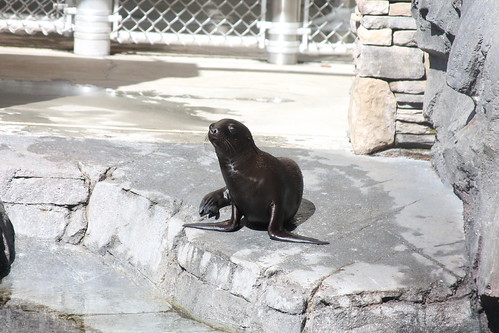
PHOTO RELEASE: SEA LION PUP DEBUTS AT THE SMITHSONIAN’S NATIONAL ZOO


28955862910_bd9df666e8.jpg


Press Release - National Zoo| FONZ

https://www.youtube.com/watch?v=6y68tQU6y7A
 
SMITHSONIAN SCIENTISTS AID IN DECODING A MAMMALIAN MYSTERY: THE GENETICS OF THE PANGOLIN


Smithsonian Conservation Biology Institute scientists, as part of a team of international researchers, have shed light on the genetics of the pangolin, a mammalian mystery. Recently published in the August edition of Genome Research, this study compared the genetic makeup of both Malayan and Chinese pangolins to those of other more discernible mammals. The scientists learned that sets of pseudogenes (or copies of genes that no longer function) are responsible for some of pangolins' more curious characteristics, for example, their lack of teeth. Most surprisingly, the study found that unlike most other mammals a gene associated with the skin's ability to fight disease does not function in pangolins. This suggests that instead, their scales were developed to serve as armor to defend against predators. Pangolins use their long, muscular tongues to slurp up ants and termites. They are the only mammals that are entirely covered in scales and can curl into a ball when frightened. Native to Africa and Asia, all eight species of pangolin are designated as vulnerable, endangered, or critically endangered by the International Union for Conservation of Nature. Threatened by relentless hunting and poaching for food and medicinal purposes, a better understanding of the pangolin is crucial to its conservation.

Press Release - National Zoo| FONZ

Pangolin genomes and the evolution of mammalian scales and immunity

Is it possible for a mod to change the title of the thread to "Smithsonian national zoo and conservation biology institute news"? Or something along those lines since a lot of the news isn't about the zoo.
 
Last edited:
We had 2 agoutis born at the Small Mammal House yesterday morning! The babies are active and appear to be doing well. Agoutis are native to South America and are the only animals capable of opening the husk of a Brazil nut, which makes them critical to the dispersal of Brazil nut seeds.
Zoo's Facebook. The accompanying photo is adorable but I don't know how to embed photos.
 
The website looks the same to me as well.

Edit: I'm using my phone, perhaps the mobile site wasn't updated.
 
Do you guys have windows 10?

I can't really think of any other reason why it would be different.
 
It is now the updated form for me on both phone and computer, and I am quite impressed. Right now I've just scrolled through the animals section and it is quite up to date. It even lists Japanese giant salamanders as being in the Reptile Discovery Center rather than Asia Trail.
Here's a few flaws:
-Greater hedgehog tenrecs and rock cavies aren't on exhibit, but they are listed as being so
-They list Philippine crocodile as Crocodylus novaeguineae mindorensis even though it is well established that they are a full species.
-it lists the gharial's genus name as Gavialia. Just a typo, but should be fixed
-southern swamp sparrow's scientific name is capitalized like this:
Melospiza georgiana Georgiana
-the titi monkey page has a photo of a coppery titi, with the scientific name of the red-bellied titi and claims it is called either. It says titis are only found on exhibit in Amazonia, which isn't true (a coppery lives in the Small Mammal House). There is no mention of white-eared titis (Amazonia) at all.
-lots of other minor typos
-the Meet the Animals directory has only so many animals per page, with fourteen pages. It has the same URL for each page so if you were to, for example, look at the North Island Brown Kiwi page, which is linked off of Animal page #9, when you hit the back button, you'd be on page one. There isn't an option to skip to a certain page and the scroll bar at the bottom only shows 9 options (plus the first and last page) at a time. It's hard to explain but if you visit the page you'll understand.
-lists Panamanian golden frog as Atelopus varius zeteki instead of Atelopus zeteki. There are both Panamian golden frogs and golden color morphs of Atelopus varius in captivity in the USA, and as far as I'm aware the golden color morph of Atelopus varius doesn't have a subspecies name so this listing is invalid.
-oriental fire-bellied toads are listed but those are off exhibit

Exhibits page:
-Lemur Island, Think Tank, Great Ape House, O-Line, and Gibbon Ridge are all on one page. That's being nitpicky but each is considered its own exhibit.
-includes the giant anteaters, prairie dogs, and North American porcupines as part of Great Cats :confused:
-lists 3.5 Asian small clawed otters on Asia trail. This sign is gone so if the site is accurate, 3 otters have left the zoo.
-no information about the otter/wood duck switch on American Trail
-lists a sloth for Amazonia. I've never seen one there and they aren't signed, but there could be one.

That's all I could find in a one-hour thorough search.
 
I highly doubt the site is finished (well I hope it isn't at least).

Lot's of typos, inaccuracies and laziness. There isn't even a page about Experience Migration.

-includes the giant anteaters, prairie dogs, and North American porcupines as part of Great Cats :confused:

Then when you click on "nearby" it list those tree animals as living near the exhibit.

In my opinion the website looks much better than the old site, but besides the look it hasn't improved much.
 
I highly doubt the site is finished (well I hope it isn't at least).

Lot's of typos, inaccuracies and laziness. There isn't even a page about Experience Migration.

In my opinion the website looks much better than the old site, but besides the look it hasn't improved much.

We can only hope. Perhaps someone will stumble onto the site and fix the things I pointed out.

There's a bit of detail about EM on the page for the bird house, but the detail is minimal.

The main improvements were structuring for the animal pages and animal exhibits- all much nicer to sort through now. Hopefully it'll stay a bit more updated. The animal pages have a LOT more info about each species, which is nice.
 
Back
Top