
I don’t think either species is(was?) signed last time I checked.Interesting. I last visited a few years ago of course but at the time Wolf's Guenon was the only species signed for that enclosure.
I don’t think either species is(was?) signed last time I checked.Interesting. I last visited a few years ago of course but at the time Wolf's Guenon was the only species signed for that enclosure.
The Blue Monkeys have moved multiple times in the last few years, going on and off exhibit all the time. When I last visited they were exhibited in Gorilla Valley with Angolan Colobus, Rock Hyrax, and Sulawesi Crested Macaque, but they have been moved back to the Lied Jungle according to recent photos.That's great information, @birdsandbats and @Dhole dude as Omaha has certainly switched around a lot of species over the years. I always saw numerous mixed-species primate exhibits at that zoo during my visits, but Lied Jungle is not as consistent as it used to be. Now, it can be a surprise as to what someone would see if they hadn't visited in a few years. That's exciting if they still have Blue Monkeys, one of my all-time favourite species and a real rarity these days.


I am reading this thread with interest!
When people talk about showing macaques in large groups and comparing several guenons next to each other - it is basically rediscovering the trend very popular in the 1970s-1980s. During that time, a typical large zoo had a monkey house with a row of similar exhibits showing several guenons. Another very common exhibit type was a large moated enclosure for a large troop of macaques, usually rhesus or crab-eating. It was designed as either rocks or a ruined Asian temple (think The Jungle Book). A large monkey troop with multiple youngsters was always visitors favourite during these years, indeed. Only few these rocks remained until today.
I'm surprised at how many US zoos you've seen this species at! Only three AZA zoos house this species today, but both Tulsa and Lincoln Park have bred this species in recent years. There are a few non-AZA holders too, and this species' future in US zoos is likely highly dependent on the commitment of non-AZA zoos such as Metro Richmond.Diana Monkeys are yet another example of an eye-catching primate, with the contrast between black-and-white (and a splash of orange!) being particularly vivid. I've seen this species at 15 zoos. Two-thirds of those visits were between 2008 and 2010, but since then I've visited hundreds of new zoos and rarely seen these primates. In fact, Zootierliste only has approximately 30 zoos in the world that currently have this species in captivity, therefore us zoo nerds need to appreciate Diana Monkeys when we come across them.
1- Toledo Zoo (USA) – Diana Monkey – 2008
2- Detroit Zoo (USA) – Diana Monkey – 2008
3- Cincinnati Zoo & Botanical Garden (USA) – Diana Monkey – 2008
4- Omaha’s Henry Doorly Zoo & Aquarium (USA) – Diana Monkey – 2008
5- Tulsa Zoo (USA) – Diana Monkey – 2010
6- Fort Wayne Children’s Zoo (USA) – Diana Monkey – 2010
7- Milwaukee County Zoo (USA) – Diana Monkey – 2010
8- Riverbanks Zoo & Garden (USA) – Diana Monkey – 2010
9- Baton Rouge Zoo (USA) – Diana Monkey – 2010
10- Audubon Zoo (USA) – Diana Monkey – 2010
11- Potawatomi Zoo (USA) – Diana Monkey – 2012
12- Jackson Zoo (USA) – Diana Monkey – 2012
13- Artis Royal Zoo (Netherlands) – Diana Monkey – 2019
14- Berlin Tierpark (Germany) – Diana Monkey – 2019
15- Osnabruck Zoo (Germany) – Diana Monkey – 2019

@vogelcommando
Quite often, this primate species has been mixed with other mammals. Omaha’s Henry Doorly Zoo & Aquarium (USA) has moved Diana Monkeys around its zoo over the years, but in the past I've seen Diana Monkeys, Colobus Monkeys and Gorillas all in the same space.

Baton Rouge Zoo (USA) had a single Diana Monkey in with a Mandrill back in 2010:

Audubon Zoo (USA) had Diana Monkeys in with Lesser Spot-nosed Guenons in 2010:

Berlin Tierpark (Germany) had Diana Monkeys when I was there in 2019, one of only 3 out of the 120 European zoos/aquariums I've visited with the species.

@Jogy

@MagpieGoose

Osnabruck Zoo (Germany) has Diana Monkeys, Drills and Forest Buffalo all together in the same space.

@RonBurrgundy

Then there's another odd combination of Gorillas, Meerkats (!!) and Diana Monkeys all together at Artis Royal Zoo (Netherlands):

My Mammal Lists:
Gibbons - 143 zoos and 192 exhibits (9 species: 64 White-handed, 62 Siamang, 36 Northern White-cheeked, 12 Yellow-cheeked, 7 Southern Grey, 5 Pileated, 3 Silvery, 2 Agile, 1 Eastern Hoolock, with some zoos having multiple species)
Elephants - 104 zoos (61 Asian, 53 African, including some zoos with both)
Spider Monkeys - 91 zoos and 95 exhibits (5 species: Black-headed, Colombian Brown, Geoffroy's, Red-faced Black, White-bellied)
Macaques - 80 zoos and 113 exhibits (12 species: 25 Lion-tailed, 23 Japanese, 16 Barbary, 13 Sulawesi Crested, 10 Pig-tailed, 9 Rhesus, 7 Crab-eating, 4 Bonnet, 2 Stump-tailed, 2 Toque, 1 Booted, 1 Tonkean, including some zoos with multiple species)
Squirrel Monkeys - 78 zoos (multiple species)
Colobus Monkeys - 72 zoos (3 species: Angolan, King, Mantled Guereza)
Gorillas - 74 (2 species: Western Lowland, plus 1 Eastern Lowland at Antwerp Zoo)
Orangutans - 74 (2 species: Bornean, Sumatran)
Capuchins - 71 zoos and 81 exhibits (7 species: 44 Tufted, 19 White-faced, 9 Golden-bellied, 5 White-fronted, 2 Crested, 1 Hooded, 1 Wedge-capped, with 10 zoos having two species)
Chimpanzees - 64
Saki Monkeys - 58 zoos (2 species: 56 White-faced, 2 Bearded)
Langurs - 48 zoos (6 species: 17 Francois', 9 Dusky Leaf, 8 East Javan, 6 Hanuman, 6 Silvery Lutung, 2 Red-shanked Douc)
Baboons - 41 zoos and 49 exhibits (4 species: 31 Hamadryas, 11 Olive, 6 Guinea, 1 Yellow, with some zoos having multiple species)
Mandrills - 41
Howler Monkeys - 40 zoos (2 species: 34 Black, 6 Red)
Mangabeys - 30 zoos (5 species: 11 Red-capped, 9 Black Crested, 6 Golden-bellied, 3 White-naped, 1 Sooty)
De Brazza's Monkeys - 28 zoos
Douroucoulis - 22 zoos (5 species: Grey-legged, Humboldt's, Nancy Ma's, Southern Bolivian, Three-striped)
Patas Monkeys - 20 zoos
Titi Monkeys - 19 zoos (3 species: 11 White-eared, 7 Coppery, 1 Red-bellied)
Diana Monkeys - 15 zoos
Bonobos - 14
Wolf's Mona Monkeys - 12 zoos
Drills - 8
Geladas - 6
I'm surprised at how many US zoos you've seen this species at! Only three AZA zoos house this species today, but both Tulsa and Lincoln Park have bred this species in recent years. There are a few non-AZA holders too, and this species' future in US zoos is likely highly dependent on the commitment of non-AZA zoos such as Metro Richmond.
Is it a bit sad? Yes. However, at the same time there are only so many spaces in zoos to go around. The goal of "let's try to display as many species as we can" is unfortunately contrary with the goals of having sustainable populations that don't rely on wild-caught imports and displaying animals in large, naturalistic exhibits. While I do think there are ways that AZA zoos can improve the diversity in their collection without harming those other two goals, some level of phase outs are going to be necessary if we want to maintain sustainable populations of animals. Granted, there are certain species that get a lot of love from zoos that would be able to lose holders to little or no detriment (e.g., ring-tailed lemur, guereza colobus, etc.), but generally speaking any time one species gains spaces in zoos it is often at the detriment of space for a different species, and not many species can afford to lose space. So while yes, it's sad to see certain species on their way out, at the same time it oftentimes is at the benefit of a different population that needs those spaces.It's a bit sad to see that Diana Monkeys are struggling to maintain a foothold in American zoos. The AZA is lauded by many zoo nerds, but as the years go by it seems that non-accredited zoos are in some ways far more fascinating when it comes to their animal collections. And, as you correctly point out, if not for the commitment of non-AZA zoos then Diana Monkeys will completely disappear.

the Red-Backed Bearded Saki's were on display(kind of) when I went to DWA last year, they are in a hard to see into exhibit above the Ocelot, across from the Harpy Eagles I only saw 2 or 3 of them in the exhibit but because I couldn't really see them that well there could of been more.I don't think they've been on display for at least 2 years. I didn't see them or any indication of them in December of 2021. For this facility, that doesn't say much, per say, but I haven't seen any other recent mention of the bearded sakis and there have been many visits from Zoochatters since.

If you want to see guenons outside of the AZA (including this species!), and if you ever head back to the East Coast again, then you'd need to check out Southwick's Zoo. While the zoo is certainly flawed, it's better than a lot of non-AZA zoos and at least has education as a major part of its mission. My most recent visit here was 2021, at which point I saw five guenon species on display! Those species being: Wolf's guenon, Schmidt's red-tailed monkey, Debrazza's monkey, patas monkey, and Chlorocebus sp. If you're "lucky," you may even get to see a young Schmidt's guenon outside of its enclosure (photos by @ThylacineAlive, 2018)all American facilities and 8 out of 10 AZA-accredited. That has been the trend for me with all the Guenon species so far.
:

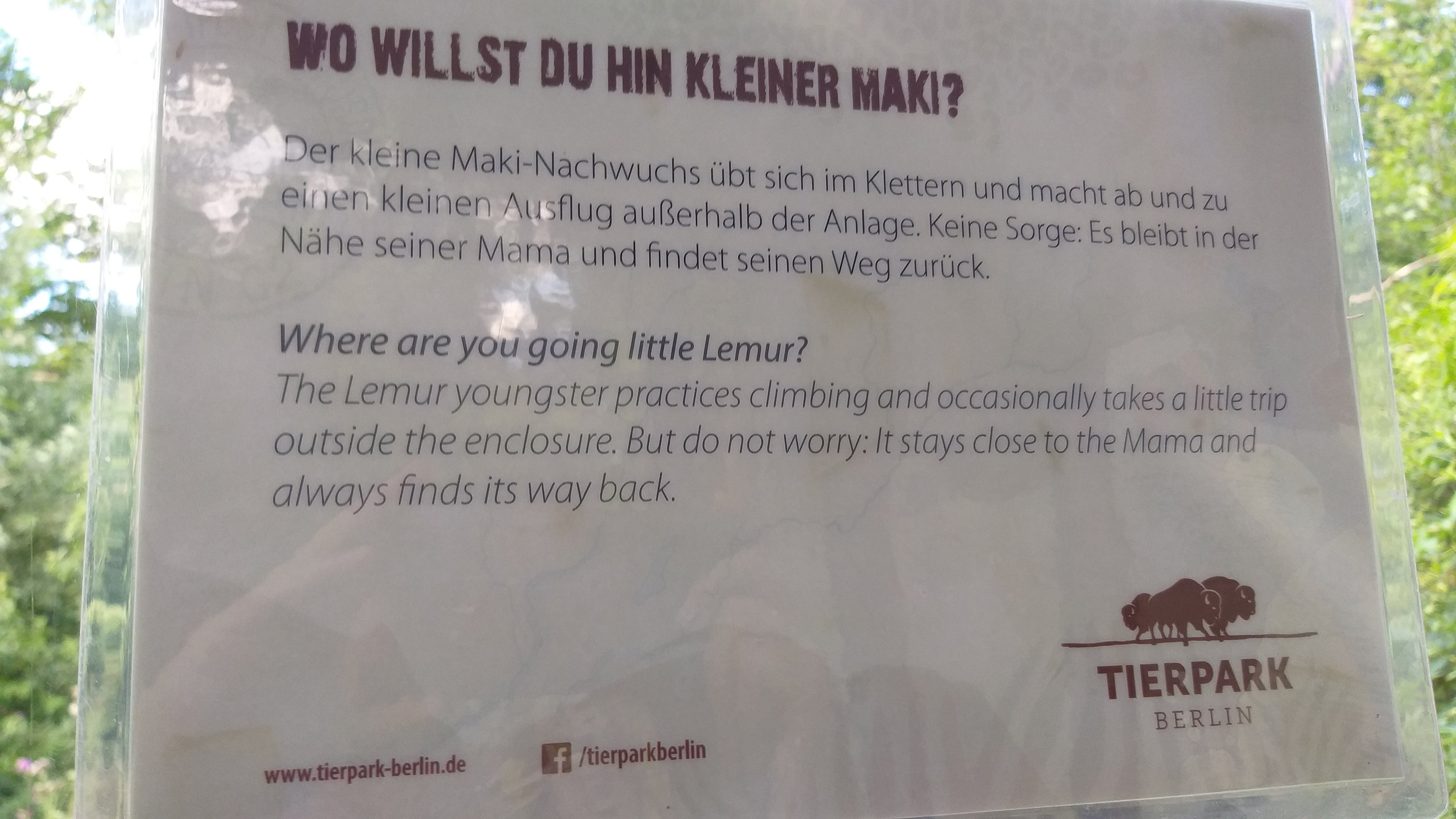
This reminds me of a sign (by the primate house, in front of a enclosure housing various lemurs) at Tierpark Berlin.If you want to see guenons outside of the AZA (including this species!), and if you ever head back to the East Coast again, then you'd need to check out Southwick's Zoo. While the zoo is certainly flawed, it's better than a lot of non-AZA zoos and at least has education as a major part of its mission. My most recent visit here was 2021, at which point I saw five guenon species on display! Those species being: Wolf's guenon, Schmidt's red-tailed monkey, Debrazza's monkey, patas monkey, and Chlorocebus sp. If you're "lucky," you may even get to see a young Schmidt's guenon outside of its enclosure (photos by @ThylacineAlive, 2018)




This is probably one of those things everyone else already knew about, but I was tripped up for a moment by this lion fountain considering there's an identical one at Greenville Zoo. I shouldn't be surprised, but it turns out they're mass produced and you too can have your own lion fountain for a mere few grand!
I don't recall whether I've actually posted in here yet or not but I've been slowly catching up, several pages behind, ever since it was created. I absolutely adore a good passion project thread like this.