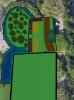
The Greenhouse “Aula Surga“ (Indonesian for paradise hall)
Part 1
Aula Surga will replace the old predator house.
It‘s structured into two parts.
The first part is a greenhouse which is 2,130 m² large.
View attachment 774294
Description:
You enter the greenhouse after you have seen the African mountain region.
At the right you can see glass panes of a terrarium but you only see a wide reptilian tail. Maybe you can see the whole reptile later, but that‘s uninteresting now.
A
Sumatra Laughingthrush just set down on the overgrown terrarium roof and it sings something to lure a female. He‘s successful; a female flies in a tree next to the path.
We leave them alone and go on, until we come to a cross. We take the right way to see the terrarium.
You can see terrarium more precise, because there‘s no distance between the terrarium and the path. There‘s a
Timor Python in the water next to the glass panel. You can see the body of the python that we saw before; it lies in a tree hollow.
Right next to the first terrarium is a secound terrarium where you see an active
Crocodile Monitor. It climbs on one of the branches in its terrarium.
We want to go on, but that‘s a dead end. A small brown mammal runs suddenly runs across the path. It looks like a mouse but we heard there are free-roaming treeshrews in this house so we follow it. And it wasn‘t for nothing; we see a
Nothern Treeshrew which sits on a bowl with berries. The treeshrew led us to one of five feeding stations in the greenhouse. In addition to the treeshrew there are also a few birds. A
Muellers Western Hooded Pitta flies away as we came; a
Ruby-throated Bulbul sits together with the threeshrew on a bowl; two brown ground doves which we can‘t identify run between two bowls back and forth and three
Superb Fruit Doves sit on higher bowls.
We watch this feeding station a bit longer, but we go on now.
At the glass pane of the python terrarium is a brown spot. We look more precise and see a
Common Tree Frog, our first amphibious.
We come to the cross again and take the left way now. After we walked a bit along there‘s a enclosure which fences are logs at the left. This enclosure is very muddy and houses a group of five
Southern Asian Forest Tortoises. On their feeding bowl you see another free-flying bird: a
White-eared Catbird which is looking unsuccessful for something to eat. Suddenly it flies away and we hear cackle like that from chickens. A group of
Green Junglefowl comes out of the forest and begins to peck at the ground. Another noisy bird species settled down in the trees next to the tortoise enclosure: two couples of
Solomon Island Eclectus.
A few steps further is the next feeding station which is lively attended. A flock of
Brown Lorys and
Goldie‘s Lorikeets flies around between five bowls; three
Victoria Crowned Pigeons peck relaxed for food; another
Nothern Treeshrew sits between these big pigeons; a single
Nicobar Pigeons sits in a higher feeding bowl circled by lorikeets;
Crested Partridges with chicks running around everywhere there and
Ruby-throated Bulbuls argue with lorikeets over berries.
We continue our walk and come to the mangrove forest which is on the shore of the big river. A couple of
Asian Fairy-bluebirds welcome us to the mangrove and a
Wompoo Fruit Dove flies across our way. The path leads us now over a bridge over which we reach a group of islands covered in mangroves. We can watch out from these islands the river residents: on a sandbank lies a young
Malaysian Giant Turtle; three
Sunda teals are chased away by a couple of
White-winged Ducks which has chicks; everywhere
Asian Common Toads sit on stones, rocks or logs;
Giant Gouramis swim relaxed through the river and
Lesser Whistling Ducks and
Amboina Box Turtles share a log to sit.
On one island is the third feeding station where wee see the
Wompoo Fruit Dove Ruby-throated Bulbuls and Asian Fairy-bluebirds again; a
Chinese Water Dragon serves itself at the duck food; a couple of
Silver-tipped Imperial Pigeons lands in the trees around the station and waits until we leave the station.
We reach finally the other shore and are welcomed by a flug of
Grosbeak Starlings in rice fields. We enjoy our view from a higher wooden platform over the rice fields and spot a
Chinese Water Dragon before we continue our walk. There‘s another cross and we take the right way into the jungle.
Nicobar Pigeons, Northern Treeshrews and
Crested Partridges cross our path while we here a loud splashing. The path becomes steeper and we reach a platform from which we can see and reach a hanging bridge next to the waterfall. We walk over it, get a bit wet and reach the other side where the fourth feeding station is. A couple of
Muellers Western Hooded Pittas picks for berries;
Kalongs and
Orange-fronted Fruit Doves eat bigger fruit slices and we missed the
Sulawesi Hornbill which just flies away and we only see its tail. For going back to the main path are two ways: the first is the same with which we came here, the second leads over stones in the river; we choose the secound.
As we walk to the stones we see the
Sulawesi Hornbill again. It‘s flying to a nesting box which is bricked up.
We all know what that means, right?
Arrived at the stones we see the next rarity: 6 adult
Cotton Pygmy Geese with goslings.
Feedback is welcome
To be continued


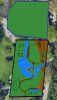

 , because our visit was before the regular opening)