Pristine Park Zoo — A New In-the-works Project!
Hey everyone! I’m back on this thread after a bit of a hiatus from posting my ideas, and I have an all new zoo project in the works that I’m proud to introduce you to — Welcome to the Pristine Park Zoo! After lots of morphing, time and dedication into this rather average-sized, but pleasant project, I don’t think it will disappoint!
Introduction: The Pristine Park Zoo is a near 35 acre animal-based facility located in a small city park in Charlotte, North Carolina, and is considered by both locals and tourists as both an excellent and charming zoo prioritizing visitor experience, conservation, and education. The zoo opened in 1997 as part of a government agreement and efforts from local tax payers to formulate a zoological park consisting of vets, zoologists, technicians, and other core employees. Despite its much more recent opening and construction compared to a majority of city zoos in the United States, the Pristine Park Zoo was purposefully designed to mimic old structure. The zoo was granted an AZA accreditation in 2007 and has maintained it ever since. The facility is primarily bird-focused, with a good mix of aquatic and terrestrial species of animals, though there aren’t really any massive species of animals, like elephants, giraffes, or rhinos. There are four main zones and several sub-exhibits within each zone.
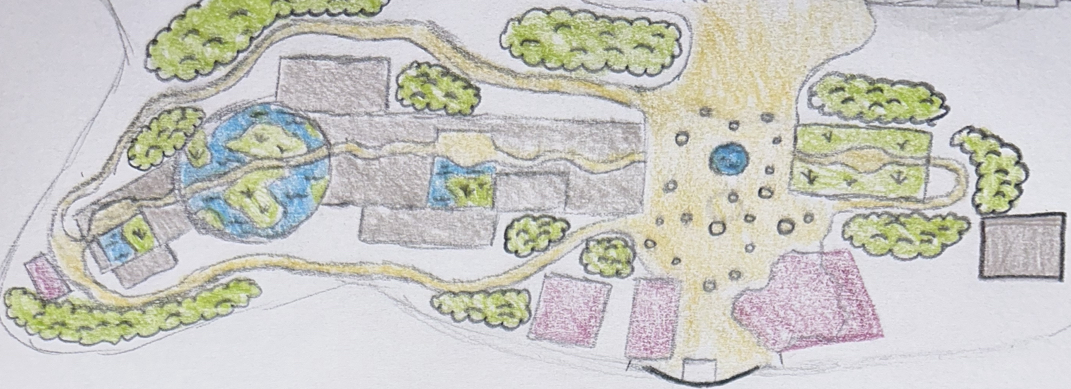
The Ecology Plaza map is seen below. A few map notes:
- Purple buildings are buildings accessible to the public. This includes a dining space, a gift shop, an educational classroom, and restrooms.
- Gray buildings are for employees only, typically for animal keepers and behind-the-scenes holding areas.
The Ecology Plaza
As soon as guests enter in through the zoo’s entrance, they’ve arrived in the first zone: The Ecology Plaza. Past the ticket booth that has been engrained in the middle of the zoos first gates, to the right is the zoos main restaurant and to the left is the gift shop. Once visitors make their way past these two buildings, they are greeted with the large plaza surrounded by several large exhibits on the side.
The
Leahre Family Alcid Fountain is the first spot in the zoo where guests will witness animals. Many of the exhibits are named after major financial contributors to either the exhibit or the zone. The alcid fountain is simply a fountain with several bronze models of alcid species, including puffins and guillemots. The birds are wading on rocks with water spewing out of it, which flows into a surrounding circular pool with a diameter of 15 ft, home to a small group of
Common Carp (Cyprinus carpio) (0.0.18).
To the left of the fountain from the visitors perspective is the
Conservatory of America, a medium-sized rectangular building home to a wide variety of birds and several mammals and reptiles that dwell in the wetlands, rivers, grasslands, and marshes of the familiar North American continent to visitors. The aim of this conservatory is to be immersive and showcase that in the case of American locals, you don’t need to travel super far to see the beauty of nature and the animal kingdom after all — there is a stunning variety of wetland birds that are widespread across the North American continent, many of which are common, and that beauty should be embraced alongside the desire of seeing the wildlife in other places.
The first habitat in the Conservatory of America is down a short, indoor, windy pathway that is furnished with polished and dark wood to give the building an American feel, an also create a sense of ambience as one is being immersed into the impressive enclosures ahead. To the left of this path is a viewing window space for the
North American River Otter (Lontra canadensis) (1.2) in their outdoor habitat. This space provides facts about otters and their behavior, as well as possible environmental threats. This habitat is a 350 sq ft yard with nature-esque, thick wooden pillars along the far back of the exhibit. On the other sides are brick walls leading into facilitative operations for the otters. At the top of the pool of the exhibit is a small waterfall flowing into it, leading into 6 ft deep water. The land space has a large carved tree trunk with acts as a sleeping and relaxation place with a soft surface. The land of the exhibit contains grass blades mixed with gravel and sand patches, and along the brick walls are several vines to contribute to naturalism.
Beyond the otter viewing is a little bit more of the wooden pathway style before guests are greeted with the doors to the conservatory dome. This glass dome is a wooden board walkthrough through a 55 ft diameter long and 35 ft high circular aviation wetland-themed habitat, home to a wide variety of wading birds and waterfowl from North America, including the follow species:
- Barrow’s Goldeneye (Bucephala islandica) (2.2)
- Black-crowned Night Heron (Nycticorax nycticorax) (1.1)
- Blue-winged Teal (Spatula discors) (2.3)
- Bufflehead (Bucephala albeola) (1.1)
- Canvasback (Aythya valisineria) (2.1)
- Cattle Egret (Bubulcus ibis) (1.0)
- Hooded Merganser (Lophodytes cucullatus) (3.2)
- Northern Pintail (Ara acuta) (1.1)
- Northern Shoveler (Spatula clypeata) (2.2)
- Roseate Spoonbill (Platalea ajaja) (1.2)
- Ruddy Duck (Oxyura jamaicensis) (3.3)
- Wood Duck (Aix sponsa) (3.5)
Alongside the duck and wading bird species are several passerine birds dwelling in the trees, including the
American Robin (Turdus migratorius) (4.5),
Baltimore Oriole (Icterus galbula) (3.2),
Common Grackle (Quiscalus quiscula) (3.4), and the
Swainson’s Thrush (Catharus ustulatus) (2.2). Designed specifically as a lush, wetland type set-up, a vast majority of the exhibit is a balanced mix between land and water space. Within the water are circular tree stumps in the shallow, 6 ft deep pools, and on the land space there are large distinct mangrove trees, lots of vines, lichen, grass patches along the ground, as well as gravel and sand. There are also some logs along the water for the wading bird species, and several leafless trees for the passerines to dwell on.
The last exhibit of the Conservatory of America is past another short walk along the indoor wooden path, this time to the right. This is a separate 350 sq ft yard, home to the
American Alligator (Alligator mississippiensis) (1.1). This exhibit is half land and half water area, with the land space pretty much just being flat grass with several bushes along the side of the wall. The drill is the same as the otter exhibit — large, thick wooden pillars aligning the back of the yard, along with vines along the buildings on the side adding to naturalism. The pool goes 4 feet deep.
That marks the end of the Conservatory of America, and out this doorway, guests are given the option to head down a pathway leading to the plaza again or to the rest of the zoo.
The next and final region of The Ecology Plaza is a fascinating one —
Mitschie’s Solar Butterfly Garden. This exhibit is across the Leahre Family Alcid Fountain, around the same distance from the fountain as the Conservatory of America is. This is a seasonal, netted walkthrough garden being a rectangular 550 sq ft habitat, with wooden edges along the tops and sides. Within the garden are several solar panels, powering the exhibits fans along the top wooden area, which have signage near them used to teach guests about how solar energy benefits not just the living conditions of butterflies, but also how they reduce gas emissions and are a more sustainable and environmentally-friendly form of energy. The actual garden itself is native-grown, with several native flower species planted and the rest of the foliage mostly left untouched. There are several rocks, and in the middle of the pathway is a large tree with vines and branches growing down it. Essentially, this is a large butterfly terrarium. Speaking of butterflies, the species lineup in here is:
- Atlas Moth (Attacus atlas)
- Autumn Leaf (Doleschllia bisaltide)
- Arizona Sister (Adelpha eulalia)
- Banded Orange (Dryadula phaetusa)
- Black Swallowtail (Papilio polyxenes)
- Cabbage White (Pieris rapae)
- Giant Swallowtail (Papilio cresphontes)
- Julia Butterfly (Dryas iulia)
- Malachite (Siproeta stelenes)
- Mexican Sister (Adelpha fessonia)
- Mosaic (Colobura dirce)
- Clipper (Parthenos sylvia)
- Monarch (Danaus plexippus)
- Mourning Cloak (Nymphalis antiopa)
- Painted Lady (Vanessa cardui)
- Paper Kite (Idea leuconoe)
- Purple Mort Blue (Eryphanis polyxena)
- Red Postman (Heliconius sara)
- Ruby-spotted Swallowtail (Papilio anchisiades)
- Rusty-tipped Page (Siproeta epaphua)
- Silver-spotted Skipper (Epargyreus clarus)
- Tiger Longwing (Heliconius hecate)
- White Peacock (Anartia jatrophae)
- Zebra Longwing (Heliconius charithonia)
The path continues to another door which leads either into the rest of the zoo or back to The Ecology Plaza.
That’s a wrap to The Ecology Plaza, a native introduction to everything else that the zoo has to offer! I’m very excited to prepare, polish, and share the rest, as I’m very proud of some of my ideas and my work. Stay tuned!