Vienna
In October, the zoo-visiting need started to show its face again, so I had to book a new trip again. This time it was between Vienna + Budapest, or Poznan + Wroclaw. Vienna is a really nice city, so here I could visit some other things as well. The Wroclaw trip would be solely zoo-focused though. Since my girlfriend wanted to come along as well, I let her choose, and she chose for Vienna. Understandably, to be fair, as we'd already been in Poland two months ago.
Tiergarten Schönbrunn
https://www.zoovienna.at/media/uploads/dokumente/plan2019_winter_eng_web_lr.pdf
Visited on November 10
I already travelled to Vienna two years ago, on a visit to a friend of mine who was on an Erasmus exchange programme there. This included a visit to the Tiergarten, but as this friend (and the ones I was travelling with) weren’t into zoos, they didn’t like it much and we skipped parts of the zoo, as well as the Desert and Palm Houses outside the zoo.
So this year I wanted to make things right and spend all the time I wanted at the zoo, and I did. We arrived 30 minutes after opening (as we’d arrived fairly late at our apartment the night before and waking up before 8 really wasn’t an option). This was plenty of time, as we’d completed our visit around 3 PM, having spent just under 5 hours in the zoo.
I think Vienna is an extraordinarily well-executed example of a zoo using its history as an advantage. The Central Pavillion is of course the prime example of this, but also the Bird House, Cat House and Monkey House are marvellously reinvented to house their inhabitants in line with modern husbandry. It also uses a historic bear cage to show how animals used to be housed in zoos (and so they show the enormous leaps zoos have made in the past century).
Something that’s more remarkable for an old zoo like Schönbrunn, is the lack of anything that’s truly bad. No other zoo built in a similar age has achieved this as far as I know, and this makes Schönbrunn one of the best zoos I’ve ever visited: a combination of superb exhibitry, a good collection, and a rich history. What else could anyone want?
Statistics
I saw
168 species in Schönbrunn: 61 mammals, 71 birds, 26 reptiles and 10 amphibians. This was less than I’d expected and even though we missed a few species, I’d still expected Schönbrunn to be a 200+ species zoo.
Schönbrunn has 22 species I didn’t see anywhere else this year.
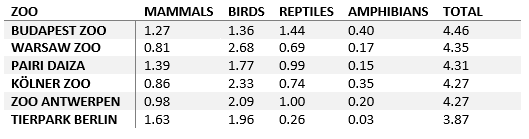
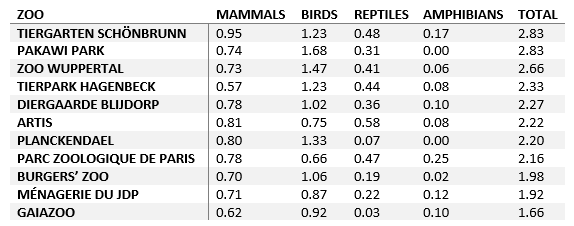
With a ZooScore of 3,22, Schönbrunn is tied with Avifauna.
Enclosures
- Best in Class:
Schönbrunn has a world-class polar bear habitat called Franz Josef Land. This exhibit has 2 enclosures: one larger one, and a smaller one. It includes underwater viewing. We only saw one polar bear as the other one was busy giving birth to a cub.
This zoo also has one of the best enclosures for Indian rhinoceros. These animals are mixed with Asian ungulates (nilgai, blackbuck and sika deer) and have access to spacious outdoor paddocks, with plenty of rocks, trees and bars for scratching, as well as a pool and mud wallows. The indoor is less spacious, but still has more space than the usual rhinoceros barn.
- Upper Middle Class:
The Rainforest Hall in Vienna is an excellent representation of an Asian rainforest. A multitude of species are exhibited here, including but not limited to the biggest amount of blue-crowned hanging parrots I’ve ever seen, java sparrows, leafbirds, small-clawed otters, archerfish, free-flying bats (both flying foxes in the main hall and Seba’s short-tailed bats in a walkthrough cave), and tons of other stuff. Sadly the nocturnal path was closed during our visit.
The Bird House doesn’t have an enormous amount of species, but they are exhibited in two marvellous walkthrough enclosures. Some of the birds can be hard to spot, but generally you can easily see all inhabitants.
Another historic house is the Cat House, which has been beautifully restored, and where visitors now walk in the former indoor enclosures. Housed here are cheetahs, Amur tigers and Amur leopards. The latter two are housed in spacious aviaries, and the cheetahs are housed in grassy paddocks.
Then at last, the Monkey House is also beautifully renovated. While it formerly used to house a multitude of species, it now has half a dozen species, mostly smaller-sized primates. King colobuses are housed here in a decent-sized enclosure along with meerkats. A trio of tamarin species is housed with armadillos, and squirrel monkeys share their enclosure with agoutis. There’s also supposed to be lemurs in here, but these weren’t on-show during my visit. All this is well-furnished, with plenty of natural vegetation. More than suitable for the apes’ needs.
The ORANG.erie houses a trio (1.2) of Bornean orangutan. These graceful apes have access to a moated (the moat houses native fish) enclosure filled with climbing structures, and an equally full glass-fronted indoor enclosure. There’s also a lot of high-quality educational material to be found here.
- Lick of Paint:
The European area has some good enclosures, but with only three species, is just lacking in animals. Adding a few more animals, such as brown bears, eagles or an aviary with European waterfowl, would do this area a lot of good.
The bird of prey aviaries near the rhino house are mediocre at best, and don’t look well-maintained. That’s not a look that is common at all in Vienna, and while they’re not bad, they still stand out as the worst part of the zoo.
The Insektarium has terrariums for many species of beetle, stick insect, and mantis. This is probably the biggest insect house I’ve seen to date, but while it’s a good exhibit, it’s little more than terrariums with name tags. I think some more interactive educational material would work great in this house.
The Desert House, outside of the zoo, felt a bit abandoned. Quite a few enclosures looked empty, and there wasn’t much life in the hall. Perhaps this was because of winter, but it just wasn’t in optimal condition when we visited.
Animal Highlights
Pallas’ long-tongued bat, Egypt hedgehog, king colobus, corn crake, orange-bellied leafbird, green-winged pytilia, blue-backed manakin, purple honeycreeper, eastern paradise whydah, little bittern, black-billed amazon, yellow-billed amazon, northern rockhopper, Morelet’s crocodile, tentacled snake, lesser Antillean iguana, northern river terrapin, little rock frog.
Haus des Meeres
https://www.haus-des-meeres.at/fxdata/hausdesmeeres/prod/fximg/large/Ebenenplan_4717.jpg
Visited on November 13
An aquarium inside a flak tower, who would have though of that? Austrians, apparently. This building is huge, but I’d expected it to be bigger honestly. There’s quite a few tanks on the lower floors, but as you get higher, fewer and fewer tanks are encountered. There’s also a rainforest and a crocodile enclosure with a few free-flying birds.
The collection suffers from some serious space restrictions, and it obviously has a hard time expanding. For an entrance fee that’s relatively pricey, I don’t think the zoo is worth it. It’s nice to do if you’re in the city for long enough, but I think there’s plenty other stuff to see in Vienna (or if you want to do zoos, there’s trains to Budapest, Prague and Munich.
Statistics
I saw
81 species in Haus des Meeres: 6 mammals, 19 birds, 46 reptiles and 10 amphibians.
Haus des Meeres had 20 species I didn’t see anywhere else this year. That’s a high amount for such a small collection.
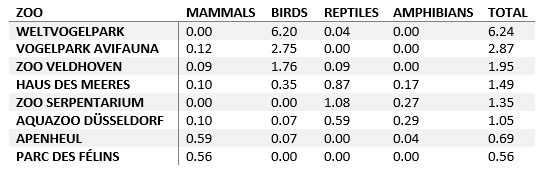
With a ZooScore of 1,46, Haus des Meeres ranks below GaiaZoo, and at the top of the lower tier.
Enclosures
Most of the enclosures in Haus des Meeres are fine but not much more. The worst ones would be a terrarium for 3 (!) Komodo dragons that wasn’t even big enough for one, and an aquarium with a variety of smallish fish and a juvenile black-tipped shark, but that’s awfully small for the species. The rainforest exhibit is quite nice though, with some cool species, and a nice use of the vertical space that’s plentiful in the aquarium. Make sure to look up as you’re buying your tickets, as there’s a glass window above your head which gives a nice view into this crocodile tank.
Animal Highlights
Silvery marmoset, saddleback tamarin (nominate ssp), eastern yellow-billed hornbill, red-billed buffalo weaver, bank myna, slender-billed starling, rough green snake, common death adder, inland taipan, Taylor’s cantil, Aruba island rattlesnake, spiny-headed treefrog, Surinam toad.