Subspecies held in the USA, for ZTL

I have a question regarding echidna subspecies:
Short-beaked Echidnas: Are any of the subspecies listings are accurate? There's currently:
  • 2 listings for New Guinea
  • 1 listing for Kangaroo Island
  • 1 listing for South-East Australian
  • 1 listing for Tasmanian
 
I have a question regarding echidna subspecies:
Short-beaked Echidnas: Are any of the subspecies listings are accurate? There's currently:
  • 2 listings for New Guinea
  • 1 listing for Kangaroo Island
  • 1 listing for South-East Australian
  • 1 listing for Tasmanian

Tasmanian is accurate, that's Brookfield's old Adelaide.
There are animals marked as coming from the state of South Australia, whether they actually came from Kangaroo Island is another question. Many echidnas are stated to have passed through Adelaide so chances are many are the relevant mainland subspecies.

Unclear on the New Guineas, those animals are marked with undetermined origins in the studbook. Something may be further known though.
 
In the past, LA Zoo has categorized one of their echidnas as the Kangaroo Island subspecies. I'm not sure if that is still the case, but it was as of at least last year. I would expect most echidnas outside of Australia to be the nominate (Southeastern) subspecies, but one would need to be able to trace precise origins to be sure.

As for the New Guinea listings, I suspect those are incorrect. Europe imported quite a few of this subspecies about 8-10 years ago. Around that same time, San Diegos animals seemed to have just randomly changed to being listed as such. I've not found any connection between their animals and the European imports. It's possible they're legitimate, but I somewhat doubt it.

~Thylo
 
In the past, LA Zoo has categorized one of their echidnas as the Kangaroo Island subspecies. I'm not sure if that is still the case, but it was as of at least last year. I would expect most echidnas outside of Australia to be the nominate (Southeastern) subspecies, but one would need to be able to trace precise origins to be sure.

As for the New Guinea listings, I suspect those are incorrect. Europe imported quite a few of this subspecies about 8-10 years ago. Around that same time, San Diegos animals seemed to have just randomly changed to being listed as such. I've not found any connection between their animals and the European imports. It's possible they're legitimate, but I somewhat doubt it.

~Thylo
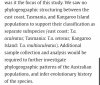
Interesting 2019 paper here on echidna DNA testing (for the purposes of identifying smuggled animals) which has samples from both LA and San Diego. The attached appendix gives locality origin of the animals (the two from LA are both given as NSW; one from SD as Melbourne Zoo, another as "unknown" [it groups with the LA and Melbourne animals genetically], and a third was Indonesia ["obtained legally from an Indonesian Zoo" in the paper's text]).

https://www.sciencedirect.com/science/article/pii/S0379073818305024
 
Interesting 2019 paper here on echidna DNA testing (for the purposes of identifying smuggled animals) which has samples from both LA and San Diego. The attached appendix gives locality origin of the animals (the two from LA are both given as NSW; one from SD as Melbourne Zoo, another as "unknown" [it groups with the LA and Melbourne animals genetically], and a third was Indonesia ["obtained legally from an Indonesian Zoo" in the paper's text]).

https://www.sciencedirect.com/science/article/pii/S0379073818305024

Very interesting - particularly in regards to no genetic evidence to separate Kangaroo Island and Tasmanian from nominate.

Screenshot_20250819_225523_Chrome.jpg

A further study of this to analyze whether those two subspecies are valid and determine how removed New Guineas are from Australian ones would be interesting to read.
 

Attachments

  • Screenshot_20250819_225523_Chrome.jpg
    Screenshot_20250819_225523_Chrome.jpg
    120.8 KB · Views: 98
Because it is sometimes a bit hard to see what changes and ideas you'd all request, does this list have them all? If yes (please like this post then) I will take it to the discussion with my fellow admins:


General rules

  • Don’t assign subspecies without hard provenance (studbook, import records, genetics).

  • Prefer species-level (or genus-level for Aotus) when uncertain.

  • Mark known hybrids explicitly.

  • Remove duplicate entries and signage-only assumptions.
Taxon-by-taxon

  • Western Grey Kangaroo: Standardize US entries to M. f. melanops where reasonable; otherwise keep at species level.

  • Bearded Saki: Set US holdings to Chiropotes sagulatus (Guyana origin); remove mixed C. chiropotes/satanas IDs.

  • Geoffroy’s Spider Monkey: AZA manages A. g. geoffroyi; note presence of vellerosus and hybrids; use species level for non-AZA unless documented.

  • Night Monkeys (Aotus): Add a genus-level option; avoid “best-guess” species.

  • Angolan Colobus: Keep Tanzanian subspecies (founders from Tanzania); add a species-level option in ZTL for uncertain cases.

  • Cape/Crested Porcupine: Most AZA are Hystrix africaeaustralis. Correct mislisted cristata (e.g., Alexandria, Caldwell, Columbus, Ellen Trout, Lowry Park, Oregon, Phoenix, Pueblo) to africaeaustralis; keep the few true cristata correctly flagged.

  • St. Vincent Agouti: Drop D. l. albida subspecies—treat NA holdings at species level.

  • Chinchilla: Clarify/merge “domestic vs. non-domestic” paths; avoid split entries.

  • Wildlife World Zoo (rodents): USDA-only entries should be reviewed/flagged; remove clear misIDs.

  • Plains Zebra: Treat US holdings as hybrid/species-level; remove subspecies labels.

  • Asian Elephant: Where mainland origin is verifiable, add Indian subspecies; otherwise keep at species level and fix inaccurate listings.

  • Lions: Remove dupes. Treat AZA lions primarily as krugeri; mark the Sudan-origin line and its descendants as generic/hybrid; non-AZA as generic unless proven.

  • Tigers: Non-AZA “Amur” claims need proof; otherwise list as generic.

  • African Wildcat (Omaha): Resolve duplicate taxa (lybica vs. tristrami) per chosen taxonomy; keep one.

  • Rusty-spotted Cat: Add a species-level option; verify any “Sri Lanka” claims.

  • Eurasian Lynx: Avoid subspecies claims in US; default to species-level unless evidenced.

  • Binturong: Remove outdated Javan claims (e.g., San Diego); DWA no longer Palawan; “nominate” at Sustainable Safari is unconfirmed; note Palawan × generic crosses as generic/hybrid.

  • Brown Bear: Recheck all subspecies; keep confirmed cases (e.g., Sitka at Bronx/Brookfield), revert doubtful—especially non-AZA—to species-level.

  • Sloth Bear: Subspecies in AZA are uncertain—mostly species-level; “Sri Lankan” only with solid origin.

  • Sun Bear: Current Bornean and nominate listings appear accurate.

  • Gray Wolf: Outside Mexican wolf (C. l. baileyi), avoid subspecies—use species-level without provenance.

  • Red Fox: Don’t blanket-assign V. v. fulva; many are mixed—default to species-level.

  • Harbor Seal:
    • Move all US entries incorrectly set to P. v. vitulina (European) to P. v. concolor (Western Atlantic) where appropriate.

    • Shift these 8 to species-level due to no evidence: Georgia Aquarium, Lincoln Park, Louisville, Milwaukee County, Central Park, Fresno, Point Defiance, Seattle Aquarium.

    • SeaWorld parks likely hold mixed stocks—needs audit.

 
That's a great summary of what we have for mammals so far @Animal! Haven't reviewed artiodactyls yet, that's pretty much what I had for the rest. Just a few clarifications:

Western Grey Kangaroo: Standardize US entries to M. f. melanops where reasonable; otherwise keep at species level.

I think we decided keeping these all at species level is appropriate.

Bearded Saki: Set US holdings to Chiropotes sagulatus (Guyana origin); remove mixed C. chiropotes/satanas IDs.
St. Vincent Agouti: Drop D. l. albida subspecies—treat NA holdings at species level.
Correct mislisted cristata (e.g., Alexandria, Caldwell, Columbus, Ellen Trout, Lowry Park, Oregon, Phoenix, Pueblo) to africaeaustralis

These changes have already been requested and made :) (I moved the mislisted cristata entries to former - since some of them may in fact be former holders - but deleting them would be appropriate too).

Sloth Bear: Subspecies in AZA are uncertain—mostly species-level; “Sri Lankan” only with solid origin.

For the most part yes. I think the handful of animals recently imported from Europe are confirmed Indian, but otherwise most or all animals are not confirmed to subspecies (even if some of them truly are Sri Lankan or Indian).

Angolan Colobus: Keep Tanzanian subspecies (founders from Tanzania); add a species-level option in ZTL for uncertain cases.

I don't think we need a species-level option yet, and it may just add more confusion. The whole US population should be one under one taxonomic entry, which is Tanzanian.

Wildlife World Zoo (rodents): USDA-only entries should be reviewed/flagged; remove clear misIDs.

I think so. For clarity, USDA reports *are* a valid source - but due to semi-frequent misIDs (especially for taxa like rodents, bats, some birds, etc) best practice would be to validate with other sources.
 
Geoffroy’s Spider Monkey: AZA manages A. g. geoffroyi; note presence of vellerosus and hybrids; use species level for non-AZA unless documented.

Vellerosus and geoffroyi are both prominent, assumptions cannot be made. Several hybrids about as well.

I think so. For clarity, USDA reports *are* a valid source - but due to semi-frequent misIDs (especially for taxa like rodents, bats, some birds, etc) best practice would be to validate with other sources.

I second this - it's a good reference but rodents, native bats, and such would be good to validate. The difficulty is with WW being a distributor, things can be moving in and out very regularly and be tough to confirm. They've literally gotten in trouble for their own records not matching what inspectors saw on their inspection.
 
Re:lions, sounds like a plan then! Moving on to bears:

Brown Bear: are any of the subspecies listings are accurate? There's currently:
  • 45 listings for Grizzly, some of which are in non-accredited zoos;
  • 7 listings for Syrian;
  • 5 listings for Alaskan Peninsular (U. a. gyas);
  • 3 listings for Kodiak;
  • 3 listings for Sitka;
  • 1 listing for "Alaskan" (U. a. alascensis);
  • 1 listing for European;
  • 1 listing for Hokkaido;
There's also 16 entries for no-subspecies Brown Bear, 6 of which are noted as being signed for subspecies but in doubt and 2 of which are noted as being wild origin from Alaska but not assigned to a subspecies.
As usual, I suspect the validity on most of the unaccredited zoo listings - those being all of the non-natives, a few of the Grizzly and a couple of the Alaskans - but I'm open to hearing otherwise.

Sloth Bear: several of our zoos are listed for Indian ssp and one also for Sri Lankan ssp. Are these listings accurate, and also is most or nearly all of the population definitely one of the two subspecies rather than generic?

Sun Bear: are the current listings for Bornean and nominate accurate? There are 5 for the former and 4 for the latter.
The Kodiak Bear listings for Wildwood and Toledo should both be accurate, those animals are rescue cubs from Kodiak Island. I'm not sure about the other two listings.
 
Another update needed: dik-diks. All the remaining dik-diks in the USA are cavendishi. Officially there are some animals listed as such and other listed as kirkii (sensu lato), but the most recent edition of the AZA studbook confirms that the entire population has been DNA tested and are all Cytotype A, aka cavendishi. Both kirkii (sensu stricto) and thomasi have been held by US zoos in the past, but the population underwent genetic analysis starting in the mid-80's and population segregated by cytotype (which correspond to subspecies) since the first studbook was published in 1990. All current holdings should reflect this.

~Thylo
 
One I forgot to mention:

Brazilian Three-banded Armadillo: A few US zoos claim to have this, and have been listed under it in ZTL; are these potentially legitimate or just mislabeled Southern Three-banded?

Moving on to some artiodactyls:

Collared Peccary: A few Arizona zoos and one Texas zoo have been listed under the local subspecies, with rarely any real explanation or evidence given for the source location. My thought would be that at this point captive animals are more likely all/nearly all a mix of unknown stock, especially since multiple subspecies are present in the US.

White-tailed Deer: a species for which many captive animals in the US are pure subspecies, but I wonder if subspecific entries have been done accurately so far? Especially for Arizona (couesii) and Northern (borealis).

Sika Deer: A deer park in Wisconsin is listed for Japanese and The Wilds in Ohio is listed for Vietnamese; are either of these legitimate?

Elk: Again, several entries made for Rocky Mountain (nelsoni) - especially in the Rocky Mountain states - with no explanation of how that ID was decided.

Persian Fallow Deer: Metro Richmond Zoo is listed for this subspecies with no info or sources at all.

American Bison: this is another species with one big disagreement that has resulted in many duplicate entries: a lot are listed under species level and a lot are listed under Plains. I have heard arguments go both ways on the appropriate way to list these - and I realize there is a lot going on in regards to American Bison "purity" - but the current situation clearly reflects randomness rather than a standardized approach.
 
Brazilian Three-banded Armadillo: A few US zoos claim to have this, and have been listed under it in ZTL; are these potentially legitimate or just mislabeled Southern Three-banded?

This one is another one of those "look-alike" messes. Three of the four ZTL listings cite USDA, however if you compare the Southern SSP to all USDA reports for Brazilian, you find many facilities apparently aren't labeling them accurately. Whether there are any Brazilian outside the AZA, I've yet to see any sort of confirmation.
 
Sika Deer: A deer park in Wisconsin is listed for Japanese and The Wilds in Ohio is listed for Vietnamese; are either of these legitimate?.
The Wilds does, indeed, have two Vietnamese sika. They, along with the San Diego Zoo Safari Park, are the last two holders of the remnant former SSP program for this subspecies. I'd be hesitant of declaring the of purity of any sika in North America beyond these animals and the Formosan animal at the Bronx.

Persian Fallow Deer: Metro Richmond Zoo is listed for this subspecies with no info or sources at all
Metro Richmond is, indeed, the last American holder of this species. They directly imported a herd in the 1980s, and their remaining five animals are direct descendents of those animals.
 
Sika Deer: A deer park in Wisconsin is listed for Japanese
Which subspecies does this refer to? I believe there are multiple subspecies from Japan (eg. aplodontus, nippon, centralis, yakushimae and yesoensis), unless there's been some taxonomic changes I'm unaware of.
 
Which subspecies does this refer to? I believe there are multiple subspecies from Japan (eg. aplodontus, nippon, centralis, yakushimae and yesoensis), unless there's been some taxonomic changes I'm unaware of.

C. n. nippon, which is labeled in Zootierliste as "Japanese sika deer".

They, along with the San Diego Zoo Safari Park, are the last two holders of the remnant former SSP program for this subspecies. I'd be hesitant of declaring the of purity of any sika in North America beyond these animals and the Formosan animal at the Bronx.

Good to know! The Vietnamese sika are not listed for the safari park in ZTL currently. I also missed that Formosan entry for Bronx.
 
One I forgot to mention:

Brazilian Three-banded Armadillo: A few US zoos claim to have this, and have been listed under it in ZTL; are these potentially legitimate or just mislabeled Southern Three-banded?

Moving on to some artiodactyls:

Collared Peccary: A few Arizona zoos and one Texas zoo have been listed under the local subspecies, with rarely any real explanation or evidence given for the source location. My thought would be that at this point captive animals are more likely all/nearly all a mix of unknown stock, especially since multiple subspecies are present in the US.

White-tailed Deer: a species for which many captive animals in the US are pure subspecies, but I wonder if subspecific entries have been done accurately so far? Especially for Arizona (couesii) and Northern (borealis).

Sika Deer: A deer park in Wisconsin is listed for Japanese and The Wilds in Ohio is listed for Vietnamese; are either of these legitimate?

Elk: Again, several entries made for Rocky Mountain (nelsoni) - especially in the Rocky Mountain states - with no explanation of how that ID was decided.

Persian Fallow Deer: Metro Richmond Zoo is listed for this subspecies with no info or sources at all.

American Bison: this is another species with one big disagreement that has resulted in many duplicate entries: a lot are listed under species level and a lot are listed under Plains. I have heard arguments go both ways on the appropriate way to list these - and I realize there is a lot going on in regards to American Bison "purity" - but the current situation clearly reflects randomness rather than a standardized approach.

The thing with native ungulates is that many animals are the result of wild rescues. Like with native raptors and Harbor Seals, you really need to be able to track down where the animals originated to be able to identify them to subspecies.

What I have for North American deer:
White-Tailed Deer
-Chattanooga has/had nominate in 2019
-Buttonwood, Beardsley, Maine Wildlife Park, and ZooAmerica all have/had borealis on my various visits
-Tampa held clavium in 2013, but it doesn't look like they hold deer anymore
-ASDM has/had couesi in 2018
-Sedgwick and Tulsa have/had macrourus
-Fort Worth, Houston, OKC have/had texanus
Mule Deer
-Orange County has/had inyoensis in 2018
-CALM has/had columbianus in 2018
-ASDM has/had eremicus in 2018
Wapiti
-Queens has roosevelti
-The central North American subspecies is tricky. I personally follow the taxonomy that lumps manitobensis and nelsoni with the 'extinct' nominate, so I haven't really tracked the other subspecies. I have OKC, Sedgwick, and ZooAmerica all down as canadensis following this.
Moose
-Maine Wildlife Park has americana

The above is only for what I have personally seen and investigated.

For peccaries, I have Orange County as angulatus and ASDM / Omaha as sonoriensis. All other peccary I've seen in the US I was unable to verify origin/subspecies.

~Thylo
 
The thing with native ungulates is that many animals are the result of wild rescues. Like with native raptors and Harbor Seals, you really need to be able to track down where the animals originated to be able to identify them to subspecies.

Thanks for the info on all of those.

Yes, the problem currently is that 1) myself and at least a few others strongly suspect many native species were entered under subspecies in ZTL *without* that work of verifying a source location, and 2) due to a lack of information given in nearly all the entries, it's very difficult to tell which and how many entries are unverified.
 
Back
Top