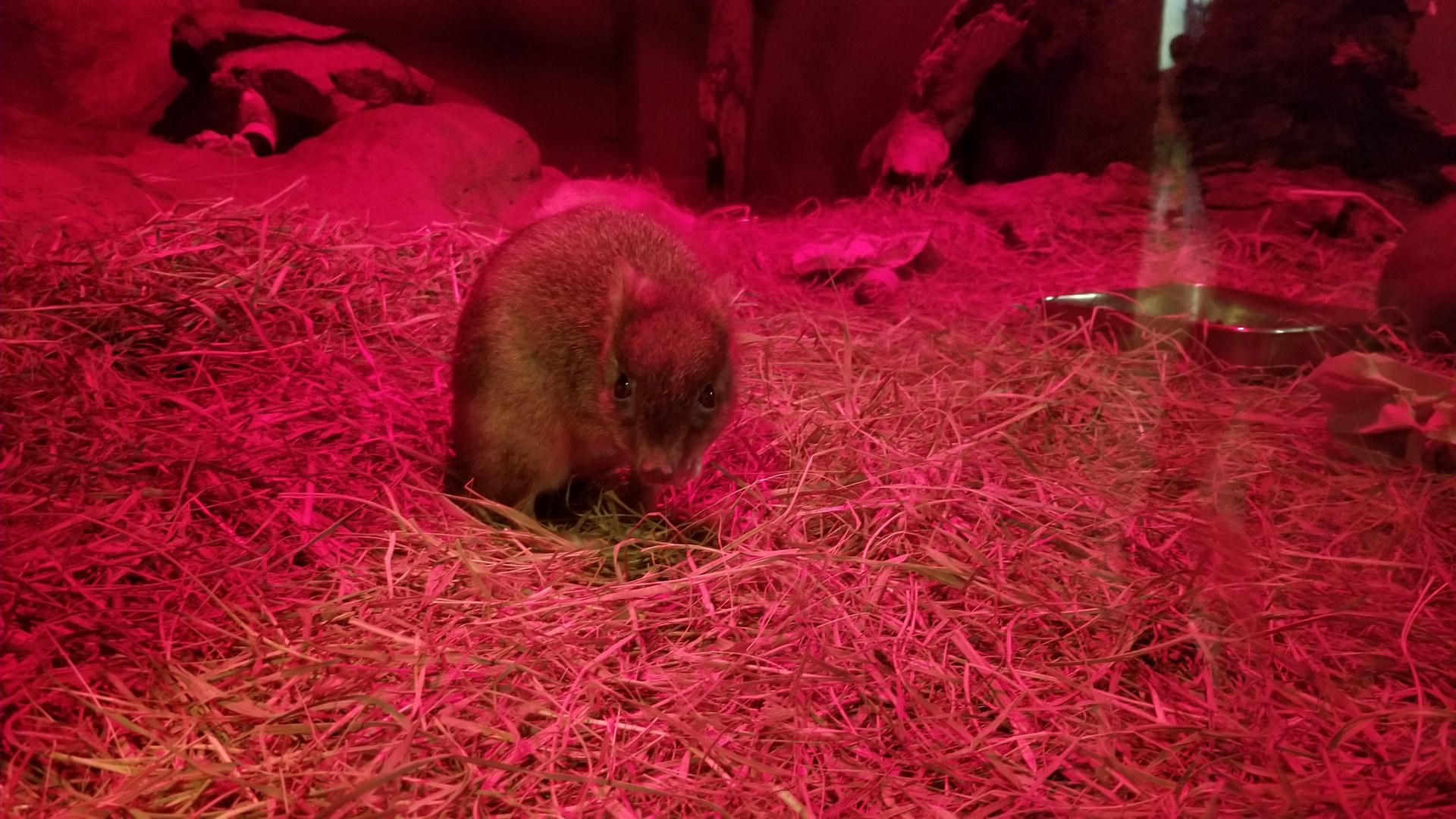
The brush tailed bettong

Ah I see, what is the name of your zoo ?

I'm really curious to know more about it and see what species you keep.

That is a shame but it does seem to me (it might be a pretty superficial assesment though as I am only seeing it from the outside) that there is a lot more public concern for endangered species within Australia and that there is quite a strong support for their conservation.

I suppose it shouldn't come as a suprise that the average Australian may not know the names or habits of all of the native mammals as there are just so many marsupials species out there.

Yes, could be, but they do sound like very talented escape artists which is quite interesting to learn.
Moonlit Sanctuary Wildlife Conservation Park

Most Australians are familiar with the brushtail and ringtail possums that live in the suburbs, and the "big five", kangaroos, koalas, wombats, devils and dingoes. They would have an awareness of a variety of other animals but would be very sketchy about what the are and what they are like.
 
Moonlit Sanctuary Wildlife Conservation Park

Most Australians are familiar with the brushtail and ringtail possums that live in the suburbs, and the "big five", kangaroos, koalas, wombats, devils and dingoes. They would have an awareness of a variety of other animals but would be very sketchy about what the are and what they are like.

Brilliant ! I will definitely check this out !

Of course the "big five" that you mention are interesting but for me personally it is the smaller and more obscure marsupials that have really grabbed my attention recently.
 
Have you begun your own zoo ? If so what animals do you currently work with ?


When you say the "private trade" do you mean that this species is being kept as a pet in the US ?

I don't own my own zoo. In two months I'll be able to get the licensing to be able to do my own educational outreach programs.

By private trade, I mean any zoos that aren't AZA-accredited facilities. This would include individuals being kept as pets. I don't think they're typically kept as pets, though.
 
I don't own my own zoo. In two months I'll be able to get the licensing to be able to do my own educational outreach programs.

By private trade, I mean any zoos that aren't AZA-accredited facilities. This would include individuals being kept as pets. I don't think they're typically kept as pets, though.

That is brilliant to hear @EsserWarrior ! I wish you the best of luck in this and I'm sure you will do this wonderfully ! Environmental education outreach programs are a very important aspect of conservation.
 
That is really depressing that such an incredible and critically endangered species is languishing in crappy road side zoos.

The word 'roadside zoo' is an unfair term used to describe privately owned and little to no funding at a zoo. it would not be fair to put wonderful places such as Darling Downs Zoo or Halls gap under the category of 'roadside zoo', as these places almost entirely survive on their own income, the only money they receive from government are for conservation programs or stimilus packages. Yes there are also a lot of terrible 'roadside zoos' as well namely Phillip Island Wildlife park. Although in an American context that Birdsandbats is implying might be different as I don't know the quality of 'roadside zoos' over there.

Brilliant ! I will definitely check this out !

Of course the "big five" that you mention are interesting but for me personally it is the smaller and more obscure marsupials that have really grabbed my attention recently.

Moonlit is a great place, collection wise it's a little mainstream (although still one of the best in Victoria) but their outstanding exhibitry more than makes up for that (except that emu enclosure).

I have a couple reviews about it, there are photos in the gallery and Moonlit has a decent website and great interactive facebook page, so there are plenty of places to look for information.
 
The word 'roadside zoo' is an unfair term used to describe privately owned and little to no funding at a zoo. it would not be fair to put wonderful places such as Darling Downs Zoo or Halls gap under the category of 'roadside zoo', as these places almost entirely survive on their own income, the only money they receive from government are for conservation programs or stimilus packages. Yes there are also a lot of terrible 'roadside zoos' as well namely Phillip Island Wildlife park. Although in an American context that Birdsandbats is implying might be different as I don't know the quality of 'roadside zoos' over there.


Moonlit is a great place, collection wise it's a little mainstream (although still one of the best in Victoria) but their outstanding exhibitry more than makes up for that (except that emu enclosure).

I have a couple reviews about it, there are photos in the gallery and Moonlit has a decent website and great interactive facebook page, so there are plenty of places to look for information.
To help you understand what I mean by a "roadside zoo" here in America, it might help to read through this thread: Snowleopard's 2018 Road Trip
 
The word 'roadside zoo' is an unfair term used to describe privately owned and little to no funding at a zoo. it would not be fair to put wonderful places such as Darling Downs Zoo or Halls gap under the category of 'roadside zoo', as these places almost entirely survive on their own income, the only money they receive from government are for conservation programs or stimilus packages. Yes there are also a lot of terrible 'roadside zoos' as well namely Phillip Island Wildlife park. Although in an American context that Birdsandbats is implying might be different as I don't know the quality of 'roadside zoos' over there.


Moonlit is a great place, collection wise it's a little mainstream (although still one of the best in Victoria) but their outstanding exhibitry more than makes up for that (except that emu enclosure).

I have a couple reviews about it, there are photos in the gallery and Moonlit has a decent website and great interactive facebook page, so there are plenty of places to look for information.

Ah yes, but I meant "roadside zoos" specifically in the context of these places in the USA and wasn't really thinking about Australia when I wrote that as I assumed birds and bats was talking about US roadside zoos.

I'm going to check these out , I'm just impressed that there is a zoo out there that features bettongs in an environmental education / conservation in action talk. They are evidently not exactly the most well known marsupial and hopefully these events do bring more attention to these incredible little mammals.

Me too, which is one reason why I started Moonlit.

It seems like a brilliant place, I'm very impressed with the work that you are doing.
 
Last edited:
The word 'roadside zoo' is an unfair term used to describe privately owned and little to no funding at a zoo. it would not be fair to put wonderful places such as Darling Downs Zoo or Halls gap under the category of 'roadside zoo', as these places almost entirely survive on their own income, the only money they receive from government are for conservation programs or stimilus packages. Yes there are also a lot of terrible 'roadside zoos' as well namely Phillip Island Wildlife park. Although in an American context that Birdsandbats is implying might be different as I don't know the quality of 'roadside zoos' over there.

This is not what a roadside zoo is. It's more when you have a tiny, privately owned and operated zoo with a high percentage of terrible enclosures housing mostly species readily available in the private trade. These are usually places you've never heard the name of, or have heard it in a bad context. These places almost always exist purely as a hobby of the owner or, more often, as a tourist trap to turn a profit quick.

~Thylo
 
This is not what a roadside zoo is. It's more when you have a tiny, privately owned and operated zoo with a high percentage of terrible enclosures housing mostly species readily available in the private trade. These are usually places you've never heard the name of, or have heard it in a bad context. These places almost always exist purely as a hobby of the owner or, more often, as a tourist trap to turn a profit quick.

~Thylo

Yep thats the sense that I meant it in and I imagine that birds and bats did too.

A lot of brilliant zoos (probably the majority) start out from very rustic and humble origins and thats ok but I tend to think of "roadside zoos" within the US context as being the worst of the worst and purely profit driven.
 
That is brilliant to hear @EsserWarrior ! I wish you the best of luck in this and I'm sure you will do this wonderfully ! Environmental education outreach programs are a very important aspect of conservation.

I believe that educational outreach programs can be just as - if not more - important as zoos when it comes to sparking a passion for wildlife conservation in people. Being able to close to the animals and getting a personal experience learning about/interacting with the animals allows them to appreciate all kinds of animals - even if they're not massive exotic animals - and it also allows me to teach people how to properly care for their companion animals.
 
I believe that educational outreach programs can be just as - if not more - important as zoos when it comes to sparking a passion for wildlife conservation in people. Being able to close to the animals and getting a personal experience learning about/interacting with the animals allows them to appreciate all kinds of animals - even if they're not massive exotic animals - and it also allows me to teach people how to properly care for their companion animals.

Yes, you are definitely right about that!

It is all about facilitating that emotional connecting to living wild animals and winning hearts and minds to the cause of conservation.

I would actually say that we need more educators and outreach programs that work specifically with the smaller, neglected and "obscurer" (for want of a better word) species like the brush tailed bettong for example rather than large "charismatic" exotics ( but then again I do have this bias towards / in favour of the smaller species).

By the way it would be brilliant if you do eventually have a bettong for this kind of work (and are able to contribute to their conservation).
 
Last edited:
Yes, you are definitely right about that!

It is all about facilitating that emotional connecting to living wild animals and winning hearts and minds to the cause of conservation.

I would actually say that we need more educators and outreach programs that work specifically with the smaller, neglected and "obscurer" (for want of a better word) species like the brush tailed bettong for example rather than large "charismatic" exotics ( but then again I do have this bias towards / in favour of the smaller species).

By the way it would be brilliant if you do eventually have a bettong for this kind of work (and are able to contribute to their conservation).

The only problem with educational programs is that we often risk losing our careers from bans on traveling animal acts. Many of these acts are formed to try and stop things like circuses, but they're too vague in their descriptions and don't exclude things like educational outreach programs. It's extremely stressful when you constantly have things threatening the legality of your future career!
 
The only problem with educational programs is that we often risk losing our careers from bans on traveling animal acts. Many of these acts are formed to try and stop things like circuses, but they're too vague in their descriptions and don't exclude things like educational outreach programs. It's extremely stressful when you constantly have things threatening the legality of your future career!

Yes, true, I don't doubt that there are difficulties to this kind of work.

Even so there are always obstacles in any aspect of conservation and environmental education / outreach is no exception.

If you persist and face these challenges head on I'm sure you will become a successful educator and be able to make your impact.
 
There's about 25 zoos in the USA with the species, a fairly even mix of AZA and non-AZA establishments. I've seen them at Smithsonian, where they have a fairly well-lit nocturnal exhibit in the small mammal house.


Three places in the USA have northern bettong, all non-AZA. One possibly has eastern/Tasmanian bettong.
 
There's about 25 zoos in the USA with the species, a fairly even mix of AZA and non-AZA establishments. I've seen them at Smithsonian, where they have a fairly well-lit nocturnal exhibit in the small mammal house.


Three places in the USA have northern bettong, all non-AZA. One possibly has eastern/Tasmanian bettong.

Great shot !

That is quite a lot of zoos that hold them.
 
Back
Top