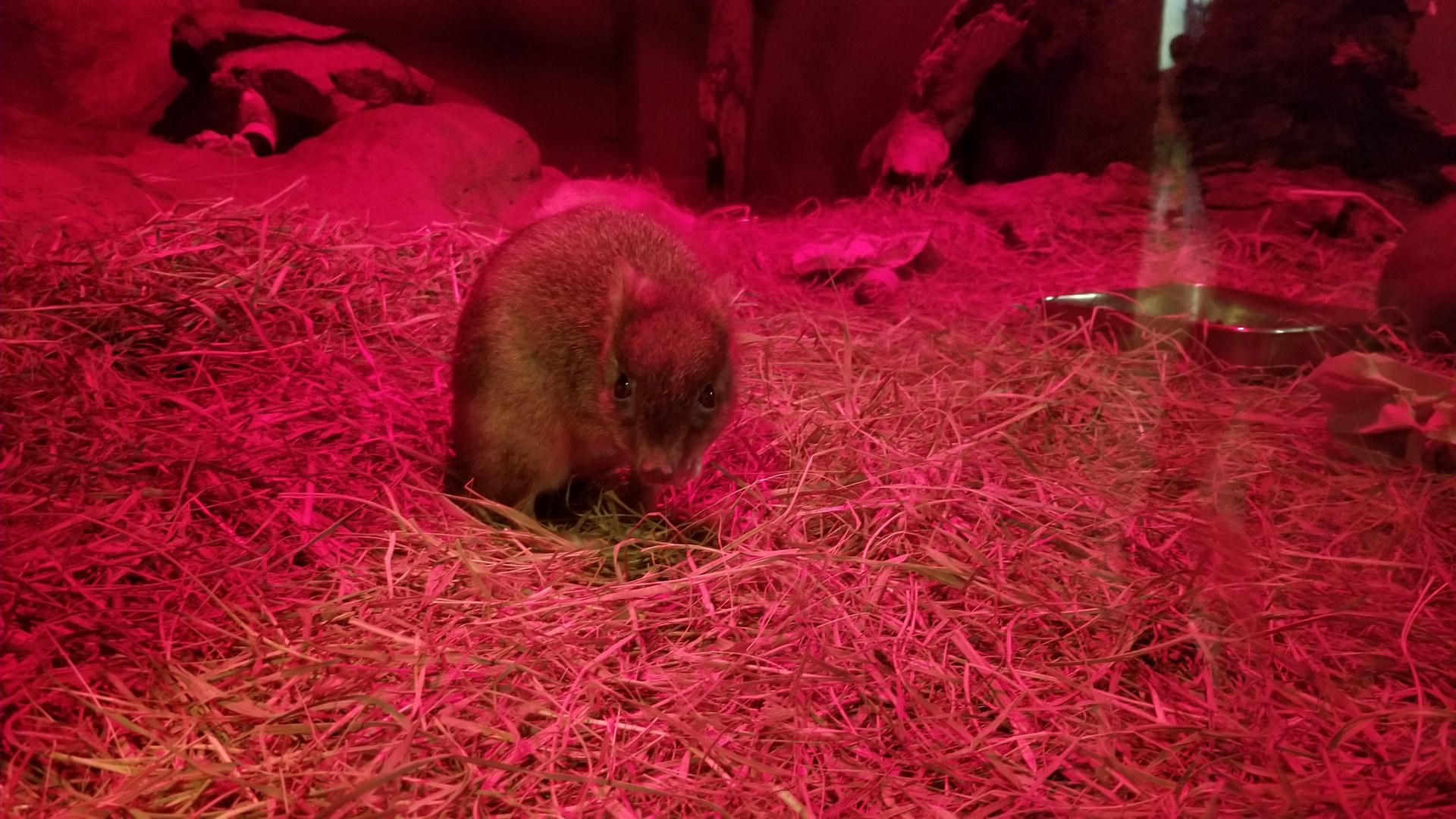
The brush tailed bettong

That is a brilliant shot @gentle lemur ! I think they are really quite a photogenic animal despite their shyness / skittishness.

What is their enclosure like at Shaldon in your opinion ?

In the caption to your photo you mention that these are kept with lemurs which is quite an interesting mix.
Thank you. It's not the greatest image, but I really struggled to get it. The woylie enclosure is not marked on the little map on the Shaldon website, but it is at the northern end of zoo's site, next to the indoor part of the squirrel monkey exhibit, and on the other side of the path from the meerkats. From memory, I would estimate that it is about 2.5 metres wide and the viewing points are at least 4 m from the rear wall. The keeper's area is wired off on the right hand side with a door into the monkey exhibit too. As the photo shows, it is furnished with straw, logs and and branches plus several nestboxes stuffed with straw and at least two food bowls and water dishes, with the incongruous stepladder I mentioned in the caption (I presume it was temporary for some work in the enclosure). The enclosure is so dark and the rear part has so many twiggy branches, that I couldn't see much of the back of the enclosure, but there may have more boxes there, presumably including at least one small, high one for mouse lemur(s). I certainly saw one lemur bouncing around rapidly, but I think there may well be more: an unusual combination perhaps, but not inappropriate.
 
There's about 25 zoos in the USA with the species, a fairly even mix of AZA and non-AZA establishments. I've seen them at Smithsonian, where they have a fairly well-lit nocturnal exhibit in the small mammal house.


Three places in the USA have northern bettong, all non-AZA. One possibly has eastern/Tasmanian bettong.

There's going to be way more than 25 zoos with Woylie, and as @Chlidonias said it's highly unlikely any other bettong species are present in the US. I know of potorro potentially still being at GPZ but that's it.

~Thylo
 
Sorry for being late to the party! I wanted to share my experience(s) of seeing and not seeing brush-tailed bettongs!

I visited two German zoos on two consecutive days two years ago, both holding brush-tailed bettong. I was really hoping to see them at Opel Zoo, but as it recently snowed when I visited, only the red kangaroos they share an enclosure with were visible. No worries, I think to myself, I just hope I'll see the one at Tierpark Donnersberg tomorrow. Luckily I did see it, but only after speaking with the keeper with my limited German, who encouraged it to come out of its box. It was in a dark area of an indoor enclosure, so my choices of photography were very limited, but I got some very grainy shots of what looked like a shrunken rat-like kangaroo or wallaby, very different to the long-nosed potoroos I've seen before, but still unmistakably related.

To answer one of @Onychorhynchus coronatus 's questions at the start of this thread, yes, I'd love to see more of these interesting creatures in zoos, especially seeing as they are critically endangered in the wild and we need as many woylies as we can get!
 
Thank you. It's not the greatest image, but I really struggled to get it. The woylie enclosure is not marked on the little map on the Shaldon website, but it is at the northern end of zoo's site, next to the indoor part of the squirrel monkey exhibit, and on the other side of the path from the meerkats. From memory, I would estimate that it is about 2.5 metres wide and the viewing points are at least 4 m from the rear wall. The keeper's area is wired off on the right hand side with a door into the monkey exhibit too. As the photo shows, it is furnished with straw, logs and and branches plus several nestboxes stuffed with straw and at least two food bowls and water dishes, with the incongruous stepladder I mentioned in the caption (I presume it was temporary for some work in the enclosure). The enclosure is so dark and the rear part has so many twiggy branches, that I couldn't see much of the back of the enclosure, but there may have more boxes there, presumably including at least one small, high one for mouse lemur(s). I certainly saw one lemur bouncing around rapidly, but I think there may well be more: an unusual combination perhaps, but not inappropriate.

It sounds like a pretty decent enclosure and the picture is neither too bad and seems to have been worth the challenges to get ;).

I think it is definitely a good combination of animals in husbandry terms. However, there is an admittedly pedantic part of me that definitely prefers to see animals from the same region / habitat mixed together in enclosures at zoos :rolleyes:.

For example, I have to admit that I would much rather see the Malagasy giant jumping rats at ZSL mixed with aye-aye or mouse lemur than with galagos. I suppose with the bettong it would be great to see them with a distinct looking marsupial species or perhaps a bird of some kind native to the same woodland / scrubland habitat.
 
Sorry for being late to the party! I wanted to share my experience(s) of seeing and not seeing brush-tailed bettongs!

I visited two German zoos on two consecutive days two years ago, both holding brush-tailed bettong. I was really hoping to see them at Opel Zoo, but as it recently snowed when I visited, only the red kangaroos they share an enclosure with were visible. No worries, I think to myself, I just hope I'll see the one at Tierpark Donnersberg tomorrow. Luckily I did see it, but only after speaking with the keeper with my limited German, who encouraged it to come out of its box. It was in a dark area of an indoor enclosure, so my choices of photography were very limited, but I got some very grainy shots of what looked like a shrunken rat-like kangaroo or wallaby, very different to the long-nosed potoroos I've seen before, but still unmistakably related.

To answer one of @Onychorhynchus coronatus 's questions at the start of this thread, yes, I'd love to see more of these interesting creatures in zoos, especially seeing as they are critically endangered in the wild and we need as many woylies as we can get!

Great to hear more personal experiences with this species Mo !

The cryptic hiding away type behaviour of the woylie and the difficulty of photographing them in zoos seems to be quite a commonly mentioned experience with zoochatters regarding this species.

It is certainly interesting for me to read this because I don't think I've ever come across this species in a zoo (unless they were kept in Bristol during the time of my visit many years ago and in any case I don't remember seeing any).

I totally agree ! Lets hope that this species becomes more common in zoos around the world as the species definitely needs more ex-situ attention and I would definitely like to see one in the future as they are fascinating.
 
There's going to be way more than 25 zoos with Woylie, and as @Chlidonias said it's highly unlikely any other bettong species are present in the US. I know of potorro potentially still being at GPZ but that's it.

~Thylo

One of the places is the only US holder of three-striped palm civet, one of the first two holders of pale fox, and one of the first holders of Geoffroy's cat. They also have brush-tailed.
Another is North Georgia Wildlife Park. I can't find a photo, but they do have some less common small mammals.
And here's the third: Log into Facebook | Facebook

The Eastern/Tasmanian would be at Tennessee Safari Park, which I do find unlikely.

As for Woylie, feel free to add anywhere I'm missing from my rough list:
Animal Edventures
Animal Wonders Inc
Birmingham Zoo
Bridges For Brain Injury
Capron Park Zoo
Cleveland Metroparks Zoo
Columbus Zoo
Cub Creek Science Camp
Darby Acres Farm/Safari*
Frankin Drive-Thru Safari*
Gladys Porter Zoo
Lake Superior Zoo
Lincoln Park Zoo
Los Angeles Zoo
Oak Creek Zoological Conservatory
Pacific Animal Productions
Potawatomi Zoo
Prospect Park Zoo
San Diego Zoo, Safari Park?
Smithsonian National Zoo
Wildlife Encounter Ecology Center
Wildlife World Zoo
Wowee Wildlife

Asterisks are unconfirmed.
 
One of the places is the only US holder of three-striped palm civet, one of the first two holders of pale fox, and one of the first holders of Geoffroy's cat. They also have brush-tailed.
Another is North Georgia Wildlife Park. I can't find a photo, but they do have some less common small mammals.
And here's the third: Log into Facebook | Facebook

The Eastern/Tasmanian would be at Tennessee Safari Park, which I do find unlikely.

As for Woylie, feel free to add anywhere I'm missing from my rough list:
Animal Edventures
Animal Wonders Inc
Birmingham Zoo
Bridges For Brain Injury
Capron Park Zoo
Cleveland Metroparks Zoo
Columbus Zoo
Cub Creek Science Camp
Darby Acres Farm/Safari*
Frankin Drive-Thru Safari*
Gladys Porter Zoo
Lake Superior Zoo
Lincoln Park Zoo
Los Angeles Zoo
Oak Creek Zoological Conservatory
Pacific Animal Productions
Potawatomi Zoo
Prospect Park Zoo
San Diego Zoo, Safari Park?
Smithsonian National Zoo
Wildlife Encounter Ecology Center
Wildlife World Zoo
Wowee Wildlife

Asterisks are unconfirmed.

That is a lot of zoos and hopefully they will be added to more of them in the future.

One of the places on the list "Animal Wonders Inc" was actually featured with a bettong used for educational talks on a Youtube popular science video I watched yesterday that I will post below.

I thought that the educator (and the bettong of course) did brilliantly in the interview and I learned some things that I didn't previously know about the species.

 
One of the places is the only US holder of three-striped palm civet, one of the first two holders of pale fox, and one of the first holders of Geoffroy's cat. They also have brush-tailed.
Another is North Georgia Wildlife Park. I can't find a photo, but they do have some less common small mammals.
And here's the third: Log into Facebook | Facebook

The Eastern/Tasmanian would be at Tennessee Safari Park, which I do find unlikely.

As for Woylie, feel free to add anywhere I'm missing from my rough list:
Animal Edventures
Animal Wonders Inc
Birmingham Zoo
Bridges For Brain Injury
Capron Park Zoo
Cleveland Metroparks Zoo
Columbus Zoo
Cub Creek Science Camp
Darby Acres Farm/Safari*
Frankin Drive-Thru Safari*
Gladys Porter Zoo
Lake Superior Zoo
Lincoln Park Zoo
Los Angeles Zoo
Oak Creek Zoological Conservatory
Pacific Animal Productions
Potawatomi Zoo
Prospect Park Zoo
San Diego Zoo, Safari Park?
Smithsonian National Zoo
Wildlife Encounter Ecology Center
Wildlife World Zoo
Wowee Wildlife

Asterisks are unconfirmed.
The problem we in Australia have with the idea of them being northern bettongs is that northern bettongs are an endangered species found over a restricted area in the far north of the country. To the best of my knowledge they have never been held by an Australian zoo (although there was a breeding colony associated with reintroduction programs that closed more than 10 years ago). To be exported legally they would have to be captive bred, going to an AZA zoo, and either entering an established breeding program or in numbers that would allow a program to be established.

So these animals are either:
a) Not northern bettongs or
b) Illegally poached from the wild then illegally smuggled out of Australia and illegally smuggled into the United States, either by one of the people/organisations you mention above or by a third party. Either way it does not reflect well on the people/organisations concerned.
 
b) Illegally poached from the wild then illegally smuggled out of Australia and illegally smuggled into the United States, either by one of the people/organisations you mention above or by a third party. Either way it does not reflect well on the people/organisations concerned.

I imagine that this must be an incredibly hard and almost futile thing to do though right ?
 
The problem we in Australia have with the idea of them being northern bettongs is that northern bettongs are an endangered species found over a restricted area in the far north of the country. To the best of my knowledge they have never been held by an Australian zoo (although there was a breeding colony associated with reintroduction programs that closed more than 10 years ago). To be exported legally they would have to be captive bred, going to an AZA zoo, and either entering an established breeding program or in numbers that would allow a program to be established.

So these animals are either:
a) Not northern bettongs or
b) Illegally poached from the wild then illegally smuggled out of Australia and illegally smuggled into the United States, either by one of the people/organisations you mention above or by a third party. Either way it does not reflect well on the people/organisations concerned.

I have no idea what their origins are. I provided all of the info I know about them.

Isn't the woylie critically endangered?
 
I have no idea what their origins are. I provided all of the info I know about them.

Isn't the woylie critically endangered?
As has been mentioned the woylie has been on a roller coast ride. Once endangered it recovered to be classified Least Concern by 1992 with populations in the hundreds of thousands. It then collapsed to become Vulnerable in 2002 and Critically Endangered by 2012 where it remains today. However there have for many years been large numbers in captivity, and can be kept privately is some Australian states. Like many arid-zone animals they do well in captivity. Therefore they are eligible for export to overseas zoos and have probably bred well after arrival.

Re the northern bettongs I understand you are reporting what you have been told, it just seems improbable.
 
As has been mentioned the woylie has been on a roller coast ride. Once endangered it recovered to be classified Least Concern by 1992 with populations in the hundreds of thousands. It then collapsed to become Vulnerable in 2002 and Critically Endangered by 2012 where it remains today. However there have for many years been large numbers in captivity, and can be kept privately is some Australian states. Like many arid-zone animals they do well in captivity. Therefore they are eligible for export to overseas zoos and have probably bred well after arrival.

Re the northern bettongs I understand you are reporting what you have been told, it just seems improbable.

Brilliant comment MRJ, very interesting, sad but also encouraging to read, I need to familiarise myself more with the history of this species conservation so apologies for my previous comment and its inaccuracies.
 
I imagine that this must be an incredibly hard and almost futile thing to do though right ?
If you have enough money anything is possible. It would be an expensive operation involving light aircraft from outback air strips, or perhaps a boat from an isolated beach, travelling north into Indonesia or PNG. Getting into the USA might be easier in that I'm guessing not many border guards would readily identify a bettong, let alone the species.
 
Last edited:
If you have enough money anything is possible. It would be an expensive operation involving light aircraft from outback air strips, or perhaps a boat from an isolated beach, travelling north into Indonesia or PNG. Getting into the USA might be easier in that I'm guessing not many border guides would readily identify a bettong, let alone the species.

I really can't imagine anyone doing that or going to those lengths to obtain this species (are small obscure marsupials as sought after on the black market as Australian birds or reptiles ?).

But I suppose in spite of the risks and strict laws within Australia there would be people who would attempt to illegally traffick the species if there was a market / demand for it and lucrative earnings to be made.
 
Last edited:
One of the places is the only US holder of three-striped palm civet, one of the first two holders of pale fox, and one of the first holders of Geoffroy's cat. They also have brush-tailed.
Another is North Georgia Wildlife Park. I can't find a photo, but they do have some less common small mammals.
And here's the third: Log into Facebook | Facebook

The Eastern/Tasmanian would be at Tennessee Safari Park, which I do find unlikely.
Neither species is even remotely likely. The three bettongs in question all look very similar, and I can say I am 100% confident that this is exactly the same situation as the "Mountain Coatis" or the "Leaf Muntjacs" which are traded in the USA.
 
To the best of my knowledge they have never been held by an Australian zoo (although there was a breeding colony associated with reintroduction programs that closed more than 10 years ago).
They have been kept in a few zoos (currently kept at Kuranda and Port Douglas), but yes they are certainly not going to have been exported into the US private trade.
 
I must admit that I knew very little about the northern bettong, so decided to do some reading. It turns out that it is closely related to the brush-tailed bettong and is considered by some authorities to be a subspecies or even a cline. They look almost exactly the same, so I increasingly believe that the supposed holders of northern bettongs in the US have simply misidentified their animals.
 
Yes, true, I don't doubt that there are difficulties to this kind of work.

Even so there are always obstacles in any aspect of conservation and environmental education / outreach is no exception.

If you persist and face these challenges head on I'm sure you will become a successful educator and be able to make your impact.

The potential ban on traveling animal acts is out of my control. Unless the legislature would be convinced to exclude educational outreach programs.. :confused: I don't believe there are enough candidates to do so.

A few of my friends - who are educators - have phased this species out of their programs, so I'm curious to see what the existing facilities with bettong do once their current individuals pass away. (Animal Wonders Montana only has one female. Animal Edvetures recently got their 1.1 pair. I'm not sure what Pacific Animal Productions has.)
 
The potential ban on traveling animal acts is out of my control. Unless the legislature would be convinced to exclude educational outreach programs.. :confused: I don't believe there are enough candidates to do so.

A few of my friends - who are educators - have phased this species out of their programs, so I'm curious to see what the existing facilities with bettong do once their current individuals pass away. (Animal Wonders Montana only has one female. Animal Edvetures recently got their 1.1 pair. I'm not sure what Pacific Animal Productions has.)
I think traveling animals acts will probably be safe in Wisconsin. I can only imagine the collective outrage the City of Baraboo would have otherwise!
 
So these animals are either:
a) Not northern bettongs or
b) Illegally poached from the wild then illegally smuggled out of Australia and illegally smuggled into the United States, either by one of the people/organisations you mention above or by a third party. Either way it does not reflect well on the people/organisations concerned.

It wouldn't be the first time the American private trade (and thence zoos buying animals from the private trade) labelled something more prosaic as something rare and exciting to get a higher price or to steal prestige :p just look at the fact that literally dozens of places claim to have Mountain Coati when they merely hold Ring-tailed Coati!
 
Back
Top