Part VII: Hoofstock And Highland
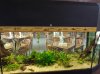
Whilst in the cafeteria I took the opportunity to have a look around the aquarium which is found within the building. Considering the location, it represented a rather solid array of taxa, with species such as Black-spotted Puffer (Arothron nigropunctatus) and Spotted Gar (Lepisosteus oculatus) found within. The food in the cafeteria was rather nice too, all things considered, with very generous portion sizes; anyone who has met me in person will know just how significant the quantity of food provided was when I say there was actually too much food for me to eat!
Once we had all eaten - discussing the thoughts of myself and Hel about the collection so far, Doctor Who and my shaky ability at speaking German as we did so - we decided we would fill in one or two parts of the collection we had bypassed so far, before making our way towards the gazelle and antelope paddocks via the giraffe house. As such, we made our way to the lemur area which is found near the hyena enclosures opposite the elephant house.
We first entered the walkthrough portion of the enclosure, which held a combination of Red Ruffed Lemur (Varecia rubra) and Pied Ruffed Lemur (Varecia variegata variegata) - although I would be inclined to worry that the two species were at risk of interbreeding, as they so often did in captivity prior to their specific separation becoming apparent, I was seriously impressed by this area. It gives plenty of space for the species kept within, and they are capable of getting some way from the public; always an important facet of walkthrough enclosures in my opinion. That said, the lemurs came very close to us! Further along from the walk-through was the lemur island itself, which the two ruffed lemur taxa shared with Mongoose Lemur (Eulemur mongoz) and accessed via a log bridge from their indoor housing. Something which really does warrant mention here, and which particularly caught my attention, was the fact that the lemur housing was clad in genuine rockwork to make it look like a cliff; this could so easily have been achieved with mock-rock and the fact this easy route was not taken rather impressed me. Much as with the lemur forest walkthrough, the lemur island was a high quality enclosure which had been pulled off well - and yet it was an enclosure I had heard little to nothing about before my visit, which I rather think speaks a lot for what most people tend to discuss when speaking of Tierpark.
Whilst in the area, we popped back over to the hyena area in order to have a look at the Spotted Hyena (Crocuta crocuta) enclosure, which we had bypassed previously. This was somewhat larger than the enclosures given to the other hyena species we had seen so far at Tierpark, being roughly twice the size of the enclosures for Aardwolf or Brown Hyena and rather more vegetated than either. The animals within the enclosure were pretty active for the species, and I rather enjoyed being able to watch the hyenas at length; my previous experience with this species, at Colchester, having more or less consisted of watching two sleeping animals, with one waking for a short time to be fed. Next to the Spotted Hyena enclosure was an enclosure for Chinese Dhole (Cuon alpinus lepturus), a species I always enjoy seeing due to their high level of activity, unusual appearance and tendency to vocalise in rather un-canid like fashions. The enclosure was quite large, and the inhabitants looked a little less fox-like than those dhole I had seen in the past - something I suspect may have been due to the age of the animals, as I seem to recall they get darker and more grizzled with age.
Having seen these enclosures, we made our way towards the giraffe house. Before reaching the house itself, we passed the heavily-wooded enclosure for one of the real treasures of the collection; a group of Southern Mountain Reedbuck (Redunca fulvorufula fulvorufula) which I observed for some time. I rather suspect a lot of people either forget this species are held at the collection, or do not realise just how unusual they are - something I might easily have done myself, were it not for the fact my interest in antelope and gazelle taxa, along with caprine hoofstock, has seen a substantial increase in the past year or two. As such, I was rather looking forward to the next few areas of Tierpark Berlin.
The giraffe house at Tierpark Berlin, which we now entered, provided a solid, relatively good indoor enclosure for the inhabitants - which on the day in question were all found in their extensive outdoor paddocks. All things considered, I actually felt it was a shame that the housing and paddocks were being taken up by non-subspecific hybrid giraffes which by all accounts are somewhat inbred at this point in time; a relic, I am told, of the fact that one of the few things that both Berlin collections were unable to source and transport during the Cold War were pure giraffes. I fear, however, that this is a state of affairs unlikely to change any time in the near future, as there are precious few collections willing to take surplus giraffe individuals at the best of times, never mind surplus hybrids. As such, even if the new management in Berlin wished to obtain pure giraffe individuals, they would likely have trouble dealing with their current stock.
We were very interested, whilst in the giraffe house, to investigate the recent arrivals which are now onshow in a small display there - a breeding group of Naked Mole Rat (Heterocephalus glaber) which arrived at the end of 2013 and have already bred with some alacrity. When we visited, we were able to see the queen of the group surrounded by a great deal of newborn larvae. It is a strange experience indeed to realise that an adult Naked Mole Rat looks positively normal when compared to the young of the species!
Having exited the giraffe house, we investigated the enclosure opposite, which held Ellipsen Waterbuck (Kobus ellipsiprymnus ellipsiprymnus); overall, I think this is the waterbuck taxon I prefer, out of the two I have seen. Of course, this species - which elsewhere would be one of the highlights - rather pales in comparison with some of the other species in this area of the Tierpark! The enclosure, as with all of the hoofstock paddocks I had seen thus far at Tierpark, was a reasonably good size and seemed okay for the species within. The next enclosure which we reached was a sizeable one, containing a mix of Mhorr Gazelle (Nanger dama mhorr) and Addax (Addax nasomaculatus) - although the two species were keeping well apart from one another when we were observing them. I was particularly pleased to see the Mhorr Gazelle, as the last individuals of this taxon at Woburn Safari Park left the collection prior to my first visit last year. My satisfaction was also influenced by the fact I saw the closely related Nubian Red-necked Gazelle at Marwell in 2013, and as such can now compare the two taxa from personal experience - I was rather struck by how the Mhorr, in many ways, represents a diametric colour-swap of the Red-necked with the general morphology of the two remaining largely similar. At this point, we were also able to see the paddock for Watusi cattle through the gazelle enclosure; a portion of the zoo which we had not, at that point, passed through.
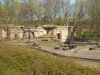
The next two enclosures rather broke with the overall theme of gazelle and antelope paddocks, with one being rather better than the other. First was a sizeable enclosure for Barbary Macaque (Macaca sylvana) which was apparently designed to look like a ruined temple of some description, and which held a large and very active group of macaques, whilst the second enclosure was an aviary for Waldrapp (Geronticus ermitica). Although there was nothing actually wrong with the latter of these enclosures, it seemed a bit out-of-place and much like many other Waldrapp aviaries I have seen in the past - conversely, whilst the macaque enclosure was also arguably out of place among gazelle enclosures, somehow it looked *right* in a way the ibis enclosure had not. The fact that it provided something a little different from the norm certainly helped, and my regard for the enclosure was increased further when my German companions informed me that the artificial ruins within had been entirely constructed from rock and masonry from the ruined buildings of post-war Berlin. An enclosure with such an unorthodox yet fitting background deserves, I feel, more recognition.
We next came to an enclosure with a sizeable group of Arabian Oryx (Oryx leucoryx), a species of which I am rather fond and which normally I would pay a great deal of attention to - but these were immediately next to the paddock for a species which far and away cast these, and even the Mountain Reedbuck, into the shade; Southern Gerenuk (Litocranius walleri walleri). These very attractive gazelle arrived at the Tierpark in the summer of 2013, the first of their species in Europe since the 1970's, and represent a species I had never dreamed I would actually see. I had heard they were incredibly skittish, quite delicate, and apt to inadvertently kill themselves if startled, so I had only half-believed the 2,2 animals would survive until my visit. However, my fears were unfounded, as all four animals are still alive now and - if my observations are anything to go by - seemed a lot more relaxed and calm being onshow than I had expected.
Two of our German companions - Sven and Katja - observed at this point that they would have to leave the Tierpark in an hour or two. As such, we decided our immediate plan of action would be to visit the "highland" area of Tierpark, before slowly making our way towards the exit to bid farewell to the pair.
As we headed towards the start of the highland area, we passed a cattle house with two large paddocks - one containing Cape Buffalo (Syncerus caffer caffer) and the other containing Congo Buffalo (Syncerus caffer nanus), thus providing the chance for myself and Hel to visually compare the two subspecies at close range, not to mention see the former taxon for the first time. Although the two taxa look rather similar at first glance, when seen in close proximity to one another it was quite obvious that the Cape Buffalo was significantly larger and more robust than its cousin.
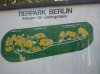
We started to make our way up the hill to the start of the collection of highland species; this was split into two geographic segments, Asian and European, with plans to expand the area to encompass an American segment in the future - something which the Tierpark already discusses on a notice board in this area. However, my companions were rather pessimistic, considering the lack of funds and the change in management, about the prospect of this development actually taking place. Our route around the highland area was to take us around the Asian area first, before looping around the European segment. However, my companions counselled that we omit one section of the European segment - a path cutting through the centre towards a Raven (Corvus corax) enclosure - as it would entail a further uphill climb for a species they correctly assumed I was very familiar with already. As such, I took this counsel gladly.
The Asian segment of the highland area contained the following species as we walked along in a clockwise route:
Ural Owl (Strix uralensis)
White-lipped deer (Cervus albirostris)
Transcapian urial (Ovis vignei arkal)
Chinese goral (Naemorhedus griseus arnouxianus)
Marco Polo sheep (Ovis ammon polii)
Tajik markhor (Capra falconeri heptneri)
Altai lynx (Lynx lynx wardi)
Northern blue sheep (Pseudois nayaur szechuanensis)
Sichuan takin (Budorcas taxicolor tibetana)
Steller's sea eagle (Haliaeetus pelagicus)
The European segment of the highland area contained the following species as we once again walked in a more-or-less clockwise fashion:
Alpine Ibex (Capra ibex)
Snowy Owl (Bubo scandica)
European Wolverine (Gulo gulo gulo)
Alpine chamois (Rupicapra rupicapra rupicapra)
Eurasian elk (Alces alces alces)
European wildcat (Felis silvestris silvestris)
European mouflon (Ovis orientalis musimon)
Eurasian crane (Grus grus grus)
Bearded Vulture (Gypaetus barbatus barbatus)
As someone who holds the Highland Wildlife Park as one of his favorite collections, the range and diversity of species held in this part of the Tierpark - all in enclosures which struck me as very good for the species they held, if a little bland to the eye in some cases - was incredibly attractive to me. Indeed, many of the species in this area which were not new to me were so purely because I had seen them previously at said collection - but even so, the majority of species in the Asian area particularly were entirely new to me. It struck me as somewhat ironic that in any other collection, the Marco Polo Sheep would be deemed a star attraction head and shoulders over the other hoofstock held there - but here, it is only one of many such stars in the highland area alone. One individual which, I believe, deserves particular note is the breeding female Steller's Sea Eagle, who is an example of the unusual "black" colour-morph which until the early 2000's was so little-known it was held to be an extinct subspecies of the eagle. In point of fact, it was the birth of this female to two wild-caught adults with the usual colouration which both proved the black Steller's was extant, and was merely a recessive colour morph.
It is, I feel, something of a shame that it is unlikely the American extension will come to pass; there is, I believe, more than enough space for this extension to take place, and as many of the species intended for the area are already in the collection such a development would help to free up space elsewhere in the Tierpark for enclosures to be expanded and improved. Dismissing all other species for a moment, were the Missouri Cougar to be relocated here as planned this would provide that much more room in the Alfred-Brehm Haus - something which I am sure no one could contest would be a bad thing. Even without this extension, of course, the highland area of Tierpark Berlin is certainly one of the world-class facets of the collection, both for the species it holds and the overall design and layout of the area. Other than the aforementioned Highland Wildlife Park, I suspect the only real rival for an exhibit like this would be presented by Alpen Zoo - which in point of fact, my German companions strongly urged I visit upon seeing my enjoyment of this area of Tierpark. This is, of course, something I certainly intend to do.
After a brief rest, we made our way down the hill, and towards the Monkey House.
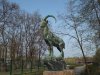
Attached are images of one enclosure from the aquarium in the zoo cafeteria, the Barbary Macaque enclosure, a statue of an Ibex in the highland area, and a sign talking about plans for the proposed "American" extension to the highland area.