Part IV: Gondwanaland: Introduction, Volcano Tunnel and South America
In order to cover Gondwanaland, which for all intents and purposes is the centrepiece of Zoo Leipzig, it is probably wisest to divide this account into three sections; first I shall give a little background information on the house, before then giving a walkthrough account of our time in Gondwanaland before finally offering my final thoughts and opinions on the house as a whole.
Opening in July 2011, the Gondwanaland tropical house at Zoo Leipzig is one of the six themed areas which form the "Zoo Of The Future" masterplan which has been underway at the collection since 2000. Constructed along the lines of "immersion" exhibits from the USA such as Lied Jungle at Omaha's Henry Doorly Zoo, and one of the largest such tropical houses in the world, Gondwanaland is intended to emulate the natural habitat of taxa from the various regions of the world which once partially comprised the Gondwana supercontinent. As such, the house comprises four distinct sections; a "Primeval Volcano Tunnel" intended to represent primitive taxa similar to those present on the supercontinent millions of years ago, followed by South American, African and finally Asian walkthrough exhibits. This means that one tropical biome once part of Gondwana - Australia - is not represented whatsoever, barring those taxa held within the volcano tunnel. More interesting, however, is the presence of an Asian biome when one considers that barring the Indian subcontinent, this continent was not part of Gondwana, rather being part of the northern supercontinent Laurasia. The lack of any Antarctic taxa, naturally, can be excused

Of the 27,000 sq. metres covered by the Gondwanaland house as a whole, the public portion of the house comprises roughly 16,500 sq. metres, the vast majority of this comprising the central tropical hall. The main path running through the three zones reaches an approximate length of 650 metres, with an additional 90 metres forming a loop running to and from a high viewing point at the centre of the hall via suspension bridges. Officially speaking, the central hall is said to be kept at a constant temperature of roughly 28°C, with humidity varying between 65-75% depending on external factors - this is largely intended to maintain the vast amount of trees and other vegetation planted throughout the house, the vast majority of which are native to the regions represented. However, I rather suspect that the true figure for both the temperature and humidity levels is rather higher.
Before entering Gondwanaland, having been warned by other Zoochatters about the extreme heat and humidity, and the lack of anywhere to purchase refreshments once we had started making our way around the house, we each retrieved bottles of water from our bags which we had packed for this express purpose and placed them into pouches on the exterior of our rucksacks for ease of access. We then made our way into the "Volcano Tunnel", the first area of the house which we would pass through and the only one not tied to a specific geographic location. Rather, it contained a selection of taxa from throughout the landmasses which once comprised Gondwana which are close in morphology to some of the animals which had lived during the time of the supercontinent, many of which are from zoological groups described by some as "living fossils". As the name would suggest, this portion of the house was designed to resemble an empty and cooled magma tunnel, dimly lit in places and with projected images of cool solidified lava on the floor, which presumably were tied into pressure or vibration sensors which would "melt" the lava as it was walked on, before cooling once again. Various tanks and enclosures were dotted throughout the walls.
The first such tank contained two fish taxa belonging to the Centrarchidae;
Pumpkinseed Sunfish (
Lepomis gibbosus) and
Flier (
Centrarchus macropterus), something which struck me as doubly-unusual. Firstly, these fish belonged to a group which is very recent in geological terms, having arisen in the Miocene period over 100 million years after the breaking of Gondwana. Secondly, and perhaps even more importantly, this group is - and always has been - restricted to North America, which geologically was never part of Gondwana, having been part of the northern supercontinent Laurasia. Considering the vast amount of emphasis given in both the zoo guidebook and the guidebook devoted to Gondwanaland to the fact that this area was devoted to "living fossils" representing taxa present on Gondwana itself, this did not strike me as a good start! The only saving grace was the presence of a third taxon,
Spotted Gar (
Lepisosteus oculatus); although again belonging to a group restricted to North America, in this particular case the presence of gar can be justified through the fact that fossils attributable to this group have been found worldwide, and in rock dating back to the Early Cretaceous - roughly speaking, contemporaneous with the breakup of Gondwana.
The second tank, however, was much more suitable for the theme and setting of Gondwanaland; containing as it did
Eastern Long-necked Turtle (
Chelodina longicollis),
Australian Lungfish (
Neoceratodus forsteri),
McCullochs Rainbowfish (
Melanotaenia maccullochi) and
Duboulay's Rainbowfish (
Melanotaenia duboulayi), all of which are Australian endemics and as such suitable for the setting. Moreover, the turtle and lungfish are important representatives of groups which have remained near-unchanged for millions of years; in the case of the turtle, a Gondwanan-specific clade of turtles among the most basal of all chelonians. The taxonomic importance of the lungfish as representatives of the Sarcopterygii, and as such very akin to the progenitors of the first tetrapods, is further underlined by the fact that the next two tanks also contained examples of this group; first a tank containing
South American Lungfish (
Lepidosiren paradoxa), followed by a tank containing
West African Lungfish (
Protopterus annectens) and a species of
African Jewelfish (
Hemichromis letourneuxi). It was quite satisfying to see three different lungfish taxa in such close proximity; even moreso considering the fact the Australian taxon is somewhat unusual in captive collections. However, the display could have been better served by displaying one of the lesser-known African taxa, for instance Marbled or Slender, rather than the near-ubiquitous West African. However, this is just a minor point compared to my more well-founded reservations about the taxa displayed in the first tank of this area.
The final tank in this section contained
Mangrove Horseshoe Crab (
Carcinoscorpius rotundicauda), a south-east Asian taxon which I was quite pleased to see, as this represented a species of horseshoe crab which to my knowledge I had not seen previously. We then reached a mid-size enclosure, lightly dotted with vegetation and various logs and branches along with prolific use of mock rock, which contained a pair of young female
Komodo Dragon (
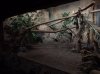
Varanus komodoensis); informational signage explained that they were, as yet, too young and small in size to risk mixing with the large adult male held elsewhere in Gondwanaland. Turning a corner from here, we came to a long dark corridor which was much-less well-lit when compared to the portion of the "Volcano Tunnel" we had walked through thus far.
The first, and largest, enclosure in this portion of the Volcano Tunnel was filled with numerous logs, branches, nestboxes and low-lying vegetation, and contained several
Eastern Quoll (
Dasyurus viverrinus) of both colour-morphs. Leipzig was the first European collection to hold this taxon since a single individual at Budapest passed away in 1993, the last survivor of a short-lived population which was found in a handful of collections over the prior decade or so, having imported six individuals from Melbourne Zoo in 2011. In the intervening time, the species has bred profusely and has been dispersed to a number of other European collections - however I fear that this population will prove as short-lived as the previous attempt, as the last of those individuals originally important have now passed away and no further imports have taken place. As such, if breeding falters at Leipzig - the only European collection currently holding the taxon to have successfully bred them thus far - the short lifespan inherent to dasyurid taxa and inbreeding depression is liable to cause the population to crash. This will be a shame, of course, as I have a fondness for dasyurid marsupials and feel they are under-represented in captive collections. The next enclosure contained
Pygmy Slow Loris (
Nycticebus pygmaeus); a nice neough taxon but one which, if I am to be honest, rather failed to keep my attention when compared with the taxa housed on other side. The Eastern Quoll I have of course already discussed, along with my distinct fondness for dasyurid taxa. This latter point rather came into play once again, as just beyond the Pygmy Slow Loris was a small and rocky glass-fronted enclosure which contained
Kowari (
Dasycercus byrnei), yet another member of this unusual group of carnivorous marsupials. As such I found myself flitting between the two enclosures holding these marsupials, in order to view both to my satisfaction. Pleasingly, both taxa were very active and visible; although the dim light conditions meant that I was unable to obtain particularly good photographs of either, I was entirely happy to content myself with viewing the animals scurry to and fro for a time. This portion of Gondwanaland did, at one point, contain a third taxon which would have attracted my attention to an equal or - possibly - greater extent; Virginia Opossum. However, the individuals held at Leipzig are long-since deceased, opossum taxa having an even more brief lifespan than dasyurids - as such the group is even more scarce in European collections than the latter group, and I have still never seen any opossum taxon
A pity, but there you go.
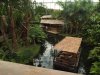
Soon, we emerged back into the light, and a wave of overwhelming heat and humidity hit us as we entered the "Mubaan Village" plaza, which marked both the start and end of the visitors footpath through the three geographic zone, and we finally got our first view of the tropical hall of Gondwanaland. At least, Chris did - the rest of us immediately had to remove our glasses to wipe away the sudden condensation which had formed, before we were able to view the hall ourselves. The plaza was designed to look like a south-east Asian village in terms of architecture, and contained a gift shop, restaurant and - most importantly for our needs - lockers in which we were able to place our excess bags and coats. This was also the point where, if we so chose, we would be able to embark upon the boat ride through the tropical hall - something which we decided we would leave until last before deciding whether to do so or not, as we thought it more prudent to prioritise making our way around Gondwanaland on foot. There was a great deal of vegetation dotted throughout the village, with more visible as far as our eyes could see; the overwhelming sound was the roaring of the waterfall present at the far end of the building, flowing into the canal which wove its way through the three zones. Curiously, we were unable to hear a single bird calling; nor could we see any free-flying birds at this point in time, although we knew they were present.
Having decided, as noted, to embark upon our way through the three major zones of Gondwanaland rather than using the boat ride, we now started to walk along the path which took us into the South America zone. The vegetation was thick and omnipresent, and the path took a weaving route around and over the canal, giving views of the boats slowly crawling along in the water. The first major feature we reached was a bridge over the water onto a small island, which was signposted as holding free-roaming
Common Squirrel Monkey (
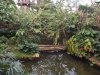
Saimiri sciureus), a taxon which in my experience is seldom unwilling to venture near people in walkthrough enclosures, to the point that they can be quite a problem! However, very unusually, the inhabitants of this exhibit seemed extremely nervous, restricting themselves to the highest possible points of the enclosure when they even dared to venture onto the publicly-accessible island itself; the majority of individuals remaining on a neighbouring thickly vegetated island which contained their living quarters.
As we moved along the path further, we reached a crossroads - to our left was a route which travelled a low route through an "Amazon Grotto" tunnel before coming back onto the main path to our right, whilst travelling straight on would bypass this area. Naturally, we turned left, and came to a window which granted us views across a steep and well-vegetated enclosure containing
Ocelot (
Leopardus pardalis), a taxon of which I am rather fond. Due to the thick vegetation and high level of climbing opportunity present within the enclosure, it took quite some time before we were able to spot the inhabitant of the enclosure; it was quite satisfying to find an enclosure which gave the ocelots the chance to hide away from the public gaze, although the counterpoint must be made that the prolonged period of time we spent examining the enclosure allowed us to notice that it was rather smaller than it seemed, with the thickness of the vegetation and the fact we were looking upwards into the enclosure creating an impression of depth which would lead the casual observer to overestimate the enclosure space. That said, the beneficial effect of being able to hide away hopefully would compensate for the inhabitants having little space.
The next enclosure we reached was a mid-size enclosure filled with low-lying vegetation and open areas of exposed soil, with a large pond taking up approximately half of the exhibit as a whole. As the gradient of the tunnel we were walking through sloped downwards, windows gave us an underwater view of this pond. Signage on the walls told us that the land portion of this enclosure held
Greenish Acuchy (
Myoprocta pratti), whilst the pond contained
Arrau River Turtle (
Podocnemis expansa),
Arapaima (
Arapaima gigas),
Redtail Catfish (
Phractocephalus hemioliopterus),
Ripsaw Catfish (
Oxydoras niger),
Barred Sorubim (
Pseudoplatystoma fasciatum) and
Pacu (
Colossoma macropomum). Overall, I thought that this comprised a very well-stocked representation of Amazonian river taxa, kept in a decent replication of a submerged forest environment. The one major taxon which one might have expected to see in such an exhibit -
Red-bellied Piranha (
Pygocentrus nattereri) - was housed in a separate and rather smaller tank opposite.
The next notable point we reached was the underwater viewing for the
Giant Otter (
Pteronura brasiliensis) enclosure, which we would view in more detail from a different point on the path. However, I did notice at this point that the water level seemed rather lower than I would have expected as suitable for this taxon; certainly it was rather shallower than the similar underwater viewing window for Giant Otter with which I was familiar at Chester Zoo. Continuing on, we reached a point from which we were able to look across the canal to a very well-vegetated island which was signposted as containing
Linnaeus' Two-toed Sloth (
Choloepus didactylus). This enclosure was quite pleasant in appearance, containing as it did numerous climbing opportunities for the inhabitants; however it did seem a little empty, quite possibly due to the fact that it was originally intended and designed to hold multiple species, including Azara's Agouti and Southern Tamandua as well as the Linnaeus' Sloth. Of these, the agouti has left the collection since Gondwanaland opened and has never been replaced with an alternate taxon, whilst the Tamandua has never gone on-display despite this having been alleged to be imminent at several points in time - to the point that it is mentioned in the Gondwanaland guidebook as being on-display!
We then rejoined the main path and ascended past the enclosure containing the Green Acouchy, which quite satisfyingly was active and readily visible - this taxon was one which I had never seen prior to my trip to Germany, yet I had obtained only the merest glimpses at Zoo Berlin and Magdeburg. As such I was pleased to get the opportunity to photograph the individual on-display in Gondwanaland. We next passed the main body of the Giant Otter enclosure; at first glance it looked excellent, being thickly planted with vegetation on the land portion of the exhibit, with logs forming a "bridge" of sorts over the water, and with the pool within the enclosure being quite sizable in area - albeit rather shallow as far as we could tell. However, when we looked closer it was apparent that much of the enclosure was, in fact, hotwired to prevent access by the giant otters - presumably due to the fact that the vegetation and trees at one end of the enclosure formed part of another exhibit; as such the large enclosure was only half the size it seemed, with a portion being merely for decoration and another segment actually forming another enclosure entirely. In fact, I was informed at a later date that the concealed restriction of the enclosure space extended even further than I had realised. Overall this struck me as quite a pity, as aesthetically the enclosure looked great and very naturalistic - but as already noted, I had already noticed that superficial aesthetics often seemed to take priority over enclosure quality elsewhere in the collection. As such, I was not unduly surprised to notice details such as this, and the use of perspective to hide an overly small - in my opinion - Ocelot enclosure. I had also noticed by now that the lack of birdsong or visible free-flying birds was not restricted to the area around the Asian village plaza; as such I was starting to wonder whether the numbers of free-flying birds had been deliberately kept low to prevent any risk of the carefully maintained and pristine looking trees and vegetation within Gondwanaland being altered or damaged, and furthermore to prevent the paths and visitor areas from any chance of being fouled by visible bird droppings.
As the path curved around, we reached a batch of signage detailing the inhabitants of the aforementioned enclosure semi-concealed in such a way as to appear part of the giant otter enclosure;
White-faced Saki (
Pithecia pithecia) and
Silvery Marmoset (Mico argentatus), neither of which were visible at this point in time. However, it could be argued that this was a positive point, being a reflection of just how thick the vegetation within Gondwanaland was, and moreover the fact that both taxa within the enclosure were small primates rather explained the reason the giant otters were prevented from making use of much of the land area; it would be very easy for predators such as these to kill and feed upon their neighbours were they to gain the opportunity. However, a counter-argument could be put forward that there was no reason why these taxa had to be housed in this particular enclosure, both being more than suitable to be mixed with the squirrel monkeys on their pair of islands had the design taken this into account. This would have permitted the giant otters a much larger exhibit, and potentially improved the quality of the walkthrough primate exhibit - which as already mentioned was slightly diminished by the reluctance of the squirrel monkeys to actually access the walkthrough area. Before leaving the "South America" portion of Gondwanaland, we finally passed the upper level of the Ocelot enclosure we had viewed previously. This permitted us much-closer views of the inhabitants of the enclosure, but moreover made it all the more apparent just how small the enclosure really was.
(
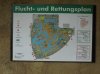
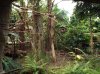
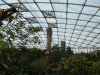
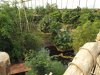
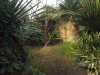
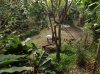
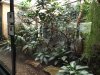
Attached are images of the Komodo Dragon enclosure in the Volcano Tunnel, a Fire Safety plan of Gondwanaland, the Squirrel Monkey enclosure, the Boat Jetty viewed from a bridge, the island enclosure for Linnaeus' Two-toed Sloth and a view across Gondwanaland from the Ocelot enclosure)


 after all, part of my aim in writing these reports is to give a picture of the collections for anyone wanting to visit them!