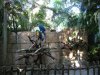
The Parrot on a Stick Exhibit (and why it should end)

pachyderm pro

Well-Known Member
5+ year member
Parrots are among one of the most intelligent animals in the world. They are highly sociable and can famously mimic humans and as a result have become a favorite in the eyes of the general public. This is why it is so baffling that in zoos, parrots really do get the short end of the stick (pun intended) and visitors rarely seem to bat an eye. Often, there wings are clipped and they are placed on a single stick with no other forms of stimulation. I imagine they aren't stuck to them 24/7, but why even stick them here in the first place? Is it that much of a hassle to build them a proper aviary?

This photo by @ThylacineAlive was the straw (or stick) that broke the camels back and really made me think about this topic. The photo in question shows a military macaw at Omaha's Henry Doorly Zoo - one of the most well regarded zoos in America - confined to a single stick with nothing else to do. Why does a zoo with prestige of Omaha still continue this practice in the year 2020? Maybe I could understand if this was many decades ago, back when elephants were still chained to the ground, when bears were in concrete pits and monkeys were in crib cages, but seriously. They aren't alone either, off the top of my head I can think of at least a dozen other major zoos in America that continue a similar practice, and while it's not as common across the pond, I'm sure there are a good number of European zoos as well. The most brutal example I have seen is easily this abomination at Wildlife World Zoo in Arizona.

Has the AZA said anything about this? There standards for animals like elephants have increased, but how come they still allow parrots to spend most of their very long lives on a stick without the ability to fly. Really, I can't think of a single parrot exhibit I have personally seen that has really impressed me. Can anybody prove me wrong on this last part?
 
100% agree here.

I think the practice of wing-clipping parrot is banned in Europe, at least I never seen a parrot on a stick in Europe. However some zoos make spectacular shows with groups of free-flying macaws.

Parrots rival primates and dolphins in intelligence (e.g. their natural vocalization includes specific sounds - names - for different individuals in a flock). They should be given at least a minimum for their mental needs - an aviary large enough to fly, same species partner or a flock and behavioral enrichment.

Another practice which should be banned is hand-rearing parrots without a parrot companion, which results in very behaviorally abnormal, imprinted birds. Owners think it is nice, but such parrots often pluck feathers and have similar very heavy mental issues. The sad thing is that many such parrots still live and will suffer for decades.

And that some American zoos think it is popular and traditional - it was popular and traditional for public to throw food to bears and monkeys but it ended.
 
I also agree that this concept is outdated and should be banned. I can remember when many zoos used to exhibit Macaws and Cockatoos actually chained on small perches. At least this is in the distant past now. But is the clipped-wing Macaws on sticks/framework of perches actually banned in Europe now? One UK zoo I know that still had a display of this type, until at least a few years ago, is Colchester -though I don't know if it is still there.
 
Last edited:
One UK zoo I know that still had a display of this type, until at least a few years ago, is Colchester -though I don't know if it is still there.

The flightless macaws lived on Parrot Rock, which has been empty for a long time now. I'm not entirely certain of the history of the Colchester macaws either - I think one ended up in the bird display and there they suggested that it was a rescue bird that never flew, despite not being pinioned or feather-clipped.
 
I don't think I have seen a true parrot on a stick exhibit in the past 20 years in a European zoo, the last being in Artis and Rhenen. I have seen some leftovers like in Zurich, where they have a lot of climbing opportunities, but pinioning itself can't be reversed.
 
I've seen a few parrot on stick exhibits, most notably at Toronto Zoo's mayan ruins exhibit, who at least have a shade structure.

I suppose a couple toys on the stick could at least provide a temporary solution. Free-flight aviaries are otherwise the best bet for parrots.
 
I agree completely and have thought this for a long time. The AZA is hypocritical in this regard for claiming to be a leader in animal welfare and allowing its members to continue this abhorrent practice. WAZA has come out against the practice and so should AZA (and ZAA for that matter). I don't think I have seen it in Europe either (I have been to 15 or more zoos there). Off the top of my head the only macaw aviary I recall seeing here in the States was at Gladys Porter Zoo. However I do hope the practice of macaws and cockatoos on a stick is gradually going away. I know my local Reid Park Zoo recently did away with their exhibit to make way for a new black-necked swan exhibit. Of course the swans are also clipped or pinioned, which I am not happy about, but at least they have a pool.
 
That is very good news to hear that this practice is virtually non existent in Europe. It is really quite a shame that this isn't the case over here, and the AZA really should eradicate this ASAP. It's not like removing these exhibits be much of hassle. If a zoo can invest several millions of dollars into new exhibits, removing these perches would barely be an inconvenience.

The concept of birds being pinioned as a whole really should be done away with. Maybe waterfowl or flamingos I could understand, but otherwise whats even the point? Restricting the flight of an animals that was literally made to fly. I understand that this cannot be undone, but once this current generation of pinioned birds pass, hopefully things will turn around.

 
That is very good news to hear that this practice is virtually non existent in Europe. It is really quite a shame that this isn't the case over here, and the AZA really should eradicate this ASAP. It's not like removing these exhibits be much of hassle. If a zoo can invest several millions of dollars into new exhibits, removing these perches would barely be an inconvenience.

The concept of birds being pinioned as a whole really should be done away with. Maybe waterfowl or flamingos I could understand, but otherwise whats even the point? Restricting the flight of an animals that was literally made to fly. I understand that this cannot be undone, but once this current generation of pinioned birds pass, hopefully things will turn around.

Even with waterfowl or other ground- living birds , pinioning seriously comprises their life. People think becaus e.g. waterfowl spend a lot of time swimming, lack of flight doesn't affect them so much. I once kept pinioned Carolina ducks. I could see how the inability to fly clearly affected and stressed them quite considerably. I would never keep pinioned birds again.
 
Even with waterfowl or other ground- living birds , pinioning seriously comprises their life. People think becaus e.g. waterfowl spend a lot of time swimming, lack of flight doesn't affect them so much. I once kept pinioned Carolina ducks. I could see how the inability to fly clearly affected and stressed them quite considerably. I would never keep pinioned birds again.

That's interesting considering ducks are flightless anyway for about a month per year during moult. Do you think their distress was due to being flightless or specifically from pinioning making them lop-sided?
 
I agree the "parrot on a stick" exhibit should be ended, although I can't say I've seen any real egregious examples in person. The closest I can think of are the pair of Green-winged Macaws in SF zoo's tropical house (confined to a certain set of perches I believe) and two macaws in Fresno Chaffee's South American Aviary, which were (are?) confined to a large perching/climbing structure. Fresno's structure was at least somewhat complex and had some toys. Most parrots (ambassador birds aside) that I have seen have been in aviaries, and usually in pairs. I can't think of any facility I've been to on the Pacific coast with a true parrot on stick set up, maybe I'm forgetting one...
 
Here is a brief list of some major zoos that still continue the practice (with photos).

Fort Worth Zoo:
4914.JPG

Audubon Zoo (more of a series of ropes than sticks, still not any better):AudubonZoo185.jpg

Brookfield Zoo (they are in a free-flight aviary, but the macaws are segregated to just the sticks):BeFunky_South_america.jpg

Kansas City Zoo: Kansas_City_Zoo_352.jpg

Zoo Tampa (a bit hard to see, look under the shade structure):Lowry_Park_Zoo_2014_246.JPG

Omaha's Henry Doorly Zoo (a different location than the photo I mentioned in the original post):P1230418.JPG

Palm Beach Zoo:
IMG_29332.JPG

Saint Louis Zoo (may no longer exist):Saint_Louis_Zoo_020.jpg

Caldwell Zoo:
IMG_06203.JPG

Nashville Zoo (not as terrible as the rest, still nothing to be proud of):20180324_201430.jpg
 

Attachments

  • 4914.JPG
    4914.JPG
    271.1 KB · Views: 163
  • 20180324_201430.jpg
    20180324_201430.jpg
    183.3 KB · Views: 160
  • AudubonZoo185.jpg
    AudubonZoo185.jpg
    251.3 KB · Views: 170
  • BeFunky_South_america.jpg
    BeFunky_South_america.jpg
    183.9 KB · Views: 164
  • IMG_06203.JPG
    IMG_06203.JPG
    146.4 KB · Views: 158
  • IMG_29332.JPG
    IMG_29332.JPG
    234 KB · Views: 155
  • Kansas_City_Zoo_352.jpg
    Kansas_City_Zoo_352.jpg
    146.3 KB · Views: 167
  • Lowry_Park_Zoo_2014_246.JPG
    Lowry_Park_Zoo_2014_246.JPG
    202.5 KB · Views: 158
  • P1230418.JPG
    P1230418.JPG
    197.8 KB · Views: 165
  • Saint_Louis_Zoo_020.jpg
    Saint_Louis_Zoo_020.jpg
    252.3 KB · Views: 162
Continued...

San Diego Zoo Safari Park:
IMG_0365.JPG

Dallas Zoo:z0095.JPG

SeaWorld Orlando:
A32.JPG

SeaWorld San Diego:
SeaWorldSD282.JPG

San Antonio Zoo:
IMG_6768.JPG

Oakland Zoo:
P11301661.JPG

Birmingham Zoo: Birmingham_Zoo_114.jpg

Cleveland Metroparks Zoo (right corner of the exhibit):
Cleveland_Zoo_340.jpg

Disney's Animal Kingdom:DiscoveryIsland031.jpg
 

Attachments

  • A32.JPG
    A32.JPG
    235.7 KB · Views: 159
  • IMG_0365.JPG
    IMG_0365.JPG
    265.5 KB · Views: 170
  • SeaWorldSD282.JPG
    SeaWorldSD282.JPG
    208 KB · Views: 162
  • z0095.JPG
    z0095.JPG
    232.2 KB · Views: 164
  • Birmingham_Zoo_114.jpg
    Birmingham_Zoo_114.jpg
    268.6 KB · Views: 159
  • IMG_6768.JPG
    IMG_6768.JPG
    215 KB · Views: 165
  • P11301661.JPG
    P11301661.JPG
    280.5 KB · Views: 162
  • Cleveland_Zoo_340.jpg
    Cleveland_Zoo_340.jpg
    233.7 KB · Views: 167
  • DiscoveryIsland031.jpg
    DiscoveryIsland031.jpg
    228.4 KB · Views: 170
Where is the one at SeaWorld San Diego? I certainly didn't see anything like that when I visited!
 
I think part of the issue is that, as mentioned, pinioning cannot be reversed and parrots live for quite a long time. I'd hope most of these examples are birds that were clipped in the past and are now sentenced to a flightless life. That said, they don't need to be on a stick just because this is the case.

As far as Omaha goes, the sticks themselves are barely a foot in length giving the birds very little room to move around. Thankfully, though, they seem to spend very little time here, as over my two day visit I noticed saw the birds out once and they were accompanied by keepers. My question has always been, though, where do these birds live when not on a stick?

~Thylo
 
I don't think I have seen a true parrot on a stick exhibit in the past 20 years in a European zoo, the last being in Artis and Rhenen. I have seen some leftovers like in Zurich, where they have a lot of climbing opportunities, but pinioning itself can't be reversed.

This is one of the great surprises from my European trip last summer to 95 zoos in the Netherlands, Belgium, Germany and France. After seeing what felt like an endless stream of 'parrot on a stick' situations in American zoos, I don't recall a single time when I witnessed the same situation in Europe. Bravo!
 
I found a PowerPoint online put together by several AZA zoo officials with help from the Avian Special Advisory Group and avian TAG chairs. The PowerPoint is about the considerations of flight restriction practices. It's not particularly detailed: its purpose seems to be suggesting all of the questions facilities should consider when evaluating flight restriction for any species or individual bird: http://aviansag.org/ASAG_Documents/To_Fly_or_Not_to_Fly.pdf

While I'll leave others to interpret the overall resource as they would like, a detail I wanted to point out is that wing clipping - the clipping of primary flight feathers - is predominantly how zoo parrots are flight-restricted, rather than pinioning. This means that most flight-restricting in zoo parrots is temporary and could be reversed within one molt cycle (1 year max). The flip side of this fact is that most zoo parrots in open-topped enclosures are being *actively* flight-restricted, rather than irreversibly pinioned long ago as @ThylacineAlive hoped was the case.

It seems that in general this topic is one that the AZA has largely allowed individual facilities to make their own decisions about; the same is true for population reduction through culling.
 
The Los Angeles Zoo I volunteer at and visit so many times doesn't have exhibits with parrots on stick perches ever. the parrots are in exhibits like the roundhouses and the galahs in the aviary.
 
Something that hasn't mentioned here yet is that some of these parrots, usually the cockatoos and macaws, are rescued pets who can't fly either because their wings were restricted beforehand or their wing muscles atrophied, and that's why they're kept on perches. Obviously that doesn't apply to every parrot, but perhaps this will explain the situation for some of them.
 
Back
Top