Split proposed to NACC in 2019 and unanimously rejected.
You are using an out of date browser. It may not display this or other websites correctly.
You should upgrade or use an alternative browser.
You should upgrade or use an alternative browser.
The Taxonomy Thread
- Thread starter jbnbsn99
- Start date

Scrub jays being 2 species :
https://www.eurekalert.org/news-rel...OnYq5cuZWOzQFmybdLERFNXrr7ER7tNuNHl-W1Tm5MzMI
https://www.eurekalert.org/news-rel...OnYq5cuZWOzQFmybdLERFNXrr7ER7tNuNHl-W1Tm5MzMI

Scrub-jays are a lot more than two species.Scrub jays being 2 species :
Genomic research supports recognizing new scrub jay species in Texas and Mexico
 Looks to be an interesting new potential split though.
On the taxonomy of the Bush robins : 2 overlooked species ?:
Cryptic species in a colorful genus: Integrative taxonomy of the bush robins (Aves, Muscicapidae, Tarsiger) suggests two overlooked species - ScienceDirect
Cryptic species in a colorful genus: Integrative taxonomy of the bush robins (Aves, Muscicapidae, Tarsiger) suggests two overlooked species - ScienceDirect
2 European robin-subspecies from the Canary Islands being full species ? :
Research suggests two new endemic robins for Canary Islands - BirdGuides
Research suggests two new endemic robins for Canary Islands - BirdGuides

Birdsage
Well-Known Member
The eBird October 2022 checklist update, featuring Atlas Wheatear, Chihuahuan Meadowlark, Cuban Kite, and Green Pheasant:
2022 Taxonomy Update—COMPLETE - eBird
2022 Taxonomy Update—COMPLETE - eBird

This open access article, published in 2021 in Scientific Reports, had passed me by;
Population genetics and evolutionary history of the endangered Eld’s deer (Rucervus eldii) with implications for planning species recovery | Scientific Reports
Main points being that Rucervus eldii is maintained as a single species, with the Hainan population potentially as an undescribed 4th subspecies; but it is removed from Rucervus (retained for barasingha and Schomburgk’s deer) and returned to Cervus, along with all present Rusa species and Pere David's deer, due to paraphyly.
Has this been refuted since, or if not why the delay in more widespread acceptance of these findings?
Population genetics and evolutionary history of the endangered Eld’s deer (Rucervus eldii) with implications for planning species recovery | Scientific Reports
Main points being that Rucervus eldii is maintained as a single species, with the Hainan population potentially as an undescribed 4th subspecies; but it is removed from Rucervus (retained for barasingha and Schomburgk’s deer) and returned to Cervus, along with all present Rusa species and Pere David's deer, due to paraphyly.
Has this been refuted since, or if not why the delay in more widespread acceptance of these findings?
Molecular exploration of fossil eggshell uncovers hidden lineage of giant extinct bird | Nature Communications
New elephant bird study, looking at mitochondrial genomes obtained from eggshell fragments. Main findings seem to be:
New elephant bird study, looking at mitochondrial genomes obtained from eggshell fragments. Main findings seem to be:
- Separation of Mullerornis into a distinct family, still the sister lineage of the other elephant birds.
- Suggestion that Vorombe titan is a synonym of Aepyornis maximus, and the difference in size of bone remains may be due to extreme sexual dimorphism.
- The discovery of a distinct lineage in northern Madagascar, related to Aepyornis hildebranti of the central highlands, and either the sister species or a subspecies of that taxon- the authors refrain from naming it since no bone remains have yet been found, only eggshells.
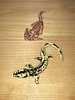
I thought that Diplocaulus was an amphibian. On Saturday, I visited the Cambridge Zoology Museum and found that lepospondyls were classified as reptilomorphs (Reptiliomorpha - Wikipedia), distantly related to the ancestors of mammals and reptiles.
Birdsage
Well-Known Member
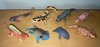
I found that out when I got a set of “prehistoric amphibian“ figurines. It contained Diplocaulus as well as “Eogyrinus”. Not only was “Eogyrinus“ a reptiliomorph; it is also an invalid genus and junior synonym of Pholiderpeton. In case you’re wondering, the set also includes Crassigyrinus (now known to be a stem-tetrapod), four temnospondyls, and one true lissamphibian (the transitional stem-frog Triadobatrachus). For the record, these figures were released in 1998.I thought that Diplocaulus was an amphibian. On Saturday, I visited the Cambridge Zoology Museum and found that lepospondyls were classified as reptilomorphs (Reptiliomorpha - Wikipedia), distantly related to the ancestors of mammals and reptiles.

Attachments
A new study suggests the nine-banded armadillo is 4 species, and that two other Dasypus species, D. mazzai & D. sabanicola, may not be distinct species but belong to the main South American species of nine-bandeds;
Exon capture museomics deciphers the nine-banded armadillo species complex and identifies a new species endemic to the Guiana Shield
Exon capture museomics deciphers the nine-banded armadillo species complex and identifies a new species endemic to the Guiana Shield