The Zoochat Photographic Guide to Rodents: part one

The California Ground Squirrel subspecies in Shasta County should be fischeri, which is already represented by a photo (have a look to see if your one is better though).

According to John Long's Introduced Mammals of the World, the American Red Squirrel introduced to Newfoundland is the subspecies ungavensis from Labrador, which is not yet pictured in the galleries.

I'll look and see on the ground squirrel.

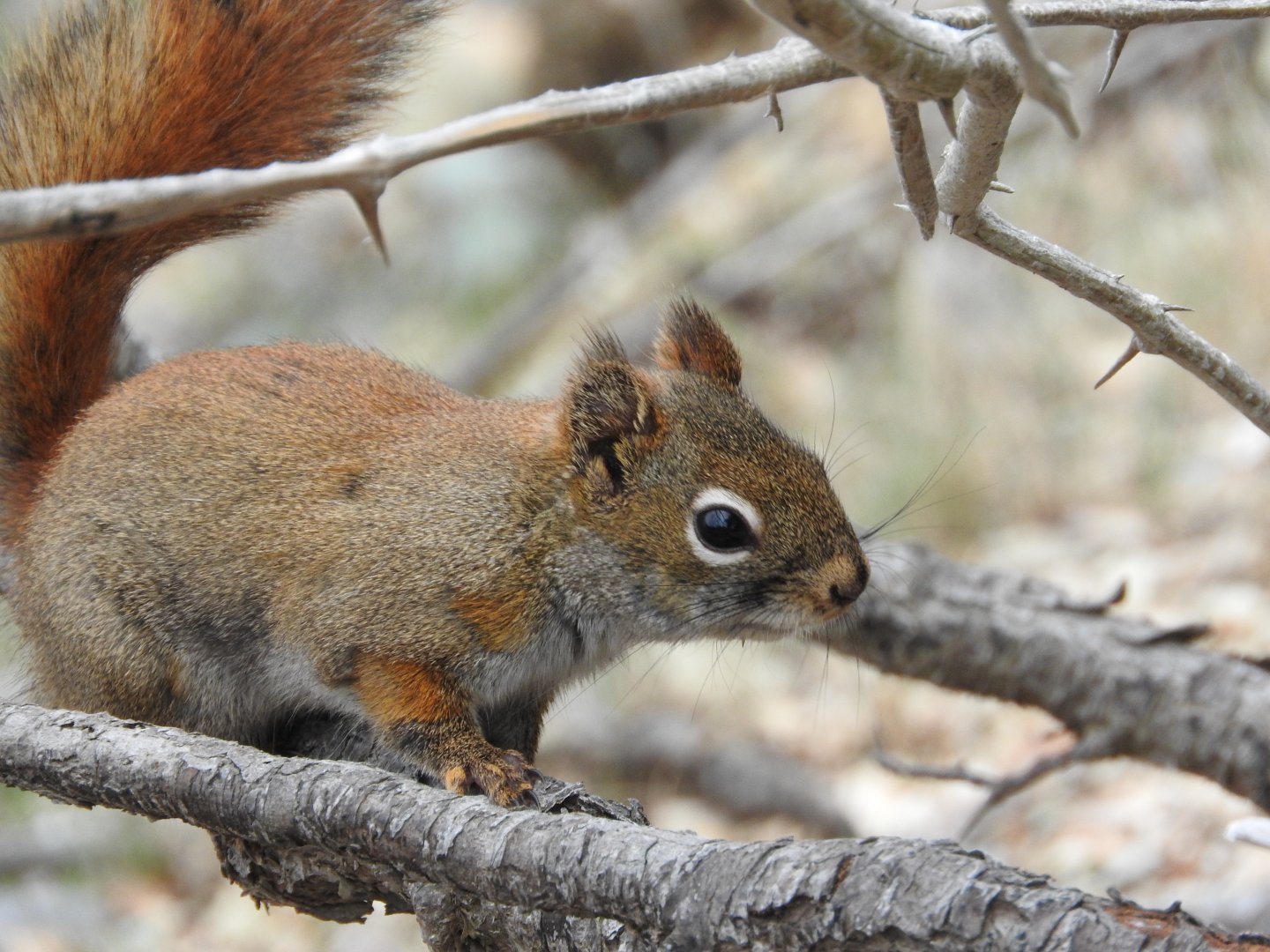
I just remembered I had uploaded the Red Squirrel photo, .
 
I too have a red squirrel photo in which the specimen is slightly redder but the photo was taken from around 40 metres away so quality is not great:

DSC_1515 (2).JPG
 

Attachments

  • DSC_1515 (2).JPG
    DSC_1515 (2).JPG
    118 KB · Views: 115
Turns out that people don't like photographing North American Porcupines apparently! The only one with photos is the ASDM.

Do you know if they have only ever had couesi, or is that just what they have currently? There is a photo by Giant Eland which I'd prefer to use but it is from 2010 (https://www.zoochat.com/community/media/arizona-sonora-desert-museum-2010.206449/); otherwise all the others are by Arizona Docent from a few years more recent, of which I would choose this one from 2014 (N American porcupine | ZooChat).

No idea which subspecies it is but here is a North American porcupine photo from Thoiry. Not sure if it will help.

DSC_0554.JPG
 

Attachments

  • DSC_0554.JPG
    DSC_0554.JPG
    133.6 KB · Views: 113
Another new species added: Western Grey Squirrel Sciurus griseus by @Giant Eland.

The Sciurus entries are on page one of this thread.

There are two photos in the Turtle Bay Exploration Park gallery (under USA); I used the first one below.

full


full
 
I have a picture of the nominate subspecies of Xerus erythropus but it's of really bad quality so I'm not sure it's worth uploading?
 
Last edited:
Another new squirrel species added to the thread, with Mutable Sun Squirrel Heliosciurus mutabilis by @Giant Eland

full

mutable sun squirrel (Heliosciurus mutabilis) - ZooChat

Post here (#114, on page 6 of the thread): The Zoochat Photographic Guide to Rodents: part one


I can't really find any good (and reliable) pictures online to confirm this ID but the species is really variable in colouration and I think it is probably correct. African squirrels are confusing.

In doing some research it would appear this is another Smith's bush squirrel instead. Photos on iNaturalist of each species as well as descriptions of their habits (sun squirrels being found high in trees, bush squirrels being found on the ground/bottow of trees) back this up.

Unfortunately at the time my guides identified this as a "sun squirrel" and Mutable is the species in the area- but we know how often animals can be confidently mis-identified. Definitely colored differently from other bush squirrels I've seen- but their coloration can vary. I'll upload another angle of this animal I managed (albeit focused incorrectly!).
 

Attachments

  • IMG_6612.JPG
    IMG_6612.JPG
    87.9 KB · Views: 2
In doing some research it would appear this is another Smith's bush squirrel instead. Photos on iNaturalist of each species as well as descriptions of their habits (sun squirrels being found high in trees, bush squirrels being found on the ground/bottow of trees) back this up.

Unfortunately at the time my guides identified this as a "sun squirrel" and Mutable is the species in the area- but we know how often animals can be confidently mis-identified. Definitely colored differently from other bush squirrels I've seen- but their coloration can vary. I'll upload another angle of this animal I managed (albeit focused incorrectly!).
Yeah, those were the two species it had to be between. Being found high or low on the trees isn't a good indicator, because simply being found low on a tree doesn't mean anything really.

Both species are really variable apparently. I was swayed by Kingdon's Mammals of Africa saying that the body of the Mutable Sun Squirrel was abundantly flecked in cream and that it has a blackish tail which could both fit with your uploaded photo - but the other photo shows the tail fully and it is that of a Smith's. And also the Kingdon field guide in which I (just now) finally found a picture of the Mutable Sun Squirrel, shows an animal nothing like the written description in the other book (for one thing the tail is shown as being very prominently banded!).
 
A paper has just been published on the taxonomy of the Sciurinae, which included genetic samples from almost every species (Museomics of tree squirrels: a dense taxon sampling of mitogenomes reveals hidden diversity, phenotypic convergence, and the need of a taxonomic overhaul | BMC Evolutionary Biology).

Because the genus Sciurus has always been such a taxonomic mess, I had retained all the species within Sciurus anyway and just made some comments on various scenarios in the introductory post for it (The Zoochat Photographic Guide to Rodents: part one), so I didn't have to rework the thread at all - and even if I'd wanted to do that, the whole thing would need to be changed next time someone publishes a paper!

But below is how this new paper has divided up the genera within the subfamily.


..........................................


Tamiasciurus remains in line with the standard, with three species (douglasii, hudsonicus, fremonti) although they didn't include genetic samples for fremonti in their study. (In this thread I include fremonti as a subspecies within hudsonicus with the note that it may be a full species, but separate mearnsi with the note that it may not be valid. (This post: The Zoochat Photographic Guide to Rodents: part one)


..........................................


Rheithrosciurus remains monotypic (R. macrotis).


..........................................


Microsciurus (the Neotropical dwarf squirrels) has been divided into three genera (one unnamed). The genus is in this post of the thread: The Zoochat Photographic Guide to Rodents: part one.


Microsciurus
Microsciurus alfari (including M. venustulus)
Microsciurus "species 1" (a Colombian form previously included within M. mimulus)

Leptosciurus
Leptosciurus mimulus
Leptosciurus pucheranii
(the study found that Sciurus pucheranii was not actually a single variable species but rather two entirely different lineages, and hence they placed one form (the nominate subspecies pucheranii) here amongst the dwarf squirrels and the remaining subspecies they renamed as Hadrosciurus ignitus)
Leptosciurus similis
Leptosciurus otinus
Leptosciurus boquetensis
Leptosciurus isthmius


"Microsciurus"
"Microsciurus" sabanillae
"Microsciurus"
"species 2" (an undescribed form from Peru and Brazil, variously included in Microsciurus or Syntheosciurus)
"Microsciurus" flaviventer

(Note that M. santanderensis and M. simonsi are not included in the three genera above because they were amongst the few species not sampled genetically in this study).


..........................................


Syntheosciurus retains the Bangs' Mountain Squirrel (S. brochus) but they add in the Red-tailed Squirrel (S. granatensis) which seems suspect.


..........................................


For Sciurus they retained only three species in the genus (only the Old World species, and apparently not recognising S. meridionalis at all) and divided all the rest between nine genera:

Sciurus for anomalus, lis and vulgaris.

Hesperosciurus for griseus and aberti.

Parasciurus for arizonensis, nayaritensis, niger, alleni and oculatus.

Neosciurus
for carolinensis.

Syntheosciurus
for granatensis (this was an existing genus to which they moved this one Sciurus species; and they include richmondi in granatensis).

Echinosciurus
for aureogaster, colliaei, deppei, yucatanensis and variegatoides.

Leptosciurus
for pucheranii (this was a genus they created to house some of the Microsciurus species, and to which they moved this one Sciurus species).

Simosciurus
for nebouxii and stramineus.

Guerlinguetus
for aestuans and brasiliensis.

Hadrosciurus
for igniventris, pyrrhinus, ignitus and spadiceus.
 
A photo of Northern Flying Squirrel Glaucomys sabrinus has been added by @Giant Eland which bumps the species total for the thread up another one.

full

Northern flying squirrel (Glaucomys sabrinus) - ZooChat

The photo was taken at the Maine Wildlife Park which mostly has local animals apparently, but both sabrinus and volans are found in Maine. I can't really tell the two species apart, but the tail does look much too long for the animal to be a volans.
 
A photo of Northern Flying Squirrel Glaucomys sabrinus has been added by @Giant Eland which bumps the species total for the thread up another one.

full

Northern flying squirrel (Glaucomys sabrinus) - ZooChat

The photo was taken at the Maine Wildlife Park which mostly has local animals apparently, but both sabrinus and volans are found in Maine. I can't really tell the two species apart, but the tail does look much too long for the animal to be a volans.
AFAIK Tail length is not a reliable way to differentiate the two species. Measurements of the enitre body length can, but there is plenty of overlap. The only reliable way to tell them apart is a close examination of the belly fur - the belly fur of Southern is all-white while the belly fur of Northern is gray at the base. I am not sure this squirrel is identifiable from this photo.
 
I'm confused, if the zoo identified their animal(s) as Northern why would we need to re-identify?
Because it is quite common for zoos to misidentify small mammals, or to keep old signage for new animals, or to put new animals into the enclosures of previous or existing animals.

I'm not saying this squirrel has to be misidentified - I think it is a Northern - but with the rodent threads it has happened quite a few times that a photo turns out to actually be some other species (and also just the other day on the marsupial thread with the Smithsonian's Common Opossum).
 
Taxidermed specimen of Hagen's Flying Squirrel (Petinomys hageni) and Arrow Flying Squirrel (Petinomys sagitta) are on display in Naturalis. I can upload a photo (it will include some other flying/gliding animals however).
 
Back
Top