The Zoochat Photographic Guide To The Pelecaniformes

Sarus Crane

Well-Known Member
5+ year member
The clade of birds within the Aequornithes known as the Pelecaniformes are familiar types of birds that are found near or on the water. The Pelecaniformes include favorites such as the pelicans, herons, ibises, hamerkop and the imposing Shoebill. With so much diversity in this one clade let’s dive in and discover the enigmatic birds that soar, wade and swim in aquatic habitats. Without further ado, please give a warm welcome to the Pelecaniformes!
 
Last edited by a moderator:
PELECANIFORMES

THRESKIORNITHIDAE - Ibises and Spoonbills (14 genera, 35 species)

ARDEIDAE - Herons (19 genera, 65 species)

SCOPIDAE - Hamerkop (1 monotypic genus)

BALAENICIPITIDAE - Shoebill (1 monotypic genus)

PELECANIDAE - Pelicans (1 genus, 8 species)
 
Last edited by a moderator:
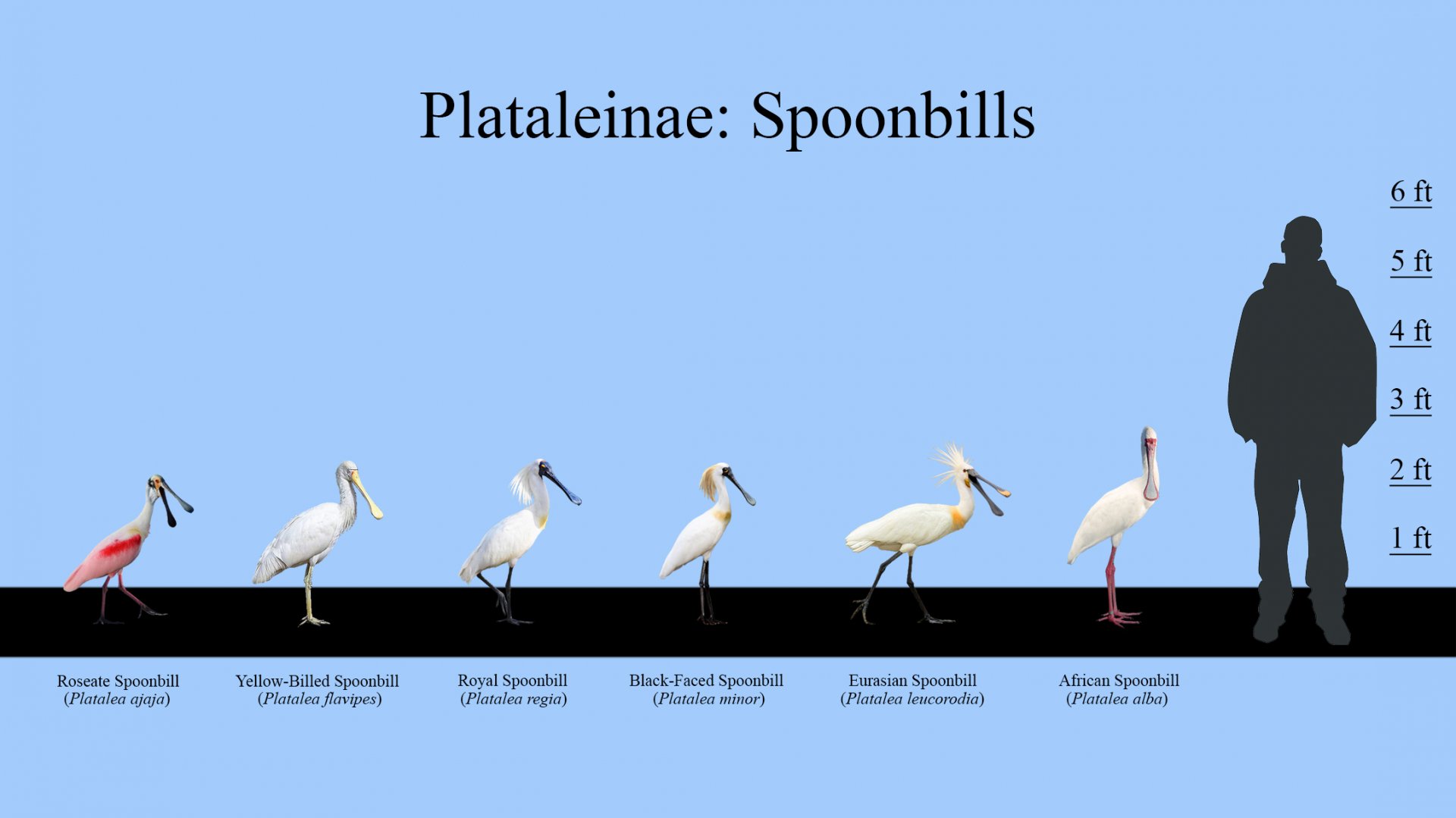
The Plataleinae, also known as the spoonbills is a subfamily of birds in the order Threskiornithidae which also includes the ibises (Threskiornithinae). These peculiar birds with their spoon-shaped bills (hence their name) are medium sized waders and are spread throughout both the Old & New World. There are 6 species and they live in a variety of different locations and climates both tropical and temperate. Please give a warm welcome to the Plataleinae!


The spoonbills comprise of one genus Platalea and they include the following species:

Platalea - Spoonbills

  • Roseate Spoonbill (Platalea ajaja)
  • Yellow-Billed Spoonbill (Platalea flavipes)
  • Royal Spoonbill (Platalea regia)
  • Black-Faced Spoonbill (Platalea minor)
  • Eurasian Spoonbill (Platalea leucorodia)
  • African Spoonbill (Platalea alba)
 
Roseate Spoonbill (Platalea ajaja)

This species is restricted to the New World and ranges from Florida through Central America and into South America in the Amazon. It is the only species of spoonbill with pink colored plumage. Although it is listed as Least Concern by the IUCN and has many stable populations now, a century ago it suffered a massive decline in Florida during the plume trade. It is a commonly seen species in tropical aviaries and South American Amazon themed exhibits in both zoos and aquariums. Juveniles are a light rosy pink with white feathers on the head and neck while adults sport the same rosy pink plumage, but with a scarlet patch on the shoulders and bald greenish colored skin on the head.

Monotypic

Photo of juvenile by @ThylacineAlive

full


Photo of adult by @JigerofLemuria

full
 
Last edited by a moderator:
Yellow-Billed Spoonbill (Platalea flavipes)

The only species of spoonbill that shows a trace of its ibis ancestry and has a yellow colored bill, the Yellow-Billed Spoonbill is the Roseate's closest relative and lives in the tropical regions of Australia where it can be found feeding on a variety of aquatic life alongside it's cousin the Royal Spoonbill. This species is all white in plumage and is easily distinguished by its yellow bill and legs. The face has black lines that border where the feathers meet the skin along with black plumes on the wings and feathered hackles on the chest like its relative the Australian White Ibis. This species is listed as Least Concern by the IUCN.

Monotypic

Photo by @LaughingDove

full
 
Last edited by a moderator:
Royal Spoonbill (Platalea regia)

Residing in Australia and neighboring oceanic islands including New Zealand, this species shares its outback habitat in with the Yellow-Billed Spoonbill. It can be distinguished by its black face with a yellow area above each eye in addition to a red patch on the top of the head. It's bill is broader than the Yellow-Billed Spoonbill and is able to catch a variety of prey from insects to fish to amphibians. In the breeding season it develops a large white flowing crest and its chest turns bright yellow. This species is listed as Least Concern by the IUCN.

Monotypic

Photo by @devilfish

full
 
Last edited by a moderator:
Black-Faced Spoonbill (Platalea minor)
The smallest species of white spoonbill, the Black-Faced Spoonbill is also the farthest east residing as well as the rarest. It lives in the coastal areas of eastern Asia primarily in China, North Korea, South Korea and Taiwan. Appearing much like the Royal Spoonbill, the Black-Faced has a black face with two yellow spots on each side of its face: one above and below each eye. During breeding season the crest and chest patch become a golden hue and the species often nests on remote islands and cliffs on the coast accompanied by neighboring gulls and cormorants. During the 1990's the population suffered a severe decline, but due to stringent conservation efforts numbers rebounded to 2,693 birds in 2012. Being rare in captivity, this spoonbill is natural monument #205 in South Korea and is listed as Endangered by the IUCN.

Monotypic

Photo of an adult at Jurong Bird Park by @Zooish

full


Photo of two individuals nesting at Weltvogelpark Walsrode by @Tomek

full
 
Eurasian Spoonbill (Platalea leucorodia)

The only species of spoonbill in which the facial skin is covered by feathers, the Eurasian Spoonbill ranks alongside the African Spoonbill as the largest species in the genus Platalea. It has white plumage and black legs like its relatives, but has a yellow spot at the end of its upper bill. The throat skin of this species is colored yellow, but tinged on the base with scarlet. During breeding season the patch on the chest and flowing crest becomes a bright yellow. Eurasian Spoonbills are wide ranging from North Africa eastwards to Japan and southward to India. It was observed for the first time in the wild during the breeding seasons of 2012-2013 & 2014-2015 on a small island in Incheon, South Korea that a Eurasian Spoonbill mated with two Black-Faced Spoonbills where 11 eggs were laid and 9 hybrid chicks were hatched. This species is commonly found in zoos across Europe and Asia and is listed as Least Concern by the IUCN.

There are three subspecies. They are P.l.leucorodia which occupies all areas other than the two following subspecies, P.l.balsaci which is found on the islands off the Banc d'Arguin of the coast of Mauritania and P.l.archeri which is found on the coasts of the Red Sea and Somalia. Birds that live in Asia are sometimes given their own subspecies, Pl.major.

Photo of a juvenile at Slimbridge by @Maguari

full


Photo of non-breeding adults at Attica Zoological Park by @CatDog

full


Photo of an adult nesting pair at Chester Zoo by @Writhedhornbill

full
 
Last edited by a moderator:
African Spoonbill (Platalea alba)

Ranging throughout sub-Saharan Africa and Madagascar, the African Spoonbill is the only spoonbill with red colored skin on its face and legs. It can often be found along rivers and water bodies such as the Great Rift Valley in East Africa. It has all white plumage which becomes thicker during the breeding season along with richer red coloring on the legs and facial skin. It's bill is grey with red skin bordering the edges. A noisy colonial species, it can often be found nesting with other African waders such as Yellow-Billed Storks and Hadada Ibises. It does very well in zoos being represented in North America, Europe, and Asia often in mixed species aviaries. It is listed as Least Concern by the IUCN.

Photo of an adult at Planckendael by @vogelcommando

full


Photo of a nesting group at Safaripark Beekse Bergen by @vogelcommando

full


Photo of a breeding group at Jacksonville Zoo by @Sarus Crane

full
 
Last edited by a moderator:
Moderator note:

@Sarus Crane has kindly agreed to expand the remit of this thread to encompass the entirety of the Pelecaniformes and Suliformes - as such, I have edited the title of this thread and the first few posts to reflect this change :)
 
The subfamily Threskiornithinae, also known as the ibises, includes 28 living species. They live on every continent except in Polar Regions and can be found in a wide variety of habitats from lush grasslands, wetlands, rocky arid environments and even mountainous regions. This diverse group of birds has been featured in multiple cultures and while most of the 28 species are doing well, others are struggling to survive among the encroachment of civilization.

Threskiornis
  • African Sacred Ibis (Threskiornis aethiopicus)
  • Malagasy Sacred Ibis (Threskiornis bernieri)
  • Oriental Sacred Ibis (Threskiornis melanocephalus)
  • Australian Sacred Ibis (Threskiornis molucca)
  • Straw-Necked Ibis (Threskiornis spinicollis)
Pseudibis
  • Red-Naped Ibis (Pseudibis papillosa)
  • White-Shouldered Ibis (Pseudibis davisoni)
Thaumatibis
  • Giant Ibis (Thaumatibis gigantea)
Geronticus
  • Northern Bald Ibis (Geronticus eremita)
  • Southern Bald Ibis (Geronticus calvus)
Nipponia
  • Oriental Crested Ibis (Nipponia nippon)
Bostrychia
  • Olive Ibis (Bostrychia olivacea)
  • São Tomé Ibis (Bostrychia bocagei)
  • Spot-Breasted Ibis (Bostrychia rara)
  • Hadada Ibis (Bostrychia hagedash)
  • Wattled Ibis (Bostrychia carunculata)
Theristicus
  • Plumbeous Ibis (Theristicus caerulescens)
  • Buff-Necked Ibis (Theristicus caudatus)
  • Andean Ibis (Theristicus branickii)
  • Black-Faced Ibis (Theristicus melanopis)
Cercibis
  • Sharp-Tailed Ibis (Cercibis oxycerca)
Mesembrinibis
  • Green Ibis (Mesembrinibis cayennensis)
Phimosus
  • Bare-Faced Ibis (Phimosus infuscatus)
Eudocimus
  • White Ibis (Eudocimus albus)
  • Scarlet Ibis (Eudocimus ruber)
Plegadis
  • Glossy Ibis (Plegadis falcinellus)
  • White-Faced Ibis (Plegadis chihi)
  • Puna Ibis (Plegadis ridgwayi)
Lophotibis
  • Madagascar Ibis (Lophotibis cristata)
 
Last edited by a moderator:
Threskiornis

African Sacred Ibis (Threskiornis aethiopicus)

A large, familiar species the African Sacred Ibis is perhaps the best known of all the ibises. The body is covered in white feathers with yellow lining the legs and black plumes on the back. Bare red skin is visible on the underside of the wing and both the head and neck are featherless. This species has a thick bill which it uses to catch and scavenge a range of food. It was worshipped as the god Thoth in Ancient Egypt and is still common in many parts of Africa as well as Europe where populations were introduced by different zoos. A common bird, it is found within zoos and has begun to make its way into the aviaries of private aviculturists. It is listed as Least Concern by the IUCN.

Monotypic

Photo of a juvenile at Kasteelpark Born by @vogelcommando

full


Photo of an adult at Planckendael by @vogelcommando

full


Photo of a an individual in a nest with chicks at Mondo Verde by @KevinB

full
 
Last edited by a moderator:
Malagasy Sacred Ibis (Threskiornis bernieri)

Appearing nearly just like the African Sacred Ibis apart from its slightly slimmer bill, blue eyes, and the yellow feathers lining its legs, the Malagasy Sacred Ibis was previously considered a subspecies of T.aethiopicus. Listed as Endangered by the IUCN, it is threatened by habitat loss as well as collection of eggs and chicks for consumption. Zoo Berlin has been actively involved in the conservation of this species since 1994 by educating the local people about the ibis’s importance as well as helping to promote agriculture and conservation of its habitat. Weltvogelpark Walsrode holds a large number of this species.

There are two subspecies. They are T.b.bernieri, which occupies the island of Madagascar and T.b.abbotti which is found on Aldabra island.

Photo of an adult at Weltvogelpark Walsrode by @Tomek

full


Photo showing the species' pale eyes at Weltvogelpark Walsrode by @Tomek

full


A photo of two individuals at Weltvogelpark Walsrode by @ThylacineAlive

full
 
Last edited by a moderator:
Oriental Sacred Ibis (Threskiornis melanocephalus)

Like the preceding two species in its genus, this ibis has the white feathers covering the majority of its body with a black face and neck, but lacks the black scapular plumes. In the breeding season these pale plumes turn grey. A wide ranging species, this ibis occurs in China, Nepal, India, Southeast Asia as well as the Malay Peninsula. It often accumulates with other Asian waders such as Great and Little Egrets, Asian Openbills, and Painted Storks in wetland habitats where it can easily be distinguished as it is the only ibis in Asia with a white body and black head and neck. It is listed as Least Concern by the IUCN.

Monotypic

Photo of a juvenile in Wilpattu National Park, Sri Lanka by @Chlidonias

full


Photo of an adult at Rotterdam zoo by @vogelcommando

full
 
Last edited by a moderator:
Australian Sacred Ibis (Threskiornis molucca)

This well-known South Pacific species, comically termed the “bin chicken” by locals is very adaptive living in both the wild as well as urban areas where it has learned to scavenge on human trash within the last couple of decades. Its appearance is like that of the other species except its scapulars is patterned black and white along with the red spots that adorn the back of the head. It is listed as Least Concern by the IUCN.

There are two subspecies. They are T.m.molucca, which occupies eastern Melanesia and Australia and T.m.pygmaeus which is found on the Rennell and Bellona islands in the Solomon Islands.

Photo of a juvenile at Axe Valley Bird & Animal Park by @logroll

full


Photo of an adult by @WhistlingKite24

full


Photo of a group in the wild by @LaughingDove

full


Photo of a group at Lotherton Hall by @Macaw16

full
 
Straw-Necked Ibis (Threskiornis spinicollis)

The only species in Threskiornis which has a largely non-white colored body, the Straw-Necked Ibis is darkly feathered on the main body which shimmers purple, green and blue in bright sunlight. It still has the black face and differs in addition from the others by its reddish colored legs and the yellow feathers on its neck that look like straw. Its distribution is Australia, New Guinea and parts of Indonesia and is listed as Least Concern by the IUCN.

Monotypic

Photo of an adult in the wild by @WhistlingKite24

full


Closeup of an individual at Exmoor Zoo showing the straw-like neck feathers by @gulogulogulo

full


Photo of a group in the wild by @LaughingDove

full
 
Pseudibis

Red-Naped Ibis (Pseudibis papillosa)

This species is also known as the Indian Black Ibis because it largely inhabits the subcontinent of India along with small numbers occurring in Pakistan and Nepal. Several unique characteristics distinguish it. Its body is dark brown with red legs along with wings that are colored indigo blue with a white shoulder patch. In addition, this species has black skin on the head with a scarlet caruncle on the nape. It is listed as Least Concern by the IUCN.

Monotypic

Photo of two individuals in the wild by @Junklekitteb

full
 
Last edited by a moderator:
White-Shouldered Ibis (Pseudibis davisoni)

Formerly considered a subspecies of the Red-Naped Ibis, the White-Shouldered Ibis can be distinguished by its larger size and white strip of skin that lies just below the chin and wraps around the nape. Like its name implies this species has a visible white patch on its shoulder. Once a formerly wide-ranging species throughout Southeast Asia, the White-Shouldered Ibis is now confined to just three countries in the northeastern regions of Cambodia as well as south Vietnam, a small portion of southern Laos, and in East Kalimantan. The largest population is found in Western Siem Pang, Cambodia. It is listed as Critically Endangered by the IUCN.

Monotypic

Photo of an adult at Bangpra Wildlife Breeding Centre by @LaughingDove

full


Closeup of an adult at Phnom Tamao Zoological Park & Wildlife Rescue Center Breeding Center by @devilfish

full
 
Red-Naped Ibis (Pseudibis papillosa)

These were around in European public collections until about 15 years ago - and I believe one or two are still around in private hands - so there's a chance someone here might have a photo.

I think the best bet would be to check with @Tim May , @vogelcommando or perhaps @gentle lemur, as I suspect they are the likeliest to have seen the species. Perhaps @Chlidonias too?
 
Back
Top