Berlin Tierpark Tierpark Berlin news 2021

^And here is the new joy of Berlin Tierpark:
130130.jpg

Copyright: W. Dreier (with kind permission)

 
Berlin Zoo blames Russian mix-up after polar bear incest revelation | DW | 18.05.2021

It has been revealed that due to a mix-up in the records, Hertha is confirmed to be inbred to a sibling pair.

This is tough news. The polar bears are some of the most popular animals in the park and as far as I know they wanted to breed with them again soon. Now both female bears will stay in Berlin but they probably will move to Berlin Zoo, once the old female Katjusha passes on. She is one of the oldest polar bears in Europe. Then Berlin Tierpark may get new polar bears. But they could also take a break to extend the enclosure (this has been planned for some time now).
 
So this is the History of the Tierpark Gerenuks :

First Import 2013 : 2.2
The females and one male died in 2014 and 2015, the second male is still alive ( Zoo)

Second Import 2015 : 1.3
The females died in 2015, 2016 and 2018, the male is still alive (Zoo)

Third Import 2020 : 2.2 ( born 2017, 2019,2020)
All alive ( Tierpark)


Offspring from five females)

Female 1 (died in 2015)
1.0 born Feb 2015, died Sep. 2015
1.0 born Nov. 2015, died same day
--------------------------------------------------------
Female 2 ( died in 2018)
0.1 born 2017 , since March 2021 in the Zoo.
-she had three young ( Female 3)
0.0.1 born Feb.2019 ( died the same day)
0.1 born March 2020, alive Tierpark
1.0 born Nov 2020, alive , since March 2021 in the Zoo.
---------------------------------------------------------
Female 2
0.1 born July 2018, alive Tierpark
- she had two young :( Female 4)
1.0 born May 2020, died two days later
1.0 born March 2021, alive Tierpark

So three births in 2020.
-------------------------------------------------------------
Female 5 : one of the 2020 imported females (pregnant imported )
0.1, born April 2021, Tierpark

So 3.1 Gerenuk at the Zoo, and 3.5 at the Tierpark. 5.7 were imported, ten births, of which was one sired in the USA.

Hopefully the pair at the Zoo will continue breeding- maybe, the female is pregnant at this time ? I have no idea....time will show. But it looks not too bad for this species now. With a little bit luck, the two new females will give birth next spring, or even in this autumn.

W. Dreier just wrote, there are indeed 6,6 gerenuks in Berlin now.

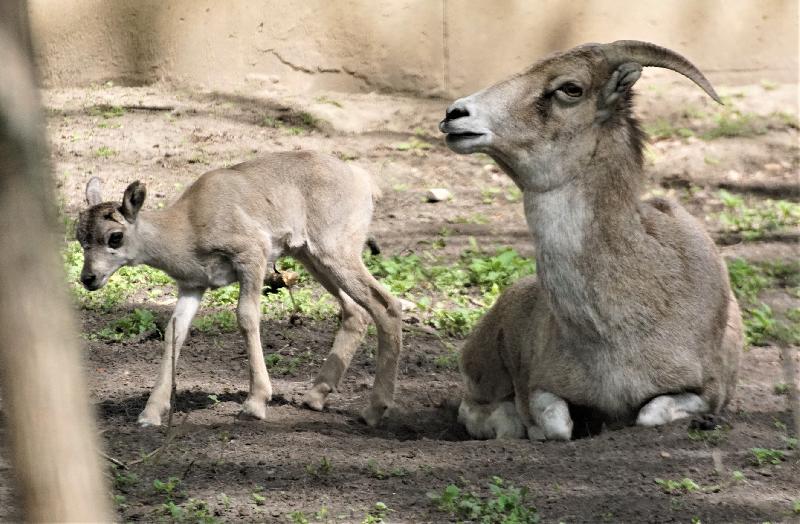
Besides that the Marco Polo sheep just had female offspring again!

I really don't know what's going on this year, but please keep it coming!
 
This is tough news. The polar bears are some of the most popular animals in the park and as far as I know they wanted to breed with them again soon. Now both female bears will stay in Berlin but they probably will move to Berlin Zoo, once the old female Katjusha passes on. She is one of the oldest polar bears in Europe. Then Berlin Tierpark may get new polar bears. But they could also take a break to extend the enclosure (this has been planned for some time now).
Surely, Berlin should only keep polar bears at the Zoo or the Tierpark, but not both.
 
That would give preference to one over the other.
Surely that exists at the moment. Berlin Zoo has the aquarium. Berlin Tierpark has more space for some larger species. Berlin Tierpark was created in the former East Germany and was run by different people to those running Berlin Zoo. The Tierpark and Zoo are not far apart and should have different species to encourage people to visit both.
 
Berlin Zoo has the aquarium. Berlin Tierpark has more space for some larger species. The Tierpark and Zoo are not far apart and should have different species to encourage people to visit both.

I agree. This also is kind of what they have started to do:
-Asian elephants and rhinos at Berlin Zoo, African elephants and rhinos at Berlin Tierpark
-Hippos at the Zoo and manatees at the Tierpark (not at present, but they want to return them at some point)
-African wild dogs at the Zoo, hyena at the Tierpark
-different subspecies of giraffes, large cats etc.
and so on

Having said that, Berlin Zoo has been very reluctant to give up popular species. Usually, it mostly works the other way around. For that reason, I don't see them giving up their polar bears, even thoughthey also have Giant Pandas. Tierpark Berlin has more space and wants to breed again in the future. Also the polar bears are some of their most popular animals. So they won't give up theirs either. Along the same lines, if Tierpark Berlin gets to show orangs or seals again (as they plan to do), Berlin Zoo very likely won't give up theirs.
 
Why would either zoo want to give up the most important species of all?! I hope both continue to have polar bears, even if it is the only species overlap

It is kind of a complicated issue. Of course, they want each zoo to be as complete and attractive as possible. At the same time, they don't want them to appear almost identical, as this wouldn't motivate people to actually visit both of them. In a way it is both a dream and a nightmare for a zoo administration to be in charge of two large/very large zoos. There is far more potential, but it is also far more complicated.

In the past, Berlin Tierpark has been stripped of some of its most expensive but also most attractive and popular animals (apes, seals, pygmy hippos...). They have all the space and natural landscapes you'd need to create one of the finest zoos on the globe, but they lack(ed) funding (this started to change but then Covid-19 kicked in) and haven't been independent since Berlin Zoo took them over. Returning some of the lost attractions will be a project for decades rather than years.
Meanwhile, Berlin Zoo never as much as thought of giving up just one of the 4 groups of apes for instance. Some of the generous donors even made very clear they would never accept that. On the other hand, space is limited, while standards are ever increasing.

Personally, I think the newly developed concept seems the best/most logical compromise:
-Berlin Zoo gets to keep the most popular species and builds attractive, state of the art enclosures for them. They also stick with the classic systematic approach: So children asking to see "the" monkeys, elephants, lions, penguins, crocodiles etc will virtually always find them very quickly and easily (and usually there will be even more than they probably looked for). So this would be very satisfying for average visitors.
-Berlin Tierpark, however, develops a new profile with geo zones and naturalistic landscapes with large groups/herds and large/huge (often mixed species) exhibits, thus justifying the huge space. For instance, the Africa zone will include many of the most spectacular animals like elephants, (hopefully rhinos), giraffes, buffalos, zebras and common antelopes and also some rarely seen species like gerenuks or honey badgers/ratels. And Himalaya will be set on an actual hill and display far, far more than "just" snow leopards and red pandas.
One advantage of these complementary concepts is that it will allow visitors to develop a more complex and comprehensive view on nature. And on a more pragmatic level, it also makes more allowance for some redundancy: Berlin Zoo exhibits polar bears close to other carnivores and close to mentally associated animals like seals and penguins. Berlin Tierpark, however, embeds them in a North American area with moose, wood bisons etc. (They will handle this similarly, when Berlin Tierpark gets orangs and seals again) And they are flexible to have a breeding couple/group at the one zoo and a bachelor group at the other one.
 
Last edited:
Seems Berlin hasn’t been able to solve the mortality issues that San Diego and others report. A remember last year from San Diego showed mortality similar to this that was causing the population to barely hold at its small size.
I am just wondering if any Gerenuk are kept in private hands within the USA?, As there are so many species which are I was thinking about total numbers all up.
 
I am just wondering if any Gerenuk are kept in private hands within the USA?, As there are so many species which are I was thinking about total numbers all up.
Personally, I really do not think so. One of the species the AZA's netwerk is fairly dedicated to. You might consider White Oak private facility in some respects and they are a principal holder of the species.
 
Personally, I really do not think so. One of the species the AZA's netwerk is fairly dedicated to. You might consider White Oak private facility in some respects and they are a principal holder of the species.
I believe the San Deigo Safari park has/had a rather large herd at some stage but unsure of what they may have now. I had read that the zoo had imported/collected semen fresh from east Africa and got as far as the US airport only to be refused entry because of the paper work. :(
 
I believe the San Deigo Safari park has/had a rather large herd at some stage but unsure of what they may have now. I had read that the zoo had imported/collected semen fresh from east Africa and got as far as the US airport only to be refused entry because of the paper work. :(

The newest gerenuk came from San Diego.
 
I believe the San Deigo Safari park has/had a rather large herd at some stage but unsure of what they may have now. I had read that the zoo had imported/collected semen fresh from east Africa and got as far as the US airport only to be refused entry because of the paper work. :(
Proof that some legislation does actually prevent conservation action and while at the same time failing to act and respond in the wider enforcement picture to frequent illegal wildlife trade and poaching.
 
Personally, I really do not think so. One of the species the AZA's netwerk is fairly dedicated to. You might consider White Oak private facility in some respects and they are a principal holder of the species.

As of late last year 48 in 10 institutions with a slow decline in the population due to the aforementioned mortality. I don’t believe their is much of a private population like @Kifaru Bwana said.
 
I am not at all against having the same specie at Berlin Zoo and Tierpark, could be even an asset to better breeding results with one bachelor group being held close from a breeding group and allowing to swipe breeding male easily and often. Reminds me of Karlsruhe zoo and its secondary site where they have a large group of male goitered gazelle. That is actually the set-up they seem to develop for gerenuk.

However, in the case of polar bears at Berlin Zoo, I think one must acknoledge that the main current exhibit is simply not big enough for polar bears. I would rather try to house a smaller specie of bear (and rarer and more endangered) or redesign the area by merging several of the small enclosures.
 
Back
Top