Toledo Zoo Toledo Zoo When Short on Time?

I've noticed a few of you have mentioned the Aquarium as must-see. I just finished watching the Zoo Tours video on it, and I have to ask: what's so notable about it? I'm not a big fish person, so don't know much about a lot of the species on display, however it doesn't seem like there's much there that isn't standard to other US aquariums. Sure, the building looks nice, but is there anything so notable that I should prioritize it over seeing the Bird House, Reptile House, ProMedica, Flamingos, Penguins, or Tembo Trail?

Thanks for the suggestion, but elephants are one of the focal species for the Zoo Exhibitry class I'm taking so are a must-see, as are the great apes and tigers. Otherwise, I'd definitely consider your advice.
I personally don’t see the Aquarium as a must see at all. While the Flashlight Fish are cool it’s skippable in my opinion besides that. Also you can see the Elephants outside of Tembo Trail in a viewing area at the very end of the path that goes to Tembo and the Reptile House. I saw them every time I went to that spot.
 
I've noticed a few of you have mentioned the Aquarium as must-see. I just finished watching the Zoo Tours video on it, and I have to ask: what's so notable about it? I'm not a big fish person, so don't know much about a lot of the species on display, however it doesn't seem like there's much there that isn't standard to other US aquariums. Sure, the building looks nice, but is there anything so notable that I should prioritize it over seeing the Bird House, Reptile House, ProMedica, Flamingos, Penguins, or Tembo Trail?

Thanks for the suggestion, but elephants are one of the focal species for the Zoo Exhibitry class I'm taking so are a must-see, as are the great apes and tigers. Otherwise, I'd definitely consider your advice.

I don't think the Aquarium is must see for those of us from the northeast. It's really nice on the outside though, if you're into architecture! Pop in the entrance and see the bonnetheads, they're the first exhibit.
 
The aquarium is more interesting as a piece of zoological history than as a modern exhibit complex. If your home zoo has a good amount of Works Progress Era stuff then it can be skipped.
 
Possibly unpopular opinion, but, if your priority is to experience the whole zoo rather than to spend a lot of time looking every individual exhibit, you can just walk the zoo. That's what I do when there's a place I really want to see and my time is limited - earlier this year I did Columbus in three hours or so - saw every exhibits, stopped and briefly loitered at the ones that were of special interest, and kept moving. Would I have liked to have spent longer? Absolutely, but I was in a crunch and was forced to sandwich the visit in between other obligations.

A lot of these exhibits at Toledo - penguin, flamingo, arctic, Kodiak, Tembo Trail - you can just walk through, absorb your impressions, and keep going. For reptiles, aviary, aquarium, and the museum, you can drift through - if it's a species that you have seen lots of times before, then you don't need to spend several minutes searching for it. If it's something that interests you a lot, take your time. If fish aren't your thing (they aren't especially mine), just walk through the aquarium, soak it in, and you'll be out in a few minutes.

I personally like the experience of taking in the whole zoo and getting an appreciation for it as an entity rather than spending lots of time only taking in a quarter of it. That being said, I tend to process things and make impressions pretty quickly, so that might not be the impression that works best for everyone.
 
Thank you everyone for your advice! I visited today, and quickly got through everything but the farmyard in 2.5 hours. This left me with enough time for repeat visits to the aviary (twice), pheasantry, museum of natural history, reptile house, primate forest, and Tasmanian devils.

I probably spent about an hour total in the natural history museum, and it is certainly an impressive exhibit. On my first walk through I was rushing to see everything, so honestly found the museum underwhelming, but on my second walk-through when able to really take my time I was blown away! The poison dart frog walk-through in particular is a genius exhibit, and it was a real treat to see a group of four golden poison dart frogs directly off the path, without any fogged-up glass separating them from visitors. I was also impressed by the sturgeon touch tank (they certainly didn't feel like I was expecting them to), and the salamander exhibit was visually impressive, despite the fact I only saw a single cave salamander and some sort of small tree frog that was unsigned. Upstairs, the venomous snake exhibits are certainly impressive, and I saw four elapids and thirteen viperids that I'd never seen before! The mixed-species rattlesnake species was particularly impressive, and the timber rattlesnake (I forget if this was in here or reptile house) had just finished shedding, so was absolutely gorgeous (I'm partial to any freshly-shed snake). Unfortunately, the flying snakes were a no-show (albeit slightly less frustrating of one than the Japanese giant salamanders at Detroit the day before), but almost every other venomous snake species was visible, and it really shows they put a lot of thought into the exhibits to make them great for the inhabitants but also great for visitors. All in all, this is probably my second favorite exhibit complex I've ever seen, only after Bronx's Congo Gorilla Forest. If it wasn't for the fact the signage leaves a lot to be desired in some sections, it'd likely be my favorite.

The aviary was also very impressive, and is my favorite bird-themed exhibit I'd ever seen (excluding Detroit's penguin center). Raggiana bird-of-paradise and Andean cock-of-the-rock were both highlights, as was the active, large group of emperor tamarins. The large flocks of starlings were also impressive to see, and in the African walk-through aviary the superb starlings and buffalo weavers were all very active and flying right near my head! The only part of the exhibit I wasn't a fan of was the Australian aviary, which just seemed to have wasted potential. Budgeriars, cockatiels, and Australian crested doves just seem like a waste of space compared to how many other impressive rare species are housed in the building. Perhaps the number one highlight of the day, however, were the kagus. On all three times through the building, the kagus were right near the front and would follow me around as I moved through the room. At many points they were also making their impressive displays, and it was so cool having the birds displaying and following me across the exhibit. I don't know if that's normal behavior for this pair of kagu or if there was something about me that triggered it, but it was really cool to see anyways and to have such a unique experience with a really unique bird.

Also bird-related, the Flamingo Key was a rather impressive aviary. I also felt it was a really smart move housing sea ducks in the penguin exhibit. While I didn't see any penguins outside, having underwater viewing for diving long-tailed ducks and spectacled eiders was a really unique experience that was also very neat to see. Another thing that surprised me was having three cinereous vulture cages (with the mixed-species waldrapp ibis one particularly impressive). I know plenty of zoos (including Toledo) have plenty of off-show bird areas for breeding that include multiple enclosures for the same species, actually showing three different vulture habitats on display was a neat touch, in my opinion.

The reptile house is definitely showing its age in some parts, and some of the tanks seemed on the small side, however in all fairness it'd be impossible to compete in exhibit quality with the Detroit's reptile conservation center I saw yesterday. It is still really cool to see older buildings with modern interiors, and this was an impressive, recurring theme at Toledo. The parts of the reptile house that impressed me the most, however, was getting to see a tuatara- really incredible animals that I saw for the first time today, and a saltwater crocodile- it surprised me just how big it was! The wall of Ranitomeya exhibits were also very nice, and it's cool to see a zoo highlight so many poison dart frog species so prominently.

On Tembo Trail, I was also impressed by the elephant barn. While the yards were average, the barn itself is probably the best elephant barn I've ever seen, which is certainly important for a northern zoo. There was an elephant keeper out at the yard when I walked through, so got to spend a few minutes learning about some of their elephant training techniques and how they manage their nutrition, which was nice.

While those were all very impressive parts of the zoo, oftentimes the best exhibits of their kind I've ever seen, there were also parts of this zoo that left a lot to be desired. While seeing the tiger cubs was absolutely adorable, the tiger exhibits were probably the smallest I've ever seen in an AZA zoo, which is a shame given they don't look like they're that old. It'd be nice to see in the future the zoo invest in some improvements to the tiger exhibit. A series of rotational tiger/snow leopard exhibits taking over the current dingo/tiger/snow leopard exhibits could be neat to see. The Arctic Encounter also left a lot to be desired. While the pinniped pool was nice, it was easily the weakest of four polar bear exhibits I saw this week. The Africa! section was also rather poor, with bad viewing angles and the bizarre inclusion of Bactrian camels.

Overall, however, I was very impressed by the Toledo Zoo- and it's now my third favorite zoo I've ever visited, after Bronx and Detroit. The best parts of the zoo were very impressive, and honestly if Arctic Encounter and Africa! simply weren't there, it'd likely rank as my second favorite due to how impressive the historic buildings are. Thanks for all the advice, I had a great visit!
 
Thank you everyone for your advice! I visited today, and quickly got through everything but the farmyard in 2.5 hours. This left me with enough time for repeat visits to the aviary (twice), pheasantry, museum of natural history, reptile house, primate forest, and Tasmanian devils.

I probably spent about an hour total in the natural history museum, and it is certainly an impressive exhibit. On my first walk through I was rushing to see everything, so honestly found the museum underwhelming, but on my second walk-through when able to really take my time I was blown away! The poison dart frog walk-through in particular is a genius exhibit, and it was a real treat to see a group of four golden poison dart frogs directly off the path, without any fogged-up glass separating them from visitors. I was also impressed by the sturgeon touch tank (they certainly didn't feel like I was expecting them to), and the salamander exhibit was visually impressive, despite the fact I only saw a single cave salamander and some sort of small tree frog that was unsigned. Upstairs, the venomous snake exhibits are certainly impressive, and I saw four elapids and thirteen viperids that I'd never seen before! The mixed-species rattlesnake species was particularly impressive, and the timber rattlesnake (I forget if this was in here or reptile house) had just finished shedding, so was absolutely gorgeous (I'm partial to any freshly-shed snake). Unfortunately, the flying snakes were a no-show (albeit slightly less frustrating of one than the Japanese giant salamanders at Detroit the day before), but almost every other venomous snake species was visible, and it really shows they put a lot of thought into the exhibits to make them great for the inhabitants but also great for visitors. All in all, this is probably my second favorite exhibit complex I've ever seen, only after Bronx's Congo Gorilla Forest. If it wasn't for the fact the signage leaves a lot to be desired in some sections, it'd likely be my favorite.

The aviary was also very impressive, and is my favorite bird-themed exhibit I'd ever seen (excluding Detroit's penguin center). Raggiana bird-of-paradise and Andean cock-of-the-rock were both highlights, as was the active, large group of emperor tamarins. The large flocks of starlings were also impressive to see, and in the African walk-through aviary the superb starlings and buffalo weavers were all very active and flying right near my head! The only part of the exhibit I wasn't a fan of was the Australian aviary, which just seemed to have wasted potential. Budgeriars, cockatiels, and Australian crested doves just seem like a waste of space compared to how many other impressive rare species are housed in the building. Perhaps the number one highlight of the day, however, were the kagus. On all three times through the building, the kagus were right near the front and would follow me around as I moved through the room. At many points they were also making their impressive displays, and it was so cool having the birds displaying and following me across the exhibit. I don't know if that's normal behavior for this pair of kagu or if there was something about me that triggered it, but it was really cool to see anyways and to have such a unique experience with a really unique bird.

Also bird-related, the Flamingo Key was a rather impressive aviary. I also felt it was a really smart move housing sea ducks in the penguin exhibit. While I didn't see any penguins outside, having underwater viewing for diving long-tailed ducks and spectacled eiders was a really unique experience that was also very neat to see. Another thing that surprised me was having three cinereous vulture cages (with the mixed-species waldrapp ibis one particularly impressive). I know plenty of zoos (including Toledo) have plenty of off-show bird areas for breeding that include multiple enclosures for the same species, actually showing three different vulture habitats on display was a neat touch, in my opinion.

The reptile house is definitely showing its age in some parts, and some of the tanks seemed on the small side, however in all fairness it'd be impossible to compete in exhibit quality with the Detroit's reptile conservation center I saw yesterday. It is still really cool to see older buildings with modern interiors, and this was an impressive, recurring theme at Toledo. The parts of the reptile house that impressed me the most, however, was getting to see a tuatara- really incredible animals that I saw for the first time today, and a saltwater crocodile- it surprised me just how big it was! The wall of Ranitomeya exhibits were also very nice, and it's cool to see a zoo highlight so many poison dart frog species so prominently.

On Tembo Trail, I was also impressed by the elephant barn. While the yards were average, the barn itself is probably the best elephant barn I've ever seen, which is certainly important for a northern zoo. There was an elephant keeper out at the yard when I walked through, so got to spend a few minutes learning about some of their elephant training techniques and how they manage their nutrition, which was nice.

While those were all very impressive parts of the zoo, oftentimes the best exhibits of their kind I've ever seen, there were also parts of this zoo that left a lot to be desired. While seeing the tiger cubs was absolutely adorable, the tiger exhibits were probably the smallest I've ever seen in an AZA zoo, which is a shame given they don't look like they're that old. It'd be nice to see in the future the zoo invest in some improvements to the tiger exhibit. A series of rotational tiger/snow leopard exhibits taking over the current dingo/tiger/snow leopard exhibits could be neat to see. The Arctic Encounter also left a lot to be desired. While the pinniped pool was nice, it was easily the weakest of four polar bear exhibits I saw this week. The Africa! section was also rather poor, with bad viewing angles and the bizarre inclusion of Bactrian camels.

Overall, however, I was very impressed by the Toledo Zoo- and it's now my third favorite zoo I've ever visited, after Bronx and Detroit. The best parts of the zoo were very impressive, and honestly if Arctic Encounter and Africa! simply weren't there, it'd likely rank as my second favorite due to how impressive the historic buildings are. Thanks for all the advice, I had a great visit!
May I ask why you rank Detroit above Toledo? I definitely prefer Toledo and have heard that Detroit is actually gradually losing visitors to Toledo, showing much of the general public feel the same way.
 
May I ask why you rank Detroit above Toledo? I definitely prefer Toledo and have heard that Detroit is actually gradually losing visitors to Toledo, showing much of the general public feel the same way.
First off, I was very much impressed by both zoos can certainly see why someone would put Toledo over Detroit. Toledo certainly has the edge species list wise, with over 60 species I've seen nowhere else (compared to only 21 at Detroit). However, Detroit is unparalleled when it comes to habitat quality. The National Amphibian Conservation Center and Polk Penguin Conservation Center are both amongst the five best exhibits I've ever seen. It's truly incredible to see so many large, complex amphibian exhibits- as these are animals who often receive the short end of the stick, while the penguin exhibit was truly inspiring and I could've easily spent all day watching the penguins from the underwater tunnel. Truly a great experience. While unfortunately I didn't see a polar bear, the Arctic Ring of Life was also a very impressive complex and I really enjoyed seeing the sea otters.

Even a lot of the less talked about exhibits were incredible. I was blown away by the Red Panda Forest, and getting to see a red panda about twenty feet up in a tree was a really great experience and something I haven't ever seen elsewhere. The wolverine exhibit was similarly impressive, and I had a wonderful time watching the wolverine. The wolverine was climbing the tree in the exhibit, carrying a bone with it, and multiple times dropped the bone to later climb back up with the bone in mouth. So unique to see, not least of all due to how rare wolverines are in zoos.

I was also very impressed by the Reptile Conservation Center. While not the most speciose reptile house, the exhibit quality in here blew me away (with the exception of caiman/arrau and fly river turtle), as it was great to see very complex, enriching habitats for reptiles, even if some of them were no-shows. I was especially impressed by both monitor exhibits. The black tree monitor exhibit provided plenty of climbing opportunities and was very large, whereas the water monitor exhibit was extremely large and served as an excellent anchor for the building, being complex and including multiple different substrates.

Furthermore, while Toledo had some very weak areas (Arctic Encounter, Tiger Terrace, Africa!), Detroit didn't have anything that seemed inadequate. Some of the weakest exhibits (caiman/arrau, fly river turtle, sandhill crane/cinereous vulture/white stork) weren't exactly great, but still at or above the quality I've seen in other zoos. The great ape complex also wasn't overly impressive, but wasn't bad by any means either.

Lastly, I was impressed by all the native wildlife habitat areas within the Detroit Zoo. Over the course of the day, I saw multiple wild waterfowl species (including my first-ever green-winged teal), a great blue heron, plenty of passerines, a massive flock of turkey vultures, and plenty of squirrels and chipmunks. Seeing a zoo emphasize native wildlife and having habitat for wildlife throughout the zoo was really great to see, and certainly contrasts the heavily-developed zoos that are much more common. It really brought the zoo's naturalism to the next level. Overall, I suppose it is a quality vs. quantity argument. Toledo undeniably has a higher quantity of exhibits and a lot more rare species, but Detroit had some of the highest quality exhibits I've ever seen and it was refreshing to see a zoo that lacked any obviously inadequate exhibits.
 
First off, I was very much impressed by both zoos can certainly see why someone would put Toledo over Detroit. Toledo certainly has the edge species list wise, with over 60 species I've seen nowhere else (compared to only 21 at Detroit). However, Detroit is unparalleled when it comes to habitat quality. The National Amphibian Conservation Center and Polk Penguin Conservation Center are both amongst the five best exhibits I've ever seen. It's truly incredible to see so many large, complex amphibian exhibits- as these are animals who often receive the short end of the stick, while the penguin exhibit was truly inspiring and I could've easily spent all day watching the penguins from the underwater tunnel. Truly a great experience. While unfortunately I didn't see a polar bear, the Arctic Ring of Life was also a very impressive complex and I really enjoyed seeing the sea otters.

Even a lot of the less talked about exhibits were incredible. I was blown away by the Red Panda Forest, and getting to see a red panda about twenty feet up in a tree was a really great experience and something I haven't ever seen elsewhere. The wolverine exhibit was similarly impressive, and I had a wonderful time watching the wolverine. The wolverine was climbing the tree in the exhibit, carrying a bone with it, and multiple times dropped the bone to later climb back up with the bone in mouth. So unique to see, not least of all due to how rare wolverines are in zoos.

I was also very impressed by the Reptile Conservation Center. While not the most speciose reptile house, the exhibit quality in here blew me away (with the exception of caiman/arrau and fly river turtle), as it was great to see very complex, enriching habitats for reptiles, even if some of them were no-shows. I was especially impressed by both monitor exhibits. The black tree monitor exhibit provided plenty of climbing opportunities and was very large, whereas the water monitor exhibit was extremely large and served as an excellent anchor for the building, being complex and including multiple different substrates.

Furthermore, while Toledo had some very weak areas (Arctic Encounter, Tiger Terrace, Africa!), Detroit didn't have anything that seemed inadequate. Some of the weakest exhibits (caiman/arrau, fly river turtle, sandhill crane/cinereous vulture/white stork) weren't exactly great, but still at or above the quality I've seen in other zoos. The great ape complex also wasn't overly impressive, but wasn't bad by any means either.

Lastly, I was impressed by all the native wildlife habitat areas within the Detroit Zoo. Over the course of the day, I saw multiple wild waterfowl species (including my first-ever green-winged teal), a great blue heron, plenty of passerines, a massive flock of turkey vultures, and plenty of squirrels and chipmunks. Seeing a zoo emphasize native wildlife and having habitat for wildlife throughout the zoo was really great to see, and certainly contrasts the heavily-developed zoos that are much more common. It really brought the zoo's naturalism to the next level. Overall, I suppose it is a quality vs. quantity argument. Toledo undeniably has a higher quantity of exhibits and a lot more rare species, but Detroit had some of the highest quality exhibits I've ever seen and it was refreshing to see a zoo that lacked any obviously inadequate exhibits.
Certainly a fair assessment. PPCC and NACC are certainly among the greatest exhibits on the continent. But the rest of Detroit really falls flat for me. Most of the enclosures are just far too large to be practical exhibits, even if they great for husbandry. You also have very long distances where you are walking by nothing, which isn't really very fun.

Toledo of course has a variety of lackluster areas, but it also has world-class exhibits. PMNH definitely ranks above either PPCC or NACC for me at least. Also the aviary, pheasantry, and aquarium are all incredible. Toledo's grounds are also simply more dense - you never feel like any part of the zoo is simply devoid of animals, which is a common feeling on a visit to Detroit.
 
Certainly a fair assessment. PPCC and NACC are certainly among the greatest exhibits on the continent. But the rest of Detroit really falls flat for me. Most of the enclosures are just far too large to be practical exhibits, even if they great for husbandry. You also have very long distances where you are walking by nothing, which isn't really very fun.

Toledo of course has a variety of lackluster areas, but it also has world-class exhibits. PMNH definitely ranks above either PPCC or NACC for me at least. Also the aviary, pheasantry, and aquarium are all incredible. Toledo's grounds are also simply more dense - you never feel like any part of the zoo is simply devoid of animals, which is a common feeling on a visit to Detroit.
I can also understand why many would put Toledo over Detroit. Toledo was also an impressive zoo, and had a lot of really great species. I especially loved the aviary, and the Natural History Museum is the second greatest complex I've ever seen (the two Detroit exhibits are also top five). The pheasantry was good as well, and I was impressed by the other bird exhibits throughout the zoo as well (eagles, vultures, Penguin Beach, Flamingo Key). In regards to the aquarium, I've always said aquariums are hard to impress me, seeing as growing up a visit to the aquarium meant Mystic or New England, both of which any list of the country's 20 best aquariums would be incomplete without. That said, the aquarium at Toledo was a good one, and I especially liked the flashlight fish and deep sea tanks. Overall though, the aquarium didn't have much that stood out to me above what I've seen at other aquariums, and I wouldn't say it was one of the big highlights of Toledo for me.

At Detroit, the Red Panda Forest and wolverine exhibits were both really big highlights for me, as were the sea otters in Arctic Ring of Life. I suspect polar bears would be a highlight if I could see them, but instead it looked like the world's largest turkey vulture exhibit. I will concede that Detroit has some layout problems, and some of the Africa exhibits were understocked. Both the zebra/wildebeest and eland/ostrich exhibits could house either larger herds or an additional species, which would help with the feeling of being too large, while in Australia I think grey kangaroos and a larger wallaby mob would be beneficial additions to help as well. Hopefully the new complex they are building will help fill out the zoo and solve some of the emptiness problem you discuss.

While the habitats at Detroit were large, they also were well-designed to make many of the animals in view. Almost everything in the outdoor habitats were visible. Polar bears were the big exception to that, the lemurs were in due to weather, the hybrid deer didn't show, aardvarks were closed for renovation, and the beavers were in their lodge- but other than that I saw every single one of the outdoor animals. Reptile house had some no-shows, but with a little bit of effort I managed to see the vast majority of the residents.

I also think the bad parts of Toledo are really a big drag on Toledo's ranking. If Arctic Encounter and Africa! simply weren't there, there's a decent chance I'd rank Toledo higher than Detroit- since the museum and aviary in particular are so phenomenal.
 
Great discussion. Toledo wasn't a facility historically on my list but we may be taking a family trip to the area so taking notes. Detroit would probably be on the same trip but I'm more well-read on them.

How was the signage and overall educational value at Toledo?
 
Great discussion. Toledo wasn't a facility historically on my list but we may be taking a family trip to the area so taking notes. Detroit would probably be on the same trip but I'm more well-read on them.

How was the signage and overall educational value at Toledo?

My Dad, who is not an animal person at all and knows nothing about animals (and remembers nothing from zoo to zoo, it seems) loved Toledo and has it second on his list :)
 
How was the signage and overall educational value at Toledo?
I found signage to be lacking in the Museum of Natural History. A lot of the tanks only had a small plaque with the species name (common and scientific) and a fact or two. It was especially frustrating there was no photo on the sign, which made it difficult to search for an animal in a tank if it wasn't a species I was familiar with. The walk-through Tropics room also didn't have any animal signage, but did have signage for the plants which is always nice to see. Outside of the museum, there was a lot more signage. The great ape building was full of different educational stuff, and the aviary really excelled at having all sorts of educational displays on the walls, especially in the last room. A few areas in the zoo also had educational videos playing, which is neat to see and provides a different mode of learning.
 
Great discussion. Toledo wasn't a facility historically on my list but we may be taking a family trip to the area so taking notes. Detroit would probably be on the same trip but I'm more well-read on them.

How was the signage and overall educational value at Toledo?
I found signage to be lacking in the Museum of Natural History. A lot of the tanks only had a small plaque with the species name (common and scientific) and a fact or two. It was especially frustrating there was no photo on the sign, which made it difficult to search for an animal in a tank if it wasn't a species I was familiar with. The walk-through Tropics room also didn't have any animal signage, but did have signage for the plants which is always nice to see. Outside of the museum, there was a lot more signage. The great ape building was full of different educational stuff, and the aviary really excelled at having all sorts of educational displays on the walls, especially in the last room. A few areas in the zoo also had educational videos playing, which is neat to see and provides a different mode of learning.
Perhaps it's more accurate to say the museum has a ton of signage, but very little species-specific signage.
 
I found signage to be lacking in the Museum of Natural History. A lot of the tanks only had a small plaque with the species name (common and scientific) and a fact or two. It was especially frustrating there was no photo on the sign, which made it difficult to search for an animal in a tank if it wasn't a species I was familiar with. The walk-through Tropics room also didn't have any animal signage, but did have signage for the plants which is always nice to see. Outside of the museum, there was a lot more signage. The great ape building was full of different educational stuff, and the aviary really excelled at having all sorts of educational displays on the walls, especially in the last room. A few areas in the zoo also had educational videos playing, which is neat to see and provides a different mode of learning.

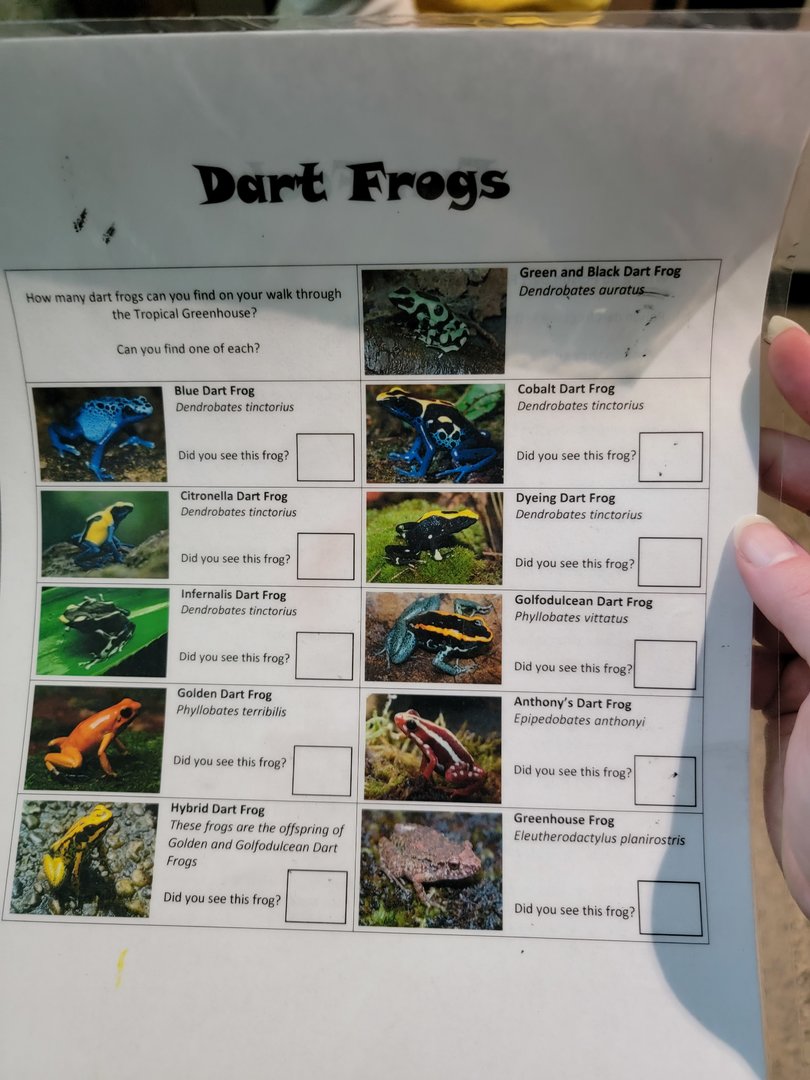
For the tropics room, ask the volunteers in the vestibule. It would be nicer to have signs of course, but they'll tell you what birds are present and answer any questions, and there's this for the frogs.

 
My Dad, who is not an animal person at all and knows nothing about animals (and remembers nothing from zoo to zoo, it seems) loved Toledo and has it second on his list :)
Good to know, thank you!

Perhaps it's more accurate to say the museum has a ton of signage, but very little species-specific signage.
This is what I really wanted to get to the heart of, so thank you. I was more curious about species-specific signage but didn't know the words. I always find it a missed opportunity when I see an animal and see a name but nothing is given to explain why it is special or unique.
 
Back
Top