Top 20 favourite birds that I have seen in New Zealand (in no particular order):
1) Pied Shag (
Hypoleucos varius) - To me, this is the most interesting shag/cormorant species on the mainland, because of the colourful bare skin on its face and because of how some individuals of this species are quite approachable for a shag species. I like the record of how at the Waikanae Estuary, where there is a famous pied shag breeding colony, a man gently stroked a juvenile pied shag's chest, and then it pecked him. Sadly the pied shag is mostly a coastal species in New Zealand, so one usually should not expect to encounter the pied shag on inland water bodies here.
View attachment 476583
2) Glossy Ibis (
Plegadis falcinellus) - I have only seen this species on one occasion in New Zealand, which was in the North Island. The glossy ibis has since become tentatively established in Blenheim in the South Island, so hopefully this species will become more common in New Zealand in the near future.
View attachment 476584
3) Caspian Tern (
Hydroprogne caspia) - A very charismatic seabird that unfortunately isn't very common in most places in New Zealand. I don't think that I have any close photos of this species and it has been years since I last had extended views of it.
4) Eurasian Coot (
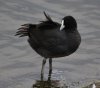
Fulica atra) - To me, seeing a coot indicates that I am somewhere that is truly away from home, as coots are very seldom seen in the Wellington City area. Also, the place where I first saw coots was at Lake Taupo, which is where I was taken for family holidays multiple times when I was young, so seeing a coot is somewhat nostalgic for me as well.
View attachment 476585
5) Plumed Whistling-Duck (
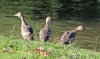
Dendrocygna eytoni) - Many New Zealand birders have only been able to see this duck in New Zealand because of a trio of them that reached a wetland park in Hawke's Bay in the early 2010s. I was lucky enough to be able to see the ducks when there was still a trio. Eventually one disappeared for an apparently unknown reason, and more recently a second one disappeared, reportedly because it was hit by a car. The last member of this trio has been seen earlier this year, so it may still be alive. This is a species that I would love to see colonise New Zealand in the near future.
View attachment 476586
6) Black-billed Gull (
Larus bulleri) - The combination of pale grey and pure white feathers goes together well with its pale iris and slender black bill, making it a very aesthetically appealing species overall. It is very sad that this species is endangered, and I have only seen it in the Wellington City area on one occasion several years ago.
7) Tomtit (
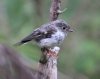
Petroica macrocephala) - A neat little bird that I wish I could see more often. Sadly, in the North Island the tomtit seems to seldom occur in gardens, apart from gardens that are adjacent to large forest tracts. I think that the attached photograph is from the only time I have ever got decent photos of a tomtit that I was able to get close to. I have found tomtits to be less approachable in my most recent encounters with the species.
View attachment 476587
8) Sacred Kingfisher (
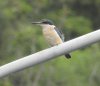
Todiramphus sanctus) - Back when I first started birding, this was a species that I was especially desperate to find and photograph. On one of those early days, I spotted a sacred kingfisher that was overlooking a coast road that was just a short drive from my house and I was absolutely thrilled; I think that the attached photograph is from that sighting. On very rare occasions, I have also seen this species on my own property. I have yet to get any good shots of sacred kingfishers with prey in their bills, but I hope that I do one day.
View attachment 476588
9) New Zealand Dotterel (
Charadrius obscurus) - I first saw this species on a beach that was right in front of the lodging that I was staying at during a holiday in Northland, and the sighting was very exciting for me at the time, because I knew that the dotterel is an endangered species. Then I learned that the New Zealand dotterel is actually not uncommon in many parts of the northern North Island, which admittedly lessened the impact of the first sighting for me, but the New Zealand dotterel remains one of my favourite New Zealand bird species. I am glad that the North Island subspecies is slowly expanding its range, and I would love to see the South Island subspecies one day; especially an individual in breeding plumage with its stunning sunset belly.
10) Pied Stilt (
Himantopus leucocephalus) - The unique thing about this species in New Zealand is that hybridising with the black stilt has resulted in the appearance of the pied stilt being very variable in New Zealand compared to in Australia. To me, this species is a good indicator of worthwhile birding sites that are bound to harbour rarities sometimes. But the pied stilt is notoriously wary and I have yet to encounter one that will allow me to get some truly good photos of it.
11) Shining Bronze-Cuckoo (
Chalcites lucidus) - This master of monotony has been my nemesis bird ever since I started birding. I still remember my first time actually seeing one, which was at Mt. Bruce. I heard it calling very close to the walking track and had my camera ready. It finally showed itself when it flew to the top of a small tree, but then it took off again almost instantly. My few subsequent sightings have not been much different, and there have been only two occasions where I have managed to take photos of the shining bronze-cuckoo that were almost-passable, but nothing better. Bad luck, I suppose.
12) Paradise Shelduck (
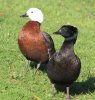
Casarca variegata) - Basically a form of the Australian shelduck with the sexual dimorphism settings turned up. I love photographing this species whenever I am able to get close to it, though I have never been able to get a photo that shows the male and female both in-focus and right next to each other. I am glad that the paradise shelduck has been able to adapt to New Zealand's changed landscapes, unlike so many other endemic species.
View attachment 476589
13) Black-fronted Dotterel (
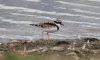
Elseyornis melanops) - A cute tiny shorebird that first colonised New Zealand in the 1950s but is still quite uncommon. I think that I have only seen it on two occasions, and on the latter occasion my views of the species were not good at all. In New Zealand, the black-fronted dotterel still has somewhat specific habitat requirements, but hopefully it will become a bit more widespread in the near future.
View attachment 476590
14) New Zealand Grebe (
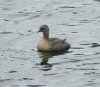
Poliocephalus rufopectus) - Always a pleasure to see, even if it is probably among the most drab-looking grebe species in existence. This species is most interesting to watch when it carries its small chicks on its back, but so far I have only seen this while I was a big distance away from them.
View attachment 476591
15) New Zealand Pipit (
Anthus novaeseelandiae) - This endearing passerine is not particularly rare, but because it has an overwhelming preference for quieter habitats, I am hardly ever able to look for it. Also, the pipit isn't always approachable when I finally do get to visit places where it is found, which can be frustrating.
16) Weka (
Gallirallus australis) - Anyone who has encountered wild weka can tell you that it is a species that is overflowing with personality, and it is tragic that the weka has a very restricted distribution in the North Island. I also find it to be interesting how the weka's predatory habits can make the presence of weka problematic for the conservation of other native bird species.
17) New Zealand Scaup (
Aythya novaeseelandiae) - The males of this species are especially beautiful, and I am glad that this species is fully protected. I also like how the male New Zealand scaup looks very different from the Australian hardhead, which could indicate that the scaup and hardhead are not sister species. The New Zealand scaup can be found in Zealandia in Wellington City, but it does not breed well there thanks to eels and falcons.
18) Eastern Reef-Heron (
Egretta sacra) - I have only seen this species in the Wellington City area, even though its numbers appear to be extremely small here. In my first year of birding, I saw this species on multiple occasions, and one of those times it was just a few minutes’ walk from my house. I don't think that I've had any definite sightings of this species since then, but I think that I had a possible sighting of an eastern reef-heron not far from my house just last year, and my heart sank when that unidentified heron disappeared right after I spotted it.
19) White-faced Heron (
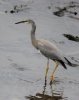
Egretta novaehollandiae) - Naturalists such as Tim Low think that it is a bad thing when a species naturally colonises a heavily-modified habitat, but at least in the case of this species, I don't care for that opinion. It is undeniable that the white-faced heron makes an important contribution to native bird presence in New Zealand's rural areas and suburban streams. Personally, I am glad that New Zealand now has a heron species that is so common that it is taken for granted.
View attachment 476594
20) Whitehead (
Mohoua albicilla) - Though not a particularly beautiful species, especially compared to the yellowhead (which I have yet to see), I still think that the whitehead is an interesting bird that is worth a frantic effort to photograph whenever it is near enough. Hopefully it will become more common and widespread as a garden bird in the North Island in the near future if invasive predator control becomes more successful.
Top 15 birds that have been recorded in New Zealand that I want to see (in no particular order):
1) Australasian Bittern (
Botaurus poiciloptilus)
2) Red-necked Avocet (
Recurvirostra novaehollandiae)
3) Hoary-headed Grebe (
Poliocephalus poliocephalus)
4) Pacific Heron (
Ardea pacifica)
5) Nankeen Kestrel (
Falco cenchroides)
6) Indian Ocean Yellow-nosed Mollymawk (
Thalassarche carteri)
7) Australian Shelduck (
Casarca tadornoides)
8) Fairy Martin (
Petrochelidon ariel)
9) Red-tailed Tropicbird (
Phaethon rubricauda)
10) Long-tailed Cuckoo (
Urodynamis taitensis)
11) Pacific Gull (
Larus pacificus)
12) Auckland Island Shag (
Leucocarbo colensoi)
13) New Zealand Fernbird (
Poodytes punctatus)
14) Australian Tern (
Gelochelidon macrotarsa)
15) Great Crested Tern (
Thalasseus bergii)




 Here are my top 20 favourite birds I've seen in Australia: