Trends in European zoo collections in the 21st century

A very interesting summary! It is nice that the overall number of mammal species in Europe did not decrease. However, with so many new institutions opening or growing, I would wish that it significantly increase!

I wonder how many mammal species were present in the European zoos in the year 1990 or 1980?
 
On non-declining mammal species number and busting another myth

While there have been a lot of changes in European zoo collections, the overall number of mammal species kept was not one of them. In 2000 there were 637-647 species and in 2023 640-644 species, which if you take the average for each year would mean 642 species kept both in 2000 and 2023. So even when taking the uncertainty into account there has been basically no change. Zootierliste will of course not have been 100% accurate, but it is the best available and I don’t see much reason to not believe that the number of mammal species kept in Europe has been stable compared to the start of the century. Data quality for the most species rich zoos is reliable for the start of the century and even if 10 species were missed (though apart from a few small rodents, I cannot think of any likely misses), that would be a fraction of the total. A hypothetical decrease of 10 species to the 642 now would be quite meaningless.

full

@Rhino00 Spinifex hopping mice are one species that could have still been present in low numbers in 2000, though it is more likely they had already disappeared before

Zoochatters did however overwhelmingly think that the number of mammal species had decreased. 74% of the people who filled in the questionnaire thought so and only 2 people (5%) predicted no change in the numbers, while 21% thought the number of mammal species kept had increased. The median expected change was a 13% decrease, which would have meant we would have had a net loss of some 83 mammal species this century, given we started off with ±642. Thankfully that did not happen. While there has been no change in the number of species held, most people who filled in the survey assumed that there would be more mammal species in Europe than there are in reality. The median expectation for 2000 was 800 and for 2023 was 723. So even with the expected decrease there was still an expectation of some 80 more mammal species in Europe currently compared to reality.

I think the most important reason for the overestimation is that it is genuinely hard to estimate these numbers, given that a lot of the diversity is hidden in rodents of which some zoos seem to have an endless amount. When making a list of captive mammals I had seen some years ago, I was also surprised how low my total was. Another factor, which was already mentioned by others is that Zootierliste also lists a plethora of subspecies, which further complicates estimating how many species are kept.

full

@Therabu Barbary lion are one of the many, sometimes questionable, subspecies listed in Zootierliste, obscuring the actual number of species

As to the why people expected a decrease where there is none, I think there are 4 main reasons, 3 of which will be discussed in detail in this post. The first is that it is a favourite pastime of many Zoochatters to bemoan the loss of animal species X from a zoo/country/continent. Such negative stories often seem to have a bigger impact than the positive ones, as it fits into the general narrative of the site. This creates a sort of echo chamber where every loss is a self-fulfilling prophecy of zoos in general allegedly not caring anymore about rare mammals. Gains are still applauded but just seen as a way to somewhat decrease the overall loss. Many species that are lost also have been kept for just a short period of time, so don’t really count on any longer time span. What also happens is that we already calculate for future losses, there are some 30 species which we know will disappear, even though it might take many years in some instances. But these dead ends are a normal thing and 23 years ago there was a comparable number of dead ends as now. Most of those have indeed disappeared, though some have left that category because of additional imports. Species disappearing has always been a common part of the European zoo landscape, but until now these losses were perfectly compensated with new species appearing in their place. Whether this will likely hold in the future will be covered the final mammal post.

full

@Jogy Eastern gorilla have been a dead end throughout the century, but could remain in Europe for another 20 years

Another part of the story seems to be how easy we forget that some species are relatively new. 24 years ago there were no black-and-rufous sengi, common cusimanse, greater guinea pig, Luzon giant cloud rats or Visayan warty pig in Europe. So while the gains from a few years back are taken for granted, the losses are bemoaned. The hard truth is that losses are just unavoidable in a world where the majority of mammal species is represented only by a few holders and a limited number of individuals. But that is also offset by gains, either from the private sector or overseas. It doesn’t do to focus only on one side of the equation.

full

@HOMIN96 While only around for 20 years, it feels like bush hyrax have been in Europe forever

Not only is there a common belief that there has been a decrease in mammals, it is also often assumed that the average zoo holds less mammal species compared to 2000. It makes sense to think that if individual zoos hold less species than before, there are also less species than before overall and if not that there are many more rarities now compared to 2000. This also seems to be a wrong assumption. I compared the listings from the International Zoo Yearbooks from 2003 (species data from 1998) with those from 2021 for some 220 European zoos. There actually seems to have been a slight net increase of mammal holdings on the continent in the past 25 years from 13.351 to 13.723 (+2.6%). This estimate is a conservative one as many zoos that are currently expanding at a high pace were tiny in 2000 and weren’t listed in the IZY back then and it is impossible to assess how many mammal species they did have at the time. So for zoos like Noah’s Ark Zoo Farm, Parc Animalier d’Auvergne or Parc Animalier de Sainte Croix, which each have sizable mammal collections now it is not possible to measure exactly how large their increase was. Another reason why the estimate is conservative is because some zoos have numbers listed for 1998, but not 2021. In those cases I have taken a quick Zootierliste search for all mammal taxa as a replacement. While this number includes possible doubling of subspecies, that is outweighed by ignoring domestics, which do seem to be included in the IZY numbers. Data in the IZY are of-course also not 100% accurate, I have the feeling certain zoos give higher numbers than they actually have/had, but that is as much the case for the 1998 as the 2021 data, so should overall not have an impact at the aggregated level.

full

@Gavial The growth of many French zoos has meant that for carnivores, primates and ungulates holding capacity has increased overall in Europe, with exhibits such as this takin valley in the Auvergne

The main reason for this difference between data and perception is probably caused by which zoos have actually had a net loss in species, compared to the zoos that gained species. Overall 91 zoos in the survey had a decrease in mammal species held, compared to 120 with gains. But looking at the ones which have lost species, the ones with the biggest losses are also some of the most known. With Zoo Berlin, Tierpark Berlin, Antwerp, Marwell and Blijdorp as top-5 and other big names such as Artis Amsterdam, London, Wilhelma, Paris Zoo des Vincennes, Leipzig, Lisbon and Munich in the top-25 it is no surprise people think there has been a serious loss. The top-25 of zoos that have gained species is much more varied. It contains the nouveau riche like Pairi Daiza, Sosto and Beauval, but also more under the radar zoos like Beale, Osnabrueck, Opole and Monde Sauvage. But responsible for about half of the overall net gain is Zoo Plzen. While Zoo Plzen is now known as a rarity hunter Valhalla, that only started around the turn of the century, back in 1998 Zoo Plzen had only 48 mammal species. Currently it is the most mammal species rich zoo of them all. While overall the number of mammal holdings has slightly increased, the number of mammals at the most species rich zoos has decreased. While both Berlins had over 200 mammal species each in 1998, no zoo topped 170 in 2021. The number of zoos with more than 100 mammal species has also decreased from 19 to 11 this century. But the median zoo in 1998 held 47 species, compared to 51 species now. So big losses at the top are compensated by smaller gains across the board. Looking at a country level, e.g. Czechia and France have seen a large net gain, whereas Germany has seen a sizable net loss, whereas the United Kingdom is relatively stable. In the Netherlands losses in the 4 big zoos are compensated by the appearance of new zoos (Overloon & Gaiazoo) and gains in other zoos.

full

@Green_mamba The nouveau riche like Pairi Daiza and many smaller zoos have compensated for species richness losses in the city zoos of old

In the next post we will explore which families & orders have made the largest gains and losses. Given some of the most notable losses have occurred in the most popular orders, this is probably another reason why many people expected a decrease in the number of mammal species held. But that is a story for another time.
Vincennes (Paris zoo) is an interesting exemple.
In the late 20th century they claimed to have 140-150 species (only mammals and birds with a few reptiles). After a period of decline and a complete closure (2008-14) it reopened.
Now there are more species (255 officially numbered), but we cannot hide that the zoo get rid of many species formerly present, including elephants, hippos, tigers or bears, that may be perceived as a net decrease in species diversity.
 
A very interesting summary! It is nice that the overall number of mammal species in Europe did not decrease. However, with so many new institutions opening or growing, I would wish that it significantly increase!

I wonder how many mammal species were present in the European zoos in the year 1990 or 1980?

I think 1990 or 2000 doesn't make a big difference, I have looked quickly at data for marsupials, primates, carnivores and ungulates and those numbers are very comparable between 2000 and 1990. 1980 and earlier might be somewhat higher as there were many more rare imports around, but on the other hand the number of zoos with special animals was lower too. But species numbers those days were really just numbers, which didn't mean much as the vast majority were rarely kept.

While it would be nice to see more species and it would be possible, there are a good number of species that have a larger number of holders these days. If increased holding capacity means more space for the same rare species that is also good long term as it increases the resilience of those populations. For long term stability there are still far too many small and fragile populations.
 
Last edited:
The hard truth is that losses are just unavoidable in a world where the majority of mammal species is represented only by a few holders and a limited number of individuals.

While Zoo Plzen is now known as a rarity hunter Valhalla, that only started around the turn of the century, back in 1998 Zoo Plzen had only 48 mammal species. Currently it is the most mammal species rich zoo of them all.

Two questions. @lintworm you often mentioned that we will see if species XYZ has a future in Europe or not. (or something similar). Do you have a number how many species are within this category?

Second one. Do you have a number for the mammals kept at Plzen currently? It seems mean to not mention this here :p ;)
 
Second one. Do you have a number for the mammals kept at Plzen currently? It seems mean to not mention this here :p ;)

Actually it´s not so high number - I counted 183 "good" mammal species kept at Plzen at 31st Dec. 2022 according to its yearbook (excluding all domestics or multiple subspecies listed). The zoo lost and aquired a few during 2023 thus I think it should still have around 180 now.

I hope they will add a few when/if they will start construction on the newly acquired land.
 
Last edited:
Two questions. @lintworm you often mentioned that we will see if species XYZ has a future in Europe or not. (or something similar). Do you have a number how many species are within this category?

No I don't, but it is a big group, maybe 30%-50% of all mammal species currently kept in Europe. It is a given that now, as in the past, many species kept in Europe are only around because one or a few zoos are interested in them or growing the population is so hard that with some bad luck the population could disappear in 10-20 years. Most of such species are not EEP managed but some like bear cuscus or Balabac chevrotain are. If something happens unexpectedly (genetic bottleneck, skewed sex ratio, unsuccessful pairings etc.) or the few zoos supporting this species drop out, such species can quickly disappear. But this has always been the case and while I cannot back it up with data, my feeling is that the single most important reason whether a species is around or not, is interest of 1-5 curators/directors for individual species.
 
But this has always been the case and while I cannot back it up with data, my feeling is that the single most important reason whether a species is around or not, is interest of 1-5 curators/directors for individual species.

This is something that will be difficult to measure, but I think you are right. And this is not just with zoo animals, but also in conservation. Some species are still around because of the dedication of one person. Which is something EAZA has recognised:

Zooquaria-88-LR.pdf (eaza.net)

In a handful cases it might even be a private keeper passionate about a species that ensures that a species is still around in zoos as this person keeps providing it to zoos. And I think this dependence on a single person or a small group of people is recognised. Just how to mitigate it, is very difficult. A single job change or retirement can be the end of a species in Europe.

It might be interesting to see if the amount of papers published (and maybe even specialised grey literature) on a species correlates to it's sustainability in human care.
 
Families & order trends

Today it is time for some “boring” number crunching, don’t expect too much in terms of fancy analyses, this one is for the nerds ;).

In total some 880 mammal species have been present in Europe at some point this century. That means that of the whole pool some 73% of all mammal species kept this century are present in zoos now. Another 103 were kept in 2000, but not currently and some 128 species were gained this century, but subsequently lost. Small mammals had the highest turnover rate, only 67% of all insectivores and 72% of all rodents kept currently were also present in 2000. The most stable orders were odd-toed ungulates and the 2 xenarthran orders of armadillos and sloths + anteaters. Some other orders also didn’t see any change between species present now and in 2000, but those are typically represented by a single species like monotremes and sea cows. The larger orders saw a quite average level of stability, with a large number of species present in 2000 being still kept in 2023: carnivores (89%), even-toed ungulates (88%) and primates (83%).

full

@Therabu While remaining stable in species numbers, 2/3rds of the xenarthran species have added a significan number of holders, including the great hairy armadillo

21 of the 22 orders have been present throughout the century, only the pangolins were a gain this century and given the interest in further imports and the first breeding success in Prague, they will likely remain around for the foreseeable future. If greater bilby ever make it to Europe a 23rd order will be represented, but given the absence of the other mammal orders in captivity, this is the realistic maximum.

full

@Hix The Australian version of votsotsa would be more than welcome in Europe

There are a few orders that have made huge relative gains: dasyuromorphs (from 2 to 4), sengi (from 1 to 3) and hyraxes (from 1 to 4) have doubled/tripled/quadrupled in representation. If you look at the number of of species gained, most species were however gained by carnivores (+13) and rodents (+12 - +14). The diprotodonts (kangaroos, wombats and the like) also had a net gain of 4 species, and opossums too (+2). Apart from the 8 orders gaining species, 8 didn’t see any net change and 6 orders had a net loss. Percentually seen the tree shrews saw the largest loss from 3-4 to just a single species (-67% - -75%). The largest net loss in terms of number of species comes non-surprisingly from the primates with 20-23 species lost; even-toed ungulates (-9) and cetaceans (-4) were the other order with a large net loss. Insectivores, elephants and bats all saw a net loss of 1 species.

full

@GregOz Langurs have been leading the decline of primate species in Europe, with over 1/3 of losses (8 species) caused by these leaf-eating monkeys, like this mitered leaf monkey

When moving to the families, 106 different ones have been kept this century of which 93 were present in 2000 and only a single family of those 93 was lost: South American river dolphins. With pangolins, birch mice, spalacids, ring-tail possums and vespertilionid bats 5 families were gained, so 97 mammal families are around now. An additional 8 families have been present this century but neither in 2000 nor in 2023, including tarsiers, dassie rats and moles. All those temporarily present families were only represented by a single species this century.

full

@ro6ca66 Ringtail possums were one of the gained families this century, though this family is still limited to Hamerton

The families with the biggest gains are the murid rodents (+11), viverrids (+6), squirrels (+4) and mongooses (+4). Another 28 families saw gains too this century. When looking at percentages the increases of sengi (+200%), hyraxes (+300%), mongoose (+67%), Malagasy carnivores (+67%) are the most impressive, apart from a number of families doubling their presence from 1 to 2 species including chevrotains and mole rats. 43 families saw no net changes in terms of species held in 2000 and 2023. Many of those are small, but cats (30 species), capuchins & squirrel monkeys (9 species), bears (8) species and equids (7 species) are the largest to have remained stable in species numbers (though not necessarily with the exact same species). 23 families had a net loss of species, of which unsurprisingly the net loss of 14 species in the Old World monkeys is the largest. Bovids (-8), cricetids (-7), flying foxes (-3) and dolphins (-3) follow in the list of families with the largest declines. Looking percentually the largest declines came from the tree shrews (-67% - -75%), gliders (-50%), sakis (-40%), apart from the red pandas and pacas that went from 2 to 1 species each.

full

@gentle lemur Lesser tree shrew was one of the 2-3 tree shrew species lost from Europe this century

The relatively strong decrease of primates and bovids might be an indicator as to why many people thought there would be a decrease overall, even though carnivores and rodents alone compensate for the losses. The decline in primate species numbers (some 13%) is the median decrease expected at the start, but is thus the largest net loss of a single order, not of all mammals. While the absolute increases are rather small (sum of +10), the marsupial orders, hyraxes, pangolins and sengi have become a lot more common, with the biggest losses occurring in the biggest orders and families, there has been an overall increase of diversity, even when species richness remained stable. The tree-shrews are the exception being the only “exotic” small mammal order with a large number of losses.

full

@robreintjes Apart from the new species appearing, plenty of oddball species that were already present like aardvark have made gains too.

In the coming posts we will look in some more detail at what kind of species have gained popularity/appeared and which ones were lost or decreased in popularity.
 
Origin matters

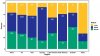
While there are differences between how the different mammal families and orders have fared, there is also considerable geographical bias when comparing the winners and losers. For this post I have made a list of the 739 species that were either present in 2000, in 2023 or both. This means all the gained-and-lost species as well as species whose status is unclear were excluded. For each species I noted the region(s) in which they primarily occur. For some species that occur in multiple regions, I only noted a single region as the European zoo animals belong to a subspecies unique to a single region, e.g. the harbour seals in Europe are all of the European subspecies. I used a mix of continents and biogeographical zones, so New Guinea and Australia are under Oceania, but the parts of Indonesia east of the Wallace line are included under Asia, sorry bear cuscus… I also used North America and Latin America (South America + Central America + Caribbean) as regions, as I felt most tropical Central American species fit better with their southern counterparts. This is no hard science and they are certainly not “correct” geographical divisions and there are always some cases whose placement is debatable. But overall it gives a pretty good overview of where the winners and losers come from. I divided all species into 3 categories: winners (gains, species gaining popularity), stable and losers (losses, dead ends & species losing popularity). Using the original categories (e.g. dead ends or gains) isn’t informative as the sample size gets too small, so you get results driven by a few species.

Regionaldifference.jpeg
Figure 1: Overview of the percentage of winning/losing/stable species per region and all regions compared. The white numbers indicate the individual number of species per category (e.g. Africa - Winner contains 95 species)

With 249 African species and 244 Asian species (includes double counting of e.g. lions and caracals) these 2 regions were home to the most species, followed by Latin America with 142 species. Europe with 77 species, North America with 58 species and Oceania with 45 species were the regions with the poorest representation in absolute numbers, apart from the species with a predominantly (sub-)polar distribution (6 species).

Of all species combined 33% were winners, 26% losers and 41% remained stable (Figure 1). 2 regions had clearly more winners than the mean: Africa (38%) and Oceania (48%). The gain for Africa is strongly driven by the increased popularity of Malagasy species, but also for species restricted to mainland Africa there were relatively more winners (39%). The Oceania percentage is most strongly driven by Australian endemic species (53% winners) and New Guinean species (50%) winners. The regions with the smallest number of winners were the polar region (17%), North America (17%) and surprisingly Europe (18%). Asia (26%) also had less winners than average, whereas Latin America was more average (34%).

full

@Fallax Dusky pademelon are one of the big winners of the Oceanian invasion in European zoos

Whereas Europe had a surprisingly low number of winners, the number of losers was even lower (9%). The percentage of losers was also somewhat lower than average for Africa and Oceania (both 24%). North America (24%) and Asia (28%) were somewhat average, whereas Latin America (32%) and the polar regions (67%) had a higher than average number of losers. The percentage of stable species was highest for Europe (72%) and North America (59%), but also somewhat higher in Asia (48%). With 41% Africa is completely average, whereas Latin America (34%), Oceania (31%) and the polar regions (17%) have a below average number of stable species, though in the polar case much can be attributed to the small sample size.

The gain of Oceania can be easily understood, multiple zoos have invested heavily in Australian-themed exhibit complexes and these animals are thus the big winner of more heavy geographical theming. At the start of the century only very few zoos had anything that looked remotely like a worthy Australian complex, but nowadays these are, while still uncommon, spreading rapidly. In the past years alone Stuttgart, Copenhagen and Prague have opened some relatively species rich areas and Hamerton alone is responsible for the import of multiple Australian species the past decade.

Africa has profited not only from an increased interest in Madagascar (lemurs & euplerid carnivores), but also from the import and establishment of a sizable number of smaller species. From tree hyrax to black-and-rufous sengi to a range of rodents, the diversity of African species has increased. It also helps that primate species, the group with the biggest losses, constitute only 20% of the mainland Africa species kept in Europe this century. While there have been some ungulate losses, overall there have been more winners (19) than losers (9) when it comes to ungulate species from Africa, because quite some species already present in 2000 have become a lot more common.

full

@hmb_zoo While primates have seen some heavy losses, the lemurs have as a group gained considerable popularity

That Latin American species do so poorly compared to the other big tropical regions (Africa & Asia) can be explained by how many of Latin American species in Europe are primates (37%) and primates are the group with the biggest losses. For the other groups Latin American species are quite comparable to Old World species. Although there is a trend that some of the most widespread American species are losing popularity like collared peccary, puma and nine-banded armadillo. There is a tendency to think that North American species are on the losing side, but the vast majority hasn’t seen much of a change in status, though there are clearly more losers than winners. The majority of North American species, even the stable and winning species tend to be relatively rare though. Of all North American winners it is only the North American porcupine that has become significantly more common and lost rarity status along the way.

full

@Therabu While counted as a stable species bighorn sheep numbers now are just as small as 24 years ago

Contrary to what I expected there were overall less European species gaining popularity than average. But they still improved as even less were lost/losing. That the overwhelming majority is stable can partly be explained by the typical wildpark species from red deer to pine marten which haven’t seen any change. There are some small gains visible with European rodents, but less than I anticipated. Asia has also been more stable than the average. This higher stability can mostly be explained by Eurasian species from Eurasian lynx to mountain hare which haven’t seen any meaningful change in their status. Whereas Asian carnivores were among the biggest winners of them all, this was compensated by Asian ungulates not profiting as much as e.g. the African ungulates and only 7 Asian primates were considered winners, whereas 11 Asian primate species were lost this century and 5 are a dead end.

full

@GregOz The purple-faced langur was one of the many primate casualties this century

Overall there are some trends apparent when looking at the origin of mammal species, but they are far from the complete picture. In the next posts we will look at IUCN status, EEP status and weight as possible factors explaining the trends that we see in European zoo mammals.
 

Attachments

  • Regionaldifference.jpeg
    Regionaldifference.jpeg
    61.6 KB · Views: 253
I also used North America and Latin America (South America + Central America + Caribbean) as regions, as I felt most tropical Central American species fit better with their southern counterparts. This is no hard science and they are certainly not “correct” geographical divisions and there are always some cases whose placement is debatable.
They may not be the "correct" geographical divisions, but I would certainly argue they are correct zoogeographical ones. Central America has way more in common with South America species wise, hence why they are considered the Neotropics and not the Nearctic.
 
It is worth mentioning that both Australia and Madagascar for decades had a total ban on export of native wildlife, which seems to be eased only around 2000.

Something as common in the wild as galah was practically absent in European zoos for much of the second half of the 20. century.
 
@lintworm this thread doesn't stop to amaze me!

Some thoughts on the last post. I'm not sure if continents are the best option to find out why some species are gaining or loosing popularity.

I wonder if there would be a difference if you look after zoogeographic regions instead of the continents. Especially for Asia, with it's wide variety of eco systems. I can't prove it, but i think that many of the Asians species gaining popularity are at least to some point cold temperature tolerate ones.

This explain iMo also the stable North American stuff. While they are pretty sure on the decline in major zoos, many smaller or private zoos still keeps them, as they don't need heated stables.
 
@lintworm this thread doesn't stop to amaze me!

Some thoughts on the last post. I'm not sure if continents are the best option to find out why some species are gaining or loosing popularity.

I wonder if there would be a difference if you look after zoogeographic regions instead of the continents. Especially for Asia, with it's wide variety of eco systems. I can't prove it, but i think that many of the Asians species gaining popularity are at least to some point cold temperature tolerate ones.

This explain iMo also the stable North American stuff. While they are pretty sure on the decline in major zoos, many smaller or private zoos still keeps them, as they don't need heated stables.

Using biogeographical regions instead of my arbitrary reasons was indeed an option, but I opted for a more continental approach first and once I though of changing that would have been too much work. I initially chose against biogeographical regions, because especially for Asia there are a lot of species which overlap between regions and I felt that that number was far larger than when just splitting Europe from Asia.

There is not really proof for the Asian species that gain popularity being more cold tolerant. Of all holarctic or Eurasian species only wolverine gained in popularity, and all but one other (marbled polecat) fitted in the stable category. The same goes for species occuring both in Asia & Africa, which are also often quite cold tolerant (e.g. lion, striped hyena & caracal). The Asian species making gains are a mix between cold-tolerant species and tropical species. With ungulates the cold-tolerant species have the edge, but with carnivores and primates there is a bias towards tropical species. There have been substantial imports from Indonesia and the Philippines this century. Together with Madagascar these 2 island nations might have seen the biggest increase in representation of them all.
 
Such interesting information! One of the things I had no idea about before joining the forum (and built on by this thread) is how much the preference of collection managers drives what’s included particularly among smaller animals. I suppose I had the amateur view that this was all managed in some vast library and centrally controlled (in the major zoos anyway) but in a sense even with breeding programmes zoos have a hang over from their collect a menagerie days.

If I may ask a daft question though as I haven’t seen it specifically mentioned (or I’ve missed it) but has the trend towards keeping animals differently (in larger enclosures or different spaces) fundamentally impacted what is kept or have populations just shifted about to zoos who could hold animals appropriately?

Thinking of say Dudley whose polar bear enclosure now has foxes or other bear enclosure has wolverine but elsewhere there are more polar bears in other places.

I did wonder if some species have changed or declined due to animal management changes specifically or whether that’s just a minor thing or just one factor among many? The impact of husbandry and enclosure / enrichment design on what is kept interests me when I consider the enclosures I’m looking at on visits or comparing to the top 100 ratings etc so I wondered if there was a direct correlation to population changes.
 
If I may ask a daft question though as I haven’t seen it specifically mentioned (or I’ve missed it) but has the trend towards keeping animals differently (in larger enclosures or different spaces) fundamentally impacted what is kept or have populations just shifted about to zoos who could hold animals appropriately?

There is no easy answer for that. In general it is the historically important (city) zoos that have lost species (though there are exceptions like Cologne & Prague) this century. While smaller zoos have gained species as have Czech & French zoos (in France the historical city zoos like Paris & Mulhouse still lost species) in general. So while there is indeed a decline in large species kept in older zoos, this is mostly compensated by other places, such as with many antelopes or elephants. In the case of polar bears and common hippos this compensation was smaller than the loss, but with e.g. black and Indian rhino the compensation was larger than the loss. (More on that here: Trends in European zoo collections in the 21st century).

On a case by case basis you can argue that there are species that profit from the increase in mixed-species enclosures (lowland tapir, sloths) or walkthroughs (lemurs, some S-American primates). There are also signs that with traditional taxonomic displays becoming rarer the species rich primate houses & ungulate paddock rows are disappearing. But in the primate case many species losses were unavoidable as they are a leftover from the time when importing wild-caught animals was still regular. Most of those species lost never had anything of robust population to speak of, so it is hard to disentangle those things.

There might be an argument that a reason for the increase of the xenarthrans, afrotherians, marsupials and some larger rodents is due to the increase in geographically themed complexes. Such complexes typically aim to show a bit of everything, so while that means less ungulates or primates per zoo, it means some space is reserved for the zoological oddballs. This is just a hypothesis and I have no means to actually prove it.

There are some more factors (potentially) at play but I will cover them in the next posts.
 
There is no easy answer for that. In general it is the historically important (city) zoos that have lost species (though there are exceptions like Cologne & Prague) this century. While smaller zoos have gained species as have Czech & French zoos (in France the historical city zoos like Paris & Mulhouse still lost species) in general. So while there is indeed a decline in large species kept in older zoos, this is mostly compensated by other places, such as with many antelopes or elephants. In the case of polar bears and common hippos this compensation was smaller than the loss, but with e.g. black and Indian rhino the compensation was larger than the loss. (More on that here: Trends in European zoo collections in the 21st century).

On a case by case basis you can argue that there are species that profit from the increase in mixed-species enclosures (lowland tapir, sloths) or walkthroughs (lemurs, some S-American primates). There are also signs that with traditional taxonomic displays becoming rarer the species rich primate houses & ungulate paddock rows are disappearing. But in the primate case many species losses were unavoidable as they are a leftover from the time when importing wild-caught animals was still regular. Most of those species lost never had anything of robust population to speak of, so it is hard to disentangle those things.

There might be an argument that a reason for the increase of the xenarthrans, afrotherians, marsupials and some larger rodents is due to the increase in geographically themed complexes. Such complexes typically aim to show a bit of everything, so while that means less ungulates or primates per zoo, it means some space is reserved for the zoological oddballs. This is just a hypothesis and I have no means to actually prove it.

There are some more factors (potentially) at play but I will cover them in the next posts.

Thanks! Such a complex topic, great to hear your thoughts. The complexes with multiple species / walkthroughs and mixes are fascinating as a visitor (for me anyway) but it would be less enjoyable in a way if it were making a zoo or collection poorer. This all shows zoos are always advancing which I suppose is the trend debate we are seeing the most as sometimes there is a suggestion things are going backwards but really they are just changing and evolving against a whole host of complexities. Certainly makes one appreciate the effort that goes in at a great collection.
 
There are also signs that with traditional taxonomic displays becoming rarer the species rich primate houses & ungulate paddock rows are disappearing.

I doubt that you intended it, but now i understand my misleading thought about asian cold tolerate animals. Many zoos switching to a geozoo opened smaller Himalayan areas quite recently. However most of them only shows 3-5 different species.
 
Just wondering, will this thread be continuing to include exotic birds or reptiles trends in European zoos? I'm Aussie, but have found this thread actually rather interesting to read through :)
 
Back
Top