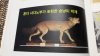
Quote from IUCN dhole page:
"As of August 2013, there were at least 223 Dholes in 38 zoos worldwide (International Species Information System [ISIS] unpubl.), including zoos in Europe (24 zoos), Asia (nine zoos), North America (four zoos), and Australia (one zoo). There also are captive Dholes in additional zoos and breeding farms which are not members of ISIS. The origin of most captive Dholes is unclear, and their subspecific classification is probably wrong. The most numerous subspecies in captivity is listed as C. a. lepturus, which occurs in at least 20 zoos worldwide and is the most common Dhole in European zoos. Firstly, inbreeding may be an issue because captive Dholes listed as lepturus trace their origin to only three founders: a single Dhole from a game farm in North America with an unknown origin (H. Maisch pers. comm.), and Dholes from the Moscow Zoo, which originated from only two individuals captured in Qinghai Province, China in 1957 (Sosnovskii 1967). Secondly, the Dholes captured in Qinghai Province should represent either C. a. hesperius or C. a. fumosus, from the putative northern Dhole group, rather than lepturus which historically occurred only south of the Yangtze River and is part of the southern Dhole group (Durbin et al. 2004). The putative southern Dholes are represented in several Indian zoos (probably C. alpinus dukhunensis), and in zoos in Phnom Penh, Cambodia, and Sydney, Australia (C. alpinus infuscus). Other zoos do not list subspecies, thus it is likely that putative subspecies from different origins have been interbred (M. Boeer pers. comm.), such as that done in Singapore Zoo. The European Endangered Species Programme (EEP) does not consider subspecies, but it does regard Dholes in European zoos as a Chinese ecotype, and prevents mixing this type with Dholes from other origins (e.g., India, Cambodia). Nevertheless, the value of any of captive Dholes for potential reintroduction efforts is uncertain, at least until genetic studies can confirm their origin and subspecific classification. Until that time, we recommend that captive Dholes from the putative northern and southern groups be managed separately, such as that done by the EEP."