Undescribed, Rediscovered and New Species in Zoos and Aquariums

In general (not just in zoos and aquaria), there are many species kept by private collectors that are currently undescribed (many of them being fish and invertebrates). One animal that comes to mind is the Rubber duckie isopod (Cubaris sp.) from Southeastern Asia (there's other relatives that are also undescribed). Spotlighting them because I find these critters adorable.
good-humidity-percentage-for-rubber-ducky-isopods-v0-l3wsyx5xucc81.jpg
 
In general (not just in zoos and aquaria), there are many species kept by private collectors that are currently undescribed (many of them being fish and invertebrates). One animal that comes to mind is the Rubber duckie isopod (Cubaris sp.) from Southeastern Asia (there's other relatives that are also undescribed). Spotlighting them because I find these critters adorable.
good-humidity-percentage-for-rubber-ducky-isopods-v0-l3wsyx5xucc81.jpg
These Cubaris sp. cause me a fair bit of concern... High value in the private trade, various undescribed species seem to be available entirely or largely as wild caught stock, no regulations on export- strikes me as a recipe for disaster further down the line. Yes isopods are likely to have a higher level of offtake that can be sustained than say, turtles or Poecilotheria tarantulas, but we have literally no data on that.
 
Hopefully reviving the thread cause I like topics like this,
Recently a paper came out that officially described Betta iaspis and Betta mulyadii. Both species were pretty available in the aquarium hobby prior to being described. B. iaspis was known as "Betta sp. Jade" which I did see quite a lot for sale, and B. mulyadii was known as "Betta sp. Apiapi", which I didn't see as often as "Betta sp. Jade" but it still popped up time to time.
Another paper came out describing 7 new species of Freshwater Crayfish that were described from Western Indonesia, it mentions some of them already being in the hobby prior to being described, but I'm not involved with that side so I don't know much about it.

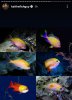
It's also not surprising given that it's Okinawa Churaumi, but they currently have an undescribed species of Selenanthias on exhibit in one of their Mesophotic Reef Tanks, saw Yi-Kai Tea (famous ichytologist from the Australian Museum) post it on his Instagram since he's in Japan at the moment, it's the one of the bottom right corner. Would love to see this one get described soon
Screenshot_20250616_200617_Instagram.jpg
 

Attachments

  • Screenshot_20250616_200617_Instagram.jpg
    Screenshot_20250616_200617_Instagram.jpg
    68.9 KB · Views: 159
There are a lot of undescribed fish species kept in aquariums, including many that have been popular in the fishkeeping hobby for decades (this is especially the case for rift lake cichlids and loricariid catfishes)!

Just the ones I have seen in captivity:
  • Western Japanese Spined Loach Cobitis sp. BIWAE type B
  • Gold Laser Cory Osteogaster. cf. aenea "Gold Laser" (variously considered a variant of the true O. aenea or an undescribed species)
  • Red Lizard Whiptail Catfish Rineloricaria sp. L010a
  • Lemon Blue-eye Bristlenose Ancistrus sp. L144
  • Orinoco Angel Pleco Hypancistrus sp. L201
  • Chocolate Zebra Pleco Hypancistrus sp. L270
  • King Tiger Pleco Hypancistrus sp. L333
  • Leopard Cactus Pleco Hypancistrus sp. L600
  • Alenquer Tiger Pleco Panaquolus sp. L397
  • Tiger Pleco Panaquolus sp. L002
  • Aobara-yoshinobori Rhinogobius sp. BB
  • Oumi-yoshinobori Rhinogobius sp. OM
  • Black Tropheus Tropheus sp. "Black"
  • Red Tropheus Tropheus sp. "Red"
  • Taiwan Reef Hap Protomelas sp. "Steveni Taiwan"
  • Mbenji Thick Lips Protomelas sp. "Mbenji Thick Lips"
  • Acei Cichlid Pseudotropheus sp. "Acei"
  • Hippo Point Salmon Ptyochromis sp. "Hippo Point Salmon"
  • Australian White Trevally Pseudocaranx cf. dentex (may be a synonym of the true African P. dentex)
  • Coral Sea Anthias Pyronotanthias cf. aurulentus "Coral Sea"
  • Magochi Platycephalus sp. 2
  • not a species but a subspecies, Hariyo Gasterosteus aculeatus ssp. 2
  • Tomiyo (freshwater type) Pungitius sp. 1 (potentially belonging to G. sinensis)
  • Coral Sea Twin Butterflyfish Prognathodes cf. geminus
Plus many taxa that likely represent cryptic species complexes but are yet to be "officially" split, such as many anemonefishes Amphiprion sp., Striped Eel Catfish Plotosus lineatus and South Pacific Lyretail Anthias Pseudanthias cf. cheirospilos
 
This is a related topic but I also believe a majority of the Crown-of-Thorn's Stars that are in human care are actually a species that is being revived taxonomically (or attempted to be revived soon). They're called the Pacific Crown of Thorns (Acanthaster cf. solaris). They're all labeled as Acanthaster planci since that was considered the only species for a long time until they decided to separate all of the species. True A. planci are much more colorful, usually a dark purple and red color scheme, and have a different body shape. The solaris species got axed a long time ago, but new research is coming out that will hopefully revive that species taxonomically wise since both species have different distributions. It's hard to look up images of them since they're not a valid species (yet), but the picture from the Aquarium of the Pacific website shows what I'm talking about, and comparing it to a true A. Planci, they are vastly different. True A. Planci on the top, A. cf Solaris on the bottom.
URL="Crown-of-thorns Starfish - ZooChat"]https://www.zoochat.com/community/data/xengallery/739/739451-2fad91b755e79

Screenshot_20250621_001649_Chrome.jpg
Pacific Crown of Thorns seem to be very round, either a light or brown dark green, and have stubby arms. Aquarium of the Pacific has a couple on exhibit now that I might see if I make the drive next week, and Point Defiance Zoo will have some when their Coral Reef exhibit is open that I will definitely see. Point Defiance actually has their's labeled as just "Acanthaster spp.", so they must be aware of the taxonomic change going on. Interesting to see if they update it accordingly, but this could under the category of undescribed / in the process of re-describing?
 

Attachments

  • Screenshot_20250621_001649_Chrome.jpg
    Screenshot_20250621_001649_Chrome.jpg
    81 KB · Views: 138
This is a related topic but I also believe a majority of the Crown-of-Thorn's Stars that are in human care are actually a species that is being revived taxonomically (or attempted to be revived soon). They're called the Pacific Crown of Thorns (Acanthaster cf. solaris). They're all labeled as Acanthaster planci since that was considered the only species for a long time until they decided to separate all of the species. True A. planci are much more colorful, usually a dark purple and red color scheme, and have a different body shape. The solaris species got axed a long time ago, but new research is coming out that will hopefully revive that species taxonomically wise since both species have different distributions. It's hard to look up images of them since they're not a valid species (yet), but the picture from the Aquarium of the Pacific website shows what I'm talking about, and comparing it to a true A. Planci, they are vastly different. True A. Planci on the top, A. cf Solaris on the bottom.
URL="Crown-of-thorns Starfish - ZooChat"]https://www.zoochat.com/community/data/xengallery/739/739451-2fad91b755e79

View attachment 802357
Pacific Crown of Thorns seem to be very round, either a light or brown dark green, and have stubby arms. Aquarium of the Pacific has a couple on exhibit now that I might see if I make the drive next week, and Point Defiance Zoo will have some when their Coral Reef exhibit is open that I will definitely see. Point Defiance actually has their's labeled as just "Acanthaster spp.", so they must be aware of the taxonomic change going on. Interesting to see if they update it accordingly, but this could under the category of undescribed / in the process of re-describing?
I had assumed the Acanthaster in Australian facilites were A. cf. solaris as thats the local taxon, but good to have something to back that up! I wonder if any other taxa are around in captivity? I believe the reason it's called cf. solaris rather than just solaris is that the original description of A. solaris doesn't note a type locality (or, of it does, there is reason to doubt that is truly the type locality) so it is difficult to ascertain whether the A. solaris description is truly referring to the central Indo-Pacific population now called cf. solaris.
 
A potentially new species of Butterflyfish has entered the aquarium trade thanks to a recent influx from a collection trip. Fenton's Butterflyfish (Prognathodes cf. geminus) / "(Prognathodes diaphanes)" (is the latin name they're currently labeling it as) is found in New Caledonia. Collected by Tim Bennett (famous Australian diver who does a lot of work in collaboration with the California Academy of Sciences as an example) collected a couple juveniles at 132m depth. There's barely any record of it, but the theory is that it was just brushed off as a regional variant of the Gemini Butterflyfish (Prognathodes geminus), who itself was only described in 2019. However, the two species are found in different locations (Gemini is found in Palau). Yi-Kai Tea from the Australian Museum is currently working on it's description.
But the juveniles that were collected were sent to Quality Marine (a wholesaler in LA), so there's currently 2 or 3 juveniles in the aquarium trade now. One of which was purchased by Andrew Sandler (the guy with the 17,000 Gallon home aquarium in New York, there's a good chance you've seen his tank(s) before) and he uploaded a video of it's arrival. There was also a little piece about it in the aquarium hobby magazine, "CORAL", in it's latest issue i read.
Really excited to see how many more Mesophotic species are coming to light, I'd guess there's a good chance we could see this one on exhibit at the California Academy of Sciences in the near future.

There's also a new, undescribed species of Cleaner Wrasse collected from the same location and similar depth that was also given to Quality Marine. Currently just called "Bennett's Cleaner Wrasse" (after Tim Bennett), it's appearance is vastly different from the other Cleaner Wrasse species. Would love to see this one someday as well. Can't wait for the official description of both of these species.
20250703_122537.jpg
 

Attachments

  • 20250703_122537.jpg
    20250703_122537.jpg
    194.8 KB · Views: 109
A potentially new species of Butterflyfish has entered the aquarium trade thanks to a recent influx from a collection trip. Fenton's Butterflyfish (Prognathodes cf. geminus) / "(Prognathodes diaphanes)" (is the latin name they're currently labeling it as) is found in New Caledonia. Collected by Tim Bennett (famous Australian diver who does a lot of work in collaboration with the California Academy of Sciences as an example) collected a couple juveniles at 132m depth. There's barely any record of it, but the theory is that it was just brushed off as a regional variant of the Gemini Butterflyfish (Prognathodes geminus), who itself was only described in 2019. However, the two species are found in different locations (Gemini is found in Palau). Yi-Kai Tea from the Australian Museum is currently working on it's description.
But the juveniles that were collected were sent to Quality Marine (a wholesaler in LA), so there's currently 2 or 3 juveniles in the aquarium trade now. One of which was purchased by Andrew Sandler (the guy with the 17,000 Gallon home aquarium in New York, there's a good chance you've seen his tank(s) before) and he uploaded a video of it's arrival. There was also a little piece about it in the aquarium hobby magazine, "CORAL", in it's latest issue i read.
Really excited to see how many more Mesophotic species are coming to light, I'd guess there's a good chance we could see this one on exhibit at the California Academy of Sciences in the near future.

There's also a new, undescribed species of Cleaner Wrasse collected from the same location and similar depth that was also given to Quality Marine. Currently just called "Bennett's Cleaner Wrasse" (after Tim Bennett), it's appearance is vastly different from the other Cleaner Wrasse species. Would love to see this one someday as well. Can't wait for the official description of both of these species.
View attachment 805380
Both of these species are already in the Zoochat galleries, photographed by yours truly!

Undescribed wrasse species (Labroides?) - ZooChat

Twin Butterflyfish (Prognathodes geminus) - ZooChat

I'd uploaded the butterflyfish before I was aware it was distinct from P. geminus, so it's labelled as that, but the specimens was collected from the Coral Sea so it will be a Fenton's Butterflyfish.
 
Both of these species are already in the Zoochat galleries, photographed by yours truly!

Undescribed wrasse species (Labroides?) - ZooChat

Twin Butterflyfish (Prognathodes geminus) - ZooChat

I'd uploaded the butterflyfish before I was aware it was distinct from P. geminus, so it's labelled as that, but the specimens was collected from the Coral Sea so it will be a Fenton's Butterflyfish.

Is the consensus for the wrasse still that it is a hybrid? Or rather a new species.
 
A species of Jelly that was just described last month, the Blue Ring Spotted Jelly (Phyllorhiza yurena) was being kept at the Ningbo Ocean World Aquarium in China on exhibit prior to it's description, while the aquarists were culturing it behind the scenes. Its whole lifecycle is documented in the paper that was published by aquarium scientists. There are some still on exhibit now, too. It looks similar to the Australian Spotted Jellies, but it has a dark blue ring on the bottom of the bell.
It's also being cultured by the Jelly Aquaculture company Exotic Aquaculture so chances are that we'll see it spread out more pretty soon.

This isn't too uncommon, I believe Monterey Bay Aquarium did it with Wigdroid Jelly (Earleria corachloeae) over a decade ago too where they completed the lifecycle, then described the species.
 
Yeah it's currently being described by Yi-Kai Tea at the Australian Museum too, they're working to see if it might just be a color morph due to it's depth range, or a new species but so far from what he's posting on his Instagram, it's leaning towards being a new species
Funny you mention Yi-Kai Tea, I heard from him last year that he suspects it may be a naturally-occurring hybrid between Labroides dimidiatus and Labroides bicolor - although I don't know if that's changed in the time since. I'm so glad the specimen was retained as a museum specimen rather tha being sold to a private collector (as Cairns Marine, the original collectors of the fish, are an aquarium wholesaler), so now the specimen can reveal it's secrets!
 
During the construction of Burgers' Bush, the zoo received quite a few plants from Wageningen university, which collected them in West Africa. One of the species was later discovered to be a whole new species. Because it was collected in Burgers' Zoo's greenhouse, is was named after the Bush: Dracaena bushii


!.jpg
Bush - Dracaena Bushii - ZooChat
 

Attachments

  • !.jpg
    !.jpg
    231.4 KB · Views: 53
Surprised this hasn't been brought up here yet - through genetic testing, it was determined that a Tapanuli orangutan (naturally thought at the time to be Sumatran) had been imported to Phoenix and later transferred to San Diego Zoo in the 70s. She passed away in 1995, but still has three(?) surviving first generation offspring and a handful of second generations around US zoos.
 
Back
Top