One of the most fiercely debated topics in biology is what constitutes a species. The idea of species is a human-made attempt to capture biological diversity in such a way we can understand it and work with it. Throughout the 20th century the dominant theory was the biological species concept (BSC), which defines species as being reproductively isolated (under natural conditions). The problem with the BSC is how to treat allopatric populations (populations separated without any change of interbreeding) of the same "species". Then it is up to biologists to decide whether the populations are distinct enough to be treated as separate species. As a response to this vagueness, several alternative species concepts arose, with the phylogenetic species concept (PSC) the one that was used most widely. The PSC's key concept is diagnosability, meaning if a population can consistently be told apart by one or multiple characters, it should be considered a separate species. This means that subspecies do not exist under this species concept and any small isolated population can be a separate species if it has at least one trait that is different from all the others. It is this concept that Groves & Grubb followed in their book Ungulate Taxonomy, which caused quite a whirlwind.
Though the PSC sounds appealing, it has the potential of recognizing every small population and even single individuals as separate species, as the diagnosability criterion only needs 1 character that is different, and that could be in the DNA... For more information about the dangers of the PSC with regards to Ungulate Taxonomy read this article:
Are There Really Twice as Many Bovid Species as We Thought? (PDF Download Available)
The fact that Groves and Grubb published a book with their view on how many ungulate species there are is perfectly fine and gives a fruitful discussion. The problem is however that their view was copied without any scrutiny in the Handbook of the Mammals of the World (HMW), but only in 1 chapter. This made it seem that all their splits were valid and as HMW is becoming the standard reference for mammals, it is potentially dangerous when institutions like IUCN would copy their approach based on HMW. After HMW their new taxonomy was further promoted in a Princeton field guide: Bovids of the world by Jose Castello. Again without checking the evidence at hand...
As I am a regular visitor to Africa, the taxonomy of especially antelopes has become particularly confusing and I slowly started to check which antelope species I had seen when using the old taxonomy, which one if G&G are to be believed and additionally what might be the best answer. The ungulate taxonomy used until recently by anyone, was getting outdated, so G&G could have made a major contribution in highlighting the true diversity of ungulates. Unfortunately they were to much in awe of the PSC to make their work helpful in the field... So in this thread I will try to see what the evidence is G&G give for their splits and see whether it holds up, given the data they provide and additional data sources (scientific articles) that are currently available. I am not a taxonomist, but I am a biologist who knows some statistics...
Anyone who has ever read a part of the book Ungulate Taxonomy will have seen it consists of a description of species (groups) with characters named in the text and sometimes aided by tables summarizing measurements on skulls and horns, where they provide sample sizes, means and standard deviation per population/species. There are however quite some things missing from the book:
1) descriptions of the abbreviations they use throughout the book
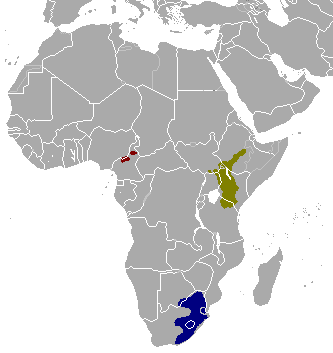
2) Maps of their proposed new species distributions
3) Any drawings or pictures of characters they deem diagnosable
4) Any results (actual data) of their multivariate statistics, which they use as main tool for analysis
5) They do not perform any tests on their univariate statistics, so they are not checking diagnosability of single characters.
6) They don't give exact locations of where single samples were taken, so one cannot assess whether all samples are along a cline or not, as distributions are often continuous.
Another main problem which has been highlighted a lot already is the often small sample size they use to back-up their claims. There is always natural variation for any single measurement around in biology and one needs a large enough sample size to capture that variation. With a sample size of just a few individuals there is a relatively high chance that you may just have randomly gotten samples that are more extreme than the actual mean of the population you sampled.
In this thread I will go from each species (group) to the next to see how well the evidence holds up and where there might indeed be more diversity than previously assumed. I am not an authority on ungulates, so this is far from a definitive review, more an informed opinion, which is more than many others have managed (e.g. Castello's book).
ARTIODACTYLA
BOVIDAE
Boselaphini
Bovini
Tragelaphini
Neotragini
Procaprini
Raphicerini
Madoquini
Ourebini
Antilopini
Asian Antilopini from here
Oreotragini
Reduncini
Aepycerotini
Cephalophini
Alcelaphini
Hippotragini
Caprini
MOSCHIDAE
CERVIDAE
Muntiacini
Muntiacini continued
Cervini
Capreolini
Alceini
Rangiferini
GIRAFFIDAE
ANTILOCAPRIDAE
TRAGULIDAE
HIPPOPOTAMIDAE
TAYASSUIDAE
CAMELIDAE
PERISSODACTYLA
EQUIDAE
TAPIRIDAE
RHINOCEROTIDAE
Though the PSC sounds appealing, it has the potential of recognizing every small population and even single individuals as separate species, as the diagnosability criterion only needs 1 character that is different, and that could be in the DNA... For more information about the dangers of the PSC with regards to Ungulate Taxonomy read this article:
Are There Really Twice as Many Bovid Species as We Thought? (PDF Download Available)
The fact that Groves and Grubb published a book with their view on how many ungulate species there are is perfectly fine and gives a fruitful discussion. The problem is however that their view was copied without any scrutiny in the Handbook of the Mammals of the World (HMW), but only in 1 chapter. This made it seem that all their splits were valid and as HMW is becoming the standard reference for mammals, it is potentially dangerous when institutions like IUCN would copy their approach based on HMW. After HMW their new taxonomy was further promoted in a Princeton field guide: Bovids of the world by Jose Castello. Again without checking the evidence at hand...
As I am a regular visitor to Africa, the taxonomy of especially antelopes has become particularly confusing and I slowly started to check which antelope species I had seen when using the old taxonomy, which one if G&G are to be believed and additionally what might be the best answer. The ungulate taxonomy used until recently by anyone, was getting outdated, so G&G could have made a major contribution in highlighting the true diversity of ungulates. Unfortunately they were to much in awe of the PSC to make their work helpful in the field... So in this thread I will try to see what the evidence is G&G give for their splits and see whether it holds up, given the data they provide and additional data sources (scientific articles) that are currently available. I am not a taxonomist, but I am a biologist who knows some statistics...
Anyone who has ever read a part of the book Ungulate Taxonomy will have seen it consists of a description of species (groups) with characters named in the text and sometimes aided by tables summarizing measurements on skulls and horns, where they provide sample sizes, means and standard deviation per population/species. There are however quite some things missing from the book:
1) descriptions of the abbreviations they use throughout the book
2) Maps of their proposed new species distributions
3) Any drawings or pictures of characters they deem diagnosable
4) Any results (actual data) of their multivariate statistics, which they use as main tool for analysis
5) They do not perform any tests on their univariate statistics, so they are not checking diagnosability of single characters.
6) They don't give exact locations of where single samples were taken, so one cannot assess whether all samples are along a cline or not, as distributions are often continuous.
Another main problem which has been highlighted a lot already is the often small sample size they use to back-up their claims. There is always natural variation for any single measurement around in biology and one needs a large enough sample size to capture that variation. With a sample size of just a few individuals there is a relatively high chance that you may just have randomly gotten samples that are more extreme than the actual mean of the population you sampled.
In this thread I will go from each species (group) to the next to see how well the evidence holds up and where there might indeed be more diversity than previously assumed. I am not an authority on ungulates, so this is far from a definitive review, more an informed opinion, which is more than many others have managed (e.g. Castello's book).
ARTIODACTYLA
BOVIDAE
Boselaphini
Bovini
Tragelaphini
Neotragini
Procaprini
Raphicerini
Madoquini
Ourebini
Antilopini
Asian Antilopini from here
Oreotragini
Reduncini
Aepycerotini
Cephalophini
Alcelaphini
Hippotragini
Caprini
MOSCHIDAE
CERVIDAE
Muntiacini
Muntiacini continued
Cervini
Capreolini
Alceini
Rangiferini
GIRAFFIDAE
ANTILOCAPRIDAE
TRAGULIDAE
HIPPOPOTAMIDAE
TAYASSUIDAE
CAMELIDAE
PERISSODACTYLA
EQUIDAE
TAPIRIDAE
RHINOCEROTIDAE
Last edited: