Ungulate taxonomy revisited: the evidence for the splits of G&G

Thank you for this thread, Lintworm, and looking for more.

Looking at five pictures of Chamois in this thread I was able to assign only one - the classic Abruzzo chamois - to any form. Individual and seasonal differences are simply bigger than differences between races or "species".

About wild sheep. Russian sources, which have most information of wild sheep of Eurasia, lump all Old World sheep into one species. They state that all local forms pass into each other clinally. Picking individuals from distant part of the range will make them look like different species, but they are connected by intermediates.

In this thread, I feel more and more like lumper. Looking at a random picture of a gazelle or a wild sheep I am unable to assign it into a form. Size, development of horns and shade of color, which are the main or only distinguishing characters, vary individually, seasonally and with age. In addition, size and horn development is strongly dependent from nutrition. This questions whether local differences are anything more than result of local food resources. Zoo populations in turn are inbred, and artificially don't show the range of variation of the original form.

I will remain much more a lumper than even moderate followers of the new taxonomy. It is fine to name subspecies, because there is no actual definition of a subspecies. But splitting chamois or sheep into species is simply artificial. And on top of this there is a problem of small sample sizes used to back up any claims of differences.
 
Thank you for this thread, Lintworm, and looking for more.

You are welcome, there is more interesting stuff to come, with African buffalo, Red deer, Sika deer and Wild boar some of the more complex species (groups) are still to come....

I will remain much more a lumper than even moderate followers of the new taxonomy. It is fine to name subspecies, because there is no actual definition of a subspecies. But splitting chamois or sheep into species is simply artificial. And on top of this there is a problem of small sample sizes used to back up any claims of differences.

Species delimitations are indeed completely arbitrarily and nobody has ever satisfactorily been able to create a working species concept for all. I personally am all for an more general evidence based approach, using a combination of morphology, genetics and behavior. The Tobias criteria followed that path and though I understand why they standardized the species limit at 7 scoring points, that is also very arbitrary and largely omits genetics.

In the end all species are to some extent artificial constructs to understand the variety of nature, but I disagree with you that there are not multiple species of wild sheep or chamois.

Looking at five pictures of Chamois in this thread I was able to assign only one - the classic Abruzzo chamois - to any form. Individual and seasonal differences are simply bigger than differences between races or "species".

Morphological differences in Chamois are indeed rather small and the pictures here in the gallery are insufficient. There are however clear differences in the winter coats between pyrenaica and rupicapra chamois with the white markings on the throat, neck and shoulders being much more extensive in Pyrenean chamois (including ornata and parva). Additionally differences in mating behaviour have been desscribed between Pyrenean and Alpine chamois, see: https://s3.amazonaws.com/academia.e...=Systematics_phylogenetic_relationships_a.pdf

There are some more subtle differences in skull characteristics. Finally the genetic data clearly indicate the existence of three major groups of chamois: Pyrenean, Alpine and Abruzzi (Apennine), there has been hybridization between the groups in the past, so according to the biological species concept they could not be treated as separate species. I (and others) find the BSC lacking in this as it leads to overlumping as it ignores evolutionary complexity almost completely.


About wild sheep. Russian sources, which have most information of wild sheep of Eurasia, lump all Old World sheep into one species. They state that all local forms pass into each other clinally. Picking individuals from distant part of the range will make them look like different species, but they are connected by intermediates.

The variation in wild sheep is not clinal though. It is clear that the different species hybridize with each other, but that is only in the contact zones in parts of Iran and possibly the Stans. The genetic data do show that each species has a different chromosome count, which is often an indication of speciation (though species with varying chromosome counts exist). Additionally the three species can clearly be differentiated by a combination of the presence of a white saddle, horn form and presence of a throat/neck ruff. Within the Mouflon, Urial and Argali there is also a lot of variation, but there is no evidence that it warrants a split if one is not following a very strict PSC approach. See this excellents paper for more info:
https://www.researchgate.net/profil...-genus-Ovis-Mammalia-Artiodactyla-Bovidae.pdf
 
Chiru

The Chiru or Tibetan antelope (Pantholops hodgsoni) is a unique bovid from the Tibetan plateau. The Chiru is considered monotypic

full

@baboon , Seling Co, Tibet, China
 
Muskox

The Muskox (Ovibos moschatus) has been treated as sister to the Takins, but genetic research has indicated that Muskox are actually sister to the Goral and Serow. Muskox live in the Canadian Arctic and Greenland, though populations have been introduced to Siberia, Norway, Alaska and Svalbard. Generally two subspecies have been recognized wardi in Greenland and moschatus in Canada. Genetic research does however not support recognition of any subspecies and morphological differences are also very small.

"Greenland muskox"
full

@Giant Eland , Moscow Zoo, Russia

"Barren Ground muskox"
full

@Patrick87 , Tierpark Berlin , Germany

Japanese serow

The Japanese serow (Capricornis crispus) is a monotypic Serow species endemic to Japan.

full

@Ituri , Woodland Park Zoo, Seattle, USA

Formosan serow

The Formosan serow (Capricornis swinhoei) is a monotypic species endemic to the island of Taiwan. It has in the past been treated as a subspecies of Japanese serow, but genetic research indicates it is actually the sister group to the Sumatran serow species group.

full

@itsallfaction , Taipei Zoo, Taiwan

Sumatran serow

The Sumatran serow (Capricornis sumatraensis) is currently classified as a monotypic species. Sumatran serow occur in peninsular Malaysia, S Thailand and Sumatra. Until recently Chinese, Himalayan and Red serow were treated as subspecies of the Sumatran serow. The split seems to have been based mostly on morphological data and genetic research on this species group would be of high priority.

full

@Pedro , Melaka Zoo, Malaysia

Himalayan serow

The Himalayan serow (Capricornis thar) was formerly treated as a subspecies of Sumatran serow, but it now considered a monotypic species. Serow from Assam in Eastern India are however red in color and according to G&G constitute a yet undescribed species.

No pictures of the "true" Himalayan serow have been uploaded to the gallery, but there is a picture of the Assam red serow:
full

@Chlidonias, Assam State Zoo, India

Burmese red serow

The Burmese red serow (Capricornis rubidus) was formerly considered a subspecies of the Sumatran serow, but is now classified as a monotypic species. Burmese red serow occur in S Bangladesh and N Myanmar.

No pictures of Burmese red serow have been uploaded to the gallery


Long-tailed goral

The Long-tailed goral (Naemorhedus caudatus) has in the past been lumped with the Chinese serow, but it is now clear it should be treated as a separate species. It occurs in NE China, Korea and far eastern Russia.

full

@alexkant , Tallinn Zoo, Estonia

Red goral

The Red goral (Naemorhedus baileyi) is a small goral from extreme S China, NE India and N Myanmar. Traditionally two subspecies have been recognized baileyi and cranbrooki. The validity of these subspecies is however disputed given the variability within each subspecies and the unlikelihood of having two subspecies in such a small area.

full

@GregOz , Shanghai Zoo, China

The Red goral in Beijing Zoo are hybrids with Chinese goral.
 
Last edited:
Snow sheep

The Snow sheep (Ovis nivicola) is a species of Wild sheep from NE Russia. Multiple subspecies are generally recognized

O.n. nivicola Kamchatka peninsula
O.n. borealis N Central Siberia
O.n. alleni E Siberia
O.n. lydekkeri NE Siberia
O.n. koriakorum Chuckchi peninsula and Koryak district

Ovis nivicola nivicola
full

@Giant Eland , San Diego Zoo, USA

Bighorn sheep

The Bighorn sheep (Ovis canadensis) that occurs along the Rocky Mountains from SW Canada to NW Mexico. There has been considerable debate over the number of subspecies recognized. Recent genetic research by Buchalski et al. (2016) and morphological research by Wehousen & Ramey (2000) suggests only three subspecies are valid. What is widely called California bighorn sheep (californiana) belongs to canadensis and the difference between the different Desert populations, nelsoni, mexicana and cremnobates are minimal.

O.c. canadensis Rocky Mountains, NW USA and SW Canada
O.c. sierrae Sierra Nevada, California, USA
O.c. nelsoni desert regions of SW USA and N Mexico, including Baja peninsula

Ovis canadensis canadensis
full

@Pleistohorse , Northwest Trek Wildlife Park, USA


"californiana
" Bighorn sheep
full

@Kakapo, Burgers' Zoo, Netherlands

Ovis canadensis nelsoni "mexicana"
full

@carlos55 , Chacapultec Zoo, Mexico

"nelsoni"
full

@ThylacineAlive , California Living Museum

Dall's sheep

The Dall's sheep or Thinhorn sheep (Ovis dallii) is a wild sheep from Alaska and NW Canada. Two subspecies are currently recognized.

O.d. dallii Dall's sheep, Alaska and extreme NW Canada
O.d. stonei Stone's sheep. NW Canada, N British Columbia and S Yukon Territory

Ovis dallii dallii
full

@Pleistohorse , Alaska Zoo, USA

Ovis dallii stonei
full

@Zebraduiker , Hogle Zoo, USA

References

Buchalski et al. (2016): https://academic.oup.com/jmammal/article/97/3/823/2459651

Wehausen & Ramey (2000): Cranial Morphometric and Evolutionary Relationships in the Northern Range of Ovis Canadensis
 
Barbary sheep

The Barbary sheep (Ammotragus lervia) is a caprine from Northern Africa, its exact affiliations have long been a mystery, but it is now treated as the sister species to the Arabian tahr. Though there is some disagreement about intraspecific variation of Barbary sheep, six species are generally recognized, though that should be treated as a preliminary number.

A.l. lervia , Morocco, N Tunisia and N Algeria
A.l. ornata Eastern and Western desert of Egypt
A.l. sahariensis C and S Algeria, SW Libya, Mauritania, Mali, Chad and presumably Western Sahara
A.l. blainei E Sudan
A.l. angusi Air Massif and Termit Massif in Niger
A.l. fassini extreme S Tunisia, Libya

Ammotragus lervia lervia
full

@Zoo Tycooner FR , La Vallée des Oiseaux, Morocco

Ammotragus lervia blainei
full

@ThylacineAlive , Roger Williams Park Zoo, USA

Ammotragus lervia fassini
full

@Giant Eland , Zoo Wroclaw, Poland

Ammotragus lervia sahariensis
full

@Giant Eland , Al Ain Zoo, UAE

Probably Ammotragus lervia ornata
full

@devilfish , Africa Safari Park, Egypt

No picture of angusi has been uploaded to the gallery

Arabian tahr

The Arabian tahr (Arabitragus jayakari) is a caprine that occurs in the United Arab Emirates and Oman. It is currently considred monotypic

full

@Giant Eland , Albustan Zoological Centre, UAE


Nilgiri tahr

The Nilgiri tahr (Nilgiriragus hylocrius) is a monotypic species that is endemic to the Nilgiri mountains in SW India.

full

@Chlidonias , Eravikulam NP, Kerala, India

Rocky Mountain goat

The Rocky Mountain goat or Mountain goat (Oreamnos americanus) is a monotypic species from the mountain ranges of W North America from Alaska to Utah and Colorado. The Rocky mountain goat is the sister species of the Takin.

full

@Nick@Amsterdam , Tierpark Berlin, Germany

Blue sheep

The Blue sheep or Bharal (Pseudois nayaur) that occurs across the Himalayas and Central China. There has been discussion over whether the Dwarf blue sheep is a separate species or not. Genetic research by Tan. et al. (2012) does however show that Dwarf blue sheep are clearly nested within the szechuanensis population of Blue sheep and should thus be treated as a population, not even as a separate subspecies. They do however find evidence of new subspecies of Blue sheep in the Helan Mountains, which is geographically isolated. This leads to the provisional recognition of three subspecies:

P.n. nayaur from the Himalayas
P.n. szechuanensis from C China
P.n. "Helan Mountains"

Pseudois nayaur nayaur
full

@Chlidonias , Ladakh, India

Pseudois nayaur szechuanensis
full

@Tomek , Warsaw Zoo, Poland


Himalayan tahr

The Himalayan tahr (Hemitragus jemlahicus) is a monotypic caprine native to the Himalayas and the sister species to the Wild goats.

Male:
full

@Eagle , Zoo Dortmund, Germany

female:
full

@bongowwf, Zoo Antwerpen, Belgium

Reference

Tan et al. (2010): Molecular evidence for the subspecific differentiation of blue sheep ( Pseudois nayaur) and polyphyletic origin of dwarf blue sheep ( Pseudois schaeferi)
 
Last edited:
Arabian tahr

The Arabian tahr (Arabitragus jayakari) is a caprine that occurs in the United Arab Emirates and Oman. It is currently considred monotypic

No pictures of Arabian tahr have been uploaded to the gallery

I'm working on it! I have photos from 2 different locations, and am just waiting for permission to post them :D
 
What is the status of any purebreed subspecies odf Aoudad outside the native range? Are zoo animals in the USA purebreed subspecies? I saw some labelled as "Kordofan" aoudad? Are introduced populations coming from purebred animals?
 
I'm working on it! I have photos from 2 different locations, and am just waiting for permission to post them :D

Great, I was already surprised there were no pictures of this one in the gallery.

What is the status of any purebreed subspecies odf Aoudad outside the native range? Are zoo animals in the USA purebreed subspecies? I saw some labelled as "Kordofan" aoudad? Are introduced populations coming from purebred animals?

The wild animals in Spain are supposed to be pure lervia, but I am not sure of the status of the ones in the US...
 
What is the status of any purebreed subspecies odf Aoudad outside the native range? Are zoo animals in the USA purebreed subspecies? I saw some labelled as "Kordofan" aoudad? Are introduced populations coming from purebred animals?

The AZA has a program for purebred blanei, though not all animals in the US are purebred. Animals listed as Kordofan in US zoos are pure, all others to my knowledge are either of unknown origin or crossbreeds.

@lintworm it should probably be noted that the AZA population of nelsoni Bighorn Sheep includes animals from the cremnobates population (as well as at least one mexicana at LA).

~Thylo
 
Wild goat

The Wild goat (Capra aegagrus) is a species of goat that occurs in the Near East from Turkey to Pakistan. The domestic goat is a descendant from this species and the population of wild goats on Crete has been shown to be an ancient feral population. Though a number of subspecies have been recognized in the past, G&G do not recognize any.

No pictures of a true male wild goat have been uploaded to the gallery, only pictures showing females
full

@fofo , Tehran Zoo, Iran

The Cretan "wild" goat (Capra hircus cretensis)
full

@alexkant , Hai-Bar, Israel

Markhor

The Markhor (Capra falconeri) is a wild goat from mountain areas in Pakistan, Afghanistan, NW India, Tajikistan and Uzbekistan. There is a hybrid population with Wild goats, called the Chiltan goat. Seven subspecies have been recognized, but G&G only recognize three valid ones. Note that a large number of Markhor in zoos actually have some domestic goat dna.

C.f. falconeri N Pakistan, NW India
C.f. megaceros S Pakistan, Afghanistan
C.f. heptneri N Afghanistan, Tajikistan, Uzbekistan

Capra falconeri falconeri (Kashmir markhor)
full

@J I N X , Lalazar Wildlife Park, Pakistan

Capra falconeri heptneri (Ta(d)jik/Turk(o)men(ian)/Bukharan markhor)
full

@Buckeye092, Columbus Zoo, USA

Alpine ibex

The Alpine ibex (Capra ibex) is a wild goat from the European Alps. In the past all ibex species were lumped into one species, but currently most authorities recognize seven Ibex species, all but 3 monotypic.

full

@ThylacineAlive , Tierpark Berlin, Germany

Spanish ibex
The Spanish ibex (Capra pyrenaica) is a wild goat that occurs on the Iberian peninsula. Five subspecies have been recognized, of which two: lusitanica from N Portugal and pyrenaica from the Pyrenees are now extinct. Generally three subspecies are recognized, but G&G do not find evidence for the existence of subspecies and there is wide variation within populations, there seems to be a cline from north to south though, with northern animals tending to be darker.

"hispanica"
full

@ThylacineAlive , Zoo de Madrid, Spain

"victoriae"
full

@Maguari , Zoo Santillana del Mar, Spain

West Caucasian ibex
The West Caucasian ibex, or Kuban tur, (Capra caucasica) is a wild goat from the western parts of the Caucasus mountains. There has been considerable debate as to whether the East and West Caucasian ibex are the same species or not, but in recent years they have mostly been treated separately, especially because of the different horn shape.

full

@Michal Sloviak , Zoo Praha, Czechia

East Caucasian ibex

The East Caucasian ibex or Dagestan tur (Capra cylindricornis) is a wild goat from the Eastern Caucasus. It is sometimes lumped with the West Caucasian tur.

full

@alexkant , Moscow Zoo, Russia

Siberian ibex

The Siberian ibex (Capra sibirica) is a wild goat from Eastern Asia and the Himalayas. Generally four subspecies are recognized

C.s. sibirica Siberia, NW China, E Kazakhstan and W Mongolia
C.s. alaiana SE Kazakhstan, N Afghanistan, Kyrgizstan, Uzbekistan, Tajikistan, W China
C.s. hagenbecki C and S Mongolia, N China
C.s. sakeen N Pakistan, N India

Capra sibirica alaiana
full

@Dormitator, Sychovo Moscow Zoo Breeding Center, Russia

Capra sibirica hagenbecki
full

@Deer Forest , Beijing Zoo, China

Generic Siberian ibex
full

@ThylacineAlive , Zoo Berlin, Germany

Nubian ibex

The Nubian ibex (Capra nubiana) is a small ibex that occurs in the mountains W of the Red Sea, Israel, the Sinai and the S of the Arabian peninsula. Generally two subspecies are recognized, though the population of the S of the Arabian peninsula might represent a third (beden).

C.n. nubiana Egypt, Sudan, possibly into NW Ethiopia and Eritrea.
C.n. sinaitica Sinai, Israel

Capra nubiana sinaitica
full

@alexkant, Hai Park Zoo, Israel

Potential Arabian subspecies:
full

@Giant Eland , Al Ain Zoo, UAE

I don't know the origin of the American and European zoo population of Nubian ibex.
full

@Maguari, Espace Animalier de la Haute-Touche, Obterre, France

Walia ibex

The Walia ibex (Capra walie) is a monotypic species that is currently restricted to the Simien Mountains in N Ethiopia.

No pictures of this species have been uploaded to the gallery.


Next: Wisent
 
Last edited by a moderator:
I've heard that both subspecies of Nubian Ibex have been kept in European zoos in the relatively recent past, though I don't know who has kept what, if both still persist, or if the population has hybridized.

~Thylo
 
Wisent

The Wisent or European bison (Bos bonasus) is the only extant wild cattle species in Europe. Previsously Wisent + American bison were placed in the genus Bison, but genetic data find that both species are firmly nested within Bos. Mitochondrial dna shows close affinities of Wisent with the Bos taurus group. G&G and others have hypothesized a hybrid origin of the Wisent, but recent research (Wang et al. 2018) show that this is due to incomplete lineage sorting. Two subspecies have been generally recognized bonasus (Lowland) and caucasicus (Caucasus), the latter is now extinct. All extant Wisents can be subdivided into a pure Lowland line and a line which has one male Caucasus wisent as an ancestor. Additionally there is a hybrid population between Wisent and American bison (Rautian et al. 2010).

G&G recognize both subspecies as full species.

Sample sizes

Sample sizes for skins are not given

Sample sizes for skulls and horns are not clearly stated, but are at least
bonasus 9
caucasicus 7

Skins

caucasicus is said to have a pelage that clearly extends down to the fetlocks and is more a warm-sepia color. bonasus is described in German only as "fahlbraun mit ockerbrauner Schattierung", which rougly translates into pale brown with ocher shading

Horns + skulls

Overall caucasicus is somewhat smaller with the occiput (back of the head) being 101-130 mm in caucasicus and 149-204 in bonasus. Additionally the shoulder height of caucasicus is given as 160 cm compared to 185 cm or more in bonasus. Both the forehoof and hindhoof are also larger in bonasus.

Additional data

Rautian et al. (2000) have a much larger sample of skull measurements and all indicate that bonasus is larger, often significantly. It is however not possible from their data to see the range of the data as only means are given and they perform a simple t-test and it is unclear whether that is a valid approach.

I have not seen any data on the genetic distance between bonasus and caucasicus.

Summarizing

Purely based on the discrete size difference one might recognize caucasicus as a separate species. But there is a lack of genetic data and populations will have been connected in the past, so a cline cannot be excluded. So for now I would remain to treat caucasicus as a subspecies of Wisent

Bos bonasus bonasus
full

@Dormitator, New Forest Wildlife Park, UK


full

@MagpieGoose , Highland Wildlife Park, UK

bonasus X caucasicus lineage
full

@Tim May, ZSL Whipsnade Zoo, UK

References

Rautian et al. (2000): A New Subspecies of the European Bison, Bison bonasus montanus ssp. nov. (Bovidae, Artiodactyla)

Wang et al. (2018): Incomplete lineage sorting rather than hybridization explains the inconsistent phylogeny of the wisent

next: African buffalo
 
African buffalo

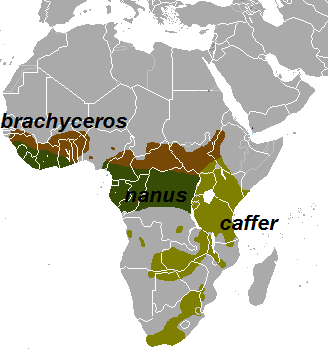
The African buffalo (Syncerus caffer) is the only wild cattle in Africa and is widespread across sub-Saharan Africa. African buffalo occur in a wide range of habitats. Traditionally four subspecies have been recognized

Syncerus_range_map.png

source: wikipedia Note that the right part of the range of brachyceros on this map is normally called aequinoctalis.

S.c. caffer Cape buffalo, S and E Africa, a savanna/woodland taxon
S.c. nanus Red forest buffalo, rainforests of W and C Africa
S.c. brachyceros W African buffalo, savannas and woodlands of W Africa
S.c. aequinoctalis Sudanese/Nile buffalo, savannas and woodlands of C Africa

G&G lump brachyceros with aequinoctalis and elevate brachyceros (naming it Lake Chad buffalo), nanus and caffer to species status. Additionally they recognize mathewsi, the buffalo from the Virunga Mountains at the border of Uganda and Rwanda with DR Congo.

Sample sizes

Sample sizes for skins are not given

Horns & skulls
caffer 73-95
brachyceros 36-60
nanus 116 - 141
mathewsi 4

Sample sizes are large for all taxa except mathewsi, which sample is minimal. In fact these are the largest samples until now.

Skins

caffer
is clearly darker than the other taxa and is often jet-black, brachyceros is lighter colored, being dark-brown, sometimes slightly reddish and never quite black. mathewsi is described as dark brown to black often with reddish tones. Female mathewsi are described as often reddish with a dark dorsal stripe and flanks. nanus is generally light-reddish brown, with dark markings developing on limbs and shoulderrs.

Horns & skulls

caffer
is the largest of the taxa, though there is wide overlap with brachyceros and mathewsi in skull measurements. When looking at the horns, caffer clearly has the largest horn span and the greatest curve. mathewsi is very similar to brachyceros in skull characteristics, but has on average a smaller horn span, though there is wide overlap in measurements. nanus is clearly smaller than caffer and also has a mostly smaller horn span and on average also smaller curve. There are however also nanus from forest edge areas and they are more similar to brachyceros. Based on multivariate analysis G&G claim to find large clear differences between brachyceros, nanus and caffer. Reported differences for matthewsi are not reliable based on the small sample size.

Additional data

The taxonomy of African buffalo has long been of interest especially as when seeing a Forest buffalo next to a Cape buffalo they look completely different and are adapted to different habitats. There are however many intermediate populations, so there is extensive debate. G&G give a good overview of the morphological variation and there have been multiple genetic studies, of which Smitz et al. (2013) is the most recent and inclusive one. They find clear evidence for the existence of two lineages that diverged 145-149 thousand years ago. On the one hand there is the lineage encompassing nanus and brachyceros (including aequinoctalis) and on the other hand caffer, no data for mathewsi were available. Interestingly nanus is not monophyletic and it appears to be "just" an eco(pheno)type and the results of several migrations into the forest. Contrary to what was previously assumed the genetic data indicate a savanna origin of African buffalo instead of a forest origin. The genetic difference between both lineages is somewhat smaller than in Kob, but larger than between the Impala taxa. There is also a difference in chromosome numbers between the caffer (52) and nanus group (54-56), which might lead to reduced fertility of hybrids.

Summarizing

Combining genetic and morphological data there is no evidence nanus and brachyceros should be split, additionally the evidence for recognizing mathewsi is very slim. Whether the nanus group and caffer group should be treated as separate species is debatable. It does however clearly look as speciation in progress, so African buffalo might best be treated as a species group including two potential species Syncerus (caffer) caffer and Syncerus (caffer) nanus, the latter including multiple ecophenotypes.

Syncerus (caffer) caffer:
full

@Kudu21, Kariega Private Game Reserve, South Africa

Syncerus (caffer) nanus "nanus" forest ecophenotype
full

@ThylacineAlive , Chester Zoo, UK

Syncerus (caffer) nanus "brachyceros" savanna ecophenotype
full

@Saro , Zoo Antwerp, Belgium

Reference

Smitz et al. (2013): Pan-African Genetic Structure in the African Buffalo (Syncerus caffer): Investigating Intraspecific Divergence

Next the remaining wild cattle
 
Gaur

The Gaur (Bos gaurus) is the largest extant cattle species and occures in India and SE Asia. Traditionally three subspecies have been recognized, but hubbacki from peninsular Malaysia is generally lumped with laosiensis.

B.g. gaurus
Indian subcontinent (somewhat smaller)
B.g. laosiensis SE Asia (somewhat larger)

Bos gaurus gaurus
full

@LaughingDove , Zoo Negara, Malaysia

Bos gaurus laosiensis
full

@Chlidonias , Melaka Zoo, Malaysia

Banteng

The Banteng (Bos javanicus) is a species of cattle from SE Asia and the islands of Borneo and Java. Generally three subspecies are recognized. Differences in karyotype have been reported between populations, as has ancient dna introgression with Gaur.

B.j. javanicus Java
B.j. lowi Borneo
B.j. birmanicus mainland SE Asia

Bos javanicus javanicus
full

@Kakapo , Burgers' Zoo, Netherlands

Bos javanicus lowi
full

@Deer Forest , Lok Kawi Wildlife Park, Malaysia

Bos javanicus birmanicus
full

@Giant Eland , Khao Keow Forest & Wildlife Reserve Park, Malaysia

Kouprey

The Kouprey (Bos sauveli) is a probably extinct species of cattle from Cambodia and Laos.

The picture shows an immature male
full

Zoo des Vincennes, Paris, France, uploaded by @Dortmunder

American bison

The American bison, also known as American buffalo (Bos bison) is a species of cattle from North America. Generally two subspecies have been recognized bison, Plains bison and athabascae, Wood bison. athabascae has been described as a larger Bison with longer more spreading horns, as well as some minor pelage differences. There has been considerable debate as to whether athabascae is a true subspecies, though the tendency is to recognize it. There are however no true athabascae left as all populations have to some degree been mixed with bison. It seems unclear how pure the remaining "athabascae" really are.

Bos bison bison
full

@ThylacineAlive , Bronx Zoo, USA

full

@ThylacineAlive , Bronx Zoo, USA

Bos bison "athabascae"
full

@ThylacineAlive , Tierpark Berlin, Germany

Yak

The Yak (Bos mutus) is a wild cattle species from the Tibetan Plateau. No pictures of living Wild Yak have been uploaded, there is only this museum display:

full

@Sarus Crane , Academy of Natural Sciences, Philedelphia, USA

Asian wild buffalo

The Asian wild buffalo, or Water buffalo, (Bubalis arnee) is a wild cattle species from SE Asia and India. Generally four wild subspecies have been recognized, of which migona is seriously threatened with hybridization with domestic Buffalo. This species has been domesticated two times. There is a River buffalo type bubalis, karyotype 2n=50 and a Swamp buffalo type carabanensis, karyotupe 2n=48. This genetic difference has long been noted. However Hassanin et al. (2012) find that bubalis is actually the sister species to Anoa, leaving Asian wild buffalo paraphyletic. Genetic differences are rather small, but if true than two different Asian wild buffalo species have been domesticated, of which bubalis is likely extinct.

The four wild subspecies are
B.a. arnee Raipur & Bastar districts, India and Kosi Putta Reserve, Nepal
B.a. fulvus Brahmaputra Valley
B.a. theerapati Irrawaddy Delta, now restricted to a few localities in Thailand and Cambodia
B.a. migona Sri Lanka

Only one picture of wild Asian wild buffalo has been uploaded of the fulvus subspecies
full

@Chlidonias, Kaziranga NP, India

River type water buffalo bubalis
full

@alexkant , Ploiesti Zoo, Romania

Swamp type water buffalo, carabanensis
full

@Patrick87 , Tierpark Berlin, Germany

Tamaraw

The Tamaraw (Bubalis mindorensis) is a small monotypic species of Buffalo endemic to the island of Mindoro in the Phillipines.

full

Picture by Steve Romo, Manila Zoo, Phillipines, uploaded by @Middle Man

Lowland anoa

The Lowland anoa (Bubalis depressicornis) is a monotypic small buffalo from Sulawesi. There has been considerable debate as to whether Lowland and Mountain anoa (Bubalis quarlesi) are the same species or not. Though variable in morphology, there seem to be some slight morphological differences. Additionally the genetical distance between Lowland and Mountain anoa are as large as between Asian wild buffalo and Anoa. Karyotpypes are variable even within species.

full

@Baldur , Zoo Praha, Czechia

Mountain anoa

The Mountain anoa (Bubalis quarlesi) is a small monotypic buffalo species from Sulawesi. There has been considerable debate as to whether it is distinct from the Lowland anoa, but is treated as a separate species here.

full

@ThylacineAlive , Zoo Krefeld

Saola

The Saola (Pseudoryx nghetinhensis) is a recently described monotypic species of wild cattle from the Annamite Mountains of Vietnam and Laos. Very little is known about this species and no pictures have been uploaded to the Zoochat gallery.

Reference

Hassanin et al. (2012): https://www.sciencedirect.com/science/article/pii/S1631069111002800

Next: Boselaphine antelope
 
The tripe Boselaphini consists of only two Asian species that are quite distinct in appearance

Nilgai

The Nilgai (Bosephalus tragocamelus) is a monotypic species from the Indian subcontinent.

Male
full

@Maguari , Usti Zoo, Czechia

Female:
full

@Giant Eland , Al Ain Zoo, UAE

Four-horned antelope

The Four-horned antelope of Chowsinga (Tetracerus quadricornis) is a unique species, as it is the only Bovid with four horns, females are hornless though. This species occurs on the Indian subcontinent and is regarded as monotypic.

full

@gentle lemur , Howletts Wild Animal Park, UK

Next: Musk deer
 
I have commented before on how badly edited and inconsistent Castello's book is, but G&G's Ungulate Taxonomy also suffers from this inconsistency. In many cases G&G perform multivariate analyses on the horn and skull measurements with an inappropriate sample size. This highly increases the chance of a false positive, which given the data in the tables are quite likely. In the Asian wild buffalo profile they do however write:

The taxonomy follows (Groves 1996b); in figure 1 of this paper, the three mainland subspecies separate cleanly on multivariate analysis, so there is a possibility that they actually should rank as distinct species, although the analysis was based on 10 skull measurements and, as only one of the three samples has more than 10 specimens, there is a reasonable possibility of a type I error (a false positive). Therefore a conservative course is provisionally followed here.

They thus seem to use a double standard in their revision, because otherwise they would not have split many other taxa, including Arabian gazelle and Topi....

This also underlines once more that G&G's book was meant to provoke debate about ungulate taxonomy, as they seem at least partly aware of the limitations, and serve as a baseline from which to increase understanding of ungulate diversity. As they state in their introduction the hope that "these examples will be examined by colleagues and, if found acceptable, used as template for further studies". Downright accepting their new taxonomy as truth has never been their goal and following their taxonomy, without questioning it the slightest like Castello did is not the way forward.

I am currently creating a summary of the past 7 pages, which will highlight the valid splits and the not so valid ones....

 
Back
Top