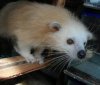
Very beautiful individual indeed!
Okay, here goes my attempt on the first half of the maze that is Batu Secret Zoo;
As you exit the structure with bear cuscuses, you walk into another elevated, roofed structure, overlooking the entire zoo and an exhibit for saltwater crocodiles (which is 2 floors down!) Then you continue on an elevated path alongside the back wall of the primate exhibits. After a while you turn right, and are faced with a medium-sized aviary for Siamangs. Between the elevated path and the aviary is a rather plain-looking exhibit for gharials and an assortment of large fish not easily identifiable from above. Continuing on an elevated path you can look into exhibits for fennec foxes, bat-eared foxes and hog badgers from above. On the other side of the fence is a slightly lower exhibit that held a single dwarf cassowary (and a daring blue peafowl, who roam freely throughout the park). Opposing this exhibit is another eye-sore of an aviary for a very active pair of rhinoceros hornbills. While the aviary was ugly, it was quite large and seemed to entertain the hornbills well.
After this you walked in between exhibits for sitatungas on your left, and patagonian maras on your right. At the end, where there is a row of small, dark exhibits for masked palm civets, common palm civets and more binturong, you can either decide to go left or right.
I went left, alongside the stretched out sitatunga enclosure. Opposing the sitatunga exhibit were two wallaby exhibits, one for dusky pademelons and one for Papuan agile wallabies (they seem like the two go-to macropods for Indonesian zoos, haha!). Next up were 2 pygmy hippos in a relatively small exhibit with an underwater viewing window, and on the other side of the path was a very aquatic exhibit for capybaras and (if I recall correctly) black swans.
Up next were 3 more monkey aviaries, much larger than the ones at the beginning of the zoo. The first held 2 black crested mangabeys, the second a small group of lion-tailed macaues, and the third a pair of Sumatran silver surilis. After this the elevated path, which we've found ourselves on yet again, curves over another nutria exhibit towards an aviary for crowned pigeons and large flying foxes (the aviary hanging at the right height for the bats to be at eye-level, sadly the lighting wasn't fantastic or it would have made for some great pictures!) and then onto two aviaries, one for each species of ruffed lemur. After this you went down, finally off of the really weirdly twisting elevated path, and were greeted by another group of meerkats, and a horribly small, dark exhibit for raccoons, and, you guessed it, more binturong. Next up was the nutria exhibit you could see from above, and after this an exhibit for American beavers and some waterfowl.
Next up was an exhibit for a small group of very loud Asian small-clawed otters in a very mock rock-heavy exhibit, and opposing this yet another highlight of the park... A pair of mountain anoa! It's not often that I'm intrigued by artiodactyla, but I stayed here quite a while to photograph them. Next up, the path continued around a relatively large pen for llamas, green peafowl, and lesser rheas. After this exhibit, you were on the ground floor, in the main central plaza of the zoo, overlooking the pen I just described, two circular glass-fenced exhibits for black-tailed prairie-dogs and Indian crested porcupines, from which you could also view the fennecs, bat-eared foxes and hog badgers from ground level. Also on this central area were various (not incredibly overwhelming) food stands, entrances to the reptile house and aquarium, and you guessed it, more binturong!
Next time I'll be describing the first reptile house, and then continuing where we left off after the nocturnal house