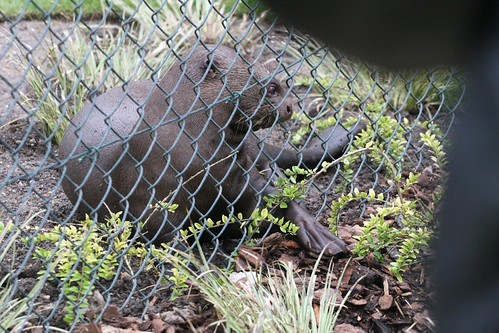
A flying visit to the zoo in lovely sunshine this afternoon, staying just long enough to check out the completed giant otter pool redevelopment and the progress being made to the site of the old otter/coati enclosure and aviaries.

Otters first, and I have mixed feelings about the way the enclosure has been adapted from its previous and original incarnation for sea lions, although you've got to hand it to the zoo for completing such an extensive renovation in such a short time. Approaching from the west in front of the penguins, the impression is not entirely favourable. Visitors are greeted with a foreboding wooden fence with perspex slats thorough which to view. None of them are at my height, and I'd suggest they're all too low for most adults. The few people trying to peer through them appeared as though there were looking through peep-holes into a compound of some sort.

On the south aspect there is one full-length perspex screen, and it affords the best, unobstructed view of the enclosure. If you're tall you can actually see over it, and if your camera has a rear-mounted screen, you can get unobstructed shots by holding it up at arms length (not so easy with an SLR).

On the east side, opposite the Jubilee Garden, the perimeter is alternately wire mesh and perspex, all with stand-offs. To address a question Alan asked, photography on this side of the enclosure is also really difficult, the extended distance between stand-off and wire/perspex hampering even shallow DOF shots.
As for the inhabitant himself, he may be a giant in the otter world but he looks tiny in what now seems like a huge enclosure. He was wandering up and down the opposite bank during my visit and went completely unnoticed by most visitors, the little S90 I had with me didn't have enough zoom to even get close. When the foliage grows he and the female that's due to join him will be really difficult to spot unless they decide to spend their time destroying the pristine grass bank nearest the viewing areas. It looks to be a great enclosure from the otters' point of view, although the percentage of water to land might be a little excessive based on the husbandry guide, and if there is deep digging its location is not obvious, although it must be somewhere on the far bank. Speaking of, although it's artificial, the bank does look remarkably like a real, muddy riverbank.

So in summary, the enclosure itself looks excellent (slight reservation about the digging area) but viewing could be greatly improved as could the aesthetics of the barriers, which are at some very strange angles.
Around by the Oakfield, there's now a plan pinned to the fence to show what the development in this area entails. Ironically, the development itself is almost complete but I suppose it's better late than never.

The fence between the Roman Garden and the area that was once home to the aviaries and coati/otter enclosure has gone, and a pathway joins the two. The area is just a large expanse of grass, and that, according to the plan, is how it will stay. The children's playground, comprising a couple of slides, is the last thing to be completed and is just a small area over the to rear of the beer garden (seen far left in the photo above) so nothing major. According to the plan, the substrate will be something called “tiger mulch”, but I don't think that'll be made from finely chopped tiger as Chester Zoo is a conservation organisation!

I was struck, once again, by what is now a huge area of wasted space in the East Zoo. Surely we could have new enclosures in these areas...
Otters first, and I have mixed feelings about the way the enclosure has been adapted from its previous and original incarnation for sea lions, although you've got to hand it to the zoo for completing such an extensive renovation in such a short time. Approaching from the west in front of the penguins, the impression is not entirely favourable. Visitors are greeted with a foreboding wooden fence with perspex slats thorough which to view. None of them are at my height, and I'd suggest they're all too low for most adults. The few people trying to peer through them appeared as though there were looking through peep-holes into a compound of some sort.
On the south aspect there is one full-length perspex screen, and it affords the best, unobstructed view of the enclosure. If you're tall you can actually see over it, and if your camera has a rear-mounted screen, you can get unobstructed shots by holding it up at arms length (not so easy with an SLR).
On the east side, opposite the Jubilee Garden, the perimeter is alternately wire mesh and perspex, all with stand-offs. To address a question Alan asked, photography on this side of the enclosure is also really difficult, the extended distance between stand-off and wire/perspex hampering even shallow DOF shots.
As for the inhabitant himself, he may be a giant in the otter world but he looks tiny in what now seems like a huge enclosure. He was wandering up and down the opposite bank during my visit and went completely unnoticed by most visitors, the little S90 I had with me didn't have enough zoom to even get close. When the foliage grows he and the female that's due to join him will be really difficult to spot unless they decide to spend their time destroying the pristine grass bank nearest the viewing areas. It looks to be a great enclosure from the otters' point of view, although the percentage of water to land might be a little excessive based on the husbandry guide, and if there is deep digging its location is not obvious, although it must be somewhere on the far bank. Speaking of, although it's artificial, the bank does look remarkably like a real, muddy riverbank.
So in summary, the enclosure itself looks excellent (slight reservation about the digging area) but viewing could be greatly improved as could the aesthetics of the barriers, which are at some very strange angles.
Around by the Oakfield, there's now a plan pinned to the fence to show what the development in this area entails. Ironically, the development itself is almost complete but I suppose it's better late than never.
The fence between the Roman Garden and the area that was once home to the aviaries and coati/otter enclosure has gone, and a pathway joins the two. The area is just a large expanse of grass, and that, according to the plan, is how it will stay. The children's playground, comprising a couple of slides, is the last thing to be completed and is just a small area over the to rear of the beer garden (seen far left in the photo above) so nothing major. According to the plan, the substrate will be something called “tiger mulch”, but I don't think that'll be made from finely chopped tiger as Chester Zoo is a conservation organisation!
I was struck, once again, by what is now a huge area of wasted space in the East Zoo. Surely we could have new enclosures in these areas...
Last edited: