When will COVID-19 restrictions be lifted?

During the Great Depression, US unemployment stayed at or above 15% for ten years

That was a different time and society. Unemployment with lockdowns past May will exceed 15%, and that will happen in most Western countries. Is that something we should accept. Do we want mass homelessness, mass migration of the population as happened some 90 years ago?


New graduates will have a very difficult time finding work (just as their older siblings did ten years ago).

It’s similar but far worse than 2008. At this point almost no hiring is being done by private sector or public sector except for healthcare. Unemployment will surge likely to double what it was at the peak of 2008. Recent graduates cannot qualify for unemployment and almost all did not receive a stimulus check. Many graduates that did have jobs offered have seen their offers rescinded. Until lockdowns are lifted enough that companies and governments that still are intent on hiring can go through the process, then its gonna be near impossible to find a job (even hourly jobs that don’t relate to ones major).
 
During the Great Depression, US unemployment stayed at or above 15% for ten years

This is true, but it's not entirely easy to compute who was/was not included in their canvasse. Going into production to support WWII efforts is what brought us out of the Great Depression, Once we sent troops abroad, they were earning a minimal salary, but was that being counted as "real" employment? Back then, women were a very small part of the workforce, serving only as teachers, secretaries, nurses, and maids, and I doubt women were even counted in "unemployment statistics" because women were thought to belong in the home. When men went to war, however, thousands of women stepped into what was once considered "men's work" producing tanks, guns, and ammunition. SInce these women had never worked and if women had never been counted in the unemployment statistics, the thousands of "Rosie the Riveters" would have had an effect on this figure. If we were to count the Rosies working men's jobs and included all the men receiving pay for being soldiers, I think this figure may have been lower for the final years.
 
Here is a US governor who has presented his plan for how the state's economy will re-open and how decisions will be made
California Gov. Gavin Newsom outlines plan to reopen in conjunction with West Coast states - CNNPolitics

Further, China is beginning to re-open factories, with protocols for safety - three months after it began shutting down. They may be better than most Western nations at enforcement but if COVID19 cases do rise we may never get the full picture.
Still: 3 months
I suppose that there will some sort of Summer (in the Northern hemisphere)
 
Last edited:
I agree with @HOMIN96 @nczoofan @Maguari (assuming I read their thoughts correctly, which I may or may not be). Whether or not an extended (say one year or more) lockdown would be necessary to control the virus, it is simply not feasible.

People keep saying this as if it’s a choice we actually have, but I don’t see anybody explaining what they think will happen once the virus comes roaring back, potentially even more widespread than it is now.

It’s one thing to say it’s ‘not feasible’ but you have to be able to say *how* everybody going back to work is itself feasible.
 
People keep saying this as if it’s a choice we actually have, but I don’t see anybody explaining what they think will happen once the virus comes roaring back, potentially even more widespread than it is now.

It’s one thing to say it’s ‘not feasible’ but you have to be able to say *how* everybody going back to work is itself feasible.

Well, for one thing I would say that of course maintaining the current lockdown and 'everybody going back to work' are not the only options. Realistically we are likely to be looking at something somewhere in between the two being the aim until a vaccine is available. Whether this means test-and-trace with individual isolations or tracking apps or huge amounts of masks and gloves and plastic screens, combined with common-sense things like home working, most industries will, I suspect, find a way to make at least some parts of their businesses work.

But, sadly (and I make no claim that this is a desirable situation), I do think it remains perfectly possible that we will simply get stuck in a cycle of locking down and releasing to try to balance keeping people sane and trade flowing with trying to keep virus transmission down as far as possible, with the implicit acceptance that there will likely be resurgences (potentially deadly ones).

As my mum put it in a sombre moment a couple of weeks ago - if it comes right down to a straight choice, governments might be forced to conclude that there's no point keeping everyone 100% safe from the virus if it means you won't be able to feed and house them when it's gone.
 
This is true, but it's not entirely easy to compute who was/was not included in their canvasse. Going into production to support WWII efforts is what brought us out of the Great Depression, Once we sent troops abroad, they were earning a minimal salary, but was that being counted as "real" employment? Back then, women were a very small part of the workforce, serving only as teachers, secretaries, nurses, and maids, and I doubt women were even counted in "unemployment statistics" because women were thought to belong in the home. When men went to war, however, thousands of women stepped into what was once considered "men's work" producing tanks, guns, and ammunition. SInce these women had never worked and if women had never been counted in the unemployment statistics, the thousands of "Rosie the Riveters" would have had an effect on this figure. If we were to count the Rosies working men's jobs and included all the men receiving pay for being soldiers, I think this figure may have been lower for the final years.

At the risk of going on a slight tangent, the Great Depression analogies scare me not only because they are potentially accurate - this could very well be just as bad - but because we best hope and pray (if that’s your thing) that we can’t get out of the second one the way we got out of the first.

As has been mentioned above, the Depression lasted throughout the 1930s. FDR’s New Deal staunched the bleeding in the US, but the only thing that actually closed the gap was a world war. The countries that weren’t successfully invaded began printing money and commandeering capital to manufacture weapons and supply. The government became, for all intents and purposes, *the* economy. It caused mind-boggling inflation that was only held in check by severe rationing in the civilian part of the economy.

By the end of World War II America, which had the good fortune to be oceans away from the front lines, had the biggest and most productive economy in world history and redirected manufacturing from bullets to consumer goods, while effectively underwriting the recovery of other (Western) countries.

Western Europe didn’t really recover from the Great Depression in a way that materially improved civilian lives until the early 1950s, and even then, as has also been mentioned, they were achieving ‘low’ levels of unemployment artificially by excluding women - half the population - from most jobs. Combined with the baby boom, this meant that really for the next 40-50 years there was a steady increase in the number of available workers to fuel economic growth.

We can be very grateful that the way the last depression was ended isn’t likely to be available to us this time - and if it is, human extinction is quite possible. But that doesn’t fill me with hope for what we might be able to do instead.
 
Well, for one thing I would say that of course maintaining the current lockdown and 'everybody going back to work' are not the only options. Realistically we are likely to be looking at something somewhere in between the two being the aim until a vaccine is available. Whether this means test-and-trace with individual isolations or tracking apps or huge amounts of masks and gloves and plastic screens, combined with common-sense things like home working, most industries will, I suspect, find a way to make at least some parts of their businesses work.

Yes, this is the intermediate solution I’ve anticipated too, but the simple truth is the capacity isn’t yet there. There is a global bidding war for PPE and NHS nurses are wearing garbage bags, so we aren’t likely to be issuing masks and gloves to entire populations any time soon. Testing capacity is similarly not yet capable of meeting that sort of demand. We simply can’t meet the sort of timelines that are being proposed in this thread - at least, not all countries can.

But, sadly (and I make no claim that this is a desirable situation), I do think it remains perfectly possible that we will simply get stuck in a cycle of locking down and releasing to try to balance keeping people sane and trade flowing with trying to keep virus transmission down as far as possible, with the implicit acceptance that there will likely be resurgences (potentially deadly ones).

Sure, except that I don’t know what this achieves. Compliance with restrictions is likely to be less widespread every time you try to clamp things down again, and critical sectors of the economy like tourism and consumer durables simply aren’t going to be responsive to such an approach.

As my mum put it in a sombre moment a couple of weeks ago - if it comes right down to a straight choice, governments might be forced to conclude that there's no point keeping everyone 100% safe from the virus if it means you won't be able to feed and house them when it's gone.

Again, this is a false choice, no matter how many times it is repeated. The economy cannot and will not recover as long as people are unable to go about their business safely.
 
As my mum put it in a sombre moment a couple of weeks ago - if it comes right down to a straight choice, governments might be forced to conclude that there's no point keeping everyone 100% safe from the virus if it means you won't be able to feed and house them when it's gone.
"Forced" seems excessive
The UK's Conservatives, the USA's GOP and Australia's Conservatives (to name a few) have made it abundantly clear by their policies that keeping the working people alive let alone housed and fed is not a priority. They answer to a different constituency and they hold the reins of power
 
Sure, except that I don’t know what this achieves. Compliance with restrictions is likely to be less widespread every time you try to clamp things down again, and critical sectors of the economy like tourism and consumer durables simply aren’t going to be responsive to such an approach.

As I say, not desirable, but in a lot of ways we have no good options on this. And I do not accept that you can go on ignoring mental health and economic damage for 18 months or more without making the long term consequences as bad as or worse than the virus itself. For 3 months, yes, definitely. For 6 months? Probably, if the case were clear. For 12-18? No. It might not cause as many direct deaths, but it may well cause as much suffering.


Again, this is a false choice, no matter how many times it is repeated. The economy cannot and will not recover as long as people are unable to go about their business safely.

As I stated above, I seriously do not think that in the UK most businesses would struggle for trade if they re-opened. They wouldn't be hitting last summer's numbers, but I think for most it would be better financially than being closed. You have indeed repeated this a number of times but it is based on what is essentially an assumption - your belief that everyone will stay in to stay safe and not give businesses trade - but I don't think as much of that would happen as you think (not here, anyway - for better or worse, Britons Carry On).

As such, I think it does come back to the political decision of when you allow businesses and consumers to make their own choice on the matter, rather than being compelled - a decision that should certainly be based on medical data but can't possibly completely disregard other issues entirely.
 
"Forced" seems excessive
The UK's Conservatives, the USA's GOP and Australia's Conservatives (to name a few) have made it abundantly clear by their policies that keeping the working people alive let alone housed and fed is not a priority. They answer to a different constituency and they hold the reins of power

Well, yes - they will take the decision based on other factors before they are 'forced' (and for the record my views on most of the last few years of Tory policies are, to put it mildly, mostly of a short and to the point variety - in most cases four letters would suffice!), but it's late here and I don't have the emotional or intellectual energy to spend ages justifying every word choice when I think my main point is clear: governments will factor these things in to decision making as they go, and they are right to do so (even if we might disagree with the relative weightings they give them at the time). Left-of-centre goverments would have to as well. This is what happens with all public health and social care decisions - cost is always weighed against benefit by someone - this just happens to be a particularly awful and difficult example.

At the end of the day, it's one of those times I'm very grateful that it's not my decision - it will not be an easy one.
 
People keep saying this as if it’s a choice we actually have, but I don’t see anybody explaining what they think will happen once the virus comes roaring back, potentially even more widespread than it is now.

It’s one thing to say it’s ‘not feasible’ but you have to be able to say *how* everybody going back to work is itself feasible.
There is a choice, it's just one that does not have desirable outcomes.

As others have pointed out, prolonged isolation/physical distancing will also likely lead to a significant loss of lives. We can only speculate whether the virus or financial stress/mental health issues/domestic violence to name a few would lead to more fatalities than the virus, but the risk they pose needs to be addressed and accounted for when deciding what is the right time to open society up.

The people who will make the choice (and as @Maguari said, I too am grateful that it's not me making it) will be weighing all those other concerns along with the virus threat.
 
As I say, not desirable, but in a lot of ways we have no good options on this. And I do not accept that you can go on ignoring mental health and economic damage for 18 months or more without making the long term consequences as bad as or worse than the virus itself. For 3 months, yes, definitely. For 6 months? Probably, if the case were clear. For 12-18? No. It might not cause as many direct deaths, but it may well cause as much suffering.

Ok, so maybe nuance is getting lost in the course of the debate (what? No! Surely not! :D ), because I don't think we are as far apart as it seems. I agree with all of that, and the good news is that if we stay the course now it *can* be limited to the lower end of that range.

When I say it "isn't a choice" I mean that it isn't a choice for however long it takes to control the initial outbreak while ramping up testing and hospital capacity to stamp down on any further spikes in cases. I don't know how long that will take, but it is likely to vary considerably by jurisdiction.

The problem is that if we lose patience and set a timeline that isn't met by our material level of preparedness, we will lose whatever ground we have made up to that time. The clock is essentially re-set.

As I stated above, I seriously do not think that in the UK most businesses would struggle for trade if they re-opened. They wouldn't be hitting last summer's numbers, but I think for most it would be better financially than being closed. You have indeed repeated this a number of times but it is based on what is essentially an assumption - your belief that everyone will stay in to stay safe and not give businesses trade - but I don't think as much of that would happen as you think (not here, anyway - for better or worse, Britons Carry On).

In the short run, perhaps you're right. We all saw the footage of the ****** piling into pubs for last drinks - I can only wonder how many people are now dying because of that behaviour.

But it won't last. As people begin to grasp the consequences of their actions, that behaviour will change. The 'Britons Carry On' analogy doesn't apply - there is no human enemy to stare down, and the virus doesn't care. It's also the case that many of the worst-hit parts of the economy simply cannot power up and down that quickly.

I also think there is a real moral problem here. It's one thing for people to make a choice whether to risk their lives for a cheeky pint, but every pub that opens will *require* staff to work. A bartender's exposure is much greater than any individual punter, as they collect and clean used glasses, handle payments, pass out drinks etc. There are better and safer ways of ensuring those people have an income.

As such, I think it does come back to the political decision of when you allow businesses and consumers to make their own choice on the matter, rather than being compelled - a decision that should certainly be based on medical data but can't possibly completely disregard other issues entirely.

I've canvassed as best I can now why I don't believe that is a meaningful distinction.[/QUOTE]
 
There is a surprising amount of data available from the 1918 Spanish Flu outbreak - particularly from the US.

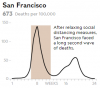
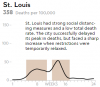
National Geographic have a great article about how different cities around the US reacted to the flu - and more importantly, what happened after they started lifting restrictions - How some cities ‘flattened the curve’ during the 1918 flu pandemic

Most cities who lifted restrictions early, saw a significant second wave of deaths and many had to go back into lockdown.

How demoralising would it be for people to feel like they have been liberated - they go out and celebrate like it's the end of the war (because it really does feel like it), only to be told that they have to go back into lockdown several weeks later.

Two examples from that article:

upload_2020-4-15_10-4-51.png upload_2020-4-15_10-5-0.png
 

Attachments

  • upload_2020-4-15_10-4-51.png
    upload_2020-4-15_10-4-51.png
    22.7 KB · Views: 18
  • upload_2020-4-15_10-5-0.png
    upload_2020-4-15_10-5-0.png
    21.2 KB · Views: 19
Ok, so maybe nuance is getting lost in the course of the debate (what? No! Surely not! :D ), because I don't think we are as far apart as it seems. I agree with all of that, and the good news is that if we stay the course now it *can* be limited to the lower end of that range.

When I say it "isn't a choice" I mean that it isn't a choice for however long it takes to control the initial outbreak while ramping up testing and hospital capacity to stamp down on any further spikes in cases. I don't know how long that will take, but it is likely to vary considerably by jurisdiction.

The problem is that if we lose patience and set a timeline that isn't met by our material level of preparedness, we will lose whatever ground we have made up to that time. The clock is essentially re-set.

Yeah, I don't think we're so much in disagreement as bogged down in our own definitions of things! Words like 'normal' and 'quickly' and 'opening up' are relative terms, which makes these discussions tricky.

It is encouraging that the UK government is sticking to its guns about not releasing too soon, though as a person who likes to know what's coming I have some instinctive sympathy with Keir Starmer's position that it might be psychologically beneficial to know exactly what indicators they're waiting for at some point (they're not going to tell him now though, of course).


In the short run, perhaps you're right. We all saw the footage of the ****** piling into pubs for last drinks - I can only wonder how many people are now dying because of that behaviour.

But it won't last. As people begin to grasp the consequences of their actions, that behaviour will change. The 'Britons Carry On' analogy doesn't apply - there is no human enemy to stare down, and the virus doesn't care. It's also the case that many of the worst-hit parts of the economy simply cannot power up and down that quickly.

What I would say on this is I don't know how much exposure you've had to British press coverage lately, but this 'wartime/Blitz spirit' attitude is very much alive and kicking and the fact it makes absolutely no sense against a virus in the way it would against (say) terrorism really doesn't seem to be stopping anyone invoking it. This is very deeply ingrained in the British psyche (to the point that even as I coolly dissect it here I can feel what is almost an underlying resentment that it won't work) - it's how we deal with things. Keep Calm and Carry On. It's arguably why we're so far behind other countries to begin with. An awful lot of Britons still draw our national character from stoic resistance in a conflict that was resolved 75 years ago.

Obviously it's being pushed alongside the stay at home messaging, but it's there. And it will mean that when things are eased people will be all geared up to Carry On once more.
 
and is probably even more painful and unwanted for those who have started relationships just before the crisis began.
...
I'm in this bloody boat, finally met someone just a few days before lockdown, we had plans to meet up, but now we're stuck with phone calls and texts... But at least we've really got to know each other first, and we're both really looking forward to getting away for a night once Boris lets us out to play again...
 
...
I'm in this bloody boat, finally met someone just a few days before lockdown, we had plans to meet up, but now we're stuck with phone calls and texts... But at least we've really got to know each other first, and we're both really looking forward to getting away for a night once Boris lets us out to play again...

Oh I'm sorry, that's really unfortunate :(
You seem to be getting the short end of the stick on all things virus-related :(
 
Luckily it looks like this lockdown shouldn't last too much longer in many US states -maybe another month or so, maybe not even that - I expect a huge boom in zoo visitors after that.
 
Back
Top