You will believe a shark can roar: Zoological malpractice in Hollywood.

In the Disney film I’ll Be Home for Christmas, the main character comes across a white-backed vulture in the desert of California. There’s the obvious issue of it being an African species, and I think it’s a bit puzzling that they would use this exotic vulture when the native and ever-abundant turkey vultures would presumably be easy to obtain.
 
In the Disney film I’ll Be Home for Christmas, the main character comes across a white-backed vulture in the desert of California. There’s the obvious issue of it being an African species, and I think it’s a bit puzzling that they would use this exotic vulture when the native and ever-abundant turkey vultures would presumably be easy to obtain.
It's illegal for a native bird to work under the MBTA, that's why so many movies use exotic birds in place of native ones - it's technically illegal to use native ones (although I highly doubt anyone would actually get in trouble for using a legally obtained native bird).
 
It's illegal for a native bird to work under the MBTA, that's why so many movies use exotic birds in place of native ones - it's technically illegal to use native ones (although I highly doubt anyone would actually get in trouble for using a legally obtained native bird).
Oh, that’s interesting.
 
It's illegal for a native bird to work under the MBTA, that's why so many movies use exotic birds in place of native ones - it's technically illegal to use native ones (although I highly doubt anyone would actually get in trouble for using a legally obtained native bird).
This doesn’t explain why movies don’t just use computer-generated birds, or why bird vocalizations are often incorrect. In these cases, ignorance on the part of the film studio or the fact that most audiences would not notice is a sufficient explanation. Furthermore, the reason why the calls of Red-tailed Hawks are often used with imagery of other birds of prey (particularly Bald Eagles) is because its scream is considered to be more impressive than the vocalizations of, for example, falcons, which often make high-pitched chittering or chirping noises, and Bald Eagles, which produce a feeble, gull-like clucking.
 
This doesn’t explain why movies don’t just use computer-generated birds, or why bird vocalizations are often incorrect. In these cases, ignorance on the part of the film studio or the fact that most audiences would not notice is a sufficient explanation. Furthermore, the reason why the calls of Red-tailed Hawks are often used with imagery of other birds of prey (particularly Bald Eagles) is because its scream is considered to be more impressive than the vocalizations of, for example, falcons, which often make high-pitched chittering or chirping noises, and Bald Eagles, which produce a feeble, gull-like clucking.
Most modern movies do use CGI birds - but remember that cheap CGI is still fairly new technology, which is why you might struggle to think of movies that do this.

I know why Red-tailed Hawk sounds are used, and I've always found it a bit silly, as I think Bald Eagles actually sound more majestic than Red-tailed Hawks do. I've noticed that in the past few years actual Bald Eagle sounds are being used more often.
 
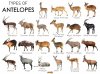
An image displaying different types of antelope, but the "Tibetan antelope" is an extremely obvious oryx.
 

Attachments

  • Types-of-Antelopes.jpg
    Types-of-Antelopes.jpg
    126.5 KB · Views: 25
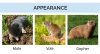
DAD1E86A-F16A-4B47-A32B-D12BE01670F7.jpeg This is a graphic from a pest control site, which uses a picture of a ground squirrel for a gopher, when real gophers look more like moles. Also, you are more likely to confuse a vole for a deer mouse than a gopher or prairie dog; the only real similarity between moles and voles in this context is in their names.
 

Attachments

  • DAD1E86A-F16A-4B47-A32B-D12BE01670F7.jpeg
    DAD1E86A-F16A-4B47-A32B-D12BE01670F7.jpeg
    82.8 KB · Views: 119
Some ground squirrels are also called gophers but do not belong to the same family as pocket gophers.
 
I meant pocket gophers (Geomyidae), which are the true gophers. It’s inaccurate to call ground squirrels gophers. You are right though, that they are commonly (though ignorantly) nicknamed gophers (for example, the “gopher” in Minnesota’s nickname refers not to pocket gophers but to Thirteen-lined Ground Squirrels).
 

Attachments

  • E4DB6DA3-22BE-4563-9082-D1AA49A2567B.jpeg
    E4DB6DA3-22BE-4563-9082-D1AA49A2567B.jpeg
    135.9 KB · Views: 12
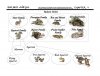
The Burgess Animal Book for Children has quite a few inaccuracies (many of them related to its early publication date of 1920), but the worst one is how the “squirrel family” (Sciuridae) is classified. The book went to the effort that it did (despite deliberately avoiding technical terms), and yet, it classified squirrels in a rather nonsensical way, even for its time.
According to the book, the squirrel family is divided into three groups (perhaps representing the level of subfamily or tribe): flying squirrels, marmots (including prairie dogs), and true squirrels. True squirrels are further divided into tree squirrels, rock squirrels, and ground squirrels (which I assume are representing the rank of “genus”). The weirdest thing about this system is the distinction between “rock squirrels” and “ground squirrels”. According to the book, chipmunks are rock squirrels, and “spermophiles” (species traditionally classified in the genus Spermophilus) are ground squirrels. The book mentions the Thirteen-lined Ground Squirrel and the “gray ground squirrels” as true ground squirrels. Of the “gray ground squirrels”, only the California Ground Squirrel is mentioned, so perhaps this term refers to species that would now be classified in the genus Otospermophilus, which ironically includes the actual Rock Squirrel. So under this classification, the Rock Squirrel is presumably not a “rock squirrel”, the marmots, chipmunks, and prairie dogs, are not ground squirrels as they really are, and the tree squirrels are not grouped with the flying squirrels even though any reasonable person (including modern taxonomists) would group them together.
 
View attachment 539977 This is a graphic from a pest control site, which uses a picture of a ground squirrel for a gopher, when real gophers look more like moles. Also, you are more likely to confuse a vole for a deer mouse than a gopher or prairie dog; the only real similarity between moles and voles in this context is in their names.
Gopher is a term that doesn't really specifically refer to any animal but more most burrowing rodents. I don't think it's inaccurate to call a woodchuck a gopher, as is being done here.
 
A TV version of 'Dracula' had Dracula flying through the window and transforming himself into a bat. A vampire bat? No, a fruit bat. Oh well, I suppose blood oranges had to come from somewhere. Watch out for the rabid mangos.


Well oddly enough in the past fruit bats were once thought to be the vampires until Desmodus rotundus was found

Even then people didn't believe it was a real vampire bat

Heck there's even Vampyrodes caraccioli which is a fruit bat
 
Last edited:
Smiling non-human primates is such a pet peeve of mine in media. I think Night At The Museum had a few scenes with a monkey smiling as a ”the monkey is happy/being silly” thing, even though with non-human primates, smiling is a sign of discomfort. It’s unfortunately become pretty common misinformation to the point where videos of primates in inproper care doing fear grimaces is a cute thing, but relaxed, comfortable primates are accused of being abused since “they look sad”. I feel like not enough people understand that animals don’t usually emote like humans do.
 
I remember years ago I was watching an episode of Suite Life of Zack and Cody on Disney Channel. In it, the character of Cody raises an orphaned hawk egg after the mother is driven off. Once the chick hatches and grows into a young hawk he plans to send him to a zoo so he’d be “safe from hunters.” This has stuck in my head for years because even back then as a little kid I knew it was illegal in the USA to hunt raptors.

Another part of this episode that bothered me is that the mom said the hawk should be set free because he’ll be “fed a mouse through a metal door” in a zoo. Nevermind that that’s really not how raptor care in zoos works anymore and the hawk has likely been imprinted on humans and can’t survive in the wild.

This has been stewing in the back of my mind for years longer than it has any right to.
 
Back
Top