Zoo of the Future: A Photographic Gallery of Innovation in Zoological Gardens of the World

This place is so big, that deer have the same chance of avoiding bears as in the wild. Similar to some fenced reserves in South Africa which have some predators and ungulates.

It's not the same though, because the bears are fed to keep them from doing that. The ones who still might go for prey, the wolves and brown bears, are in fenced areas. What was your source for bears eating most deer fawns?
 
13. Day-night rotational exhibits, Taiping Zoo

full

Serval at night in another zoo by @Jackwow

City zoos almost universally complain about lack of space. However, their exhibits stand empty at least half of the time. Many zoos lock big mammals in holding areas outside the visitor hours, which is the time when many are active.

full

Photo: @Javin 98

This exhibit at Taiping Zoo is good, but not exceptional for chimpanzees, but one of best serval exhibits in the world. The secret is that chimpanzees, like all apes, sleep at night. Then the exhibit is used by servals. A similar exhibit holds orangutans and leopard cats.

full

Photo: @devilfish

full

Photo: DannySG

Similar exhibits:

full

Photo @German Zoo World

Despite the obvious potential for animal welfare, there are very few other examples of day-night exhibits. Zoo Karlsruhe lets their hippo use elephant exhibit at night. It is especially valuable, because hippos are mostly nocturnal. They sleep and rest during day, and at night leave water and travel long distances on land to graze. Practically no zoo makes allowance for that. Zoo Fuengirola seems to have a similar arrangement for serval and pygmy hippo, but I could not find details.

full

Photo: @Jogy

Locking mammals which are active round the clock or nocturnal in small holding areas at night might be a big welfare issue of modern zoos - not recognized because we, humans, are diurnal.
 
Zoo Karlsruhe lets their hippo use elephant exhibit at night. It is especially valuable, because hippos are mostly nocturnal.
Seeing elephants have one of the shortest sleep cycles and tend to be active at night as well, this sounds great for hippos but not great for elephants, which ideally would have 24/7 access to the exhibit.

Locking mammals which are active round the clock or nocturnal in small holding areas at night might be a big welfare issue of modern zoos - not recognized because we, humans, are diurnal.
Thankfully, I think some zoos are slowly starting to realize that access to exhibits when the zoo isn't open is important. It is a serious issue, and although exhibit design and weather conditions doesn't always allow it, whenever possible I'd hope zoos give animals 24/7 access to their entire exhibits, indoor and outdoor.
 
The fact this is possible concerns me from a welfare and ethics standpoint. One of the foundations of animal welfare are the freedoms from pain, injury, and discomfort. Clearly, housing captive animals in an exhibit that allows for the non-negligible chance of predation infringes on these freedom of the deer. Humanely euthanizing surplus births to feed to carnivores is one thing (not saying I agree with that, just that it isn't as ethically concerning), but encouraging or allowing active predation is much more concerning.
I quite agree, all zoos should be governed by the 5 freedoms,some of which you have just mentioned. To anyone who has never heard of them, Google it,they might influence the way that you perceive future zoo visits
 
I quite agree, all zoos should be governed by the 5 freedoms,some of which you have just mentioned. To anyone who has never heard of them, Google it,they might influence the way that you perceive future zoo visits
I used to teach the Five Freedoms to students as workshops, it allowed the students to bounce ideas about and the feedback from them was always positive. They said it taught them more about animal welfare.
 
9. Kelp forest, Monterey Bay Aquarium
Plants in zoos

full

Photo @splendens


Zoos understandably focus on animals. Plants rarely take centre stage, despite their vital role in providing habitat for animals and supporting human life. Aquatic plants are even rarer. In 1984, the Monterey Bay Aquarium became the first one to exhibit a simulated giant kelp forest off the Californian coast. Cultivating kelp is difficult, requiring intense sunlight, water current and fresh water pumped from the sea. The tank is flatter than it appears; behind the first row of kelp lies the wall. Nevertheless, both the tank and diver presentations remain popular after nearly 40 years.


The principles of zoo exhibits seem to have changed since the creation of the kelp tank. Zoos in the late 20. century often had the ideal of showcasing entire habitats, including plants, landscapes and animals. Modern zoos usually don't try to show entire ecosystems. Plants are intended to provide shelter for animals and a pleasing sight for visitors.


Similar exhibits:
Other kelp forest tanks include Aquarium of the Pacific, Birch Aquarium, Macduff Marine Aquarium, Two Oceans Aquarium in Durban and Tokyo Sea Life Park. However, it is not always clear whether the kelp is live or artificial. Unfortunately, I didn't have the chance to see them in person.

full

Photo @Westcoastperson

Few other plants are remarkable enough to warrant their own exhibit. They include marimo - the ball-shaped growth form of algae Aegagropila linnaei.

full

Photo: @ISAO

Giant water lilies Victoria have leaves which can support weight of a person. Giant water lilies in the outdoor pond at Wilhelma zoo are cultivated from seeds every spring and die in winter frosts.


full

Photo @Maguari

Among the land plants, the Giant Arum Amorphophallus titanum is regularly showcased in zoos. It is the largest single inflorescence of any plant of the world. Multiple small flowers are hidden within a rod-shaped leaf.

full

Photo @Gigit

However, no zoo or botanical garden grows the biggest single flower of the world, Rafflesia arnoldi. Rafflesias are parasites of a specific type of lianas, Tetrastigma, and bloom only once in their lifetime. Rafflesias might be good focus species for the protection of South-East Asian rainforests. They are uncommon, slow growing, and exist as either male or female, requiring simultaneous flowering for propagation. This makes them vulnerable to rainforest fragmentation. Apparently, cultivating the liana and the Rafflesia is very challenging. What you see quite often are models.

full

Photo @Zooish
 
Last edited:
9. Kelp forest, Monterey Bay Aquarium
Plants in zoos

full

Photo @splendens


Zoos understandably focus on animals. Plants rarely take centre stage, despite their vital role in providing habitat for animals and supporting human life. Aquatic plants are even rarer. In 1984, the Monterey Bay Aquarium became the first one to exhibit a simulated giant kelp forest off the Californian coast. Cultivating kelp is difficult, requiring intense sunlight, water current and fresh water pumped from the sea. The tank is flatter than it appears; behind the first row of kelp lies the wall. Nevertheless, both the tank and diver presentations remain popular after nearly 40 years.


The principles of zoo exhibits seem to have changed since the creation of the kelp tank. Zoos in the late 20. century often had the ideal of showcasing entire habitats, including plants, landscapes and animals. Modern zoos usually don't try to show entire ecosystems. Plants are intended to provide shelter for animals and a pleasing sight for visitors.


Similar exhibits:
Other kelp forest tanks include Aquarium of the Pacific, Birch Aquarium, Macduff Marine Aquarium, Two Oceans Aquarium in Durban and Tokyo Sea Life Park. However, it is not always clear whether the kelp is live or artificial. Unfortunately, I didn't have the chance to see them in person.

full

Photo @Westcoastperson

Few other plants are remarkable enough to warrant their own exhibit. They include marimo - the ball-shaped growth form of algae Aegagropila linnaei.

full

Photo: @ISAO

Giant water lilies Victoria have leaves which can support weight of a person. Giant water lilies in the outdoor pond at Wilhelma zoo are cultivated from seeds every spring and die in winter frosts.


full

Photo @Maguari

Among the land plants, the Giant Arum Amorphophallus titanum is regularly showcased in zoos. It is the largest single inflorescence of any plant of the world. Multiple small flowers are hidden within a rod-shaped leaf.

full

Photo @Gigit

However, no zoo or botanical garden grows the biggest single flower of the world, Rafflesia arnoldi. Rafflesias are parasites of a specific type of lianas, Tetrastigma, and bloom only once in their lifetime. Rafflesias might be good focus species for the protection of South-East Asian rainforests. They are uncommon, slow growing, and exist as either male or female, requiring simultaneous flowering for propagation. This makes them vulnerable to rainforest fragmentation. Apparently, cultivating the liana and the Rafflesia is very challenging. What you see quite often are models.

full

Photo @Zooish
Ripley's Aquarium of Canada has a kelp forest tank that I thought was quite good on my visit this fall. I completely agree that plants can truly turn an aquarium exhibit into something much more impressive. While not "plants" per say, I'd imagine tanks with live coral could similarly fit in as an example of using taken for-granted parts of the ecosystem to make an exhibit way more impressive and naturalistic.
 
9. Kelp forest, Monterey Bay Aquarium
Plants in zoos

full

Photo @splendens


Zoos understandably focus on animals. Plants rarely take centre stage, despite their vital role in providing habitat for animals and supporting human life. Aquatic plants are even rarer. In 1984, the Monterey Bay Aquarium became the first one to exhibit a simulated giant kelp forest off the Californian coast. Cultivating kelp is difficult, requiring intense sunlight, water current and fresh water pumped from the sea. The tank is flatter than it appears; behind the first row of kelp lies the wall. Nevertheless, both the tank and diver presentations remain popular after nearly 40 years.


The principles of zoo exhibits seem to have changed since the creation of the kelp tank. Zoos in the late 20. century often had the ideal of showcasing entire habitats, including plants, landscapes and animals. Modern zoos usually don't try to show entire ecosystems. Plants are intended to provide shelter for animals and a pleasing sight for visitors.


Similar exhibits:
Other kelp forest tanks include Aquarium of the Pacific, Birch Aquarium, Macduff Marine Aquarium, Two Oceans Aquarium in Durban and Tokyo Sea Life Park. However, it is not always clear whether the kelp is live or artificial. Unfortunately, I didn't have the chance to see them in person.

full

Photo @Westcoastperson

Few other plants are remarkable enough to warrant their own exhibit. They include marimo - the ball-shaped growth form of algae Aegagropila linnaei.

full

Photo: @ISAO

Giant water lilies Victoria have leaves which can support weight of a person. Giant water lilies in the outdoor pond at Wilhelma zoo are cultivated from seeds every spring and die in winter frosts.


full

Photo @Maguari

Among the land plants, the Giant Arum Amorphophallus titanum is regularly showcased in zoos. It is the largest single inflorescence of any plant of the world. Multiple small flowers are hidden within a rod-shaped leaf.

full

Photo @Gigit

However, no zoo or botanical garden grows the biggest single flower of the world, Rafflesia arnoldi. Rafflesias are parasites of a specific type of lianas, Tetrastigma, and bloom only once in their lifetime. Rafflesias might be good focus species for the protection of South-East Asian rainforests. They are uncommon, slow growing, and exist as either male or female, requiring simultaneous flowering for propagation. This makes them vulnerable to rainforest fragmentation. Apparently, cultivating the liana and the Rafflesia is very challenging. What you see quite often are models.

full

Photo @Zooish
Giant Kelp aren't plants. They're protists.
 
Similar exhibits:
Other kelp forest tanks include Aquarium of the Pacific, Birch Aquarium, Macduff Marine Aquarium, Two Oceans Aquarium in Durban and Tokyo Sea Life Park. However, it is not always clear whether the kelp is live or artificial. Unfortunately, I didn't have the chance to see them in person.

Kelp forests are a dime a dozen in West Coast aquariums it feels like, and although I can't say with 100% certainty the ones you mention in California appear to have real kelp. Observe this example from Birch Aquarium (my photograph):

full


I'm a fan of these exhibits, they are usually signature tanks for aquariums on this coast. I also agree with highlighting them as designs fit for the future: IMO they make a good case that you don't need flashy colorful organisms (ex. a coral reef) to make a compelling ecosystem display.
 
However, no zoo or botanical garden grows the biggest single flower of the world, Rafflesia arnoldi. Rafflesias are parasites of a specific type of lianas, Tetrastigma, and bloom only once in their lifetime. Rafflesias might be good focus species for the protection of South-East Asian rainforests. They are uncommon, slow growing, and exist as either male or female, requiring simultaneous flowering for propagation. This makes them vulnerable to rainforest fragmentation. Apparently, cultivating the liana and the Rafflesia is very challenging. What you see quite often are models.
full

Photo @Zooish
I imagine this is because of the little fact that the Rafflesia flower literally stinks like a rotting corpse.

People already complain about some smells at zoos. I can perfectly understand why an actual corpse flower is kind of a no go.
 
Last edited:
some zoos are slowly starting to realize that access to exhibits when the zoo isn't open is important

I hope every new exhibit for nocturnal or cathemeral animals - most mammals other than monkeys and apes, will allow them to use the whole exhibit 24 hours a day. And every renovated exhibit should think about it. This might perhaps curb the zoo ambition to include particularly narrow moats and steep cliffs.

However, some zoos already allow elephants, large carnivores and others to use their exhibits round the clock, and they aren't significantly different than zoos which keep them in secure areas for over 12 hours every day.
 
Other kelp forest tanks include Aquarium of the Pacific, Birch Aquarium, Macduff Marine Aquarium, Two Oceans Aquarium in Durban and Tokyo Sea Life Park. However, it is not always clear whether the kelp is live or artificial. Unfortunately, I didn't have the chance to see them in person.
The Aquarium of the Pacific plants and macro algae are all a mix of real and fake. Trees, kelp, eelgrass, and Mangroves all could either be real or fake. However the kelp in that photo is all real.
 
10. A post for Christmas. Light sculptures at Pittsburgh Zoo and a giant isopod gift toy at Tokyo Sea Life Park
Entertainment in zoos as an unused opportunity for education

full

Safaripark Beekse Bergen. Photo: @vogelcommando

Most zoos still miss the opportunity to include non-animal amenities: an entertainment exhibition, a children's playground, a restaurant and so on, into their mission of conservation and education. For an average zoo, changing these parts will be the best cost-to-effect way to boost zoo income and education.

In the 2010s, temporary lantern sculptures shaped like animals became a common mid-winter attraction in northern zoos. But why install a random collection of dragons and whatever? A zoo can use this opportunity for education. This zoo made a light sculpture of a musk deer, a little-known, endangered and nocturnal species.

full

Photo: @Pleistohorse

A gift shop is another location of the zoo which is important for visitors. But zoos often overlook its potential for education and conservation mission. Luckily, zoos no longer need to buy standard toys. At least one company specializes in educative, diverse, unusual toy animals. One can buy any cuddly toy from a great blue turaco to a red river hog. Even a Tiktaalik - a cute plush toy which is biologically accurate, the first known prehistoric quadruped which crawled out of water to land. (A note to satisfy the taxonomic purists: technically it was still classified as a fish, not yet an amphibian).

full

So ugly and otherwordly that irresitible. Tokyo Sea Life Park, photo @FunkyGibbon

I saw several gift shops in zoos and museums with high quality merchandise. I especially remember a gift shop at Papiliorama Kerzers, with colorful children books about such things like a little girl bat which went on her adventures.

A carousel is a centuries-old children's attraction. However, this one at Brookfield Zoo draws at least some attention to endangered species. Love the babirusa.

full

Photo: @Pleistohorse
 
Last edited:
A carousel is a centuries-old children's attraction. However, this one at Brookfield Zoo draws at least some attention to endangered species. Love the babirusa.

full

Photo: @Pleistohorse
I recall I quite liked the one at Jardin des Plantes [located close to the museum];
upload_2023-12-25_20-39-56.jpeg
with both endangered and extinct animals.
il_fullxfull.2637602979_1mhv.jpg

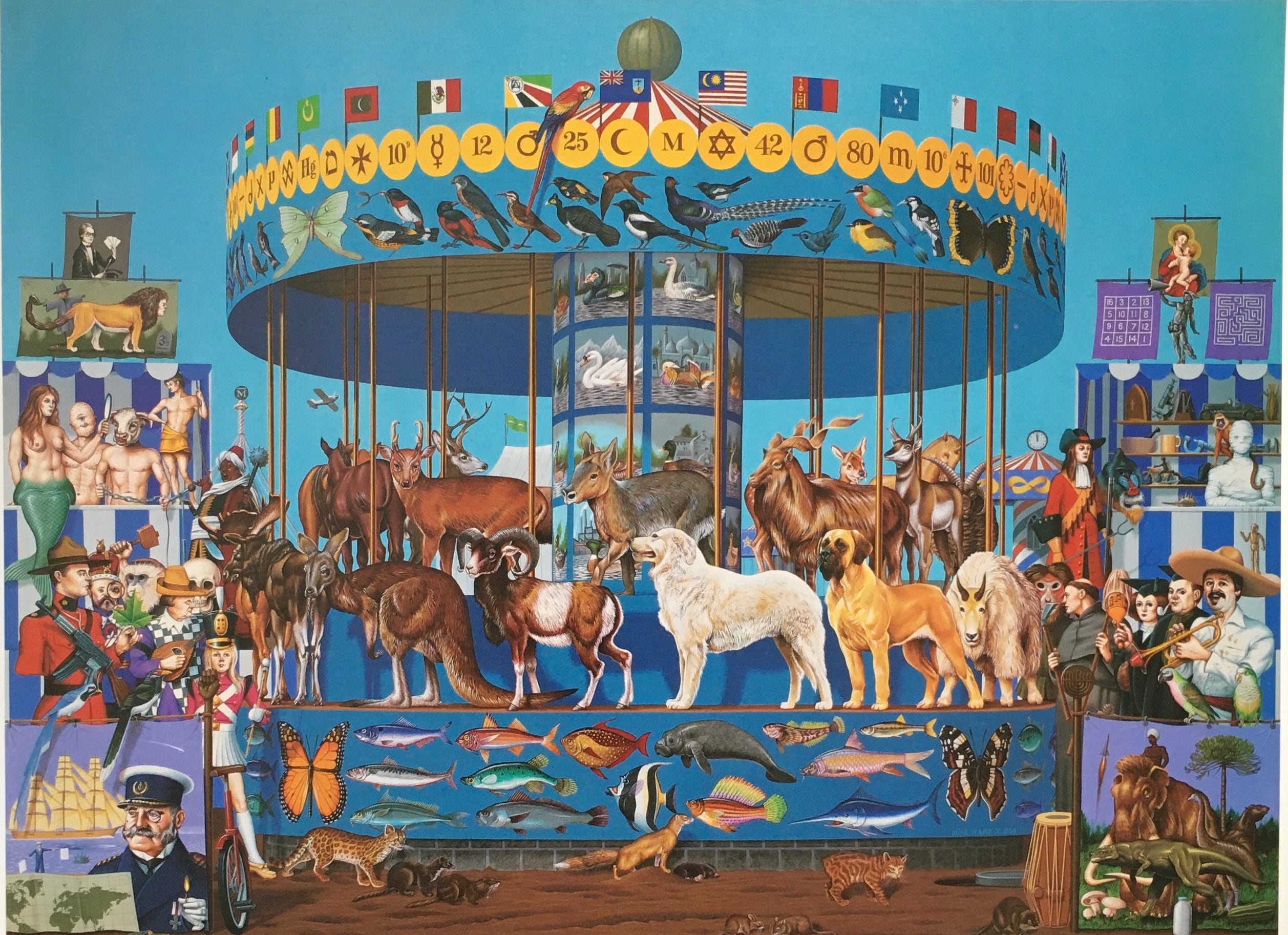
It also brings my mind to this particular imagery of Mike Wilks' Ultimate Alphabet [1986]; for the letter M. The central element is that of a merry-go-round of mammals, all of which have some form of name beginning with M. And several hundred other things contained in the picture that start with that letter...
 

Attachments

  • upload_2023-12-25_20-39-56.jpeg
    upload_2023-12-25_20-39-56.jpeg
    166.8 KB · Views: 313
A gift shop is another location of the zoo which is important for visitors. But zoos often overlook its potential for education and conservation mission. Luckily, zoos no longer need to buy standard toys. At least one company specializes in educative, diverse, unusual toy animals. One can buy any cuddly toy from a great blue turaco to a red river hog. Even a Tiktaalik - a cute plush toy which is biologically accurate, the first known prehistoric quadruped which crawled out of water to land. (A note to satisfy the taxonomic purists: technically it was still classified as a fish, not yet an amphibian).

full

So ugly and otherwordly that irresitible. Tokyo Sea Life Park, photo @FunkyGibbon
[/USER]
While I certainly agree with your point, giant isopod seems to be (surprisingly?) popular in Japan even among the general public, and getting a giant isopod plushie in japan may be as common as the Nemo next to it. So it's not as outlandish and unusual as you may think.
 
11. Africambo for elephants and other species, Magdeburg Zoo
Mixed species exhibits with the largest land mammals

full

Photo: @ThylacineAlive

Exhibiting elephants has changed very much in the last 20 years, since elephants often had only a small paddock and a concrete-floored stall. Magdeburg Zoo in 2017 opened a modern 1,4 ha exhibit, where African elephants are mixed with lechwe, impala, warthog, bat-eared fox and green monkey outdoors, and several African wading birds indoors.

full

Photo: @Paul Kalisch

full

Photo: @Newzooboy

Although elephants do not necessarily benefit, this provides more space for smaller animals, important at the time when European zoos drop one species after another because of not having sufficient space. Given diverse needs and escape possibilities of the species, and the challenge for keepers to manage anything in the presence of destructive and potentially dangerous elephants, such exhibit is especially remarkable.

full

Photo: @Kalaw

full

Is it a double decker - hadada ibis nesting on top of a hammerkop nest? Photo: @MagpieGoose

This exhibit has its own Zoolex entry:
ZooLex Exhibit - Africambo: Elephants
ZooLex Exhibit - Africambo: Elephants and cohabiting species

Similar exhibits:
Several zoos mix elephants with hoofed animals on large, safari park style exhibits. Boras zoo opened such an exhibit in the 1960s and for decades it was about the only example in zoos. Co-habitants include both giraffe and African buffalo.

full

Photo: @Kwambeze

About 50 years had to pass before other zoos followed suit. Across the pond, perhaps the best known mixed-species elephant exhibit in Giants of the Savanna at Dallas Zoo.

full

Photo: @jbnbsn99

Safaripark Beekse Bergen mixes elephants with hamadryas baboons. Baboons have their own rocks to escape. There are diverse interactions. Baboons are generally afraid of elephants, especially when one goes between them and their rock. At other times, elephants entice baboons to play or climb over them.

full

Photo: @MagpieGoose

Mixed-species exhibits of Asian elephants are especially welcome, because they and Asian wildlife in general are more endangered than African megafauna. This exhibit at ZooPark de Itatiba in Brazil makes a good use of tropical climate and natural landscape for Asian elephants, hippos, water buffalo, whistling ducks and turtles. This hippo must enjoy the access to large land area.

full


full

Photos: @David Matos Mendes

Several zoos mix Asian elephants with blackbuck or deer, including barasingha. Dierenrijk Europe mixes Asian elephants with red and axis deer and long-tailed macaques. Pairi Daiza mixes them with Eld's deer and blackbuck, but the only photo I could find has feral Egyptian geese:

full

Photo: @Therabu

Indoors, several zoos: Dresden, Emmen (new) and Prague have or had free-flying birds in the elephant house. Uniquely, Sosto Zoo has a white-cheeked gibbon living above elephants in one very tall indoor space.

full

Photo: @antonybig
 
Last edited:
I just discovered this thread having been mentioned in a recent post, and I will say that it is an excellent and thoroughly interesting idea. A few comments:

1. The spider walkthrough at London is excellent, and hearing the reactions of members of the public, and family or friends who are visiting with me, who had not expected there to be free-ranging spiders in the walkthrough, being caught off guard is always tremendously entertaining. Walkthroughs with such animals as these are easily among the things that I most wish would become more common in zoos.

3. Although I understand their educational value, I certainly hope that electronic displays such as these have too prominent a role in the 'zoo of the future,' as they seem to be a tremendous waste of space. I remember how upset I was when Sea Life London replaced their Japanese Giant Spider crabs with animated Polar Bears and Orcas, and it now seems to be an increasingly common affair!

13. Adding onto this, Shaldon Zoo gives its Owston's Civets and Margays (both nocturnal animals) 24 hour access to their outdoor areas, with a timed feeder that dispenses food at regular intervals throughout the night placed into their enclosure to simulate natural nocturnal hunting habits as well as being able to venture outside at night, both of which being things that I would love to see more zoos attempt!

10. Regarding Magdeburg, does anyone know if the African wading birds are still present indoors, as I saw no sign of them on my visit in April?

Yet again, thoroughly enjoying this thread so far!
 
12. Burgers Rimba, Burgers Zoo
Mixed species exhibits of primates and ungulates

full

Photo: @EmperorTamarin
full

Photo: @Therabu

Many threatened primates are squeezed out of zoos because of a lack of space. One solution is mixed-species exhibits, and one promising idea is to keep monkeys on an ungulate exhibit. Primates are often aggressive and highly strung. However, a well designed exhibit with tall trees and climbing frames can allow primates to live high above the ungulates with relatively little interaction. On the second floor, so to say. An excellent but not expensive exhibit at Burgers Zoo keeps six threatened species too often neglected in zoos: siamang, sunda pig-tailed macaque, banteng, hog deer, Myanmar thamin and Reeves' muntjac. Note that siamang and macaques fought and had to be separated vertically by an electric fence.

full

Photo: @KevinB

In mixed species exhibits, often the interest is only on which species are compatible. However, the size of an exhibit, or space in meters per individual animal is at least as important. The second issue is the gender and breeding of animals. Many ambitious mixed-species exhibits join only non-breeing animals.

Similar exhibits:

Mixing primates and ungulates is regular but still not as common as it deserves. I have put two examples. A low-profile exhibit of non-breeding king colobus and Nubian ibex in Poznan Nowe Zoo keeps two African species not often mixed together. Both are endangered, although technically they live in different habitats in different parts of Africa.

full

Photo: @ralph
full

Photo: @Arek
full

A stand-in king colobus by @LeeMac13

The mix of Indian rhino, pileated gibbon and muntjac in Wroclaw zoo is essentially a gibbon exhibit retro-fitted into a rhino exhibit.

full

A stand-in pileated by @alexkant
full

Photo: @ThylacineAlive
full

Photo: @Pawel_PL
full

Photo: @Arek
 
Last edited:
12. Burgers Rimba, Burgers Zoo
Mixed species exhibits of primates and ungulates

full

Photo: @EmperorTamarin
full

Photo: @Therabu

Many threatened primates are squeezed out of zoos because of a lack of space. One solution is mixed-species exhibits, and one promising idea is to keep monkeys on an ungulate exhibit. Primates are often aggressive and highly strung. However, a well designed exhibit with tall trees and climbing frames can allow primates to live high above the ungulates with relatively little interaction. On the second floor, so to say. An excellent but not expensive exhibit at Burgers Zoo keeps six threatened species too often neglected in zoos: siamang, sunda pig-tailed macaque, banteng, hog deer, Myanmar thamin and Reeves' muntjac. Note that siamang and macaques fought and had to be separated vertically by an electric fence.

full

Photo: @KevinB

In mixed species exhibits, often the interest is only on which species are compatible. However, the size of an exhibit, or space in meters per individual animal is at least as important. The second issue is the gender and breeding of animals. Many ambitious mixed-species exhibits join only non-breeing animals.

Similar exhibits:

Mixing primates and ungulates is regular but still not as common as it deserves. I have put two examples. A low-profile exhibit of non-breeding king colobus and Nubian ibex in Poznan Nowe Zoo keeps two African species not often mixed together. Both are endangered, although technically they live in different habitats in different parts of Africa.

full

Photo: @ralph
full

Photo: @Arek
full

A stand-in king colobus by @LeeMac13

A mix of Indian rhino, pileated gibbon and muntjac in Wroclaw zoo is essentially a gibbon exhibit retro-fitted into a rhino exhibit.

full

Photo: @ThylacineAlive
full

Photo: @Pawel_PL
full

Photo: @Arek
The best example of this I've seen is easily Bronx Zoo's Gelada Reserve, which mixes the geladas with Nubian ibex and rock hyrax in a 1.5-acre large Ethiopian highlands themed exhibit. Truly a remarkable exhibit!
 
The Rimba is another favourite of mine! A few other examples of primate/ungulate mixes that come to mind:
  • Rhesus Macaques and Blue Wildebeest at Longleat Safari Park
  • Barbary Macaques and Eastern Bongo at Woburn Safari Park
  • Javan Langurs and Babirusa at Whipsnade
  • Coppery Titis and Brazilian Tapir at Magdeburg Zoo*
  • Gelada Baboons and Nubian Ibex at Magdeburg Zoo
  • Gelada Baboons and Nubian Ibex at Zurich
*Although I am fairly sure that the titis only have access to the indoor area.

Whipsnade should soon get another entry to the above list with a mix of Sulawesi Crested Macaques and Lowland Anoa.

As well as the above examples, there must be countless others around the world which I am yet to have seen in person or even have forgotten about, but I would be surprised if any come close to the Rimba! Zurich’s Semien Highlands isn’t far off in terms of quality, but has the notable disadvantage of only displaying two species compared to six!
 
Back
Top