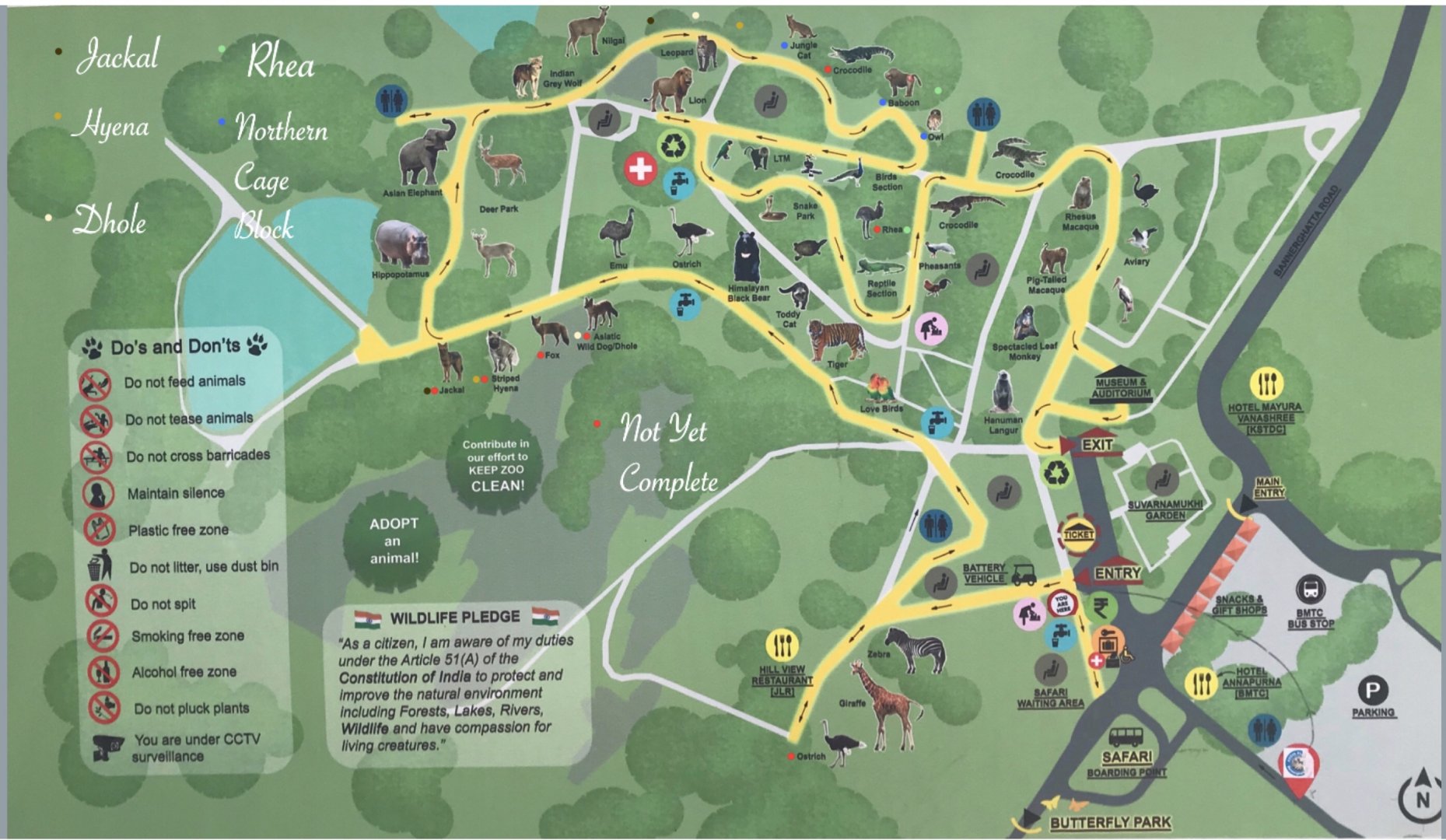
My local zoo, Bannerghatta Bio Park, has improved quite a bit since I last visited, but certainly has a ways to go before I would consider it a ‘good’ zoo. As you can see from the map above, a lot of things are still under construction or not even started to be built. I have marked these with a red dot, I will go over the zoo based on the following categories: primates, carnivores, herbivores, birds and ectotherms. Before I go into detail, there is a major changes sorely required; the complete demolition of the row of exhibits I call the ‘northern cage block’ (marked in blue). It consists of a series of outdated, small, bare mesh or chain link aviary like structures, connected by small yards which are blocked of to the animals. The primates used to be housed here but have thankfully got a new exhibit. Most of the animals still exhibited here are going to probably be moved out in the future, facilitating its demolition. I would replace it with a row of large, well planted aviaries for other animals across the zoo to move into.
Primates
Compared to their previous home in the northern cage block, the new exhibits for the rhesus macaque and grey langur (unknown sp., probably northern) are far more superior, large, open air exhibits with lots of climbing structures. The newly acquired pig-tailed langur and Phayre’s leaf monkey are also housed in similar exhibits. Bar the rhesus exhibit, there is no mesh and glass obstructing photography. The leaf monkeys however are seemingly much more arboreal, and the large trees in their exhibits have been cutdown leaving almost no shade forcing them to hide under the tiny shade structures. I would move these to an aviary in place of the former cage block. There is also a single lion tailed macaque housed near the bird exhibits (marked LTM on the map) which I would move there as well as its current exhibit is out of place and lacks any kind of enrichment.
There is also a solitary Hamadryas baboon in one of the northern cages, completely without enrichment of any kind, in far too small a cage. I would go as far as calling it the worst exhibit in the zoo. I would either move it to another zoo with other baboons or build a new, larger exhibit for it near the under construction canid row at the bottom left of the map, as well as acquiring new baboons.
Carnivores
The Bio Park also contains a safari park and rescue centre. Most of the carnivores were and still are housed here, including lions, tigers and sloth bears. Most of those in the zoo were smaller species. Recently, however a pair of tigers and a pair of lions were moved in. The tigers got a brand new, fairly decent exhibit, whereas the lions simply moved into a partitioned area if the enormous aviary like structure that serves as the leopard exhibit. This means the leopards het hardly any space compared to before. I would move the lions to a brand new exhibit across from the tigers, opening up the rest of the aviary back to the leopards. The Himalayan black bears previously lived in a tiny, octagonal monstrosity of mesh and concrete. While an outdoor area has been added (quite a nice one, to my ignorant eyes) the monstrous old enclosure which looks like it jumped from the 1800’s is still used as a holding area for one of the bears, presumably while the other is confined to the outdoor area. I would demolish entirely and send one of the bears to another zoo.
Most of the small carnivores live in small, overcrowded exhibits. The canids are already being moved to new enclosures, but the cage ‘complex’ near the bears is among the worst. It is marked ‘toddy cat’ on the map, of six fairly tiny cages containing a variety of animals but only the common palm civets and zebra finches are directly on display. I would move the civets to an aviary built to replace the northern cages. The grey mongooses, hidden away in the same block as the civets, and the jungle cats housed in a northern cage, would go to the same renovated aviaries (I know they are not for birds, but it’s the best logical word for the exhibits I imagine). I would leave the wolves as they are.
To be continued...