Day Five:
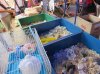
Today was our last free day in Kota Kinabalu, and we spent the morning exploring the Gaya Street Market. This large market was along one of the city’s main streets and featured a pile of stalls, selling all sorts of things, from souvenirs and food, to clothes and pets. Pets were the most interesting part, but were mostly puppies and rabbits, with a few fish too. There were also turtles (Red-eared Sliders and a Flat-shell? species), and some small rodents I didn’t recognise. The wildlife in the city was fairly minimal, a few Spotted Doves and Feral Pigeons, and also a couple of pairs of Zebra Dove. We specifically looked for House Swift colonies along Gaya Street (not just when the market was on), but couldn’t spot them.
We then headed to the northern end of the CBD, and the jetty from which boats were ferrying people to the nearby islands. Tickets had to be bought in a large, noisy and confusing building, where vendors attracted travellers by being as loud as possible. There were various options, and I’m not entirely sure how the system works, but we got tickets to Pulau Manukan and Pulau Sapi, and back to the city. The islands are all part of the Tunku Abdul Rahman National Park, Malaysia’s first marine national park. The boat was fast and we also saw the other three islands in the area, as the ferry made a circuit around the Park. Again, we didn’t spot much in the way of birdlife, just egrets, although one new species: a Pacific Reef Egret.
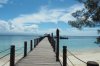
Our first stop, Pulau Manukan, is relatively well developed, with a tourist complex at one end that includes accommodation and food outlets, as well as water-based activities such as snorkelling, parasailing and kayaking. Upon arrival, we paid a small entry fee to the National Park, obtained a map and cold drink, and set off to walk around the jungle on the western end of the island. The first species we encountered was the Asian Glossy Starling, a common bird on Borneo, and in large numbers here. We also saw a skink and a feral cat, and then (after clambering over ridiculously numerous fallen trees and collapsed paths) gave up and went back to the main tourist area. We explored this for a while, and saw nothing new or interesting, before we had a swim in the warm water.
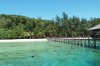
Just after noon we caught a second boat to the smallest island of the Park, Pulau Sapi. This was very close to the largest island here, Pulau Gaya, and there was even a zipline between the two. The jetty took us to a crowded beach, with food stands and equipment hire in the middle, and a steep forested hillside behind. We rented masks and fins, and set out to the snorkelling side of the beach. We’d never been snorkelling before, nor explored tropical reefs, so this was a very new experience. The small reef we snorkelled over was fairly degraded, lots of broken coral from people standing on it, and a bit of rubbish around, but the fish were incredible. Lots of species and colours, some darting away while others came close, with one species being particularly inquisitive and biting us. This was a great introduction to tropical reefs for us, but I think it would be less interesting to experienced divers, given the crowded and degraded nature of the site.
After snorkelling for a couple of hours, we returned to the jetty, and watched large schools of small fish before the boat arrived and whisked us back to Kota Kinabalu. On the way we passed the extensive stilt village of Pulau Gaya, which houses some 6000 illegal immigrants and looks incredible. Several such settlements are dotted around the Sabah coast, and are being controversially managed by the state. Upon our return to the city, we did some shopping and chilled by the pool, before walking down the waterfront and dining at a great Indian restaurant.
Overall, a fantastic and relaxing beach day, and an excellent introduction to tropical reefs. While I would have seen many new fishes, I didn’t have a camera capable of photographing them underwater, and nor do I have much interest in identifying them, so I don’t have much of an idea of what I saw. Bird-wise, I had hoped to see Philippine Scrubfowl on the islands, but no luck. We didn’t spend a lot of time in the forests, so I’ll have to have a better look next time. I think staying on the islands (Pulau Gaya has a resort) would be a good option too, more beach time and apparently there are also Bearded Pigs on Gaya, which is another priority species for me.
Borneo Wildlife Species Lists:
Birds:
21 Zebra Dove Geopelia striata
22 Pacific Reef Egret Egretta sacra
23 Asian Glossy Starling Aplonis panayensis
Photos below show: unknown rodents at the Gaya Street Markets; a boat unloading passengers at the Pulau Manukan jetty; the same jetty as seen from the boat; a school of fish off the Pulau Sapi jetty; and the massive stilt village off the coast of Pulau Gaya.