ZooChat Big Year 2021

BIRDS:
144) Eurasian whimbrel, Numenius phaeopus
145) Common ringed plover, Charadrius hiaticula
146) Bar-tailed godwit, Limosa lapponica
147) Common scoter, Melanitta nigra
148) Brambling, Fringilla montifringilla

(+8 heard only)


INVERTS:
4) Dotted border, Agriopis marginaria
First trip of the year to my local marsh to attempt photographing a group of Lesser redpolls that had been hanging around (and, of course, to try and find an Arctic!). No redpolls at all, but very good views of both of the common snipe species, very closeby thrushes etc. Snow birding at its best! Made much, much better when I suddenly saw a fox crossing the path and then the entire frozen pond, shortly followed by my first lifer mammal in 7 months!

BIRDS:
149) Eurasian woodcock, Scolopax rusticola

(+9 heard only)

MAMMALS:
6) Red fox, Vulpes vulpes
7) European polecat, Mustela putorius
 
Mammals
1. Rabbit (Oryctolagus cuniculus)
2. Coypu (Myocastor coypus)
3. Southern viscacha (Lagidium viscacia)
4. Mexican free-tailed bat (Tadarida brasiliensis)

Birds
1. Feral pigeon (Columba livia)
2. House sparrow (Passer domesticus)
3. Rufous-collared sparrow (Zonotrichia capensis)
4. Austral trush (Turdus falcklandii)
5. Eared dove (Zenaida auriculata)
6. Common diuca-finch (Diuca diuca)
7. Chilean mockingbird (Mimus thenca)
8. Monk parakeet (Myiopsitta monachus)
9. Chimango caracara (Milvago chimango)
10. Variable hawk (Geranoaetus polyosoma)
11. Andean condor (Vultur gryphus)
12. Austral trush (Curaeus curaeus)
13. Picui ground dove (Columbina picui)
14. Chilean swallow (Tachycineta leucopyga)
15. Blue and white swallow (Notochelidon cyanoleuca)
16. Plain-mantled tit-spinetail (Leptasthenura aegithaloides)
17. American kestrel (Falco sparverius)
18. Tufted tit-tyrant (Anairetes parulus)
19. House wren (Troglodytes aedon)
20. Long-tailed meadowlark (Leistes loyca)
21. Band-tailed sierra-finch (Phrygilus alaudinus)
22. Chilean tinamou (Nothoprocta perdicaria)
23. Chilean blue eagle (Geranoaetus melanoleucus)
24. California quail (Callipepla californica)

Reptiles
1. Jewel lizard (Liolaemus tenuis)
2. Elegant tree iguana (Liolaemus lemniscatus)
3. "Mountain lizard" (Liolaemus monticola)
 
Started two weeks of self-quarantine but luckily there are enough birds around to keep me happy... for now :p

BIRDS

Melbourne, Victoria
241 - Latham's Snipe (Gallinago hardwickii)

Perth, Western Australia
242 - Carnaby's Black Cockatoo (Zanda latirostris)
243 - Laughing Dove (Spilopelia senegalensis)*
244 - Red-tailed Black Cockatoo (Calyptorhynchus banksii)
Here you seem to have jumped straight from number 235 to number 241?
 
Day 5 was spent at Mission Beach, with local activities like brunch and preparing for a party on Sunday. Only one new species, found sitting in the driveway:

Reptiles
4. Yellow-spotted monitor Varanus panoptes
Reptiles
4. Australian water dragon Intellagama lesueurii
5. Elegant rainbow skink Carlia decora
Reptiles
6. Four-fingered shade skink Saproscincus tetradactylus
You have two #4 in reptiles. Are you now on 7 reptiles?
 
  • Like
Reactions: MRJ
Day 10 was a slow day around South Mission Beach enjoying the pool and the view. We did walk along the Kennedy Track which runs south along the ocean, with the hope we might pick up beach stone-curlew or other birds, but did not see any birds, and also went to a landing on the Hull River which was in the mangroves, but again no luck. We did see the cassowary with chick we saw on the first day walk right in front of us. Wonderful. South Mission Beach is a hot spot for cassowaries and we saw them four times on the roads around our accommodation.

Day 11 was devoted to packing and travelling, arriving back in Melbourne that evening.

Reptiles
8. sp. sun skink Lampropholis similis

Invertebrates
30. Greyback cane beetle Dermolepida albohirtum
31. Floury baker Aleeta curvicosta
32. Scarlet three-spined mangrove crab Neosarmatium trispinosum

Overall I had a wonderful time and added significant numbers to my lists. Notable were representatives of two new bird families for me, birds-of-paradise and boatbills. Numbers added are below, the first number to this list and the second to my overall list.

Mammals 24 / 18
Birds 100 / 52
Reptiles 8 / 7
Amphibians 6 / 5
Fish 1 /1

I've still got quite a few butterflies and some other invertebrates to add, but I think all would be new to my list.
 
Last edited:
I see them nearly every birding trip, they're very common around where I go. I think they are most common in woodlands if you want to have a try at it.

Unfortunately don't really have that option to be honest - every within a couple of miles of where I live is a concrete maze ;).
 
48. Brown-Headed Cowbird, Molothrus ater
49. Hairy Woodpecker, Dryobates villosus
50. Song Sparrow, Melospiza melodia
51. Swamp Sparrow, Melospiza georgiana
52. Eastern Screech Owl, Megascops asio

Another owl species! I was really happy to see a Screech Owl, terrific species that's also pretty hard to find in the wild. I don't think I've seen any in zoos so this is a full lifer which is nice. I'm very, very happy that I became more active at birding this year; it's resulted in some of my favourite animal experiences.
Had a really nice morning of birding today.

Mammals:
6. American Mink, Neovison vison
7. House Mouse, Mus musculus

Birds:
53. Great Blue Heron, Ardea herodias
54. Barred Owl, Strix varia
55. American Kestrel, Falco sparverius
56. Northern Mockingbird, Mimus polyglottos
57. Common Raven, Corvus corax

The Owl was great to see, really cool species and I got some nice views. The Kestrel was also nice, they're a pretty common bird but I rarely see them. I also got to see one of the Kestrels successfully hunt a mouse which was a first for me.
 
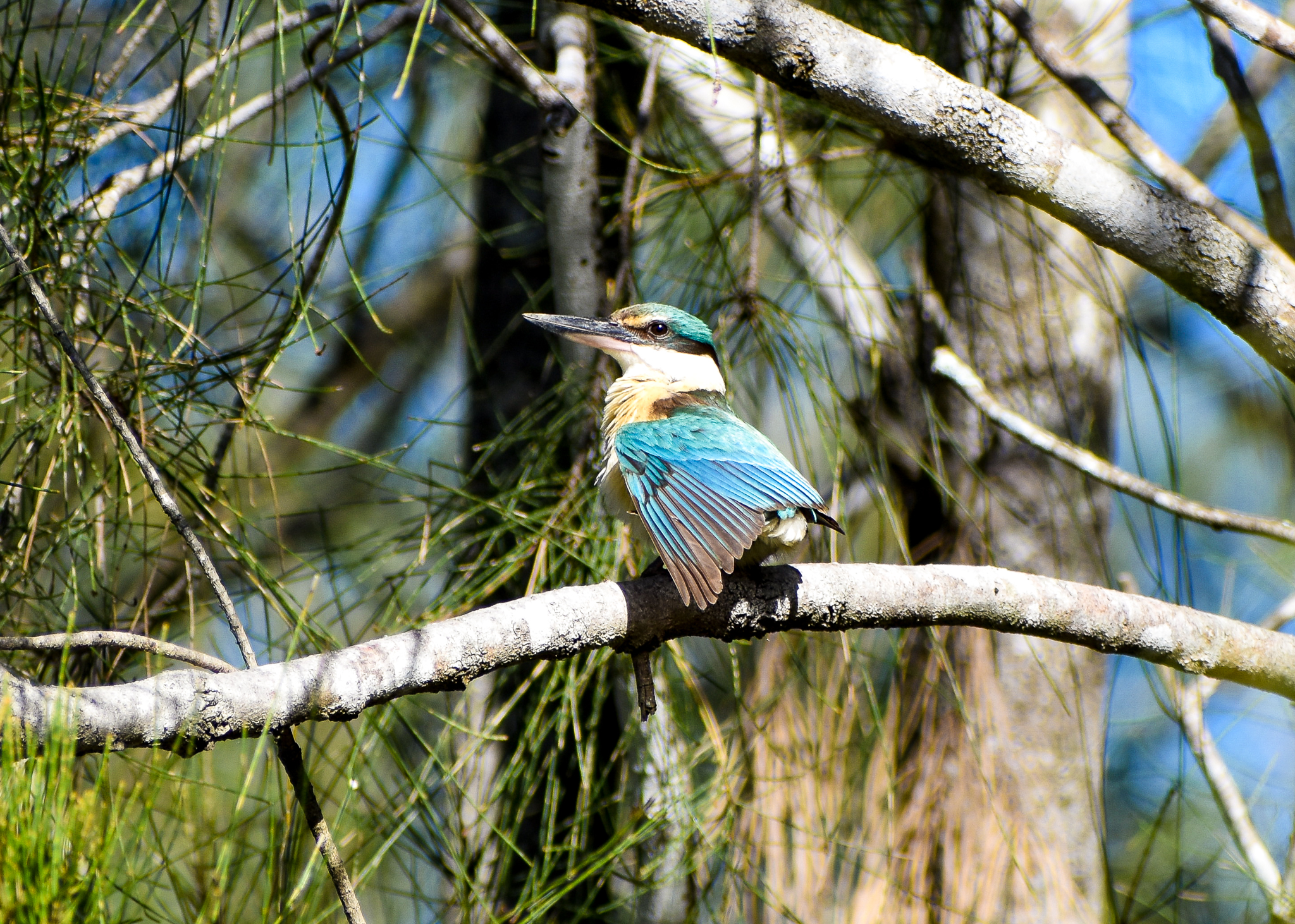
Success! I saw my first wild Black-necked Stork today!! I visited the Tinchi Tamba Wetlands Reserve which is nestled in Brisbane’s northern suburbs. I saw the stork from a distance but managed to get a good look at it. What a magnificent bird and nice to see one in the Brisbane area. The Far-eastern Curlew was another brilliant surprise to see. I didn't manage to get decent photos of the stork nor the curlew so the photo of the day is a sunbathing kingfisher.

Mammals
6) Eastern Grey Kangaroo Macropus giganteus

Birds
91) Black-necked Stork Ephippiorhynchus asiaticus

92) Superb Fairy-wren Malurus cyaneus
93) Whistling Kite Haliastur sphenurus
94) Crested Tern Thalasseus bergii
95) Far Eastern Curlew Numenius madagascariensis

My wildlife highlight for 2021 thus far has been seeing my first Richmond Birdwing Butterfly. It has long been my number one invert to see in the south-east Queensland area. This species lives in fragmented subtropical rainforest patches to the north and south of Brisbane and according to old records, used to be found along the city streets in large numbers. Absolutely marvellous creatures. Also, the neighbourhood ringtail possums have made a reappearance recently.

Mammals
7) Common Brushtail Possum Trichosurus vulpecula
8) Common Ringtail Possum Pseudocheirus peregrinus

Birds
96) Magpie Goose Anseranas semipalmata
97) Spectacled Monarch Symposiachrus trivirgatus

Herptiles
8) Elegant Snake-eyed Skink Cryptoblepharus pulcher

9) Saw-shelled Turtle Myuchelys latisternum

Invertebrates
23) Clearwing Swallowtail Cressida cressida
24) Cosmopolitan Jumping Spider Menemerus bivittatus
25) Graphic Flutterer Rhyothemis graphiptera
26) Meadow Argus Junonia villida
27) Great Carpenter Bee Xylocopa aruana
28) Richmond Birdwing Ornithoptera richmondia
29) Evening Brown Melanitis leda
30) Orange Ringlet Hypocysta adiante
31) Dome Web Spider Cyrtophora moluccensis
32) Golden-tailed Sugar Ant Camponotus aeneopilosus
33) Wandering Ringtail Austrolestes leda
34) Garden Mantid Orthodera ministralis
35) Fuscous Swallowtail Papilio fuscus
 
Some more Far North Queensland invertebrates

33. Lemon migrant Catopsillia pomona
34. Common redeye Chaetocnene beata
35. Red lacewing Cethosia cydippe
36. Common crow Euploea core
37. Blue triangle Graphium choredon
38. Orchard swallowtail Papilio aegeus
39. Small pied blue Megisba strongyle
40. Australasian giant centipede Ethmostigmus rubripes (new Class, Order, Family)
 
Little shrike-thrush has been split with the local species in FNW being the rufous shrike-thrush. We were not aware of this, and as we were using two different sources we ended up recording both. Therefore the number of bird species recorded here to date drops back to 158.
 
Finally another update, a mountain species mysteriously appearing in small numbers in my lowland area at the moment.

65. Cassin's Finch (Haemorhous cassini)

4-65-3-2-0-6

Watched a Sharp-shinned Hawk bushwhacking for sparrows yesterday but he came up empty handed. Was hoping to get some species today but no luck.

66. Sharp-shinned Hawk (Accipiter striatus)

4-66-3-2-0-6
 
Another species misidentified, this time to our advantage

98. White-browed scrubwren Sericornis frontalis
should have been
98. Fernwren Oreoscopus gutturalis
 
Birds
132. European Goldfinch
133. Chestnut-breasted Manikin
134. Double-barred Finch
135. Golden-headed Cisticola
136. Rufous Whistler
137. Brown Goshawk

Mammals
6. Grey-headed Flying Fox

Inverts
5. Black Prince Cicada

I've already seen Red Foxes this year (in the wee small hours while driving out to Lake Cargelligo I could just glimpse them disappearing into the undergrowth at the side of the road), but this morning there was one in a commuter carpark before dawn running up to people looking for food. It was quite unafraid and came quite close allowing me to try and get some photos with my phone. Unfortunately, it rarely stayed still long enough for me to get a good shot. It came right up to me, sniffed my boot - and then gave a quick nip to the toe before running off to someone else to see if they had food. Glad I was wearing steel caps!


:p

Hix

Birds
138. Blue-billed Duck
139. Australasian Shoveller
140. Black-shouldered Kite
141. Royal Spoonbill
142. Yellow-tailed Black Cockatoo
143. Channel-billed Cuckoo
144. Striated Pardalote
145. Little Lorikeet

Reptiles
2. Lace Monitor

:p

Hix
 
Back
Top