Zoochat Big Year 2022

I believe this counts as I saw the fish still alive and flailing despite being in an Osprey's talons, if not let me know

This is how I counted the Gizzard Shad I saw a Great Blue Heron catch. If it is alive while you see it, it should count. I believe the same applies to fish that you catch with rods or nets.
 
Birds

39. European robin, Erithacus rubecula 2/5/22
40. European pied flycatcher, Ficedula hypoleuca 2/5/22

I did not expect to reach my goal of 40 birds in just over four months. And this goal has just been for Finland since I'm going on a trip this summer where the bird (and other animal) species are quite different.
 
  • Like
Reactions: MRJ
A couple adjustments to my last post- including a newly added species from our Costa Rica trip as well as one more mammal for the year in Prospect Park, Brooklyn NY yesterday!

April was my first month without a new wild mammal unless I count witnessing the birth of my 1st child. Some of my mammalwatching friends have joked that witnessing your own child's birth is the one way to be able to count wild Homo sapiens on your lifelist. After that moment we become domesticated.

24. Proboscis Bat, Rhynchonycteris naso (Mar 19)
25. Honduran White Bat, Ectophylla alba
26. Short-eared Bat, Cyttarops alecto
27. Mantled Howler, Alouatta palliata
28. Greater Dog-like Bat, Peropteryx kappleri
29. Greater Sac-winged Bat, Saccopteryx bilineata
30. Chestnut Sac-winged Bat, Cormura brevirostris
31. Thomas's Shaggy Bat, Centronycteris centralis

32. Seba’s Short-tailed Bat, Carollia perspicillata
33. Chestnut Short-tailed Bat, Carollia castanea
34. Kinkajou, Potos flavus
35. Mexican Hairy Dwarf Porcupine, Coendou mexicanus
36. Striped Yellow-eared Bat, Vampyriscus nymphaea (Mar 20)
37. Pygmy Round-eared Bat, Lophostoma brasiliense
38. Central American Tent-making Bat, Uroderma convexum
39. Thomas’s Fruit-eating Bat, Dermanura watsoni
40. Thumbless Bat, Furipterus horrens
41. Commissaris's Long-tongued Bat
, Glossophaga commissarisi
42. Common Big-eared Bat, Micronycteris microtis
43. Variegated Squirrel, Sciurus variegatoides
44. Honduran Yellow-shouldered Bat, Sturnira hondurensis
45. Toltec Fruit Bat, Dermanura tolteca

46. Lowland Paca, Cuniculus paca
47. Talamancan Deer Mouse, Peromyscus nudipes
48. Cherrie's Harvest Mouse, Reithrodontomys cherrii ID CHANGE

49. Greater Fruit-eating Bat, Artibeus lituratus
50. Nine-banded Armadillo, Dasypus novemcinctus
51. Riparian Myotis, Myotis riparius (Mar 21)
52. Hoffmann’s Two-toed Sloth, Choloepus hoffmanni
53. Alfaro’s Pygmy Squirrel, Microsciurus alfari
54. Sowell’s Short-tailed Bat, Carollia sowelli
55. Underwood’s Long-tongued Bat, Hylonycteris underwoodi
56. Greater Broad-nosed Bat, Platyrrhinus vittatus

57. Brazilian Brown Bat, Eptesicus brasiliensis
58. Sumichrast's Vesper Rat, Nyctomys sumichrasti (Mar 22)
59. Gray Sac-winged Bat, Balantiopteryx plicata
60. Lesser Sac-winged Bat, Saccopteryx leptura
61. Fringe Lipped Bat, Trachops cirrhosus
62. Merriam's Long-tongued Bat, Glossophaga mutica NEW
63. Pale-spear Nosed Bat, Phyllostomus discolor
64. Northern Ghost Bat, Diclidurus albus

65. Panamanian White-throated Capuchin, Cebus imitator
66. Central American Silky Anteater, Cyclopes dorsalis
67. Red-backed Squirrel Monkey, Saimiri oerstedii
68. Greater Fishing Bat, Noctilio leporinus
69. Short-tailed Cane Rat, Zygodontomys brevicauda
70. Greater Spear-nosed Bat, Phyllostomus hastatus
71. Dark Four-eyed Opossum, Philander melanurus
72. Common Opossum, Didelphis marsupialis
73. Costa Rican Pygmy Rice Rat, Oligoryzomys costaricensis
74. Orange Nectar Bat, Lonchophylla robusta (Mar 22)
75. Mesoamerican Mustached Bat, Pteronotus mesoamericanus
76. Big Naked-backed Bat, Pteronotus gymnonotus
77. Spix’s Disc-winged Bat, Thyroptera tricolor
78. Pygmy Fruit-eating Bat, Dermanura phaeotis
79. Northern Yellow-shouldered Bat, Sturnira parvidens
80. Tome's Spiny Rat, Proechimys semispinosus
81. Central American Nectar Bat, Lonchophylla concava

82. Black Myotis, Myotis nigricans (Mar 23)
83. Peter’s Disc-winged Bat, Thyroptera discifera
84. Northern Yellow Bat, Lasiurus intermedius NEW
85. Chiriqui Harvest Mouse, Reithrodontomys creper
86. Chiriqui Rice Rat, Nephelomys devius

87. Red-tailed Squirrel, Sciurus granatensis (Mar 24)
88. Eastern Chipmunk, Tamias striatus (May 2) NEW
 
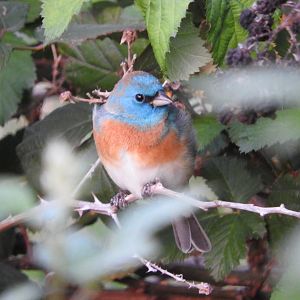
The last two weeks have been rather good for birding, with cold storms dropping various migrants. The weather cleared off a few days ago and the birds continue to be on the move. I wandered outside late this afternoon for no particular reason and presently heard what I was pretty sure was a Lazuli Bunting singing. After some annoyance of the bird changing positions several times I finally spotted him, sitting on the edge of an oak tree. I popped back inside to get my camera (as male Lazuli Buntings are worth any photo op one can get) but on returning he had vanished. Slightly grumbly over his disappearance, I took a scan of the pond across the way and turned up what appeared to be a Spotted Sandpiper and a Semipalmated Plover on the far bank. Both are nearly unheard of on the neighborhood pond, and the interest was piqued. I turned around to find a Chipping Sparrow a dozen feet away, another species I don't see too often. At that point it was game on, and in two hours I found 53 species of bird, plus a mammal, three reptiles, a fish, and a nice handful of invertebrates. A total of six year birds was quite a nice haul, along with a nice highlight of an Osprey catching a sunfish. The sunfish was flailing wildly upon just being caught, and the Osprey almost lost his dinner, but managed to keep ahold of it. Lots of breeding activity going on; Bushtits, scrub-jays, and Canada Geese on nests, heron chicks noisily begging at their rookery, and a Killdeer chick masquerading as a Semipalmated Plover. The little guy was cute, but kind of annoying when I looked at the long-range photos and realized it wasn't a Semipalmated. All in all though a very nice evening's worth of birding indeed.

Birds:

84. Black-headed Grosbeak (Pheucticus melanocephalus)
85. Hooded Oriole (Icterus cucullatus)
86. Northern Shoveler (Spatula clypeata)
87. American Avocet (Recurvirostra americana)
88. Greater Yellowlegs (Tringa melanoleuca)
89. Wilson’s Warbler (Cardellina wilsonia)
90. Ash-throated Flycatcher (Myiarchus cinerascens)
91. Western Kingbird (Tyrannus verticalis)
92. Chipping Sparrow (Spizella passerina)
93. Barn Swallow (Hirundo rustica)
94. Lazuli Bunting (Passerina amoena)
95. Spotted Sandpiper (Actitis macularius)
96. Least Sandpiper (Calidris minutilla)
97. Black-throated Gray Warbler (Setophaga nigrescens)
98. Hooded Merganser (Lophodytes cucullatus)
99. Bullock’s Oriole (Icterus cucullatus)

Fish:

1. Green Sunfish (Lepomis cyanellus) -- I believe this counts as I saw the fish still alive and flailing despite being in an Osprey's talons, if not let me know

Invertebrates:

18. Western Yellowjacket (Vespula hesperis)
19. Pacific Orangetip (Anthocharis sara)
20. “California Black Millipede" (Paemeropus angusticeps)

7-99-6-0-1-20

Not often I do a back to back post this point in the year, but the birding has been good and I crossed the 100 species mark for birds today! Highlight of the day was watching a Peregrine chase pigeons around a parking lot at high speed, and ducking as it banked three to four feet in front of my face! Five new birds for the year today, could've been six but the pesky Empidonax bailed on me before I could pin it to species. Saw baby Wood Ducks in the neighborhood pond this evening and saw the scrub-jay babies in the nest outside my window as well. And somehow I'm still lacking amphibians despite hearing two species of frog recently. Sooner or later frogs!

Birds:

100. Eared Grebe (Podiceps nigricollis)
101. North Rough-winged Swallow (Stelgidopteryx serripinnis)
102. Western Wood-Pewee (Contopus sordidulus)
103. Brown-headed Cowbird (Molothrus ater)
104. MacGillivray’s Warbler (Geothlypis tolmiei)

7-104-6-0-1-20

P.S.
I popped back inside to get my camera (as male Lazuli Buntings are worth any photo op one can get) but on returning he had vanished. Slightly grumbly over his disappearance

Apparently he heard me grumbling and decided to play nice, or he just wanted to make me practice patience, but this evening Mr. Lazuli posed for photos.
 
Birds
147. Lesser Yellowlegs Tringa flavipes
148. Dunlin Calidris alpina
149. Least Sandpiper Calidris minutilla
150. Wilson's Phalarope Phalaropus tricolor
151. Pectoral Sandpiper Calidris melanotos
152. Semipalmated Sandpiper Calidris pusilla
153. Lincoln's Sparrow Melospiza lincolnii
154. Northern Waterthrush Parkesia noveboracensis
155. Great Crested Flycatcher Myiarchus crinitus
Birds
156. Grasshopper Sparrow Ammodramus savannarum
 
  • Like
Reactions: MRJ
A few more birds to report...

A small walk at Beddington found a single common sandpiper feeding on the wet grassland. Then this morning, a trip to Rainham Marshes, in glorious summer weather, was extremely successful, especially for a group of 12 bar tailed godwit, a few of which were males in stonking summer plumage, and a family party of bearded tits with their young.

133. Common sandpiper
134. Bearded tit
135. Eurasian hobby
136. Common greenshank
137. Bar-tailed godwit
138. Common cuckoo
139. Common swift

I fly to Copenhagen on Tuesday, so hope to have a few additions from Denmark.

A lovely morning at Copenhagen Zoo with several lifers, most notably a group of hyperactive Tasmanian devils and two different species of weaver. However, they don't count for these purposes... Did manage a couple of birds and a mammal for the year list though!

Mammals
9. Red squirrel

Birds
140. Hooded crow
141. Willow warbler
 
  • Like
Reactions: CMP
Birds

41. Common pochard, Aythya ferina 3/5/22
42. Tufted duck, Aythya fuligula 3/5/22
43. Horned grebe, Podiceps auritus 3/5/22
44. Eurasian coot, Fulica atra 3/5/22
 
migration waching at landsort an island in the stockholm aracapligo. lastort is probbebly one of my favorite birding location ever. it means waking up at 3.45 am but its worth it. first day we got good miration including over a 1000of both common and velvet scoter. the second day is much smaller and one by one birders start to go back. in the end is just me and 3 other birders left at 11.15 am. me and one of the other birder also start to go back. but we only get around 10 meter until we here a lound roar from the two birders left ther BLACK SCOTER !!!!!! we run the and i get the bird in my scope. this is around 40 recoed ever in sweden and normealy 0-2 birds a year are sean but this is only the second record ever this far north if it gets acepted. alos of the 15 is birders one the island only 4 got to se it. a true contry blocker

133 common shelduck Tadorna tadorna
134 common scoter Melanitta nigra
135 velvet scoter Melanitta fusca
136 Black scoter Melanitta americana
137 red throated diver Gavia stellata
138 black throated loon Gavia arctica
139 red necked grebe Podiceps grisegena
140 eurasian hobby Falco subbuteo
141 eurasian woodcook Scolopax rusticola
142 whimbrel Numenius phaeopus
143 arctic tern Sterna paradisaea
144 razorbill Alca torda
145 common murre Uria aalge
146 black guillemot Cepphus grylle
147 short eard owl Asio flammeus
148 tree pipit Anthus trivialis
149 rock pipit Anthus petrosus
150 european redstart Phoenicurus phoenicurus
151 willow warbler Phylloscopus trochilus
152 lesser whitethroat Sylvia curruca
153 blackcap Sylvia atricapilla
154 collared flycatcher Ficedula albicollis(first time seaing a male)
 
More returning migrants plus a rare Long-tailed Duck who decided to visit a pond in town.

Birds:
155 Brown Thrasher - Toxostoma rufum
156 Baltimore Oriole - Icterus galbula
157 Pectoral Sandpiper - Calidris melanotos
158 Semipalmated Sandpiper - Calidris pusilla
159 Wilson's Phalarope - Phalaropus tricolor
160 Eastern Kingbird - Tyrannus tyrannus
161 House Wren - Troglodytes aedon
162 Snowy Plover - Charadrius nivosus
163 Marbled Godwit - Limosa fedoa
164 Forster's Tern - Sterna forsteri
165 White-faced Ibis - Plegadis chihi
166 Bank Swallow - Riparia riparia
167 Vesper Sparrow - Pooecetes gramineus
168 Long-tailed Duck - Clangula hyemalis
169 Grasshopper Sparrow - Ammodramus savannarum
170 Clay-colored Sparrow - Spizella pallida
171 Dickcissel - Spiza americana
172 Mississippi Kite - Ictinia mississippiensis
173 Chimney Swift - Chaetura pelagica

Reptiles:
3 Spiny Softshell Turtle - Apalone spinifera

Birds:
174 Great Crested Flycatcher - Myiarchus crinitus
175 Red-eyed Vireo - Vireo olivaceus
176 Gray Catbird - Dumetella carolinensis
177 Swainson's Thrush - Catharus ustulatus
178 Western Kingbird - Tyrannus verticalis
179 Warbling Vireo - Vireo gilvus
180 Nashville Warbler - Leiothlypis ruficapilla
181 Sedge Wren - Cistothorus stellaris
182 Spotted Sandpiper - Actitis macularius
183 Yellow-headed Blackbird - Xanthocephalus xanthocephalus
184 Ruby-throated Hummingbird - Archilochus colubris
185 Barred Owl - Strix varia
186 Least Flycatcher - Empidonax minimus
187 Philadelphia Vireo - Vireo philadelphicus
188 American Redstart - Setophaga ruticilla
189 Wilson's Warbler - Cardellina pusilla
 
A lovely morning at Copenhagen Zoo with several lifers, most notably a group of hyperactive Tasmanian devils and two different species of weaver. However, they don't count for these purposes... Did manage a couple of birds and a mammal for the year list though!

Mammals
9. Red squirrel

Birds
140. Hooded crow
141. Willow warbler


A lovely morning of birding along the coast at Humlebaek. Picked up three species for the year, despite almost tripping over a Norse burial mound.

Birds
142. Common eider
143. Red-breasted merganser
144. Marsh tit
 
I have managed another couple of summer migrant birds over the past couple of days. Yesterday, I was looking out of my bedroom window when my first two swallows of the year flew past. And early this morning I went out for a walk hoping to beat the dog walkers (no success there) where I managed to see another new species flying around the fishing lake:

76. Barn swallow Hirundo rustica
77. Common tern Sterna hirundo

Last year, I didn't reach 77 birds until the end of May so I'm still on track to do a lot better than that this year.

Over the past week or so, I have managed a couple more local walks. I have managed to see another two summer migrant birds and have also seen eight new invertebrates. I also managed to see my second species of fish for the year - for some reason the river has remained murky months after winter has ended, so I'm not sure how many other fish I will see:

78. Common whitethroat Curruca communis
79. Common reed warbler Acrocephalus scirpaceus

2. Common dace Leuciscus leuciscus

24. Fencepost jumping spider Marpissa muscosa
25. Large red damselfly Pyrrhosoma nymphula
26. Speckled wood butterfly Pararge aegeria
27. Nursery web spider Pisaura mirabilis
28. St Mark's fly Bibio marci
29. Banded demoiselle Calopteryx splendens
30. European hornet Vespa crabro
31. Green nettle weevil Phyllobius pomaceus
 
  • Like
Reactions: MRJ
Sure! For yourself and anybody whose interested in how I went about things, I did a write-up a couple weeks back:

I decided to hit Living Desert on Friday instead of Saturday, to see what species I could pick off early and because I thought the zoo might be a tad less crowded (spoiler: it was still fairly busy). I was able to see countless Verdin and Costa’s Hummingbirds, along with a male Gambel’s Quail calling out from inside a bush. While circling around a particular spot looking for Black-tailed Gnatcatcher, my calls brought in Abert’s Towhee and Bell’s Vireo... but no gnatcatchers. We’ll call that a decent trade. No sign of the Black-crowned Night Herons I saw three years ago, maybe unsurprising since the captive heron was moved to a different aviary. On top of the new birds, I’ve confirmed this is indeed Year of the Roadrunner; I saw the species running around on trails and across paths a few times, and even saw it picking at some food left over in the wolf pen!

Saturday was the big birding day; I headed for a nearby riparian preserve where brilliantly colored Vermilion Flycatchers were in abundance and a Great Horned Owl nest had been confirmed. Some early scouting in the parking lot was enough to get me the Vermilion Flycatcher within a few minutes, as well as Lawrence’s Goldfinch. An hour of further strolling netted Hooded Orioles, a White-winged Dove, a Yellow Warbler, and a small flock of Cedar Waxwings. Meanwhile, I’m over 95% sure a Cooper’s Hawk passed me by twice, but frustratingly I never got a good enough look or heard a noise to call it. I got some fantastic views and photos of the Great Horned Owl pair; their chick is currently at the “Star Wars puppet” phase, so it’s a bizarre-looking creature. Hopefully it’ll be a big impressive night hunter like its ‘rents some day though!

From there I headed out to my beach campsite on the Salton Sea, where I finally got a positive ID on a California Gull. A Snowy Plover was also seen scurrying along the beach amongst the miniature Western Sandpipers, lone Black-necked Stilt, and a horde of Eared Grebes. I also saw a pair of terns fly overhead, but unfortunately they went too fast and my photos are too shoddy to make the determination between three local and very similar-looking species.

I was walking back to the campsite at dusk when I heard hoots – suspiciously like Great Horned Owl hoots. I thought, “Nah, I’m still a ways off and have them on my mind; it’s probably just a dove.” But I was wrong; sitting in a bush and a palm tree across the parking lot from each other were that day’s fourth and fifth Great Horned Owls. It was just light enough for a while that I got some great shots of the one in the palm tree, which was crying out softly to the other; just as it started becoming dark and shadowy, the two birds alighted to the same tree and began vocalizing together. I’d seen wild GHOs before, but this was the first time I was treated to a pair hooting like this.

I had planned on staying and doing more beach-birding at Salton Sea in the morning, but when I walked up and down the beach I found there were even fewer birds than there had been in the evening, and the same half-dozen or so species (also, the Salton Sea smells awful). With that, I decided on a different path: redemption on Cooper’s Hawk and Black-crowned Night Heron. There was a botanic garden along my Sunday drive route back to the coast where the former was regularly seen, along with a handful of warblers. Having gotten a taste of the warbler fever with the chance Yellow I saw the previous day, I decided it was worth it to see if I could pick up whatever I could during spring migration.

My first couple hours at the gardens were a test of determination. I went to the area where several warbler species had been seen and only got a single brief look at a Townsend’s Warbler, with none of the other reported species heard or seen; meanwhile, no sign of a Cooper’s Hawk (though a close-knit pair of Red-shouldered Hawks were making a good racket). I also managed to confirm a Nuttall’s Woodpecker, an unusually late addition. I was about to call it quits when I saw another raptor swoop by quickly, followed a moment later by an unmistakable chattering of a Cooper’s Hawk. I chattered back, and so the bird and I entered into a game of chicken (or should we call it hawk?): it bouncing back and forth between trees chattering, me chattering back and following the direction for a visual. Finally, it settled itself quietly on a dead branch and I was able to confirm it visually and get some nice shots. So much effort for what is nominally a very common bird... but after having somehow missing Bushtit all of last year I’m not leaving common ones up to chance anymore! (Edit: I saw a Cooper's Hawk fly over the road at work the next week. C'est la vie.)

After that I made my way to some settling ponds in a coastal town that was my destination for Sunday evening. Here several Black-crowned Night Herons had been seen recently; I was coming to this site pretty cold info-wise, hoping that they were in clear view and I’d just easily find one. This turned out to be exactly the case; a handful of Black-crowned Night Herons were roosting on an overgrown island out in the middle of the pond, along with a Great Blue Heron and Snowy Egret. Not having looked at anything else that was around really, I was surprised to also add a flock of Gadwall to this year’s total, as well as a single Common Gallinule floating amidst a group of American Coots. With the pond’s edges thick with reeds, I took a stroll along the perimeter in hopes of stirring up a Sora, even though it was half past five in the evening at this point. It was a good thing I did; I’d only spent fifteen or twenty minutes peeking around bends in the reedbeds before a plump little Sora burst out, quickly sped into a dark tangle of vegetation, and angrily shouted at me. I suppose I was being rather rude, peering into its home...

Also an update from just the past hour: after a few failed attempts at glimpsing one, I finally got a good look in a nearby nest box and saw my first two wild Barn Owls. Owls and roadrunners, this is shaping up to be a good birding year!

Birds
153. Barn Owl (Tyto alba)

Returned from my Norcal trip with a big accomplishments and one of my goals for the year: I have matched my entire 2021 bird total with two thirds of the year still left to go!

I was able to nab all four marine mammal targets last week, two of which I saw in multiple locations. Three common seabirds were everywhere off the viewing platforms at the Monterey Bay Aquarium (though no oystercatchers unfortunately), and I picked up an additional shorebird on a spontaneous evening beach visit nearby. Though my target for the trip was marine species (and the aquarium, obviously), I also nabbed a couple of passerines in a city park along the way; a turkey chilling in an urban neighborhood; and another target of mine - Yellow-billed Magpie, several birds zipping around a riparian park in the Sacramento area. I even saw one popping in and out of a nest.

With a swallow and first amphibian on the board in the past few days, I'm anticipating fewer additions for the next while with no major birding or wildlife outings planned.

Birds
154. Chestnut-backed Chickadee (Poecile rufescens)
155. Western Tanager (Piranga ludoviciana)
156. Pigeon Guillemot (Cepphus columba)
157. Brandt’s Cormorant (Urile penicillatus)
158. Pelagic Cormorant (Urile pelagicus)
159. Whimbrel (Numenius phaeopus)
160. Wild Turkey (Meleagris gallopavo)
161. Yellow-billed Magpie (Pica nutalli)
162. Violet-green Swallow (Tachycineta thalassina)

Mammals
14. Sea Otter (Enhydra lutris)
15. California Sea Lion (Zalophus californianus)
16. Northern Elephant Seal (Mirounga angustirostris)
17. Harbor Seal (Phoca vitulina)

Reptiles
5. Southern Alligator Lizard (Elgaria multicarinata)

Amphibians
1. Western Toad (Anaxyrus boreas)
 
Last edited:
Birds:

86. Barn Swallow (Hirundo rustica)

Invertebrates:

15. Asian Lady Beetle (Harmonia axyridis)
16. Common Eastern Bumblebee (Bombus impatiens)
17. Eastern Bumblebee (Xylocopa virginica)
18. Spongy Moth (Lymantria dispar)
19. Green June Beetle (Cotinis nitida)

Mammals: 9
Birds: 86
Herptiles : 12
Fish: 10
Invertebrates: 19
Total: 136
Birds:

87. Wild Turkey (Meleagris gallapavo)
88. American Goldfinch (Spinus tristis)
89. Eastern Kingbird (Tyrannus tyrannus)

Invertebrates:

20. Cabbage White (Pieris rapae)
21. European Paper Wasp (Polistes dominula)
22. Orange Sulphur (Colias eurytheme)

Mammals: 9
Birds: 89
Herptiles : 12
Fish: 10
Invertebrates: 22
Total: 142
 
Inverts
41. Valley Carpenter Bee Xylocopa sonorina

42. California Dark-Necked Darkling Beetle Coelocnemis dilaticollis

43. Robber Fly Mallophora fautrix
 
155 common sandpiper Actitis hypoleucos
156 wood sandpiper Tringa glareola
157 spotted redshank Tringa erythropus
158 sand martin Riparia riparia
159 yellow wagtail Motacilla flava
160 whinchat Saxicola rubetra
161 sedge warbler Acrocephalus schoenobaenus
162 reed warbler Acrocephalus scirpaceus
from a bird tower comtetion that mostsly raind away
herps
2 smooth newt Lissotriton vulgaris
 
Back
Top