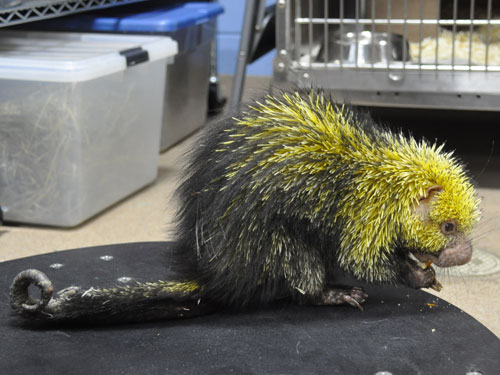
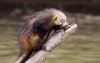
1) Are you sure it's a Mexican prehensile-tailed porcupine you saw at Animal Adventures?
2) You're still listing "Blue Poison Dart Frog" on your list, this is not a valid species.
3) What do you mean by "side-necked turtle"?
1. Yes. With the yellow and everything.
2. I took it off on my spreadsheet as I said previously. Won’t happen again.
3. That’s just what it was signed as. I’ll do some digging for specific species.
1. Yes. With the yellow and everything.
2. I took it off on my spreadsheet as I said previously. Won’t happen again.
3. That’s just what it was signed as. I’ll do some digging for specific species.
I do. Some North American Porcupines are yellowish, too. That's clearly not even a Coendou species at all. The shape, tail and quill type are all wrong, and coendous don't have all that fur.
I do. Some North American Porcupines are yellowish, too. That's clearly not even a Coendou species at all. The shape, tail and quill type are all wrong, and coendous don't have all that fur.
Yea I don’t think using a single picture to counter Leaf’s claim will work when
1) The hairiness of this species seem to vary
2) You could see a big pink nose in the porcupine in Leaf’s picture that is more similar to a prehensile tailed porcupine species than a North American porcupine.
As some one who was there with @Leaf Productions, I can 100% back him up on this. It looked like every other captive one I’ve seen pictures of in the US, and it definitely wasn’t a North American Porcupine. People really don’t have better things to do so they dispute a porcupine lol
That is not at all what is happening here and is a very rude and untrue allegation. Coendu species (other than C. prehensilis) are rare in captivity, and commonly misidentified by both visitors and zoo signage. There is very good reason to dispute a little roadside zoo having C. mexicanus. It isn't impossible but it is very improbable. I agree the second photo posted by Leaf Productions is more convincing that the one from Facebook (which is definitely just an NA Porcupine), but I still remain unconvinced as to the animal's true identify. I have seen yellowish coloration is both C. prehensilis and Erethizon dorsatum before.
Fair point, but when this is the same roadside zoo that somehow has also obtained other rarities such as ivory-billed aracari, Chinese alligator, and pallid fox, I don't think AA obtaining a Mexican hairy procupine is unreasonable.
I would agree, but we should still tread lightly here. I don't think Mexican Hairy Dwarf Porcupine has even been confirmed to be on public display anywhere in the US at all.
Fly The Coop (2/11):
1. Indian peafowl (Pavo cristatus)
2. Malay crested fireback (Lophura ignita)
We're Gonna Need a Bigger Trap (3/10):
2. Naked mole-rat (Heterocephalus glaber)
3. South African crested porcupine (Hystrix africaeaustralis)
How Many Toes Am I Holding Up? (2/9):
1. Przewalski's horse (Equus (ferus) przewalskii)
2. Indian rhinoceros (Rhinoceros unicornis)
Let That Ruminate (5/11 required, 2 bovids): Required:
1. North Sulawesi babirusa (Babyroussa celebensis)
2. Red river hog (Potamochoerus porcus)
3. Pygmy hippopotamus (Choeropsis liberiensis)
4. Masai giraffe (Giraffa (camelopardalis) tippelskirchi)
5. Caribou (Rangifer tarandus) Bovids:
1. Himalayan tahr (Hemitragus jemlahicus)
2. West Caucasian tur (Capra caucasica)
Plus European mouflon which I won't be counting.
Check Your Feeders (2/4):
2. Loggerhead shrike (Landius ludovicianus)
Thylo's Top 20 (1/8):
1. Plush-crested jay (Cyanocorax chrysops)
Small but Will Fight (3/10):
2. Meerkat (Suricata suricatta)
3. Red panda (Aliurus fulgens)
Let's Give This Another Go (1 marsupials/monotremes):
1. Southern hairy-nosed wombat (Lasiorhinus latifrons)
Don't Turn On The Lights (5/10):
4. Prehensile-tailed skink (Corucia zebra)
5. Australian green tree frog (Ranoidea caerulea)
Embrace the ABCs Challenge (6/36):
1. Indian peafowl (Toronto)
2. Western lowland gorilla (Toronto)
3. Lion (Toronto)
4. Tiger (Toronto)
5. Meerkat (Toronto)
6. African penguin (Toronto)
Second Chance Red List Challenge (12/14):
VU 2: Steller's sea eagle (Haliaeetus pelagicus)
VU 3: North Sulawesi babirusa (Babyroussa celebensis)
VU 4: San Esteban chuckwalla (Sauromalus varius)
EN 3: American eel (Anguilla rostrata)
EN 4: Pig-nosed turtle (Carettochelys insculpta) CR 1: Butterfly goodeid (Ameca splendens)
CR 2: Radiated tortoise (Astrochelys radiata)
CR 3: Western lowland gorilla (Gorilla gorilla gorilla)
CR 4: Axolotl (Ambystoma mexicanum)
Island Hoppers Challenge (13/22):
2. Sumatran orangutan (Pongo abelii)
3. North Sulawesi babirusa (Babyroussa celebensis)
4. Luzon bleeding-heart (Gallicolumba luzonica)
5. Victoria crowned pigeon (Goura victoria)
6. Nicobar pigeon (Caloenas nicobarica)
7. Komodo dragon (Varanus komodoensis)
8. Radiated tortoise (Astrochelys radiata)
9. Aldabra giant tortoise (Aldabrachelys gigantea)
10. Spider tortoise (Pyxis arachnoides)
11. Fijian banded iguana (Brachylophus fasciatus)
12. Prehensile-tailed skink (Corucia zebra)
13. Puerto Rican crested toad (Peltophryne lemur)
Plus a few fish native to Madagascar I forgot to ID.
Bona Fide Rarity Hunter (2/3):
2. Arnoult's panchax (Pachypanchax arnoulti)
Turns out Toronto's Fijian iguanas are B.fasciatus instead of B.bulabula. Also managed to ID the unknown Malagasy fish, both of which are actually very rare in North American zoos.
Bona Fide Rarity Hunter (2/3):
2. Arnoult's panchax (Pachypanchax arnoulti)
Turns out Toronto's Fijian iguanas are B.fasciatus instead of B.bulabula. Also managed to ID the unknown Malagasy fish, both of which are actually very rare in North American zoos.
I would agree, but we should still tread lightly here. I don't think Mexican Hairy Dwarf Porcupine has even been confirmed to be on public display anywhere in the US at all.
It's clear I've struck a bone with you, and for that you have my utmost apologies. On my next go-around, I will ensure myself to remove said Mexican Porcupine and replace it with another type of Rodent. Sincerest apologies.
It's clear I've struck a bone with you, and for that you have my utmost apologies. On my next go-around, I will ensure myself to remove said Mexican Porcupine and replace it with another type of Rodent. Sincerest apologies.
That is not at all what is happening here and is a very rude and untrue allegation. Coendu species (other than C. prehensilis) are rare in captivity, and commonly misidentified by both visitors and zoo signage. There is very good reason to dispute a little roadside zoo having C. mexicanus. It isn't impossible but it is very improbable. I agree the second photo posted by Leaf Productions is more convincing that the one from Facebook (which is definitely just an NA Porcupine), but I still remain unconvinced as to the animal's true identify. I have seen yellowish coloration is both C. prehensilis and Erethizon dorsatum before.
Alright, alright everybody settle down. The photo linked by @Smaggledagle does indeed look a lot like a North American Porcupine - however in digging their Facebook page I found the same photo zoomed out a bit farther showing a long tail, so it certainly is a Coendou. The photo linked by @Leaf Productions is very visibly a Coendou.
Thumbing through AA's Facebook page there are also photos of C. prehensilis and North American Porcupine. To me the animal looks like Mexican Hairy, I've never seen a prehensilis with that much fuzz.
I would agree, but we should still tread lightly here. I don't think Mexican Hairy Dwarf Porcupine has even been confirmed to be on public display anywhere in the US at all.
This appears to be a Mexican Hairy, and it is in fact not the only one in the US currently I believe. The species has been not uncommon in US facilities in the recent past and I have seen the species here. While the questioning it is not unreasonable, Mexican Hairy Dwarf Porcupine is present in tiny numbers and the animal in question here appears to be one.