Bila Senga National Park, Kenya-
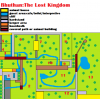
Visitors would see signs in English and Swahili reading "BILA SENGA NATIONAL PARK". The dusty path would go past various signs- silhouettes of animals found in the park, and signs like "Beware of Lions", or "Duinga Creek Up Ahead 60 meters". The path would cross Duinga and Ochombe creeks. Over Patulu Creek, the path would turn into a boardwalk. Visitors would enter the creek zone. The first exhibit would be 0.7 acres, for sitatunga antelope. Visitors would see a wide variety of interpretive signage about the sitatunga. 0.2 acres would be off-exhibit space and another 0.1 acres would be flamingo off-exhibit space. Visitors would be able to go above the sitatunga habitat on the boardwalk! Acacia trees and palms would shade the path, as well as many colorful African flowers. The creek would continue and pass greater African flamingos (the creek zone would be 2.5 acres). The boardwalk would end at Djuba Falls, where the creek turned into savannah ponds. The savannah would be 2 acres, with many acacia trees and browse for reticulated giraffes and Grant's zebras. There would be many different signs about giraffes and zebras. 0.3 acres of off-exhibit space would be indoor, and 0.2 would be outdoor. The yard would be 1.5 acres. The boardwalk would raise above the zebras and giraffes, and drop down over a flower-shaded creek, Mzumi Taro Creek, a very wide creek. Nyongo Village would be located there- 2 acres of village space, with restaurant, restrooms, ATM, gift shop, and a small petting zoo with guineafowl, African pygmy goats, and dromedary camels. The petting zoo would be 1,250 square feet and the off-exhibit area 1,000. The boardwalk would become a bridge, and 5 other acres would be left. The creek would turn into a lake, with an island (another 0.5 acres). Gwaputo Island would have a building (0.4 acres). 0.25 would be exhibit space for African pygmy mice, sulcata tortoises, and various snakes and lizards of eastern Africa. 0.05 would be visitor space, and 0.1 would be off exhibit space. Another 0.5 acre would be Kanjendi Island, where visitors could pay for a boat ride. Kanjendi would have interpretive signage- a storyline about how locals moved to Nyongo, when Bila Senga took over the island as ranger headquarters. "Ranger headquarters" would be on the island, complete with animatronic park rangers. To get to Gwaputo one-way, the cost would be 50 cents (55 shillings). The round trip to Gwaputo would be 105 shillings ($1). One way to Nyongo would be 80 shillings (75 cents), and round trip would be 150 shillings ($1.40). There would be a dock on Gwaputo, and one on Nyongo. Red tickets with "G" on it meant round-trip Gwaputo, blue tickets with G meant one-way Gwaputo, green tickets with N meant one-way Nyongo, and yellow tickets with N meant round-trip Nyongo. Visitors could also purchase an unlimited pass, for round-trip Gwaputo and Nyongo for $4.75 (500 shillings).
4 acres would be left. Visitors would only be able to see Jabari Hills (3 acres- 0.5 would be train tracks and a train shed, and 0.5 would make up the baobab tree path), via a train ride- $1.50 (160 shillings). Jabari Hills would have white rhinos, Grant's zebras, olive baboons, sulcata tortoises, and Barbary deer. Jabari Hills would have rolling hills and rocky crags. Interpretive signs would be everywhere, continuing a storyline, about how locals use Jabari Railroad to get to Mmuza market town, outside Bila Senga National Park, from Jabari station to Mmuza, stopping at Mmalaba. Visitors who didn't take the train would exit on a path past giant baobab trees, with more signs about baobab trees. They would find themselves at the entrance.




 ). The only point I was making is that you can build a snow leopard exhibit without netting.


