Zoos with the greatest future/best master plans

Los Angeles Zoo has a great master plan to finally put their great collection to use. They will also keep some of their newer exhibits like their Langur exhibit, LAIR, Gorilla exhibit, and Rainforest of the Americas. The rest of the zoo will be redone to fit in geographical areas.
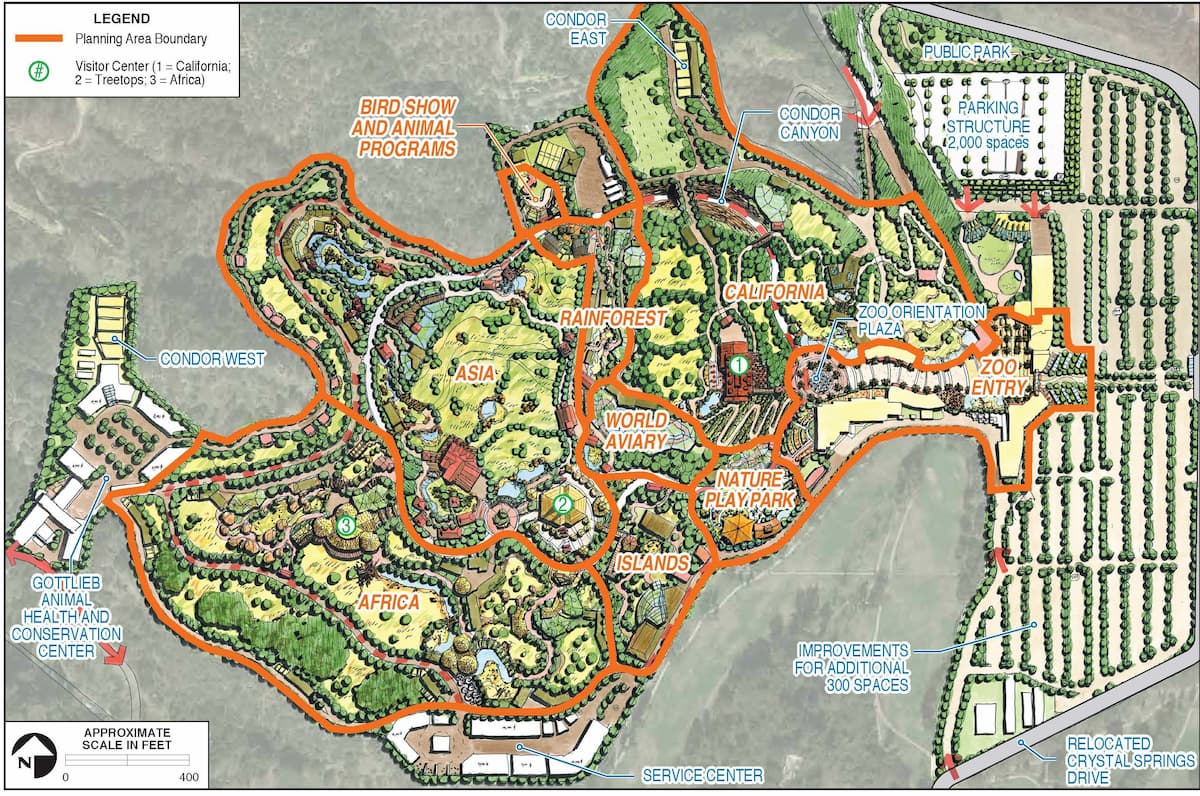
VisionPlanConceptPlan_LAZooEIR_Final.jpg

Los Angeles Zoo Vision Plan Environmental Impact Report | Los Angeles Zoo and Botanical Gardens (LA Zoo)

It makes me happy to see zoos, especially large ones, going back to the geographical areas. Biomes are all well and good, but many/most people don't have much of an idea about where animals live to be able to put the global aspect into perspective. It gives people the false idea that these animals actually live in the same area, where the might really be worlds apart.
 
Firstly, I never compared LA to such a collection, I said by the metric @Shellheart was using, such a masterplan would be the greatest to ever exist when clearly that is not the case. If Berlin were to casually throw in a couple of blue whales, that wouldn't make it the best masterplan, would it, even though it would if we were to follow the logic used upthread.

Secondly, your claim that there are no 'bold' animal choices is just wrong. If an Asian pangolin species is not bold, what is? That is just one example of a masterplan


The fact that the list of exhibits they are keeping is very short is rather telling, isn't it?

In all seriousness, though, if what you said were true, Tierpark Berlin would be beyond all hope by now, yet is developing quite well in recent times, incidentally by reusing old, 50s and 60s infrastructure like the Alfred Brehm Haus to create something new, innovative and rather pleasant actually, probably more pleasant than had they just knocked the whole thing down. I think perhaps LA should rethink their plan of action, consider the options of what they can do with what they have, solve the problems of having no exhibits until about 15 minutes into the zoo and redo the roundhouses by thinking up something new and innovative to make them into. We both know there is no shortage of innovation on the West coast of the US, so put it use.
Ok I feel like I keep repeating myself so I will say it all for the last time. Los Angeles is in Southern California, where the climate is similar to many of the habitats of the species they hold. In Southern Californian zoos we don't use building we just have exhibits: no cat houses, no primate houses, only nocturnal houses or reptile houses. So they can only refurbish their nocturnal house (which they are doing) and their Reptile house which was updated a few years ago.
The closest thing we have to "houses" are the roundhouse which are slowly deteriorating and no longer fit the needs of their inhabitants. Also many of the roundhouse exhibits are on the current path and you cannot make a trail or contious stretch of path to create an exhibit in this zoo without ripping out half of the current infrastructure. The zoos paths wind and split multiple times, in such a way that when I was young my family would get lost in the zoo. It just is not possible to update the zoo to be easier to navigate without destroying half the zoo.
Even if you can't take my word for it take a look at these exhibits for yourself. Read the comments, one of them brings up how Roundhouses were already built because of budget cuts.
Los Angeles Zoo - C-Shaped Serval Exhibit - ZooChat
Mandrill exhibit - ZooChat
Sclater's Blue-eyed Lemur exhibit - ZooChat
 
Ok I feel like I keep repeating myself so I will say it all for the last time. Los Angeles is in Southern California, where the climate is similar to many of the habitats of the species they hold. In Southern Californian zoos we don't use building we just have exhibits: no cat houses, no primate houses, only nocturnal houses or reptile houses. So they can only refurbish their nocturnal house (which they are doing) and their Reptile house which was updated a few years ago.
The closest thing we have to "houses" are the roundhouse which are slowly deteriorating and no longer fit the needs of their inhabitants. Also many of the roundhouse exhibits are on the current path and you cannot make a trail or contious stretch of path to create an exhibit in this zoo without ripping out half of the current infrastructure. The zoos paths wind and split multiple times, in such a way that when I was young my family would get lost in the zoo. It just is not possible to update the zoo to be easier to navigate without destroying half the zoo.
Even if you can't take my word for it take a look at these exhibits for yourself. Read the comments, one of them brings up how Roundhouses were already built because of budget cuts.
Los Angeles Zoo - C-Shaped Serval Exhibit - ZooChat
Mandrill exhibit - ZooChat
Sclater's Blue-eyed Lemur exhibit - ZooChat

Do you seriously think there is no more to LAZ than a load of grottos and roundhouses? Even if there are relatively few buildings for visitors or for the animals, there is masses of infrastructure all over the place! If you go to the utility infrastructure page (31) on the vision plan, it is clear to see that the place is littered with buildings, not just roundhouses. It may appear as if there are no large buildings, but I'm afraid it isn't true, and practically all these buildings would have to go.

Either way, this has got out of hand. I was just saying that Shellheart's assumption that LAZ's masterplan is the best is far from the truth, much as I, and I'm sure many others, would love it to be considering the state of the zoo nowadays.
 
It makes me happy to see zoos, especially large ones, going back to the geographical areas. Biomes are all well and good, but many/most people don't have much of an idea about where animals live to be able to put the global aspect into perspective. It gives people the false idea that these animals actually live in the same area, where the might really be worlds apart.

I agree and have the same preference about geographical areas above biomes.

However, there's one major negative aspect on that view : if you want to present f.e. a rainforest, then you have to choose in what geographical area you want to built it. Very few zoos can afford expensive rainforest buildings in all their major geographical areas. So they have to choose, and choosing is losing in terms of species. Some zoos do this very acurate: Masoala at Zurich Zoo, Monsoon forest at Chester Zoo, Asia hall at Planckendael. But even this major zoos have not three rainforest buildings.

So the risk is having too many one direction themed rainforest exhibits, and very often this is and will be the Southamerican Amazon rainforest (probably because this looks like the prototype of a rainforest for many visitors). The negative consequences of this are, amongst other things, the overrepresentation of the same species. And the fact that certain geographical areas are underrepresented: f.e. I know very few equatorial African rainforest buildings in Europe.

On the other hand, Burger's Zoo in the Netherlands is doing extremely well with it's biome-themed lay out.

So most geographical-themed zoos keep also some biomes like large rainforest buildings, Reptile houses, Aquarium, where they can show species from all over the world.

Having said this: everything I wrote above is from the point of view of a European living in a slightly colder climate zone where zoo buildings are essential.
 
Do you seriously think there is no more to LAZ than a load of grottos and roundhouses? Even if there are relatively few buildings for visitors or for the animals, there is masses of infrastructure all over the place! If you go to the utility infrastructure page (31) on the vision plan, it is clear to see that the place is littered with buildings, not just roundhouses. It may appear as if there are no large buildings, but I'm afraid it isn't true, and practically all these buildings would have to go.

Either way, this has got out of hand. I was just saying that Shellheart's assumption that LAZ's masterplan is the best is far from the truth, much as I, and I'm sure many others, would love it to be considering the state of the zoo nowadays.

I know this is digging up an old thread, but it is interesting that the debate on LAZ's MP centered on the cost effectiveness of removing the 1960's roadhouses when the major idea of the plan is to excavate a canyon through a foothill that will require hundreds lots of financial and litigational resources for the benefit of additional visitor/utility circulation and habitats for bighorn sheep and California condors. Doesn't seem worth the cost at all.
 
I know this is digging up an old thread, but it is interesting that the debate on LAZ's MP centered on the cost effectiveness of removing the 1960's roadhouses when the major idea of the plan is to excavate a canyon through a foothill that will require hundreds lots of financial and litigational resources for the benefit of additional visitor/utility circulation and habitats for bighorn sheep and California condors. Doesn't seem worth the cost at all.

It appears that the LA Zoo master plan is dead from what I'm hearing, at least under current management. It looks like the round houses and the dysfunctional circulation pathways at the zoo are not going anywhere for the foreseeable future, nor that the canyon concept is happening.
 
I know this is digging up an old thread, but it is interesting that the debate on LAZ's MP centered on the cost effectiveness of removing the 1960's roadhouses when the major idea of the plan is to excavate a canyon through a foothill that will require hundreds lots of financial and litigational resources for the benefit of additional visitor/utility circulation and habitats for bighorn sheep and California condors. Doesn't seem worth the cost at all.
One of the main reasons the L.A. Zoo master plan has not gone forward is that the zoo was sued by the Friends of Griffith Park and the Griffith J. Griffith Charitable Trust over environmental concerns. I don't know the current status of the case, but the lawsuit was filed a year ago and there doesn't seem to be any recent information publically available. Here is an article by the L.A. Times: Groups sue city of L.A. over planned zoo expansion
 
One of the main reasons the L.A. Zoo master plan has not gone forward is that the zoo was sued by the Friends of Griffith Park and the Griffith J. Griffith Charitable Trust over environmental concerns. I don't know the current status of the case, but the lawsuit was filed a year ago and there doesn't seem to be any recent information publically available. Here is an article by the L.A. Times: Groups sue city of L.A. over planned zoo expansion
Then, I think, in the spirit of the thread, it was probably not the best master plan since it was not feasible, realistic, actionable, or attainable...

I'd still give a plan props to being those things and unaccomplished for other reasons because a plan is a plan but more props if it actually was executed. It's out of date, but I'd say the 1976 Woodland Park Zoo MP is the greatest master plan of all time considering how much it changed all zoos.
 
Then, I think, in the spirit of the thread, it was probably not the best master plan since it was not feasible, realistic, actionable, or attainable...

I'd still give a plan props to being those things and unaccomplished for other reasons because a plan is a plan but more props if it actually was executed. It's out of date, but I'd say the 1976 Woodland Park Zoo MP is the greatest master plan of all time considering how much it changed all zoos.
i do not think you can simply dismiss this Masterplan in the face of a few affluent NIMBY's and "Friends of ...." the public park having objections over the wider public part and seem wanton to have influence over how the LA Zoo views its future development within its own perimeter or not. I do find that kind of litigation beyond the pale, not a sign of good democracy, off-putting and really not helping biodiversity locally nor globally.

The current Masterplan was developed with pretty much the entire general public on board and followed a due diligence checks and balances consultation process before it was even finally presented to LA Zoo members and the general public. So, it is not like no one had a say in prior to LA Zoo management and outside consultants presenting their plans and ..... the final envisioned plan and project.
 
I'm aware that Batu Secret Zoo in Indonesia has been doing a lot of revitalization from 2019 onward to move forward from the original themed-park focused to an actual dedicated modern zoo.

There has been many plans realized by now, including a Madagascar and Amazonian walkthroughs, as well as exhibits for Chinese red panda, giant otter, and snow leopard. Another grand plan for a Congo area is still underway with chimpanzess, new exhibits for the pygmy hippos and mandrills, and as well for other unconfirmed animals.
 
Then, I think, in the spirit of the thread, it was probably not the best master plan since it was not feasible, realistic, actionable, or attainable...

I think that the LA Zoo master plan is/was very realistic. It focused on upgrading what the zoo needs most - modern exhibits for African megafauna and a native California animal zone. The plan was extensively workshopped with the public.

I hope that it is not dead, but the goal of implementing parts of it before the 2028 Olympics is almost certainly not happening.
 
I think that the LA Zoo master plan is/was very realistic. It focused on upgrading what the zoo needs most - modern exhibits for African megafauna and a native California animal zone. The plan was extensively workshopped with the public.

I hope that it is not dead, but the goal of implementing parts of it before the 2028 Olympics is almost certainly not happening.
Well certain parts were realistic but let’s be honest carving out a canyon in a hill, while perfectly doable, did always seem a bit silly. We can’t act like the plan itself was not overly ambitious in some areas. I think the Ocean Pavilion was scrapped early on for a reason. It is/was a good idea but the changes it has gone through make sense.
 
Well certain parts were realistic but let’s be honest carving out a canyon in a hill, while perfectly doable, did always seem a bit silly. We can’t act like the plan itself was not overly ambitious in some areas. I think the Ocean Pavilion was scrapped early on for a reason. It is/was a good idea but the changes it has gone through make sense.

I didn't see the canyon idea as silly, nor do I think the plan was overly ambitious. It spelled out what the zoo needs to fix and proposed ideas for fixing them.
 
In 2024, the answer for best master plan is definitely 1,000% Brookfield Zoo.
Brookfield Zoo Chicago - Brookfield Zoo Chicago Press Room
What impressed and impresses me about this plan is that I feel if only a quarter or half of it were implemented, I still think the final result would be a substantial improvement for the zoo. I have expressed criticism at times in other threads but overall I do feel even if we hit the rocks, it will still result in a lot of positive change regardless.
 
i do not think you can simply dismiss this Masterplan in the face of a few affluent NIMBY's and "Friends of ...." the public park having objections over the wider public part and seem wanton to have influence over how the LA Zoo views its future development within its own perimeter or not. I do find that kind of litigation beyond the pale, not a sign of good democracy, off-putting and really not helping biodiversity locally nor globally.

The current Masterplan was developed with pretty much the entire general public on board and followed a due diligence checks and balances consultation process before it was even finally presented to LA Zoo members and the general public. So, it is not like no one had a say in prior to LA Zoo management and outside consultants presenting their plans and ..... the final envisioned plan and project.

I don't dismiss other parts of the plan, as most of the plan is pretty typical Master Plan stuff: let's renovate and improve these bads parts with this kind of organization/theme, expand Africa, put a Safari lodge restaurant in, etc. That's the main substance and 75% of all Master Plans. The other 25% is the critical "big idea," to strategically fix or drastically improve the Zoo which arguably more important and unique.

The canyon was LA's big idea, and even with the resistance to it, I just don't see the benefits outweighing the cost. We're talking hundreds of millions of dollars for what will be a wall of heighway cut on each side for a few animals and more circulation. I don't see how it fixes the zoo. As an organization that values sustainability and conservation, this is bonkers. All zoos have natural site constraints that are challenging, and to fiscally fight against that, the benefits have to outweigh the costs. I get that NIMBY is a problem, but I kind of agree that cutting through solid earth to create a manmade canyon is bad for the environmental.

Part of planning is also taking the temperature of your local community/partners and deciding if you can get buy in.
 
One of the main reasons the L.A. Zoo master plan has not gone forward is that the zoo was sued by the Friends of Griffith Park and the Griffith J. Griffith Charitable Trust over environmental concerns. I don't know the current status of the case, but the lawsuit was filed a year ago and there doesn't seem to be any recent information publically available. Here is an article by the L.A. Times: Groups sue city of L.A. over planned zoo expansion
Are there any further updates on LA's master plan? (other than the cape vulture exhibit just opening up) I'm curious if they'll end up reshuffling their priorities (rather than doing a California expansion, focusing on other parts of the zoo)
 
Are there any further updates on LA's master plan? (other than the cape vulture exhibit just opening up) I'm curious if they'll end up reshuffling their priorities (rather than doing a California expansion, focusing on other parts of the zoo)

I haven't heard anything recently about the L.A. Zoo's master plan. The new Cape vulture exhibit (and upcoming Swan Lake refurbishment) are not actually part of that plan, but resulted from dedicated grants. The zoo's website hasn't had any updates on the vision plan since August 2023. The proposed California area, which was to replace the Children's Zoo, is in jeopardy due to the previously mentioned lawsuit by the Friends of Griffith Park against the zoo. At issue is the potential removal of protected oaks and chaparral, which provides important habitat for native wildlife.

Another problem is the recently filed lawsuit by the L.A. Zoo against GLAZA (Greater Los Angeles Zoo Association). GLAZA and the zoo will be terminating their 61-year partnership at the end of June this year. Consequently, the zoo's main annual fundraising event, the Beastly Ball, has been cancelled since GLAZA did not want to plan it. Also, a lot of money that GLAZA has raised for the zoo is in limbo since GLAZA plans to keep the funds for future conservation use outside of the zoo. According to an article published in January by the L.A. Times, GLAZA currently has $49 million under its control, which the zoo is suing to obtain.

Considering that the zoo is now embroiled in two lawsuits and that the City of L.A., which owns the zoo, has significant budget problems, it doesn't look good for the zoo's master plan. Also worth mentioning is the City's commitment to host the 2028 Summer Olympics, which is a huge financial strain, and the unprecedented wildfires in Pacific Palisades (part of Los Angeles), which is going to take years to rebuild and has been estimated as the most expensive natural disaster in the country's history.

I wish I had better news, but it seems unlikely that there will be any significant progress on the zoo's master plan anytime soon. However, there are many empty exhibits throughout the zoo that could be refurbished (similar to the Cape vulture exhibit). Hopefully, the zoo will be able to get grants for these types of projects in the near future.
 
Back
Top