ZSL London Zoo ZSL London Zoo News 2024

Status
Not open for further replies.
I rather like those name choices and very much look forward to seeing them. Has anyone had very luck with active lion cubs, as family members who visited recently stated that, despite their best efforts, them and Arya were invisible throughout the day?

I was lucky enough to see them (briefly) last week feeding. Mother appears very well adept at keeping them well hidden! I’m not sure if Bhanu’s been mixed back in yet but he was incredibly vocal.

Today’s news also confirmed my suspicions on the day regarding Thug
 
Last edited by a moderator:
IIRC the sexes of the lion cubs was announced after their first health check after which the shortlist and voting for the names occured culminating with the anouncement of the names.

Not aware of the gorilla babies needing detailed medical examinations so I suspect formal recording of sex may not have occured.
 
As a aside gorillas have been identied as the wrong sex in the past at some zoos in the past eg

Bristol Zoo male gorilla revealed to be a female

Gorilla thought to be male surprises zoo with birth
Diane Fossey had a surprise when a sub-adult ‘male’ Mountain Gorilla in one of her study groups produced a baby.
N’Pongo, Jersey Zoo’s first gorilla, was initially sexed as a male, turned out female.
The first breeding female Gorilla in Europe, Basel’s Achilla, was originally sexed as a male and named Achilles:)
 
I visited during Zoo Nights yesterday with low expectations (weather forecast was bad and I had some concerns about rowdy crowds). It turned out much better than expected: the weather was dry if not exactly warm, and though there were large numbers of people, they were all much better behaved than many of the zoo's daytime visitors, generally quiet, and reacting with awe at the sight of the animals.

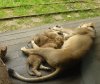
Arya was lying down with her three cubs feeding them right by the window that looks over the "rail yard" area - the watching crowd was three deep and all the way up the stairs, but good natured.

The gorillas were active inside and outside, with the babies being an obvious big hit with the human visitors.

At about 8pm (when I was in SLoRA) the lights start to go out, just when I saw a Chinese Giant Salamander was swimming out - the brief glimpse of the whole animal was quite frustrating!

The food on offer was very varied from different food vans near the terrace restaurant, but hugely over-priced (£16 (!) for some pitta bread with chicken and halloumi for example). Similar food stalls at Borough Market, Lower Marsh or Leather Lane for example would charge half that price for better food.
 

Attachments

  • P1040857.jpg
    P1040857.jpg
    179.8 KB · Views: 10
Diane Fossey had a surprise when a sub-adult ‘male’ Mountain Gorilla in one of her study groups produced a baby.
N’Pongo, Jersey Zoo’s first gorilla, was initially sexed as a male, turned out female.
The first breeding female Gorilla in Europe, Basel’s Achilla, was originally sexed as a male and named Achilles:)
These misidentifications
always seem to be when a 'male' turns out to be female. I don't think I've come across any the other way around. I guess a true male is too obvious.
 
These misidentifications
always seem to be when a 'male' turns out to be female. I don't think I've come across any the other way around. I guess a true male is too obvious.
I’m pretty sure one of Gordon Mills’ gorillas was bought as a female and turned out male? Gorilla genitalia can be tiny
 
I’m pretty sure one of Gordon Mills’ gorillas was bought as a female and turned out male? Gorilla genitalia can be tiny
Yes, they can be tiny but at birth a male is usually self evident even so. The trouble starts later on when they get really furry and the body size increases in relation to genitalia-size. But then you can still tell by the direction of the pee.. but you need to catch them doing it. .Regarding Mills, he had three females- 'Katie' and two very old ones from Copenhagen Zoo- 'Abang' and 'M'bang' who later, as 'Tessie' and 'Flossy' moved with male 'Monty' to Longleat's 'Gorilla Island'. But maybe one of the others was bought as a female too as he had a bad imbalance of males- something like 5.3. One of them, 'Winston' is still alive at San Diego Wild Animal Park in USA.
 
Last edited:
Well I don't know what happened there with the DNA testing etc but yet more confusion as Moja is definately female! As an adult she lives in Spain and her daughter Duni back in Prague Zoo recently had a (female) baby.

To bring this back to the London discussion, Prague announced the sexes(both females) and names of their two recent babies within a few weeks of their births. While a recent baby born at Gaia Park in Netherlands was sexed as male and named, within just a day or two of his birth! Each organisation is different in its approach and London do seem very reluctant to make any such announcements yet. I'll be very surprised when its finally made public, if they aren't both female though.
 
Last edited:
Are the Mongoose on full show yet? By that, I mean that you can walk up to the actual enclosure barrier. Thanks in advance.

There is still a Give us some extra space barrier by the station office window but you can see inside. They have access to part of the outside area , You are more likely to see them exiting that outside area to go inside.
One caveat is that whilst Bhanu is being integrated with Arya and the cubs sometimes there may be restrictions to access in that area.
 
Made an unplanned and very brief exhibit to London Zoo today, mainly to see the cubs and a few other areas of note. Ultimately it was a very brief (only about two-and-a-half hours) but thoroughly enjoyable visit.

Apologies for the poor quality of photos, as they were all taken from a phone.

Began with Land of the Lions and had no issue finding the cubs. All three of them, along with Arya, were playing on the platform of the themed train station, right in front of the glass. To give them some space, the keepers placed a barrier along the platform so that the closest you could get was about two metres, which ironically allowed for better views as there were no crowds immediately in front of the lions. Another very smart decision was to close the stairs and the lift to the main boardwalk, near the langurs, so that crowds from up there couldn't flood down to the lions. Both these changes were reversed later in the day when the cubs were further back in the enclosure. They were adorable, and very playful, regularly playfighting with each other or climbing on their mother, who seemed impressively unphased by their nuisance. Can't recall ever seeing lion cubs before, and certainly not this active or visible. A good way to avoid the crowds and still get good views of the lions, which I was surprised to see no other visitors pick up on, was to go to the outdoor mongoose enclosure and peer into the background, where there are no crowds, but also no glass, allowing for a much more authentic experience in that you can hear the cubs playing, and at one point one even stared at me for some time. Speaking of the Small Indian Mongoose, I sadly had no luck with them, although the barrier in place didn't keep you all that far back from the animals, and they were still very much possible to view.

AD_4nXdrEcvceQU8xuWLABQ6lFG4uhUMszrsm3HTwqG7X4RVm_YwRT0Bb4LcZrfFG4YYnC_g1B2ZRVxYJweAITYY2rQOVk5iithKoeoUr8FqnkrFNACf-h6YsKNnzmB6lXizPRYwleizt_81VioglDrfeSEotkjF


The hand-reared Humboldt Penguin chicks can be seen in the nursery enclosure just behind the main pool, one of the first signs of summer months at London Zoo. SLoRA was just as excellent as it was my first visit, and with a very visible William's Electric Blue Day Gecko, I can now say that I have seen all the species in the House at least once. Contrary to comments made upthread, including by myself, there is not one Laos Warty Newt onshow, but at least three, all very large and impressive, as well as, presumably, many more including the recently bred ones offshow. Two Ethiopian Mountain Adders could easily be seen in the foreground, having ventured much further forwards than they typically do (preferring to stick to the rock ledge at the back). Strangely, the Philippine Crocodile pool had been drained below the viewing window, so that underwater viewing isn't possible for the time being; a real shame as the crocodile was actually swimming around somewhat on this visit, and would have been spectacular to watch underwater, although I strongly suspect that this decision is only a temporary one.
AD_4nXde7-litin1g3kSaBKcZCCl5VLoGj_9emeG8moIL1z93gka6kWsUL-7ZCd-ukRKdh8iAeVAInxjzm4eFGZhfSZ4JL0D61mh3auJRlOizl439jzkpfwrBy3LCx8OWzzXnd7MgbRVu5rqN7QlGWJHSZ-sVYTb


One of the baby gorillas in Gorilla Kingdom was rolling about at the front of the enclosure, which made for the first time that I had seen either of them not clinging onto their mothers. Two gorillas ventured outside, which always used to be scarcely seen at London Zoo, but since Kiburi's arrival has become very common - in this case, the two females chased each other around the enclosure and were very entertaining in doing so. Sadly, I couldn't see the Mindanao Water Monitor in their new home in the Attenborough Komodo Dragon House, but they were signed rather well, so are certainly in there somewhere. In Outback, new themed signage had been put up around the entrance, but sadly the Congo Caecilians are now very much offshow.

Walked through the boardwalk section of Tiger Territory (officially known as 'Gibbon Treehouse and Tiger Pond,' something which I only discovered today) for the first time in a fair few visits, and was delighted to see the two cubs, which I hadn't seen since they were still very small, having matured rather well, and sitting right at the front of the enclosure. Surprisingly, a result of how few visitors even know of Tiger Pond's existence, there was only a small crowd gathering round them and it was possible to get inches away from a tiger with just about no obstruction. A wonderful experience indeed, as was seeing Asim resting on the platform in the centre of the enclosure, overlooking his surroundings and looking very charismatic whilst doing so.

Finished the visit in Blackburn Pavilion, which is as charming and magnificent as usual. Managed to spot a Javan Green Magpie in their outdoor aviary, which is usually quite the challenge, and was very much impressed by a large flock of Blue-crowned Laughingthrush performing laps of the walkthrough, seemingly oblivious to the presence of visitors. The male Scarlet-chested Sunbird, delightful as usual, appears to be developing more of a yellowish colouration on his chest, as opposed to the namesake red colour, not unlike what the zoo's previous male saw. Not sure if this colour change is a normal occurrence in the species, or exclusive to the London animals, but is rather interesting. The new aviary near the exit, which will serve as a nursery for chicks that aren't ready to fly free in the walkthrough, now has its first inhabitants (apologies if this has already been mentioned), two young White-crowned Robin-chats. Strangely, one of the two similar aviaries near the entrance housed a Purple-naped Lory. The only slight concern was that I was unable to locate both the Splendid Sunbirds and the Collared Trogon pair in the second walkthrough, although this most likely means very little, and the other trogon pair were very much visible.

AD_4nXe8mPFMvYSJywHXc6Cta6wC5qLPLYJ01fB7Zj2lUQwit3P34wOyg8Z2orAlNAh_vBkgHZ3K2p_2stnUjnMaNS8yKP1DBRmGamxRpux1xJOZZ4GswHdiEQpnZTa5Ih_Wia8sKiuCFFXXPhdcR2w7jyb0OxIO


The best news of all, however, is the arrival of a new species in the external aviaries, that being the Grosbeak Starling. They live in the aviary to the immediate left of the entrance, which they share with, among others, Javan Hill-mynas and Mountain Peacock-pheasants. I counted four, but there may well have been more, all flying back and forth between the two walls of the aviary, before mixing up their flight pattern by occasionally stopping at random branches on the way. They were all flying in impressive unison, and the sounds they made before taking off to coordinate this movement only made it more comical. According to ZTL, this arrival makes London one of just 11 European zoos and 4 UK zoos to house this species, making them a welcome addition to London's already-long list of rarities.

AD_4nXeFvMp_U7V_YEOOMhoeUaUx4a6K4GW_VVufzaSRm5luXJulqA8ul8Q8r898ay4-kivM-nm_-fFIl4wV-OE7KJZllQZRf6K-gTCSbuP2wb12-lphVpZINI1iXOq5kg9qAv411U9tUwcETW4eCQNg2tXhaRsQ


Overall, an excellent visit!
 
I've arranged a visit to London Zoo next March, this will be my first time visiting since 2008. For those who go regularly, roughly how much time would you say is needed to get around the whole zoo and see everything? The main things I'm excited to see are the new reptile house, Tiny Giants and Butterfly Paradise.
 
The best news of all, however, is the arrival of a new species in the external aviaries, that being the Grosbeak Starling. They live in the aviary to the immediate left of the entrance, which they share with, among others, Javan Hill-mynas and Mountain Peacock-pheasants.

Wait London have Javan Hill Mynas? Can't believe I missed that!
 
Wait London have Javan Hill Mynas? Can't believe I missed that!
They’re a relatively new arrival (last October, I believe), so if your visit was a while ago that would explain why you missed them.
I've arranged a visit to London Zoo next March, this will be my first time visiting since 2008. For those who go regularly, roughly how much time would you say is needed to get around the whole zoo and see everything? The main things I'm excited to see are the new reptile house, Tiny Giants and Butterfly Paradise.
I would always say 5 hours is a good amount of time to see London Zoo for a first visit if you want to see anything. It can easily be compressed into as little as 3 hours if you have little time, but you will be forced to rush round many areas and it could lead to the whole visit become rather hectic. If anything, I would allow for more time, thus allowing you to return to notable highlights from throughout the day. All that said, as with any question relating to the length of zoo visits, it is very much dependant on how long each individual seems to take when it comes to visiting zoos.
 
Jambi . also factor in that March 2025 (unless visiting on 30/31th) would typically be 10am to 4pm opening and animals with outdoor enclosures will typically spend more time inside or in their heated/sheltered areas.
 
Status
Not open for further replies.
Back
Top