Ungulate taxonomy revisited: the evidence for the splits of G&G

Suni

The Suni (Nesotragus moschatus) is a small antelope that occurs along the Indian Ocean coast from Kenya to South Africa. There has been some debate on how many subspecies of Suni there are, but only three are often recognised:

N.m. moschatus Mozambique, north of the Rufiji river, Kenya, Tanzania & possibly Malawi
N.m. kirchenpaueri montane forests in Kenya, Tanzania & Malawi
N.m. livingstonianus Mozambique south of the Rufiji river, Zimbabwe, South Africa & possibly Swaziland

G&G elevate these three subspecies to species, with livingstonianus being polytypic in having to subspecies livingstonianus and zuluensis.

Sample sizes

Sample sizes for skins are only reported for moschatus (30 from Malawi, other regions not reported)

Skull & horns
moschatus 3-10
kirchenpaueri 14-22
livingstonianus 6-15

Sample sizes for horns (males only) are smallest 3, 14 and 6 samples respectively. Skull measurements are lumped for both sexes, as they do no differ in size.

Skins

kirchenpaueri is much darker brown than the other two taxa, maybe unsurprising for a highland form. Both kirchenpaueri and moschatus are speckled, though the former more so then the latter. livingstonianus is however not obviously speckled. livingstonianus is also browner than the more reddish brown moschatus

Skulls & horns

kirchenpaueri and moschatus are indistinguishable based on the skull measurements. Horns in kirchenpaueri might be slightly longer, but only 3 samples for moschatus are available. livingstonianus does however have a distinctly longer skull. With the samples of kirchenpaueri and moschatus not overlapping with livingstonianus (113-120 vs 122-129 mm).

Additional data

Kingswood et al. (1998) found that Suni from Mt Kenya (kirchenpaueri) have a different number of chromosomes than Suni from KwaZulu Natal (livingstonianus), with 2n=52 for kirchenpaueri and 2n=56 for livingstonianus. Hybrid offspring had intermediate cytotypes of 2n=53,54 or 55. They found some evidence that the hybrids had higher perinatal mortality than the non-hybrids, but the evidence was not clear enough to point it to the hybridization specifically, as inbreeding and husbandry factors could not be excluded. It is also unclear whether 2n=53,54 or 55 Suni occur in the wild and whether there is such variation within the taxa. But nevertheless their results were strong enough that they urged that both taxa are managed separately in the wild and in captivity.

Summarizing

I see no reason to split the populations north of the Rufiji river into a montane and lowland species, as the only variation is in coat color and the animals are very similar otherwise. There might however be a split between the animals north and south of the Rufiji river. Additional genetic work is necessary to determine whether hybrids between these taxa indeed have higher perinatal mortality, an indication of reproductive isolation, and whether such hybrids also occur in the wild. Combined with the fact that animals south of the Rufiji river are indeed larger and there is no evidence of a cline, it seems possible that the Suni actually consists of two species, the larger livingstonianus in the south and the smaller moschatus in the north. Both taxa would have two subspecies.

Nesotragus moschatus moschatus
full

@lintworm , Aberdare NP, Kenya

Nesotragus moschatus / livingstonianus zuluensis
full

@Ituri , San Diego Zoo, USA

There are two other species in the Neotragini: the Royal antelope (Neotragus pygmaeus) and the Bates's pygmy antelope (Neotragus batesi).

Neotragus pygmeaus

full

@MeiLover , Brookfield Zoo, USA

There are not pictures of Neotragus batesi in the Zoochat gallery.

Reference
Kingswood et al. (1998) ZSL Publications

next: Impala
 
Last edited:
Impala

The Impala (Aepyceros melampus) is one of the best known antelopes. It occurs over a large area in Eastern and Southern Africa. Though multiple subspecies have been described throughout its range, only two are generally recognized

A.m. melampus Eastern African and most of Southern Africa
A.m. petersi (Black-faced impala) a relict population in extreme Southern Angola and NW Namibia, including Etosha NP.

Because of irresponsible introductions melampus now also occurs throughout Namibia, whereas originally both subspecies were separated by several hundred kilometers

There has been extensive debate recently on whether then nominate melampus should be divided in up to 4 subspecies, but as morphological differences are not extremely clear and contradict genetic data, there is no agreement on that. For more information see the references cited at the end of this post.

G&G naturally split petersi from melampus but do not recognize any other taxa.

Sample size

G&G do not seem to have collected any data themselves and rely on Bastos-Silveira & Lister (2006) for the morphological analysis.

Skins (males/females)
melampus (36/15)
petersi (6/5)

Skulls and horns (males/females)
melampus (34/35)
petersi (5/3)

Sample sizes for petersi are small.

Skins

petersi is clearly distinct from all other Impala in having a dark stripe on the muzzle and a dark stripe near the eye. melampus animals may have a brownish stripe there or none at all, but never so dark. Coat color is generally described to be reddish grey in petersi and is almost unique in that regard, though the Zimbabwean samples had the same colour. Most melampus are reddish-brown to reddish-yellow.

Skulls & horns

Horns of petersi are medium sized and are in the same size range as the Southern-African impala. Skull analysis show that petersi is slightly larger, but this difference is only significant when compared to the Zambian group, not with the Eastern and Southern African specimens. As they live in a drier hotter environment than melampus, petersi can be expected to be slightly larger. The African elephants in the region are also larger. In the multivariate analysis the petersi samples clearly cluster together, but they are not very distinct compared to the melampus samples.

Additional data

Lorenzen et al. (2006), Lorenzen & Siegismund (2004) and Nersting & Arctander (2001) clearly show that petersi is genetically distinct from melampus, but don't show the % divergence between the populations. Nersting & Arctander (2001) however also find some evidence of hybridization between melampus and petersi. Fortunately this is not found again by Lorenzen & Siegismund (2004). The population is likely to have split in the Pleistocene.

Summarizing

petersi is both morphologically and genetically identifiable, so under the PSC it would clearly be a separate species. However the overall morphological difference is relatively small. petersi has however adapted to a drier environment than melampus and both taxa should clearly be managed separately. Whether petersi "deserves" to be given species status I am not sure, it is a taxa that is on the boundary of being a very distinct subspecies or a very similar species. If one would use the Tobias criteria it would not be sufficient for separate species status and I am inclined to continue treating petersi as that for now.

Aepyceros melampus melampus
full

@ro6ca66 , Whipsnade, UK

full

@vogelcommando , Safaripark Beekse Bergen, Netherlands


Aepyceros melampus petersi

full

@Maguari , Zoo Lisboa, Portugal

full

@Maguari , Zoo Barcelona, Spain

References

Bastos-Silveira & Lister (2006): http://www.mnhn.ul.pt/pls/portal/docs/1/341782.PDF

Lorenzen & Siegismund (2004): https://onlinelibrary.wiley.com/doi/full/10.1111/j.1365-294X.2004.02308.x

Lorenzen et al. (2006): Regional Genetic Structuring and Evolutionary History of the Impala Aepyceros melampus | Journal of Heredity | Oxford Academic

Nersting & Arctander (2001): http://citeseerx.ist.psu.edu/viewdoc/download?doi=10.1.1.475.4402&rep=rep1&type=pdf

next: Bontebok/Blesbok
 
Bontebok / Blesbok

The Bontebok (Damaliscus pygargus pygargus) and the Blesbok (Damaliscus pygargys phillipsi) are two antelope taxa endemic to Southern Africa. The Bontebok is limited to the Western Cape of South Africa, whereas the Blesbok has a somewhat wider distribution throughout central and eastern South Africa. Blesbok originally also occurred in Lesotho and Swaziland where they have been exterminated. Through (re-)introductions Blesbok now occur again in Swaziland but also in Namibia, Botswana and Zimbabwe. As both Blesbok and Bontebok have been relocated outside their native range, hybridization is an issue.

As both taxa originally had a clearly separate distribution, with Bontebok occurring in the Cape, with winter rains and Blesbok on the grasslands with summer rain, and as they are relatively easily told apart, G&G split them into two separate species

Sample sizes

No sample sizes for skins, skulls or horns are reported.

Skins

The white between the eyes generally reaches down across the face in pygargus whereas in phillipsi it is generally not continuously white phillipsi are generally duller in colour and pygargus in good condition can have a purple bloom on the back and the flanks. pygargus also has a white rump patch which extends to the base of the tail, phillipsi have a somewhat paler patch, but never white.

Skulls & horns

Both taxa are inseparable based on the skull length: 293-335mm in pygargus and 304-328mm in phillipsi. phillipsi have on average slightly longer horns: 335-384mm but there is significant overlap with pygargus 290-356. Horn span is similar again.

Additional data

Essop et al. (1991) calculated that the genetic divergence between phillipsi and pygargus is 0.49%, which is a very small compared to other antelope taxa. Both taxa and their hybrids can however reliably be identified using genetic markers (van Wyk et al. 2013) Though both populations were until recently clearly separated, historical changes in climate meant that until relatively recently the populations were mixed. Essop et al. put the divergence date at 250.000 years ago, which should be taken as a rough estimate.

Summarizing

Both taxa can be reliably told apart, only based on the skins though and not based on skulls and horns. But both taxa have been separated relatively short and the genetic divergence is minimal. I therefore do not see a reason to split them into two separate species.

Damaliscus pygargus pygargus
full

@ThylacineAlive , Gladys Porter Zoo, USA

Damaliscus pygargys phillipsi
full

@gentle lemur , Blackpool Zoo, UK

References
Essop et al. 1991: https://www.researchgate.net/public..._bontebok_and_blesbok_using_mitochondrial_DNA

van Wyk et al. 2013: A hybrid dilemma: a molecular investigation of South African bontebok ( Damaliscus pygargus pygargus) and blesbok ( Damaliscus pygargus phillipsi)

next: Tsessebe/Topi/Tiang/Korrigum
 
Last edited:
Topi / Tsessebe / Tiang / Korrigum

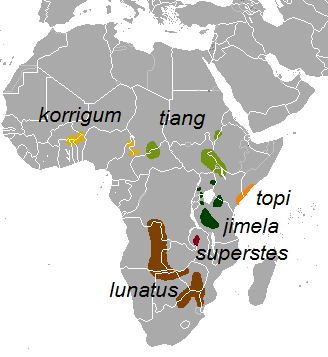
Damaliscus lunatus is a polytypic species with multiple subspecies recognized. It occured throughout Africa, but populations have been in steady decline, mostly in the northern parts of it's range. Kingdon recognizes six subspecies:

D.l. lunatus Tsessebe, Central & Southern Africa
D.l. superstes Bangweulu tsessebe, Bangweulu Flats Zambia
D.l. korrigum Korrigum, W Africa from Senegal to Chad
D.l. tiang Tiang, SE Chad to W Ethiopia and NW Kenya
D.l. topi Coastal topi, Coastal areas of Kenya and S Somalia
D.l. jimela, Topi, East Africa

Damaliscus_lunatus.png

source: wikipedia

G&G recognize all these subspecies as species and split jimela into:
selousi occuring in the Guasin-Gishu plateau, possibly extinct
ugandae, occuring in Uganda, Rwanda and extreme eastern DRC
eurus, occuring in SW Tanzania
jimela, occuring in the Serengeti - Mara ecosystem

Topi/Korrigum/Tiang are quite distinct from the two Tsessebe taxa and especially in the horns which are crescent shaped in Tsessebe and lyrate shaped in the other taxa. Combined with genetic data (see additional data) this leads G&G to discuss Tsessebe separate from the other taxa. An approach I will follow here.

Tsessebe

No new work has been done by G&G and they base their conclusions entirely on Cotterill (2003).

Sample sizes

No sample sizes for skins are reported

Horns/skulls
lunatus 114
superstes 23

Skins

superstes is slightly darker coloured than lunatus, with the facial blaze black instead of dark brown, shoulder- and haunch patches are described as dark gray in superstes as opposed to light to warm gray in lunatus

Horns/skulls

Overall there is hardly any difference between horn and skull measurements of superstes and lunatus, though the average values are somewhat slightly different, the variation within taxa is high. But the horns of superstes are indeed somewhat thicker than lunatus. Cotterill subsequently uses multivariate analysis (see Lechwe) and is able to separate superstes and lunatus based on a combination of horn and skull characteristics. His analysis is however majorly flawed. The fact that 1) 18 measurements were combined in the analysis, whereas there were only 23 superstes samples and 2) the fact that there were a lot more lunatus than superstes samples analyzed, mean that the statistical assumptions of their analysis are violated. This has as a consequence that the model is overfit and the reported differences are likely due to overfitting and not to actual differences in the samples. See Kovarovic et al. (2011) for more info and examples.

Additional data

Arctander reports that in the genetic analysis superstes and lunatus are not entirely separate.


Topi/Tiang/Korrigum

The splitting of Topi/Tiang/Korrigum is done based on original data from G&G.

Sample sizes

No sample sizes for skins are reported

Skulls (males/females)
korrigum (29-37/17-21)
tiang (4/3)
selousi (5-12/2)
jimela (9-19/6-9)
ugandae (15-18/8-11)
eurus (3/1)
topi (5/4)

Horns (males/females)
korrigum (33-36/21)
tiang (4-5/3)
selousi (7/0)
jimela (9/5-6)
ugandae (12-13/10)
eurus (3/1)
topi (5/4)


Sample sizes are again small for most taxa. The appear to have done some multivariate analysis, but the results are similarly flawed as the ones by Cotterill (2003), so I will focus just on the individual measurements

Skins

korrigum is more orange-bay in colour, whereas tiang is more reddish-bay. The other taxa are darker than both korrigum and tiang. eurus differs from ugandae only in become a bit lighter reddish bay towards the back. jimela has larger shoulder patches, which are also more clearly set off against the body colour. No skins differences are described for selousi, except that it can have some white on the blaze, which also occurs in ugandae.

Skulls/horns

tiang is said to have slightly more extreme measurements than korrigum and be somewhat more sexually dimorphic. Though this may be true on average there is a complete overlap in almost all characters, with the exception that one of the three female tiang was very slightly smaller than the smallest korrigum and the teeth of one tiang male were slightly longer than korrigum. eurus is falls completely within the variation of ugandae, except for 1 nasal length measurements that is 2 mm longer than ugandae. jimela and topi are on average somewhat smaller than ugandae and eurus, but the variation is large and there are no clear differences. The selousi samples also fall well within the range reported for the other taxa. tiang+korrigum are also pretty much inseparable from the other taxa based on skull characteristics.
korrigum and tiang have a wider horn span than the other taxa. They are however unseparable when compared to each other. Though there is slightly more sexual dimorphism in tiang than in korrigum. Male eurus horns fall completely within the variation of ugandae, whereas the singe female measurement is somewhat smaller than the ugandae measurements. topi have smaller horns than the other E African taxa, though there is some overlap with especially jimela. selousi horns are similar to ugandae as well. jimela has horns that are on average intermediate between topi and the other taxa, but there is a lot of variation.

Additional data

G&G list that the Tsessebe differs from the other taxa in that it has no x-chromosome that is acrocentric and not submetacentric. Arctander et al. (1999) find a clear genetic difference between jimela and lunatus.

Summarizing
Given the clear differences in horn shape, the genetic difference between Tsessebe and the other taxa and the different shape of the x-chromosome, this split seems valid. There is however no real reason to split lunatus and superstes. There is also no reason to split up the Topi of Eastern Africa into 5 species, the presented evidence is entirely unconvincing for that. Though the treatment of the Coastal topi as a separate subspecies seems valid given the size difference. Korrigum and Tiang should also not be split as separate species, as there are only compelling differences in the pelage and skull and horn measurements for tiang were simply too few. Korrigum and Tiang differ somewhat from the East-African Topi, but I don't feel that this difference is big enough to warrant species status. This would mean we would end get two species, Tsessebe (Damaliscus lunatus) with two subspecies: lunatus and superstes; and The Topi/Korrigum/Tiang (Damaliscus korrigum) with four subspecies: topi, jimela, korrigum, tiang.

Damaliscus lunatus lunatus
full

@Maguari , Khwai Community Area, Botswana

No photos of superstes have been uploaded to the gallery

Damaliscus korrigum jimela
full

@zooboyabroad , "jimela" Masai Mara, Kenya

full

@zooboyabroad , Masai Mara Kenya

full

@Hix , "ugandae" Lake Mburo NP, Uganda

full

@lintworm , "eurus" Katavi NP, Tanzania

No photos of korrigum, tiang or topi have been uploaded to the gallery

References

Arctander et al. (1999): https://watermark.silverchair.com/m...Ch4BG8fz5Qrroo411mGU9UliEfI-cUKlhhfjubMU9QPBE

Cotterill (2003): http://www.durban.gov.za/City_Services/ParksRecreation/museums/nsm/Documents/Tsessebe taxonomy.pdf

Kovarovic et al. (2011): https://www.sciencedirect.com/science/article/pii/S0305440311002263

Kumamoto et al. (1996): https://link.springer.com/content/pdf/10.1007/BF02261724.pdf

Next: Hartebeest
 
Hartebeest

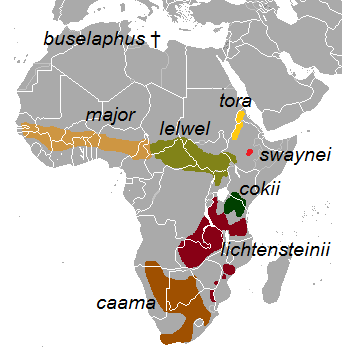
The Hartebeest (Alcelaphus buselaphus) is an antelope that was formerly widespread over Africa. 8 subspecies are normally recognized, of which one is extinct and one possibly extinct. Some of the subspecies have sometimes been treated as separate species and in the case of Lichtenstein's hartebeest even treated as a separate genus. Genetic data have shown that this genus status is not warranted.

Alcelaphus_recent.png

source: Wikipedia

The following 8 subspecies are currently recognized
A.b. buselaphus Bubal hartebeest, formerly N Africa, now extinct
A.b. major Western hartebeest / Kanki, W Africa from Senegal to Cameroon
A.b. lelwel Lelwel, SE Chad, N Central African Republic east to SW Ethiopia and NW Kenya, Uganda and potentially extreme NW Tanzania
A.b. swaynei Swaynes' hartebeest/ Korkay, Ethiopian rift valley, restricted to 3 populations
A.b. tora Tora hartebeest, NW Ethiopia, NE Sudan, SW Eritrea, possibly extinct
A.b. cokii Cokes' hartebeest / Kongoni, S Kenya & N Tanzania
A.b. lichtensteini Lichtenstein's hartebeest / Nkonzi, South-central Africa from Tanzania to Zambia, Malawi, Mozambique and extreme NE South Africa
A.b. caama, S Angola, Namibia, Botswana, South Africa

Additionally hybrids between different subspecies have been described. jacksoni (the animals in the USA) are sometimes treated as a hybrid between cokii and lelwel but are generally included in lelwel.

G&G elevate all subspecies to species status

Sample sizes

No sample sizes for skins have been reported and skin colour is largely left unreported, so the descriptions are taken from Kingdons Mammals of Africa.

Data for skulls have been taken from Ruxton & Schwarz (1929), but I do not have access to those raw data. An article by Capellini & Gosling (2007) was ignored in the species accounts, though mentioned in the genus text, but they also have some skull measurements, sample sizes are listed below. Horn data were taken from Capellini & Gosling (2006).

Skulls
buselaphus (2/1)
major (15/15)
lelwel (28/12)
swaynei (6/4)
tora (4/1)
cokii (27/11)
lichtensteini (20/15)
caama (52/19)

Horns
buselaphus (3/2)
major (20/18)
lelwel (48/16)
swaynei (8/5)
tora (6/1)
cokii (38/15)
lichtensteini (40/21)
caama (93/48)

Sample sizes are pretty good for the majority of the taxa, but very limited for buselaphus, swaynei, tora.

Skins

buselaphus was described as uniform pale brown with pale underparts. major has a golden to mid-brown pelage, whereas lelwel is rich mid-brown. swaynei is very distinct from the other E African taxa in being clearly reddish-brown which can become deep purplish black and clear black markings in the face (absent in lelwel, major, tora, cokii, buselaphus). tora is described as reddish ogre with a pale rump and underparts. cokii is mid-brown with light underparts and a pale rump. lichtensteini is also mid-brown with a darker brown saddle. caama is distinctly coloured chestnut-brown with a black facial blaze and black on the upper legs.

Skulls & horns

major has a significantly larger skull in both genders than the other taxa (Capellini & Gosling 2007; Figure 2). lelwel and lichtensteini are intermediate in size between major and the other taxa. The other taxa are similar in size, though the few tora samples are slightly larger than cokii, caama, swaynei and the single buselaphus are slightly smaller. A difference that could be significant if more data were available. These size data are closely correlated with climate data, areas with higher wet season rainfall supported larger Hartebeest taxa.

Horn shapes differ between taxa. Horn span is larger in buselaphus compared to major, and lelwel has an even smaller horn span. tora and swaynei have the largest horn span and cokii has a horn span intermediate between buselaphus and tora+swaynei. Horn span in lichtensteini and caama is comparable to major. Horns of major are strongly twisted and a U form from in front, which is a V shape in lelwel.

lichtensteini has significantly thicker horns compared to their skull length than all the other taxa. caama, lelwel and major have significantly thicker horns compared to skull length when compared to cokii, swaynei and tora. caama horns are also significantly thicker than major. This is only true in males, not for females. caama has significantly longer horns than all other taxa relative to skull length. lelwel and major also have significantly longer horns than the other taxa, but significantly smaller to caama. There is no significant difference between the other shorter horned taxa. lichtensteini and swaynei have significantly smaller pedicel heights compared to all other taxa for females, but not for males. caama has a significantly heavier skull compared to skull length than the other taxa for both sexes. For female swaynei this is smaller than other taxa, except tora and cokii.

Additional data

There have been two studies that looked at difference in mitochondrial dna in the 7 extant subspecies: Arctander et al. (1999) and Flagstad et al. (2001). The results are slightly different, but in many parts similar. There are three clear lineages, a southern lineage comprising caama and lichtensteini, a western lineage comprised of major and buselaphus and an eastern lineage comprised of swaynei, tora, lelwel and cokii. As Arctander and Flagstad contradict each other when it comes to which groups diverged from each other, I will follow Flagstad here as it is the most recent study with a higher sample size. The Southern lineage diverged from the other animals around 495.000 years ago. The split between the western and eastern lineage is dated at 389.000 years. The split between caama and lichtensteini is dated at 212.000 years, the split from tora with E Africa is dated at 230.000 years and for swaynei and lelwel+cokii this is dated at 201.000 years. The lelwel diverged around 188.000 years from swaynei and cokii. Since the original split there has been some gene flow between swaynei and cokii and also between cokii and lelwel. It is unclear when major and buselaphus diverged from each other. Jackson's hartebeest are a hybrid population between cokii + lelwel but look morphologically more like lelwel.

Summarizing

Hartebeest are an interesting case, with 8 taxa that are clearly morphological distinct and at least the extant taxa can also generally clearly separated (though between the East African taxa there has been some hybridization to complicate matters). Many of the taxa have been separated for more than 200.000 years and these boundaries are often still present, with the exception of Kenya until recently. All taxa are distinct and "behave" as separate species. I think there is a strong case to be made to treat all taxa as species, even though at least the E African taxa can still interbreed and get fertile offspring. Elevating all subspecies to species sttus has important conservation concerns as tora is possibly extinct and swaynei critically endangered. The biggest question mark would be whether buselaphus would be a distinct species from major, as genetic data are mostly lacking. But given the morphological differences, this seems justified.

Alcelaphus buselaphus
full

@Joker1706 , London Zoo, UK

Alcelaphus major
full

@Tim May , Powell-Cotton museum, UK


Alcelaphus lelwel
full

@Hix , Murchison falls NP, Uganda

Alcelaphus swaynei
full

@Maguari , Senkele Wildlife Sanctuary, Ethiopia

Alcelaphus cokii
full

@lintworm , Serengeti National Park, Tanzania

Alcelaphus lichtensteini
full

@ungulate nerd , Zoo Berlin, Germany

Alcelaphus caama
full

@Tomek , Zoo Wroclaw, Poland

Jackson's hartebeest
full

@lintworm , Ol Pejeta Conservancy, Kenya


No pictures have been uploaded yet for Alcelaphus tora.

References

Arctander et al. (1999): https://watermark.silverchair.com/m...Of3ybeurg3QdsPT1ZGgjO7fqHeRS2NrseVisNWq_lr95i

Capellini & Gosling (2006): https://www.researchgate.net/profil...tion-of-fighting-structures-in-hartebeest.pdf

Capellini & Gosling (2007): Habitat primary production and the evolution of body size within the hartebeest clade | Biological Journal of the Linnean Society | Oxford Academic

Flagstad et al. (2001): Environmental change and rates of evolution: the phylogeographic pattern within the hartebeest complex as related to climatic variation

Next: Common wildebeest
 
Last edited:
Since when is the US population hybridized? I've always seen Jackson's Hartebeest used as an alternative common name for lelwel, with the hybrid population with cokii always being referred to as the "Kenya Highland Hartebeest". Additionally, I've never seen any of the US animals referred to as anything other than pure lelwel.

~Thylo
 
Since when is the US population hybridized? I've always seen Jackson's Hartebeest used as an alternative common name for lelwel, with the hybrid population with cokii always being referred to as the "Kenya Highland Hartebeest". Additionally, I've never seen any of the US animals referred to as anything other than pure lelwel.

~Thylo

This is a slip-up from me, I thought to have read in a reputable source that this was to be the case, but I can't find it back anymore and both G&G and Kingdon treat it as a synonym to lelwel. Which leaves wikipedia :p. I will adapt it for now, but leave a note that sometime Jackson's hartebeest is regarded as a hybrid.
 
Common wildebeest

The Common wildebeest (Connochaetes taurinus) is an antelope occuring in Southern and Eastern Africa. Five subspecies are generally recognized:

C.t. taurinus Blue wildebeest / Brindled wildebeest, Southern Africa, dark brown
C.t. cooksoni Cookson's wildebeest, Luangwa Valley Zambia, brown
C.t. johnstoni White-banded wildebeest/ Johnston's wildebeest, Selous ecosystem N Mozambique & SE Tanzania, orange
C.t. albojubatus Eastern white-bearded wildebeest, N Tanzania & C Kenya, east of Gregorian Rift Valley, light brown
C.t. mearnsi Serengeti white-bearded wildebeest, Serengeti- Mara ecosystem, west of the Gregorian rift valley, yellow

800px-Connochaetes_taurinus_map.svg.png

source: Wikipedia

G&G recognize elevate all subspecies, bar cooksoni to species status and cooksoni is lumped without explanation with johnstoni.

Sample sizes

No sample sizes for skins are reported and all skin descriptions seem based on literature

Horns & skulls (males/females)
taurinus (35-42 / 8-13)
johnstoni (9-11/1)
albojubatus (9-10/1)
mearnsi (6-9/4-5)

Sample sizes are relatively small for all taxa except taurinus and given the extremely small sample sizes for females in most taxa, I will ignore them.

Skins

taurinus and johnstoni tend to have a black beard, whereas the mearnsi and albojubatus have a creamy white beard. taurinus has a generally blue-grey color, which is greyer in the other taxa. cooksoni is described by Kingdon as more brown than the other taxa, but is ignored by G&G. The mane along the nape is said to stand up in taurinus and johnstoni and to hang limp in mearnsi and albojubatus. johnstoni can have a white crescent below the eyes, but this is not present in all specimens. mearnsi is said to differ from albojubatus in having darker legs (and generally somewhat darker) and a longer tail.

Skulls/horns

mearnsi is said to have the smallest skull, but this is only true on average and there is wide overlap with both albojubatus and taurinus. johnstoni is said to have longer nasals than the other taxa, but again, this is only true when looking at the mean and there is wide overlap with all other taxa. Again only on average johnstoni and taurinus have a wider horn span than the other taxa, but measurements overlap widely. Downturn in the horns is also higher in johnstoni and taurinus but again with wide overlap with the other taxa.

Additional data

G&G mention that Arctander et al. (1999) found complete separation of the four taxa when looking at Mtdna, but they were blinded by their overly strict PSC approach. The real picture is more complicated than that and shows two distinct clades: a southern clade of taurinus and an eastern clade comprised of johnstoni, albojubatus and mearnsi. mearnsi and albojubatus are most closely related to each other, with johnstoni as sister group. The two cooksoni samples grouped with mearnsi and johnstoni, so their affinities are unclear.

Summarizing

There are some differences in skin colouration between the taxa and some trends in the horn and skull measurements that seem to group mearnsi and albojubatus together and taurinus and johnstoni together. But as the measurements between taxa do widely overlap, they cannot be reliably used to identify Wildebeest up to taxa level. The genetic data do also group johnstoni with the two Eastern taxa and not with taurinus. Though the taxa can be identified genetically, the overall differences are rather small, especially between mearnsi, albojubatus and johnstoni. I therefore see no reason to split the Common wildebeest in four separate species and given the difference in skin colour, I see value in continuing to recognize cooksoni until its status has been resolved.

Connochaetes taurinus taurinus
full

@nikola , Opel-Zoo Kronberg, Germany

Connochaetes taurinus albojubatus
full

@nikola , Zoo Wroclaw, Poland

Connochaetes taurinus mearnsi
full

@lintworm , Serengeti NP, Tanzania

No pictures have been uploaded yet for C.t. johnstoni and C.t. cooksoni

Reference
Arctander et al. 1999: https://watermark.silverchair.com/m...lOi5rGeuzgpYzOJafVYz1Au7b8iXwNA8TINVa2ruQygqi

Next: remaining Alcelphini
 
White-tailed wildebeest

The White-tailed wildebeest or Black wildebeest (Connochaetes gnu) is endemic to South Africa and considered monotypic.

full

@Maguari , Safari ParkDvur Kralove, Czech Republic

Hirola

The Hirola or Hunter's hartebeest (Beotragus hunteri) is the only species in the genus Beotragus. Hirola are critically endangered and occur only in a small area at the Kenya - Somalia border. A few Hirola have been translocated to the Tsavo East NP, outside their native range, but the population there remains very small.

full

@Zebraduiker , Gladys Porter Zoo, USA

full

@lintworm , Bern Natural History Museum, Switzerland

Next: Sable antelope
 
Sable antelope

The Sable antelope (Hippotragus niger) is one of the largest and most spectacular antelopes in Africa. This species is closely linked to the Miombo woodlands of South-Central Africa and occurs in Southern and parts of Eastern Africa. Generally 4 subspecies have been recognized, though the exact boundaries are sometimes unclear:

H.n. niger Southern Africa, south of the Zambezi river
H.n. kirkii Zambia, Malawi, N Mozambique and S Tanzania
H.n. variani Giant sable, restricted to C Angola
H.n. roosevelti E Tanzania and extreme SE Kenya

G&G elevate roosevelti to species status, but keep the other taxa as subspecies. Additionally the recognize the anselli subspecies, which is a split from kirkii and occurs E of the Luangwa.

It is however unclear where they place the Sable of SW Tanzania. in HMW these are grouped with roosevelti, but based on morphology (and genetics, see below), they do not group with roosevelti.

Sample sizes

Skins (males/females)
niger (10/7)
anselli (9/7)
kirkii (6/2)
W Tanzania (6/5)
roosevelti (1/6)
variani (9/4)

Horns & skulls (males/females)
niger (6-45/4-23)
kirkii (3-19/2-10)
anselli (10-36/7-25)
W Tanzania (2-4/2-3)
roosevelti (1-6/1)
variani (1-14/1-3)

Sample sizes are small for most taxa, especially for the split roosevelti, variani and W Tanzania

Skins

roosevelti females are said to be more light golden-red brown than the other taxa. The roosevelti males are described as blackish, but the other taxa are described in the range from black to red-brown to black or very dark black-brown.

Horns & Skulls

roosevelti is described as much smaller than the other taxa with shorter horns and less wide across the horn bases. Though the horns are on average slightly shorter, there is wide overlap with all other taxa, except the single variani specimen. There is also no evidence that roosevelti is actually smaller, though the average value is slightly smaller it falls completely within the variation of niger. The horn base is on average slightly smaller, but there is again a lot of variation within a limited sample size, so there is no discrete difference with any of the other taxa.

Additional data

This is where it gets really interesting. G&G cite Matthee & Robinson (1999) in that there are two clearly separate clades: roosevelti in one, all other taxa in the other, based on Mtdna. The roosevelti samples did however originate from W Tanzania, so outside the range of what is normally described roosevelti, but what is part of the range of kirkii. Subsequent genetic analyses (Pitra et al. 2002; 2006; Jansen van Vuuren et al. 2010) which partly build on the work of Matthee & Robinson (1999) call this kirkii and reserve roosevelti for the samples of E Tanzania and SE Kenya. The SW Tanzania population remains clearly distinct from the other populations together in the subsequent studies (see Pitra et al. 2006) and roosevelti is a sister to niger+variani. Some of the SW Tanzanian samples are however not distinct from niger and variani. Pitra et al. (2006) explain this by the fact the S populations spread north and introregressed with the SW Tanzanian population. The genetic analyses confirm that variani is genetically somewhat distinct from the other taxa (including morphological similar individuals in W Zambia). anselli is however not a recognizable taxa based on dna.

Summarizing

Given the lack of clear morphological differences and genetics that contradict the split (if roosevelti is split, kirkii from Tanzania should also be split). As these populations apparently readily hybridize, the genetic distance is not that big and the taxa are morphologically relatively similar, I see no evidence to support a split of Sable antelope. What becomes however clear with genetics is that anselli is not a valid subspecies, kirkii is restricted to SW Tanzania and that niger thus has a much wider distribution than previously assumed.

Hippotragus niger niger
full

@Tomek , Marwell Wildlife, UK

full

@ro6ca66 , Marwell Wildlife, UK

Hippotragus niger variani
full

@UngulateNerd92 , Field Museum of Natural History, Chicago, USA

No pictures of kirkii or roosevelti have been uploaded yet.

References

Jansen van Vuuren et al. (2010): An Error Occurred Setting Your User Cookie

Matthee & Robinson (1999): https://onlinelibrary.wiley.com/doi/full/10.1046/j.1365-294X.1999.00556.x

Pitra et al. (2002): https://onlinelibrary.wiley.com/doi/full/10.1046/j.1365-294X.2002.01516.x

Pitra et al. (2006): https://link.springer.com/article/10.1007/s10344-005-0026-y#CR28

Next: remaining Hippotragus species.

 
H. n. kirkii used to be kept at the San Diego Zoo Safari Park for many years so there probably are photos of them in the gallery that aren't labeled as such. Of course, if the true range of the taxa is smaller than previously thought, maybe they're not kirkii :p I do not know the import location.

~Thylo
 
Roan antelope

The Roan antelope (Hippotragus equinus) is a widespread large antelope and the closest living relative to the Sable antelope. Historically up to 6 subspecies have been recognized, and there is some geographical variation in colour and skull characteristics, but these are not clearly defined. There is however a genetic split between the western population and the Eastern and Southern African populations (Matthee & Robinson 1999). Therefore it seems logical to recognize two subspecies: H.e. koba in W Africa and H.e. equinus (including bakeri, charicus, langheldi, cottoni, dogetti).

Hippotragus equinus
full

@Tim May , Whipsnade Zoo, UK

Hippotragus equinus equinus

full

@Ituri , San Diego Safari Park, USA

I suspect all animals in Europe are equinus.

Bluebuck

The Bluebuck / Blaubok (Hippotragus leucophaeus) is an extinct antelope that occured in S Africa. The last animals were probably shot around 1799-1800.
full

@Bele , Natural History Museum Paris, France

Reference
Matthee & Robinson (1999): https://onlinelibrary.wiley.com/doi/full/10.1046/j.1365-294X.1999.00556.x

Next: Beisa oryx
 
H. n. kirkii used to be kept at the San Diego Zoo Safari Park for many years so there probably are photos of them in the gallery that aren't labeled as such. Of course, if the true range of the taxa is smaller than previously thought, maybe they're not kirkii :p I do not know the import location.

~Thylo

I suspect they will be niger according to genetic data, just as the complete European population.
 
Back
Top