Hartebeest
The Hartebeest (
Alcelaphus buselaphus) is an antelope that was formerly widespread over Africa. 8 subspecies are normally recognized, of which one is extinct and one possibly extinct. Some of the subspecies have sometimes been treated as separate species and in the case of Lichtenstein's hartebeest even treated as a separate genus. Genetic data have shown that this genus status is not warranted.
source: Wikipedia
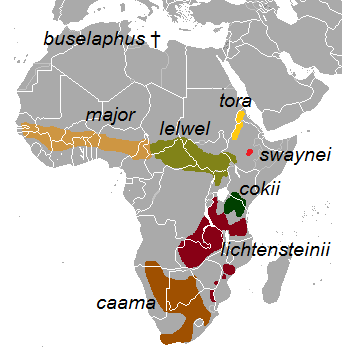
The following 8 subspecies are currently recognized
A.b. buselaphus Bubal hartebeest, formerly N Africa, now extinct
A.b. major Western hartebeest / Kanki, W Africa from Senegal to Cameroon
A.b. lelwel Lelwel, SE Chad, N Central African Republic east to SW Ethiopia and NW Kenya, Uganda and potentially extreme NW Tanzania
A.b. swaynei Swaynes' hartebeest/ Korkay, Ethiopian rift valley, restricted to 3 populations
A.b. tora Tora hartebeest, NW Ethiopia, NE Sudan, SW Eritrea, possibly extinct
A.b. cokii Cokes' hartebeest / Kongoni
, S Kenya & N Tanzania
A.b. lichtensteini Lichtenstein's hartebeest / Nkonzi, South-central Africa from Tanzania to Zambia, Malawi, Mozambique and extreme NE South Africa
A.b. caama, S Angola, Namibia, Botswana, South Africa
Additionally hybrids between different subspecies have been described.
jacksoni (the animals in the USA) are sometimes treated as a hybrid between
cokii and
lelwel but are generally included in
lelwel.
G&G elevate all subspecies to species status
Sample sizes
No sample sizes for skins have been reported and skin colour is largely left unreported, so the descriptions are taken from Kingdons Mammals of Africa.
Data for skulls have been taken from Ruxton & Schwarz (1929), but I do not have access to those raw data. An article by Capellini & Gosling (2007) was ignored in the species accounts, though mentioned in the genus text, but they also have some skull measurements, sample sizes are listed below. Horn data were taken from Capellini & Gosling (2006).
Skulls
buselaphus (2/1)
major (15/15)
lelwel (28/12)
swaynei (6/4)
tora (4/1)
cokii (27/11)
lichtensteini (20/15)
caama (52/19)
Horns
buselaphus (3/2)
major (20/18)
lelwel (48/16)
swaynei (8/5)
tora (6/1)
cokii (38/15)
lichtensteini (40/21)
caama (93/48)
Sample sizes are pretty good for the majority of the taxa, but very limited for
buselaphus, swaynei, tora.
Skins
buselaphus was described as uniform pale brown with pale underparts.
major has a golden to mid-brown pelage, whereas
lelwel is rich mid-brown.
swaynei is very distinct from the other E African taxa in being clearly reddish-brown which can become deep purplish black and clear black markings in the face (absent in
lelwel, major, tora, cokii, buselaphus).
tora is described as reddish ogre with a pale rump and underparts.
cokii is mid-brown with light underparts and a pale rump.
lichtensteini is also mid-brown with a darker brown saddle.
caama is distinctly coloured chestnut-brown with a black facial blaze and black on the upper legs.
Skulls & horns
major has a significantly larger skull in both genders than the other taxa (Capellini & Gosling 2007; Figure 2).
lelwel and
lichtensteini are intermediate in size between
major and the other taxa. The other taxa are similar in size, though the few
tora samples are slightly larger than
cokii, caama, swaynei and the single
buselaphus are slightly smaller. A difference that could be significant if more data were available. These size data are closely correlated with climate data, areas with higher wet season rainfall supported larger Hartebeest taxa.
Horn shapes differ between taxa. Horn span is larger in
buselaphus compared to
major, and
lelwel has an even smaller horn span.
tora and
swaynei have the largest horn span and
cokii has a horn span intermediate between
buselaphus and
tora+swaynei. Horn span in
lichtensteini and
caama is comparable to
major. Horns of major are strongly twisted and a U form from in front, which is a V shape in
lelwel.
lichtensteini has significantly thicker horns compared to their skull length than all the other taxa.
caama, lelwel and
major have significantly thicker horns compared to skull length when compared to
cokii, swaynei and
tora.
caama horns are also significantly thicker than
major. This is only true in males, not for females.
caama has significantly longer horns than all other taxa relative to skull length.
lelwel and
major also have significantly longer horns than the other taxa, but significantly smaller to
caama. There is no significant difference between the other shorter horned taxa.
lichtensteini and
swaynei have significantly smaller pedicel heights compared to all other taxa for females, but not for males.
caama has a significantly heavier skull compared to skull length than the other taxa for both sexes. For female
swaynei this is smaller than other taxa, except
tora and
cokii.
Additional data
There have been two studies that looked at difference in mitochondrial dna in the 7 extant subspecies: Arctander et al. (1999) and Flagstad et al. (2001). The results are slightly different, but in many parts similar. There are three clear lineages, a southern lineage comprising
caama and
lichtensteini, a western lineage comprised of
major and
buselaphus and an eastern lineage comprised of
swaynei,
tora, lelwel and
cokii. As Arctander and Flagstad contradict each other when it comes to which groups diverged from each other, I will follow Flagstad here as it is the most recent study with a higher sample size. The Southern lineage diverged from the other animals around 495.000 years ago. The split between the western and eastern lineage is dated at 389.000 years. The split between
caama and
lichtensteini is dated at 212.000 years, the split from
tora with E Africa is dated at 230.000 years and for
swaynei and
lelwel+cokii this is dated at 201.000 years. The
lelwel diverged around 188.000 years from
swaynei and
cokii. Since the original split there has been some gene flow between
swaynei and
cokii and also between
cokii and
lelwel. It is unclear when
major and
buselaphus diverged from each other. Jackson's hartebeest are a hybrid population between
cokii + lelwel but look morphologically more like
lelwel.
Summarizing
Hartebeest are an interesting case, with 8 taxa that are clearly morphological distinct and at least the extant taxa can also generally clearly separated (though between the East African taxa there has been some hybridization to complicate matters). Many of the taxa have been separated for more than 200.000 years and these boundaries are often still present, with the exception of Kenya until recently. All taxa are distinct and "behave" as separate species. I think there is a strong case to be made to treat all taxa as species, even though at least the E African taxa can still interbreed and get fertile offspring. Elevating all subspecies to species sttus has important conservation concerns as
tora is possibly extinct and
swaynei critically endangered. The biggest question mark would be whether
buselaphus would be a distinct species from
major, as genetic data are mostly lacking. But given the morphological differences, this seems justified.
Alcelaphus buselaphus
@Joker1706 , London Zoo, UK
Alcelaphus major
@Tim May , Powell-Cotton museum, UK
Alcelaphus lelwel
@Hix , Murchison falls NP, Uganda
Alcelaphus swaynei
@Maguari , Senkele Wildlife Sanctuary, Ethiopia
Alcelaphus cokii
@lintworm , Serengeti National Park, Tanzania
Alcelaphus lichtensteini
@ungulate nerd , Zoo Berlin, Germany
Alcelaphus caama
@Tomek , Zoo Wroclaw, Poland
Jackson's hartebeest
@lintworm , Ol Pejeta Conservancy, Kenya
No pictures have been uploaded yet for
Alcelaphus tora.
References
Arctander et al. (1999):
https://watermark.silverchair.com/m...Of3ybeurg3QdsPT1ZGgjO7fqHeRS2NrseVisNWq_lr95i
Capellini & Gosling (2006):
https://www.researchgate.net/profil...tion-of-fighting-structures-in-hartebeest.pdf
Capellini & Gosling (2007):
Habitat primary production and the evolution of body size within the hartebeest clade | Biological Journal of the Linnean Society | Oxford Academic
Flagstad et al. (2001):
Environmental change and rates of evolution: the phylogeographic pattern within the hartebeest complex as related to climatic variation
Next: Common wildebeest





 . I will adapt it for now, but leave a note that sometime Jackson's hartebeest is regarded as a hybrid.
