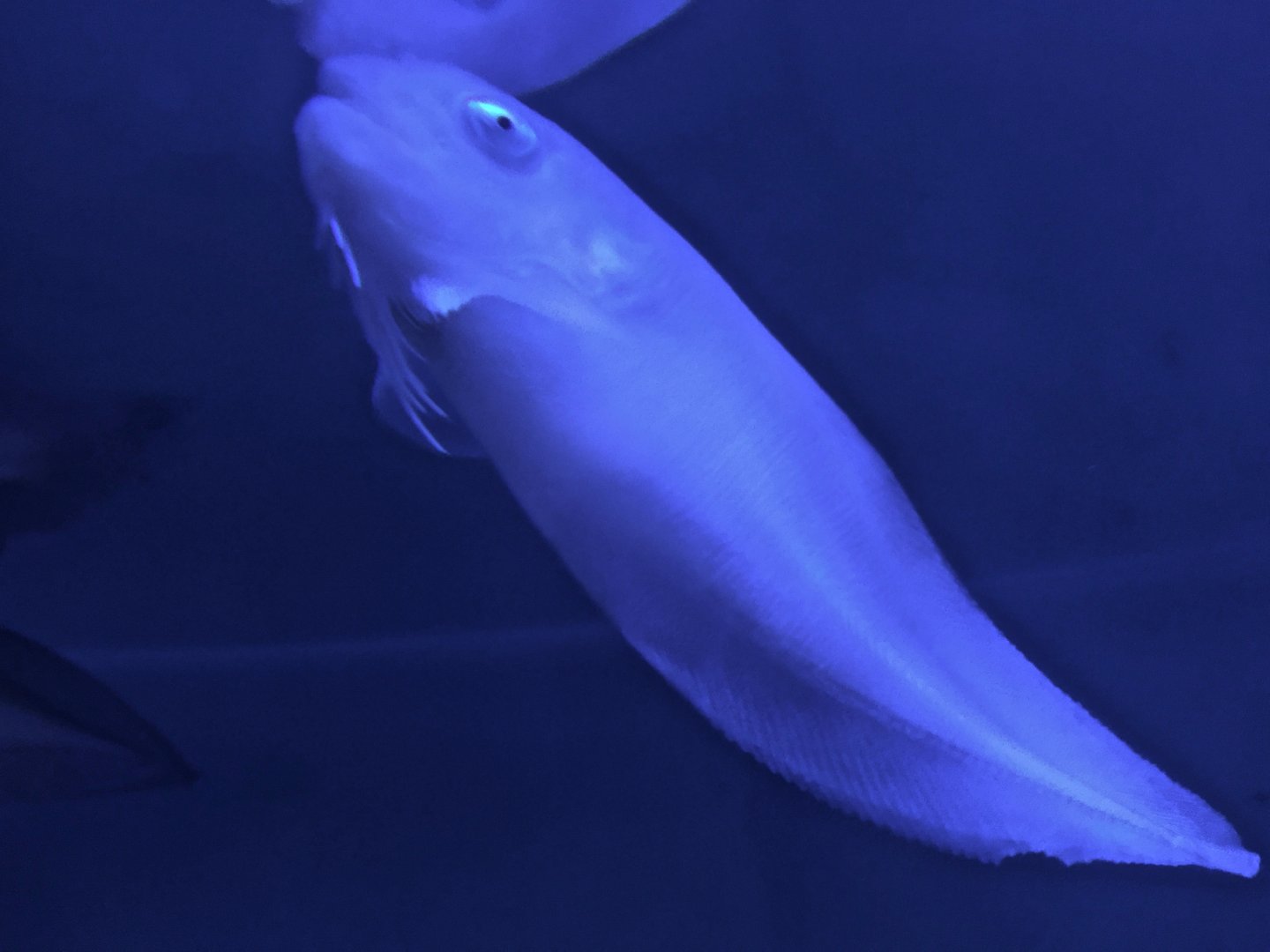
Are These in Captivity?

Status
Not open for further replies.
Got some Pacific fish:
- Giant Kelpfish
- Pacific Barracuda
- Albacore, Skipjack, Yellowfin, Bonito
- Fringehead
- Any kind of flying fish
- Opah
- Wahoo
- Snailfish
- Greenland Shark
- Oceanic puffers and triggers
- Pilotfish, and suckerfish/remoras

Have any of those been kept in captivity? I'm sure some of those more coastal fish you could exhibit, not so sure about the more pelagic species.
 
Got some Pacific fish:
- Giant Kelpfish
- Pacific Barracuda
- Albacore, Skipjack, Yellowfin, Bonito
- Fringehead
- Any kind of flying fish
- Opah
- Wahoo
- Snailfish
- Greenland Shark
- Oceanic puffers and triggers
- Pilotfish, and suckerfish/remoras

Have any of those been kept in captivity? I'm sure some of those more coastal fish you could exhibit, not so sure about the more pelagic species.

Monterey Bay Aquarium currently keeps the kelpfish, Skipjack, Yellowfin, and Sarcastic Fringehead. I believe all of those are kept elsewhere as well.
There are a few remora about, in addition to the occasional few in the private trade. Several oceanic puffers and triggers show up as well.

EDIT: Also snailfish, as I thought I remembered.
 
Got some Pacific fish:
- Giant Kelpfish
- Pacific Barracuda
- Albacore, Skipjack, Yellowfin, Bonito
- Fringehead
- Any kind of flying fish
- Opah
- Wahoo
- Snailfish
- Greenland Shark
- Oceanic puffers and triggers
- Pilotfish, and suckerfish/remoras

Have any of those been kept in captivity? I'm sure some of those more coastal fish you could exhibit, not so sure about the more pelagic species.

The Okinawa Aquarium has yellowfin and skipjack tuna, Tokyo Sea Life Park has bonito IIRC, giant kelpfish at Cabrillo Marine Aquarium (@RatioTile uploaded a pic of one), remoras are at several aquariums, Aquamarine Fukushima has a blacktip snailfish, Kamogawa aquarium has previously kept flying fish, sarcastic fringehead at Monterey Bay Aquarium.
 
Kamogawa Sea World had flying fish as of July last year, and the JAZA website has since listed more species there and at 2-3 other Japanese aquariums.
 
Yellowfin Tuna is also at Sentosa SEA aquarium and the national aquarium of Taiwan in Pingtung.
 
There are hundreds of Saiga is captivity (semi-captivity?) at Askaniya Nova in Ukraine.

~Thylo

I visited Askania Nova with an international group of zoo professionals in 2017. I am still occasionally in touch with them. They have about 600 saiga in a semi-wild setup in a steppe reserve. The population has reached the carrying capacity of the area, so they are selling off hand-reared calves every year, which is less than ideal. The population is not managed in any way, the animals live and die as in nature. The provenance of the founders and the genetic diversity of the population is not known, and could be a concern. The conservation value of the population is therefore currently not established. China has purchased an area in the Ukraine to start a saiga population with founders purchased from Askania Nova. The goal is clearly production and not conservation.
 
Are any saiga on display and if not why? Is it some welfare issue or because they're hard to obtain?

I published a comparative study on the captive management of saiga in 2017 after lengthy research for the conference of the Saiga Conservation Alliance. It is available on the Saiga Resource Centre website along with other papers, among them the English translation of a recent Russian publication. The last saiga in Europe was a male in Zoo Köln, Germany. It died in 2009. The females and the calves died earlier when a fox broke into the enclosure. This was the end of the programme, as no animals could be imported from Askania Nova by that time. It is still impossible to import saga from there into the EU (legally). Saiga are not easy to maintrain in captivity for several reasons, and since they are very difficult to reintroduce or establish in new areas, in situ is the only real option. In captivity, they are flighty, prone to injury and infections, ideally need huge enclosures, males are very agressive, calves are easy prey for corvids and seagulls, they need a dry climate, population management is difficult, etc. If you have questions, I 'd be glad to answer. There were considerable efforts, and some successes in the US, Europe and Russia, but the captive population was never stable and died out out in the end without imports. There a few rregions in the world where the climate and flora would be suitable for semi-wild ex-situ populations, but the emphasis has always been in-situ conservation. San Diego had considerable experience with them (partly in a mixed-species exhibit), and has a husbandry protocol (not published, available to zoo professionals).
 
Do you think saigas could live in open reserves in Europe, like the steppe of Hortobagy in Hungary, or diverse grazing reserves protecting heaths, dune grassland or steppes in West Europe?

Were saiga recently kept in safari parks in Europe, which could solve the problem of space/fearfulness - I only know of urban zoos keeping them?
 
Do you think saigas could live in open reserves in Europe, like the steppe of Hortobagy in Hungary, or diverse grazing reserves protecting heaths, dune grassland or steppes in West Europe?

Were saiga recently kept in safari parks in Europe, which could solve the problem of space/fearfulness - I only know of urban zoos keeping them?

As far as I know, Hortobagy National Park explored the possibility of introducing saigas, and it was established by Russian experts, that it would not work. I did a check on the flora, and it is very similar to the Kazakh steppes, so that would be OK. Loads of food plants. The climate has however become too mild for them. Saigas don't do well in mild winters. They can tolerate extreme weather conditions, but they need mostly dry soil. They have small hooves, spindly legs, and a heavy body. Like many other leggy ungulates, they get easily injured if their hooves break through a thin layer of ice (like after a warmer spell in the winter). Waterlogged soil also has a high bacterial count, and saigas are very sensitive to gastro-intenstinal infections.
Safari parks in dry climates would be OK, but you'd need a huge grassland area for them to really thrive. In Askania Nova, I saw that they can get used to slowly moving vehicles. Groups of people walking will spook them. They are very flighty and easily stressed. In large enclosues, they can gain considerable speeds, so a collision with a hard fence will be fatal. The area needs to be the small, or very big. A lot of thought and attention would have to go into their enclosure and fence design, and even that won't be a clear solution.
 
The Duke of Bedford kept saiga at Woburn in the early 1900s; the species bred there too.
The undoing of that population was the mild climate. Saigas need a dry climate. A lot of animals were lost to disease (respiratory and gastro-intestinal). Beeding saiga in captivity is not difficult as such. Keeping them alive and heathy is the real challenge.
 
The undoing of that population was the mild climate. Saigas need a dry climate. A lot of animals were lost to disease (respiratory and gastro-intestinal). Beeding saiga in captivity is not difficult as such. Keeping them alive and heathy is the real challenge.
So Arizona or Colorado might work?
 
So Arizona or Colorado might work?

Yes, that would be an option if there is little rain the warm season. But my bet would be on climates closest to their natural range in Central Asia, which would be more like the Northern United States and Southern Canada.
 
So Arizona or Colorado might work?
Two more issues came to my mind: that of predators, and that of intoducing saiga into new environments. Both are difficult. Saiga calves are easy prey for just about anything, even smaller corvids and seagulls, and coyotes or wolfes would easily corner the adults in a fenced area if they get in somehow (all of which has been observed). Saiga are protected in the wild by their incredible speed (up to 80-90 km/h), sharp vision (they spot anything on the horizon, and they bolt), and their numbers - which offer little protection in a captive setup. Netting smaller enclosures to prevent predation by Corvids on calves did not work in the Czech Republic (at Chomutov). They are very good swimmers, and will cross a ditch if not properly built. They can break themselves to pieces colliding with fences. They are similar to the pronghorn in some ways in captivity. Adults taken to a new environment will not thrive, and have reduced breeding success. One way to go is to build a breeding station, and only release the first generation born at the location. But you still have to cope with predators. Saiga - weirdly enough - don't seem to have a healthy amount of fear of predators if released from a captive setup. Transporting saiga is also tricky, although definitely possible. They are so fragile that a dart could kill them, and they are so stressed that it is tough to know how much sedative to use... They need crates not much bigger than themselves (not surprisingly). You have to cap the horns of the males, or risk serious injury. Those horns are like daggers, and males are (mostly) aggressive.
 
Are any sort of whales held in captivity? I've heard of whale sharks, sun fish and the sort but is that the largest they get to?
 
Status
Not open for further replies.
Back
Top