
I thought I would nominate five birds I see frequently, and five from my travels. Each species is from a different family.
The first five I have all seen from my kitchen window, and it would be easy to see them daily if I wanted.
1. Eastern Yellow Robin. It's bright yellow breast flashes as you walk towards it along bush paths. While there are some more sombre plumed species, most Australian robins come across with brilliant red or yellow breasts. I remember growing up with stories of "robin red-breast" and was disappointed when I eventually saw the European version, which cannot compete with brilliant reds of the flame and scarlet robins or the sheer beauty of the rose and pink robins. The eastern yellow is my resident species, and it give my heart a lift every time I see it.
2. Spotted Pardalote. Pardalotes as a family are endemic to Australia. They are tiny birds and are usually found high up in trees so can be difficult to observe. Spotted pardalotes do come down and dance around feeding, often only a metre or two away. They are stunningly beautiful in a way that is impossible to describe, with delicate markings as though decorated by some careful artist.
3. New Holland Honeyeater. As far as I remember, this would be the first bird I identified from a field guide, a tiny handbook produced by the Gould League of birds common in our area. They have black plumage with white markings and flashes of gold. A beautiful representative of this typically Australian family.
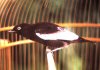
4. Magpie Lark. I grew up with these constantly in our suburban garden, when we knew them as "mudlarks". They are not larks but members of the monarch flycatcher family, albeit large members compared with other monarch flycatchers. They are very neat birds with attractive black and white plumage. Fond childhood memories.
5.Gray Shrikethrush. A handsome bird with a solid light gray plumage, it has the most beautiful and melodic calls. It belongs to the whistler family, another typical Australian family.
I'm going to come back to the other five tomorrow.
The first five I have all seen from my kitchen window, and it would be easy to see them daily if I wanted.
1. Eastern Yellow Robin. It's bright yellow breast flashes as you walk towards it along bush paths. While there are some more sombre plumed species, most Australian robins come across with brilliant red or yellow breasts. I remember growing up with stories of "robin red-breast" and was disappointed when I eventually saw the European version, which cannot compete with brilliant reds of the flame and scarlet robins or the sheer beauty of the rose and pink robins. The eastern yellow is my resident species, and it give my heart a lift every time I see it.
2. Spotted Pardalote. Pardalotes as a family are endemic to Australia. They are tiny birds and are usually found high up in trees so can be difficult to observe. Spotted pardalotes do come down and dance around feeding, often only a metre or two away. They are stunningly beautiful in a way that is impossible to describe, with delicate markings as though decorated by some careful artist.
3. New Holland Honeyeater. As far as I remember, this would be the first bird I identified from a field guide, a tiny handbook produced by the Gould League of birds common in our area. They have black plumage with white markings and flashes of gold. A beautiful representative of this typically Australian family.
4. Magpie Lark. I grew up with these constantly in our suburban garden, when we knew them as "mudlarks". They are not larks but members of the monarch flycatcher family, albeit large members compared with other monarch flycatchers. They are very neat birds with attractive black and white plumage. Fond childhood memories.
5.Gray Shrikethrush. A handsome bird with a solid light gray plumage, it has the most beautiful and melodic calls. It belongs to the whistler family, another typical Australian family.
I'm going to come back to the other five tomorrow.


 .
.



 !
! !
!
