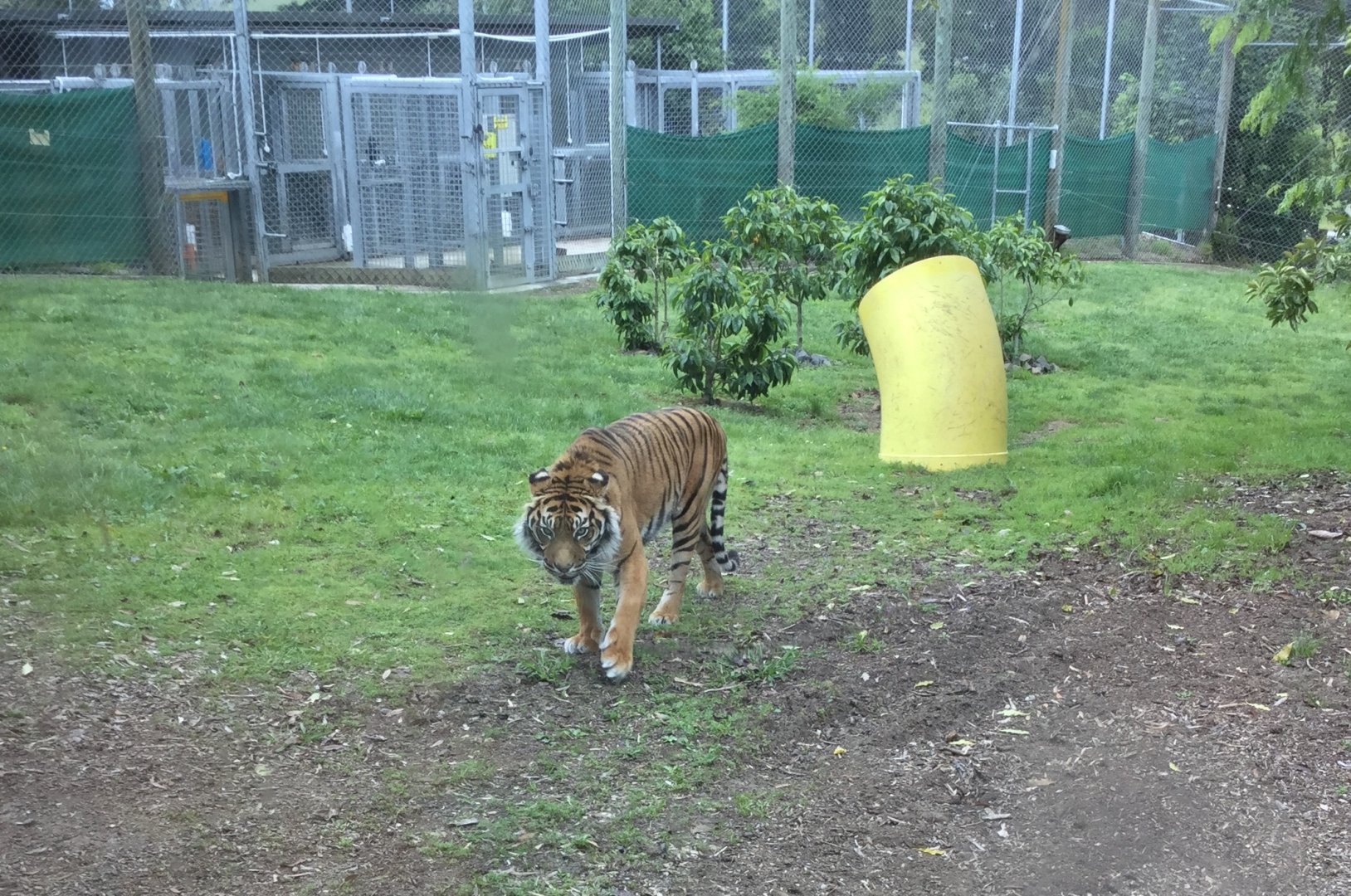
@WhistlingKite24 Oh no thats really sad, rip Maneki. She was one of the more recent Sumatran Tiges to come directly from Indonesia and not be previously blood-related in some way already with the Australasian, European and American Zoo Sumatran Tiger family trees like i.e Meta-Nico-Frank-Poetry line right?
Yes, Australia Zoo imported 1.2 (Bashii, Kaitlyn and Maneki) siblings from Indonesia in 2008. They are unrelated to the existing population. Kaitlyn has been the main breeder and has produced many cubs at Australia Zoo; 2.0 in 2013, 1.1 in 2016, 1.0 in 2019 and 1.2 in 2020. The sires of all her cubs have been males that were/are well-represented in the region. Maneki only ever produced one cub with Satu - Reggie in 2016.

The male, Bashii is at Wellington Zoo, NZ and hasn't bred with the female there. Kaitlyn is still at Australia Zoo and of course, produced the recent litter there back in February. I find that she is rarely on public display.
 
Last edited:
@WhistlingKite24 Oh thanks for the info. Its good about Kaitlyn's birthing success and that Maneki managed to have one cub (hope they all live long and prosper, shame about Maneki's illness).

@Zoofan15 Hey I've been meaning to ask if theres any details you might have seen in the old Sumatran Tiger studbooks about Frank and Poetry, i can find out about their cubs that were born but don't know anything about the years Frank and Poetry were born, the years they died and their month of arrival at Melbourne in 1980 was it?
 
@Zoofan15 Hey I've been meaning to ask if theres any details you might have seen in the old Sumatran Tiger studbooks about Frank and Poetry, i can find out about their cubs that were born but don't know anything about the years Frank and Poetry were born, the years they died and their month of arrival at Melbourne in 1980 was it?

Sure, here you go:

Poetry (F)
Born at Rotterdam Zoo 25/05/1978
Arrived at Melbourne Zoo 21/04/1979
Died at Melbourne Zoo 23/11/1997

Frank (M)
Born at Frankfurt Zoo 20/03/1980
Arrived at Melbourne Zoo 02/06/1981
Died at Melbourne Zoo 20/11/1999

If you want details of their cubs, they’re also on Post #189 of this thread.
 
While on the subject of big cats at Australia zoo I have often wondered as to why they imported Cheetah, they have never been exhibited to the public apart from a walk sometimes if you happen to be in the right place at the right time. No breeding has ever taken place and I believe kept in enclosures very close to the Tigers!
 
Thesis on Chronic Kidney Disease in Felids Held in Australian Zoos

@steveroberts found a thesis on Chronic Kidney Disease in felids held in Australian zoos last week and kindly passed it on to me.

I have gone through this very extensive thesis and pulled out what I think are some relative pieces of information regarding felids in Australian zoos. I'd encourage anyone wanting a more comprehensive overview to read through it themselves in it's entirety if they have time: Chronic Kidney Disease in Non-Domestic Felids in Australian Zoos

Introduction:

Data collection occurred between 2012 and 2015, from ten Australian zoos: Taronga Zoo, Taronga Western Plains Zoo, Werribee Open Range Zoo, Melbourne Zoo, Mogo Zoo, Dreamworld, National Zoo and Aquarium, Perth Zoo, Adelaide Zoo and Monarto Zoo.

Note: the term 'Australian zoos' is therefore not to be regarded as an all encompassing term, as in this context, it refers only to the ten zoos listed above.

Felids Held:

Species identified as having lived in Australian zoos over the past fifty years were: African and Asiatic lions, and lions of undetermined sub-species; Bengal, Sumatran, Amur, and hybrid (Bengal x Sumatran, Bengal x Amur) tigers; bobcats; caracals; cheetahs; clouded leopards; cougars; fishing cats; jaguars; jaguarundis; leopard cats; leopards and Persian leopards; Northern lynx; ocelots; servals; snow leopards; and Asian (Temminck’s) golden cats.

There were three species of small cats documented to have been kept in Australian zoos – Geoffroy’s cat (Leopardus geoffroyi geoffroyi), Pallas cat (Felis manul), and jungle cat (Felis chaus) – and two tiger/lion hybrid individual felids (Panthera) which were not included in this study due to a lack of detailed clinical records.


On Page 42, there's a census of felids kept at Australian zoos between 1965 and 2015. During this time period, there was three Clouded leopard, eight Asian lions (three males; five females), 19 Persian leopards, 32 Jaguar and a staggering 98 Leopard cat (71 of which died before the age of 30 days) held at these 10 zoos.

Prolific breeders, such as leopard cats (Felis bengalensis), cougars (Puma concolor) and lions (Panthera leo spp.) had high counts of both cub births and deaths, particularly in the decades prior to 1995, before reliable contraceptive methods via hormonal implants were available, and when euthanasia of surplus animals for curatorial reasons was necessary for population control.


Sumatran Tigers:

In Australia, congenital vestibular disease in Sumatran tiger cubs, due to a profound founder effect, has been documented and it was calculated in 1986 that the entire global captive zoo population of Sumatran tigers was founded on 17 individuals.

The Sumatran Tiger Endangered Species Program recognises the problems of maintaining genetic diversity and reducing founder effect in the remaining population, and Sumatran tigers are considered beyond breeding age at 17 years for males and 15 years for females therefore every effort is made to maximise their breeding potential in this period.


Reported causes of death in felids less than 2 years of age included intestinal obstruction due to a foreign body (piece of rubber tyre, Sumatran tiger), drowning in an enclosure moat (Sumatran tiger). I believe the first tiger mentioned was Satri (born 2008), who died as an adolescent at Perth Zoo. The second was Nakal (born 2006), who drowned at Melbourne Zoo in 2008.

Sumatran tiger cub mortality rates have declined from a peak of 47% in 1985–1994 to 15% in 2005–2015.

Shiva (born 1985) died of CKD at Taronga Zoo in March 2002.

Selatan (born 1990) died of CKD at Taronga Western Plains Zoo in May 2012. She was speyed in 2007 after contracting pyometra.

Asiatic Lions:

Eight Asiatic lions have been held in Australian zoos. These included three males and five females. The age at death (and cause) of four of the Asian lions were listed as:

Male - died September 2002 aged 20.9 years (CKD)
Male - died June 1999 aged 15.9 years (senescence)
Female - died August 2002 aged 19.1 years (CKD)
Female - died September 1993 aged 10.3 years (misadventure/killed by exhibit mate)

A full Taxon Report is given for one of these lions (a male named Kutch):

1.0 Kutch
Born at Zoo Knoxville 01/07/1983
Sent to Baton Rouge Zoo 18/03/1984
Sent to Taronga Western Plains Zoo 04/06/1989
Sent to Taronga Zoo 31/08/1993
Sent to Taronga Western Plains Zoo 13/06/1996
Sent to Taronga Zoo 23/09/1996
Sent to Taronga Western Plains Zoo 12/05/1999
Died at Taronga Western Plains Zoo 15/06/1999

Additional Info:

Taronga Zoo's male Clouded leopard, Samar, died in September 2004 of Renal lymphoma.

Taronga Zoo's male Temminck's golden, Nugi, died in November 2002 of Hydrothorax.

Taronga Zoo had 1.2 Fishing cat between 2012 and 2015 - a male born 15/05/2003; and two females born 12/01/2002 and 17/10/2003.

There was a note of infanticide due to conspecific aggression in Temminck's golden cat. A litter of two kittens was born at Melbourne Zoo in 1972, which mysteriously died the same day at 11 weeks of age; followed by another litter of two in 1973, which died a day apart at four months of age. The death of a litter on the same day (or a day apart) is nothing unusual during the first week of life; but the death of an entire litter that has survived the neonate stage implies an event took place. I had suspected their deaths were due to being introduced to the sire, as husbandry in this species may not have been aware of the dangers unfamiliar adults posed to kittens.
 
Thesis on Chronic Kidney Disease in Felids Held in Australian Zoos

@steveroberts found a thesis on Chronic Kidney Disease in felids held in Australian zoos last week and kindly passed it on to me.

I have gone through this very extensive thesis and pulled out what I think are some relative pieces of information regarding felids in Australian zoos. I'd encourage anyone wanting a more comprehensive overview to read through it themselves in it's entirety if they have time: Chronic Kidney Disease in Non-Domestic Felids in Australian Zoos

Introduction:

Data collection occurred between 2012 and 2015, from ten Australian zoos: Taronga Zoo, Taronga Western Plains Zoo, Werribee Open Range Zoo, Melbourne Zoo, Mogo Zoo, Dreamworld, National Zoo and Aquarium, Perth Zoo, Adelaide Zoo and Monarto Zoo.

Note: the term 'Australian zoos' is therefore not to be regarded as an all encompassing term, as in this context, it refers only to the ten zoos listed above.

Felids Held:

Species identified as having lived in Australian zoos over the past fifty years were: African and Asiatic lions, and lions of undetermined sub-species; Bengal, Sumatran, Amur, and hybrid (Bengal x Sumatran, Bengal x Amur) tigers; bobcats; caracals; cheetahs; clouded leopards; cougars; fishing cats; jaguars; jaguarundis; leopard cats; leopards and Persian leopards; Northern lynx; ocelots; servals; snow leopards; and Asian (Temminck’s) golden cats.

There were three species of small cats documented to have been kept in Australian zoos – Geoffroy’s cat (Leopardus geoffroyi geoffroyi), Pallas cat (Felis manul), and jungle cat (Felis chaus) – and two tiger/lion hybrid individual felids (Panthera) which were not included in this study due to a lack of detailed clinical records.


On Page 42, there's a census of felids kept at Australian zoos between 1965 and 2015. During this time period, there was three Clouded leopard, eight Asian lions (three males; five females), 19 Persian leopards, 32 Jaguar and a staggering 98 Leopard cat (71 of which died before the age of 30 days) held at these 10 zoos.

Prolific breeders, such as leopard cats (Felis bengalensis), cougars (Puma concolor) and lions (Panthera leo spp.) had high counts of both cub births and deaths, particularly in the decades prior to 1995, before reliable contraceptive methods via hormonal implants were available, and when euthanasia of surplus animals for curatorial reasons was necessary for population control.


Sumatran Tigers:

In Australia, congenital vestibular disease in Sumatran tiger cubs, due to a profound founder effect, has been documented and it was calculated in 1986 that the entire global captive zoo population of Sumatran tigers was founded on 17 individuals.

The Sumatran Tiger Endangered Species Program recognises the problems of maintaining genetic diversity and reducing founder effect in the remaining population, and Sumatran tigers are considered beyond breeding age at 17 years for males and 15 years for females therefore every effort is made to maximise their breeding potential in this period.


Reported causes of death in felids less than 2 years of age included intestinal obstruction due to a foreign body (piece of rubber tyre, Sumatran tiger), drowning in an enclosure moat (Sumatran tiger). I believe the first tiger mentioned was Satri (born 2008), who died as an adolescent at Perth Zoo. The second was Nakal (born 2006), who drowned at Melbourne Zoo in 2008.

Sumatran tiger cub mortality rates have declined from a peak of 47% in 1985–1994 to 15% in 2005–2015.

Shiva (born 1985) died of CKD at Taronga Zoo in March 2002.

Selatan (born 1990) died of CKD at Taronga Western Plains Zoo in May 2012. She was speyed in 2007 after contracting pyometra.

Asiatic Lions:

Eight Asiatic lions have been held in Australian zoos. These included three males and five females. The age at death (and cause) of four of the Asian lions were listed as:

Male - died September 2002 aged 20.9 years (CKD)
Male - died June 1999 aged 15.9 years (senescence)
Female - died August 2002 aged 19.1 years (CKD)
Female - died September 1993 aged 10.3 years (misadventure/killed by exhibit mate)

A full Taxon Report is given for one of these lions (a male named Kutch):

1.0 Kutch
Born at Zoo Knoxville 01/07/1983
Sent to Baton Rouge Zoo 18/03/1984
Sent to Taronga Western Plains Zoo 04/06/1989
Sent to Taronga Zoo 31/08/1993
Sent to Taronga Western Plains Zoo 13/06/1996
Sent to Taronga Zoo 23/09/1996
Sent to Taronga Western Plains Zoo 12/05/1999
Died at Taronga Western Plains Zoo 15/06/1999

Additional Info:

Taronga Zoo's male Clouded leopard, Samar, died in September 2004 of Renal lymphoma.

Taronga Zoo's male Temminck's golden, Nugi, died in November 2002 of Hydrothorax.

Taronga Zoo had 1.2 Fishing cat between 2012 and 2015 - a male born 15/05/2003; and two females born 12/01/2002 and 17/10/2003.

There was a note of infanticide due to conspecific aggression in Temminck's golden cat. A litter of two kittens was born at Melbourne Zoo in 1972, which mysteriously died the same day at 11 weeks of age; followed by another litter of two in 1973, which died a day apart at four months of age. The death of a litter on the same day (or a day apart) is nothing unusual during the first week of life; but the death of an entire litter that has survived the neonate stage implies an event took place. I had suspected their deaths were due to being introduced to the sire, as husbandry in this species may not have been aware of the dangers unfamiliar adults posed to kittens.

I'm glad you were able to fish out the info from this, it saved me a lot of time! :D
 
Thesis on Chronic Kidney Disease in Felids Held in Australian Zoos

@steveroberts found a thesis on Chronic Kidney Disease in felids held in Australian zoos last week and kindly passed it on to me.

I have gone through this very extensive thesis and pulled out what I think are some relative pieces of information regarding felids in Australian zoos. I'd encourage anyone wanting a more comprehensive overview to read through it themselves in it's entirety if they have time: Chronic Kidney Disease in Non-Domestic Felids in Australian Zoos

Introduction:

Data collection occurred between 2012 and 2015, from ten Australian zoos: Taronga Zoo, Taronga Western Plains Zoo, Werribee Open Range Zoo, Melbourne Zoo, Mogo Zoo, Dreamworld, National Zoo and Aquarium, Perth Zoo, Adelaide Zoo and Monarto Zoo.

Note: the term 'Australian zoos' is therefore not to be regarded as an all encompassing term, as in this context, it refers only to the ten zoos listed above.

Felids Held:

Species identified as having lived in Australian zoos over the past fifty years were: African and Asiatic lions, and lions of undetermined sub-species; Bengal, Sumatran, Amur, and hybrid (Bengal x Sumatran, Bengal x Amur) tigers; bobcats; caracals; cheetahs; clouded leopards; cougars; fishing cats; jaguars; jaguarundis; leopard cats; leopards and Persian leopards; Northern lynx; ocelots; servals; snow leopards; and Asian (Temminck’s) golden cats.

There were three species of small cats documented to have been kept in Australian zoos – Geoffroy’s cat (Leopardus geoffroyi geoffroyi), Pallas cat (Felis manul), and jungle cat (Felis chaus) – and two tiger/lion hybrid individual felids (Panthera) which were not included in this study due to a lack of detailed clinical records.


On Page 42, there's a census of felids kept at Australian zoos between 1965 and 2015. During this time period, there was three Clouded leopard, eight Asian lions (three males; five females), 19 Persian leopards, 32 Jaguar and a staggering 98 Leopard cat (71 of which died before the age of 30 days) held at these 10 zoos.

Prolific breeders, such as leopard cats (Felis bengalensis), cougars (Puma concolor) and lions (Panthera leo spp.) had high counts of both cub births and deaths, particularly in the decades prior to 1995, before reliable contraceptive methods via hormonal implants were available, and when euthanasia of surplus animals for curatorial reasons was necessary for population control.


Sumatran Tigers:

In Australia, congenital vestibular disease in Sumatran tiger cubs, due to a profound founder effect, has been documented and it was calculated in 1986 that the entire global captive zoo population of Sumatran tigers was founded on 17 individuals.

The Sumatran Tiger Endangered Species Program recognises the problems of maintaining genetic diversity and reducing founder effect in the remaining population, and Sumatran tigers are considered beyond breeding age at 17 years for males and 15 years for females therefore every effort is made to maximise their breeding potential in this period.


Reported causes of death in felids less than 2 years of age included intestinal obstruction due to a foreign body (piece of rubber tyre, Sumatran tiger), drowning in an enclosure moat (Sumatran tiger). I believe the first tiger mentioned was Satri (born 2008), who died as an adolescent at Perth Zoo. The second was Nakal (born 2006), who drowned at Melbourne Zoo in 2008.

Sumatran tiger cub mortality rates have declined from a peak of 47% in 1985–1994 to 15% in 2005–2015.

Shiva (born 1985) died of CKD at Taronga Zoo in March 2002.

Selatan (born 1990) died of CKD at Taronga Western Plains Zoo in May 2012. She was speyed in 2007 after contracting pyometra.

Asiatic Lions:

Eight Asiatic lions have been held in Australian zoos. These included three males and five females. The age at death (and cause) of four of the Asian lions were listed as:

Male - died September 2002 aged 20.9 years (CKD)
Male - died June 1999 aged 15.9 years (senescence)
Female - died August 2002 aged 19.1 years (CKD)
Female - died September 1993 aged 10.3 years (misadventure/killed by exhibit mate)

A full Taxon Report is given for one of these lions (a male named Kutch):

1.0 Kutch
Born at Zoo Knoxville 01/07/1983
Sent to Baton Rouge Zoo 18/03/1984
Sent to Taronga Western Plains Zoo 04/06/1989
Sent to Taronga Zoo 31/08/1993
Sent to Taronga Western Plains Zoo 13/06/1996
Sent to Taronga Zoo 23/09/1996
Sent to Taronga Western Plains Zoo 12/05/1999
Died at Taronga Western Plains Zoo 15/06/1999

Additional Info:

Taronga Zoo's male Clouded leopard, Samar, died in September 2004 of Renal lymphoma.

Taronga Zoo's male Temminck's golden, Nugi, died in November 2002 of Hydrothorax.

Taronga Zoo had 1.2 Fishing cat between 2012 and 2015 - a male born 15/05/2003; and two females born 12/01/2002 and 17/10/2003.

There was a note of infanticide due to conspecific aggression in Temminck's golden cat. A litter of two kittens was born at Melbourne Zoo in 1972, which mysteriously died the same day at 11 weeks of age; followed by another litter of two in 1973, which died a day apart at four months of age. The death of a litter on the same day (or a day apart) is nothing unusual during the first week of life; but the death of an entire litter that has survived the neonate stage implies an event took place. I had suspected their deaths were due to being introduced to the sire, as husbandry in this species may not have been aware of the dangers unfamiliar adults posed to kittens.
Regarding the Asiatic Lions in Australia I believe the animals that were imported from the USA were not pure blood Asiatics and I believe thats why further breeding was discontinued with the group. I do however remember that Taronga zoo had held a pure bred cub back in the 70s? that was later sent to join a group in Israel.
 
Leopard Cats

I was interested to find out more about Leopard cats in the region, so did a more thorough search of this document: Chronic Kidney Disease in Non-Domestic Felids in Australian Zoos

A total of 98 Leopard cat were recorded as being kept between the ten Australian zoos listed in Post #445. 80% of these cats died before the age of two years; and most (71 cats) died as neonates or juveniles (before six months of age).

10/19 Leopard cats born prior to 1974 died before the age of six months
20/34 Leopard cats born between 1975-1984 died before the age of six months
41/45 Leopard cats born between 1975-1984 died before the age of six months

A further seven were noted as dying as adolescents (6-24 months of age).

It noted: Leopard cats (Felis bengalensis), and Ocelots (Leopardus pardalis) have not bred or been introduced after 1994.

From what I can tell, Melbourne Zoo was the only zoo in this study (and Australia) to have held this species in the last few decades (I'm open to correction). At least one other collection (Adelaide Zoo) last held them in 1914 according to a 1977 document, but I can't confirm if they ever returned to Adelaide Zoo.

A note suggests some of the deaths were due to euthanasia:

The majority of these neonatal deaths occurred prior to 1995, and some were due to euthanasia of surplus animals for curatorial reasons, from fecund species such as leopard cats, lions, and cougars, in the period before effective and safe long-term chemical contraception was available.

A total of five adults and two juveniles were lost from data due to being transacted out of the region; or to private collections. It's not clear if these exports included two adults sent to Hamilton Zoo in 1994:

1.0 Rambo
Born at Melbourne Zoo 01/01/1988
Arrived at Hamilton Zoo 15/02/1994
Died at Hamilton Zoo 26/10/1996

0.1 Ree
Born at Melbourne Zoo 19/11/1990
Arrived at Hamilton Zoo 15/02/1994
Died at Hamilton Zoo 04/06/2008

This justification was given for the decision to phase this species out:

There are no longer living examples of most American or European non-domestic felid species such as the jaguarundi, leopard, jaguar, cougar, ocelot, Northern lynx, leopard cat or Amur tiger in Australian zoos as maintaining these populations is better served by zoos within the Northern hemisphere. Few felid species of IUCN Red List ‘Least Concern’ status or which are not threatened with extinction are maintained in Australian zoos, and modern zoos aim to maintain sustainable populations which do not rely on replenishment with wild-caught animals.
 
Leopard Cats

I was interested to find out more about Leopard cats in the region, so did a more thorough search of this document: Chronic Kidney Disease in Non-Domestic Felids in Australian Zoos

A total of 98 Leopard cat were recorded as being kept between the ten Australian zoos listed in Post #445. 80% of these cats died before the age of two years; and most (71 cats) died as neonates or juveniles (before six months of age).

10/19 Leopard cats born prior to 1974 died before the age of six months
20/34 Leopard cats born between 1975-1984 died before the age of six months
41/45 Leopard cats born between 1975-1984 died before the age of six months

A further seven were noted as dying as adolescents (6-24 months of age).

It noted: Leopard cats (Felis bengalensis), and Ocelots (Leopardus pardalis) have not bred or been introduced after 1994.

From what I can tell, Melbourne Zoo was the only zoo in this study (and Australia) to have held this species in the last few decades (I'm open to correction). At least one other collection (Adelaide Zoo) last held them in 1914 according to a 1977 document, but I can't confirm if they ever returned to Adelaide Zoo.

A note suggests some of the deaths were due to euthanasia:

The majority of these neonatal deaths occurred prior to 1995, and some were due to euthanasia of surplus animals for curatorial reasons, from fecund species such as leopard cats, lions, and cougars, in the period before effective and safe long-term chemical contraception was available.

A total of five adults and two juveniles were lost from data due to being transacted out of the region; or to private collections. It's not clear if these exports included two adults sent to Hamilton Zoo in 1994:

1.0 Rambo
Born at Melbourne Zoo 01/01/1988
Arrived at Hamilton Zoo 15/02/1994
Died at Hamilton Zoo 26/10/1996

0.1 Ree
Born at Melbourne Zoo 19/11/1990
Arrived at Hamilton Zoo 15/02/1994
Died at Hamilton Zoo 04/06/2008

This justification was given for the decision to phase this species out:

There are no longer living examples of most American or European non-domestic felid species such as the jaguarundi, leopard, jaguar, cougar, ocelot, Northern lynx, leopard cat or Amur tiger in Australian zoos as maintaining these populations is better served by zoos within the Northern hemisphere. Few felid species of IUCN Red List ‘Least Concern’ status or which are not threatened with extinction are maintained in Australian zoos, and modern zoos aim to maintain sustainable populations which do not rely on replenishment with wild-caught animals.

Do you have any details on the breeding pairs at MZ?
 
Do you have any details on the breeding pairs at MZ?

I have no idea sorry. I’d imagine there was only one - possibly two breeding pairs at any one time. 71 deceased kittens may sound like a lot, but this species can have four in a litter (and breed soon after losing a litter), so it wouldn’t be hard for a single pair to produce several kittens during their lifetime.

We know two of the surviving kittens were Rambo (born January 1988) and Ree (born November 1990); so it’s likely they were born to a mother with an R name (or to a mother and daughter, each with R names) as was a common tradition at that time.
 
Orana Wildlife Park now have Sumatran Tigers again after their last male died in February. Males Scout (2016) and Reggie (2016) made the move from Australia Zoo, here in Queensland, a week ago and are now on-display as of today. Hopefully the long-term plan will involve pairing one of these males (particularly Reggie) at another NZ zoo or bringing in a female.

Full article: New Sumatran tigers to be unveiled at Orana Wildlife Park - NZ Herald
The only tigers in the South Island are set to make their first public appearance at Orana Wildlife Park today. The two Sumatran tigers are named Reggie and Scout.
The 4-year-old big cats were transferred from Australia Zoo, arriving in Christchurch just over a week ago.

Orana's exotic species manager, Rachael Mason, said her team is very excited to work with the new arrivals.

"Scout and Reggie are beautiful animals. They are very chatty cats, greeting their keepers with a friendly, distinctive tiger chuff. "We've also seen them cuddling together and grooming each other, positive signs that they are relaxed. They have settled in well and now it is time to let them explore their new outdoor surroundings." The wildlife park's last elderly tiger, Dumai, passed away in February this year.

"We have been eagerly awaiting the arrival of these two boisterous young boys. We have completed a range of upgrades to our tiger habitat, opened in 2006, including erecting new platforms, climbing structures and updating the water features for the benefit of the cats." Sumatran tigers number less than 500 in the wild. They are threatened due to habitat loss as a result of the expansion of oil palm plantations, illegal trade and loss of prey. Mason said Orana is privileged to be an active partner in the Zoo Aquarium Association Australasia's breeding programme for this critically endangered species. "Reggie and Scout will be amazing ambassadors for their wild cousins. They will help Orana raise funds for Wild Cats Conservation Alliance, directly contributing to wild tiger conservation, while also highlighting the plight of wild tigers and how visitors can help address palm oil deforestation to conserve these magnificent big cats."
 
Orana Wildlife Park now have Sumatran Tigers again after their last male died in February. Males Scout (2016) and Reggie (2016) made the move from Australia Zoo, here in Queensland, a week ago and are now on-display as of today. Hopefully the long-term plan will involve pairing one of these males (particularly Reggie) at another NZ zoo or bringing in a female.

Full article: New Sumatran tigers to be unveiled at Orana Wildlife Park - NZ Herald

It's good to see Sumatran tigers return to Orana Wildlife Park.

I had previously wondered if Auckland Zoo's new pair would consist of Reggie and an unrelated female; but was told on my last visit to Auckland Zoo that the plan was for two young tigers to be imported from overseas (the keeper said 'probably the USA').

Orana Wildlife Park doesn't have a huge tiger exhibit - certainly not big enough to accommodate two adult males (which may not be able to live together long term); a tigress; and any cubs produced once they reach adolescence/adulthood. Any future breeding at Orana would require the transfer of one of the males to another zoo.

One option could be transfer Reggie to Hamilton Zoo. They have two unrelated females - Sali (2008) and Kirana (2014); and will soon be building a third tiger exhibit. Combined with the inevitable death of Mencari (2000) in the next few years, the next step will likely be to acquire a male to breed with Kirana.
 
A few newsy bits and pieces that haven't been mentioned in this thread yet to round off 2020:

*Mogo Wildlife Park recently received 0.2 Cheetah, Ayana and Imani (2017) from Monarto Safari Park. They are full sisters and the apparent intention is to breed from them with their resident male: Cheetahs make the move to Mogo Wildlife Park | About Regional

*Also from Mogo, the zoo announced their lioness Zuri gave birth to a litter of four cubs but unfortunately mother and the last two cubs did not make it. The remaining cubs (two females) are currently being handraised: https://www.dailytelegraph.com.au/n...h/news-story/40060d630f042901635408294b6cf23c

*Monarto have announced two Cheetah deaths recently; Dutch-born Saadani (2011) and Lion (born in 2013 at Orana). The younger male was recently transferred from Symbio but was later found to have health complications.

*Darling Downs Zoo recently received 1.0 Sumatran Tiger, Auckland-born Jalur (2008), from Tasmania Zoo. He has settled in very well, already sharing the enclosure space and den area with the zoo's resident female Rani on my recent visit two days ago.
 
Last edited:
Darling Downs Zoo recently received 1.0 Sumatran Tiger, Auckland-born Jalur (2008), from Tasmania Zoo. He has settled in very well, already sharing the enclosure space and den area with the zoo's resident female Rani on my recent visit two days ago.

That's interesting. Presumably this is a breeding transfer (as there are few other reasons for removing Jalur from the amicable pairing he was living in with his sister, Cinta). It's possible they want to breed with him, as his father is a founder (as is Rani's mother); though they're related as descendants of the Nico-Meta line:

Nico/Meta > Jambi > Molek > Jalur
Nico/Meta > Shiva > Ramalon > Rani

To bad they couldn't have received Bashi or Reggie!
 
That's interesting. Presumably this is a breeding transfer (as there are few other reasons for removing Jalur from the amicable pairing he was living in with his sister, Cinta). It's possible they want to breed with him, as his father is a founder (as is Rani's mother); though they're related as descendants of the Nico-Meta line:

Nico/Meta > Jambi > Molek > Jalur
Nico/Meta > Shiva > Ramalon > Rani

To bad they couldn't have received Bashi or Reggie!

That or Tasmania will receive an unrelated male for Cinta.
 
That or Tasmania will receive an unrelated male for Cinta.

That would be more desirable. Perhaps they are arranging a joint import with Auckland Zoo, who are importing from overseas next year. Of Nico and Meta’s 33 living descendants in the region, Cinta would be one of the most valuable as she’s a third generation tiger; as opposed to Oz’s other daughter, who is fifth generation. Considering she’s twelve years old, they’ve probably reached the optimum balance between extending the inter generational gaps versus breeding before they’re too old (15 years according to husbandry guidelines).
 
I wonder if the cubs will stay at Mogo Zoo long term. I'm guessing they can't be introduced to the pride?

It’d be near impossible to introduce them to the pride, as they wouldn’t view them as their pride. Cubs prior to reproductive age would almost certainly be killed by the male; and even once grown, they would be seen as competition by the lionesses - Snow and Chitwa.

I’d say a transfer is likely. They’re descended from two important bloodlines - their parents are the first generation offspring of founders; and Mogo Zoo likely only wants one breeding pride (which will centre around Baako and Chitwa). Auckland Zoo are one of many possibilities - as they’ll be looking to found a new pride in the next few years; as will Wellington Zoo.

One of the most valuable lions in the region is Amari (27/08/2018) at Billabong Zoo. He’s the first offspring of two founders and could be a suitable mate for these females.
 
Mencari - The World’s Oldest Living Sumatran Tiger

Mencari the Sumatran tiger turned 21 years of age on Sunday. I’ve known for a while she was the oldest Sumatran tiger in the region, but was surprised to hear Hamilton Zoo state they believe she is the oldest living Sumatran tiger in captivity WORLDWIDE. Thank you to @Nisha for confirming this appears to be true, with the second oldest Sumatran tiger held at Stuttgart (a female born April 2000 at Dudley Zoo).

The regional record holder for longevity in the region is Kemiri, who died at 22 years and 7 months at Adelaide Zoo in 2017; while a tigress named Djelita was the oldest Sumatran tiger in the world when she died at 25 years and 1 month of age in April 2016 at the Honolulu Zoo.

Interestingly, these tigers are both first cousins of Mencari:

Nico/Meta > Kali > Djelita
Nico/Meta > Shiva > Kemiri
Nico/Meta > Jambi > Mencari

Mencari was born at Wellington Zoo, where she was part of the second litter of Sumatran tigers born at their zoo; and in New Zealand. Mencari and her siblings, Jaka and Molek, were named by the Hamilton Zoo - where they were transferred to at 12 months of age. Mencari is an Indonesian name meaning ‘prowl.’

This photo of Mencari is from my visit a few weeks ago:

 
Back
Top