Hamilton Zoo Hamilton Zoo visit and species list, February 2021

Chlidonias

Moderator
Staff member
15+ year member
Today was my first visit to Hamilton Zoo. I was really impressed with the zoo - of the four "main" zoos in New Zealand I would probably rate it second. It isn't as good as Auckland Zoo but is much better than Wellington Zoo (perhaps a bias due to it being my first visit, of course). I'd probably rank it above Orana Park, but I haven't been there for many years now.

What I liked in particular were the usually-very-large enclosures. Quite often it was impossible to get photos of an entire enclosure due to its size and (more usually) due to the placement of the visitor paths in relation to the enclosure viewing. The focus on birds was also very welcome, although they seem to have fewer species than in the past.

My main "don't likes" were that there wasn't really one encompassing track around the zoo, with some major areas (the Africa Savannah and the Tigers) being on dead-end paths requiring backtracking. That the Savannah was only really viewable through a fence was also a poor experience.

There were various works in progress around the zoo, and there was a quite noticeable difference in newer enclosures and obviously older enclosures. I wouldn't say that there were any "bad" enclosures at the zoo, although some were showing their age - e.g. the old monkey cages. There were no reptiles on show at all apart for the Tuatara enclosure, Leopard Tortoises, and Cunningham's Skinks labelled for one of the aviaries. All the native lizard enclosures are either no longer there (?) or were on a now-blocked path. The native reptile enclosures being constructed behind the exotic aviaries (in photos in the gallery from a year ago) are in the same state of "being constructed" as they were a year ago.

I took photos of the majority of enclosures, and will place these where appropriate in the review to illustrate their appearance.

Of the current members, @Zoofan15 is probably most familiar with the zoo so may like to comment on any part of the review, and on any unsigned species I may have inadvertently missed.
 
Last edited:
Entering the zoo, a visitor can turn to the right which leads past the Tuatara enclosure (apparently the building behind it is a reptile house but it was not able to be entered), on past the White Rhinos, and eventually to the African Savannah; or turn to the left towards the aviaries. I am a lot more interested in birds than rhinos, so I headed left.

full

[Tuatara enclosure]

full

[Rhino enclosure]


The aviaries are pretty large, well-planted, and glass-fronted. Some had the glass white-washed ("for safety reasons" - presumably the birds' safety). In a much-earlier review Zooboy28 says that these aviaries were originally built in the 1960s.


The first aviary is Australian, displaying Galahs, Musk Lorikeets, Princess Parrots, and Cunningham's Skinks (although I did not see the skinks).

full


The second is mostly Asian birds, with Bleeding Heart Pigeons, Eclectus Parrots, Alexandrines, Moustached Parrots, and Java Sparrows. Only the first two species were signed on the aviary.

full


The third and fourth (joined) "aviaries" - formerly four separate aviaries if I interpret previous reviews correctly - now house Pigmy Marmosets and Leopard Tortoises in the larger one to the right, and Cottontop Tamarins in the one to the left. The Pigmy Marmoset "aviary" was a great size for these tiny monkeys.

full


The final aviary is a large one constructed last year, sort of an elongated dome and heavily-planted, which houses South American parrots. There is a pair each of Scarlet Macaw and Blue and Gold Macaw, as well as Sun Conures, and a small flock of unsigned Maroon-bellied Conures. Brazilian Agouti inhabits the floor of the aviary.

full


The boardwalk past this aviary leads on through the "Rainforest" section with extremely high monkey cages - obviously old and not attractive, but not actually bad either. These would be the worst enclosures at the zoo, and I wouldn't be surprised if this area was completely redeveloped at some point. These cages held Black-capped Capuchins; Ring-tailed Lemurs (Ruffed Lemurs were co-signed with these but not seen); and Geoffroy's Spider Monkeys. On the ground below the boardwalk and between the cages were the breeding groups of Brazilian Agoutis, in what were very large enclosures in comparison to other zoos.

full

[Capuchin cage]

full

[Spider Monkey cage]


Following the path onwards I passed a very strange glasshouse-style tropically-planted enclosure for Antipodes Island Parakeet - I thought this had to be a repurposed reptile enclosure, but in Zooboy28's older review I discovered it had instead been for Cottontop Tamarins. I guess this would be the worst enclosure actually, rather than the monkey cages, because it was just so out of place and such an inappropriate setting for a subantarctic bird.

full


It wasn't long before I discovered better housing for the zoo's primates, with the Ruffed Lemurs in two large planted enclosures formerly used for cats (Bobcat and Serval), and a troop of Ring-tailed Lemurs in an enormous enclosure. There was no way to get this enclosure in one photo - or even several photos because the whole of it wasn't visible. This is actually a walk-through enclosure, but only with a keeper as part of a paid "experience" (probably the style of walk-through that Wellington Zoo will be going for). Jumping ahead a bit, there was also another group of Spider Monkeys in a gigantic enclosure which has to have formerly been a tiger enclosure. It is these newer mostly-repurposed enclosures for the primates which make me think the older monkey cages' days are numbered. (I haven't looked at the zoo's masterplan, but I expect it is on there).

full

[Ruffed Lemur cage]

full

[Second enclosure for Spider Monkeys]


Before reaching these Spider Monkeys though, from the Ring-tailed Lemurs I passed a very nice and large Meerkat enclosure (with an unseen South African Porcupine asleep somewhere in there), and an equally nice Red Panda enclosure (not really possible to photograph fully), and came to the native bird section. Most people would probably branch off at the Meerkats and take the path to the Chimps, but birds are better.

full

[Meerkat enclosure]

full

[Red Panda enclosure]
 
Last edited:
The native area is in two parts, firstly a "Weka Walk" and then a walk-through forest aviary. There is some construction going on in the Weka area for an eel pond and hence the only aviary viewable here is for Kea. The Weka remained invisible, assuming they were still in there. Looking at the paper map I seem to have missed a little path which branches around the edge from the zoo's entrance which has Kakariki labelled. On the map-boards around the zoo there is a Morepork aviary inside the Weka Walk, an aviary which I could see but not approach as that path was blocked. The paper map also shows Kaka in this area but there was no aviary for them. I gather that the native reptile enclosures were also supposed to be in this area but there was no sign of them. As earlier mentioned, the native reptile building under construction could be seen from further back along the path (before the Ruffed Lemurs) but was still not finished.

full

[Kea aviary]

The walk-through forest aviary is huge and exceptionally good. I saw most of the signed species except Yellow-crowned Kakariki, Bellbird, and Banded Rail - the latter was the one I particularly wanted to get photos of! The species I did see were Kaka, Red-crowned Kakariki, NZ Pigeon, Tui, Sacred Kingfisher, and Blue Duck. I got photos of most of them.


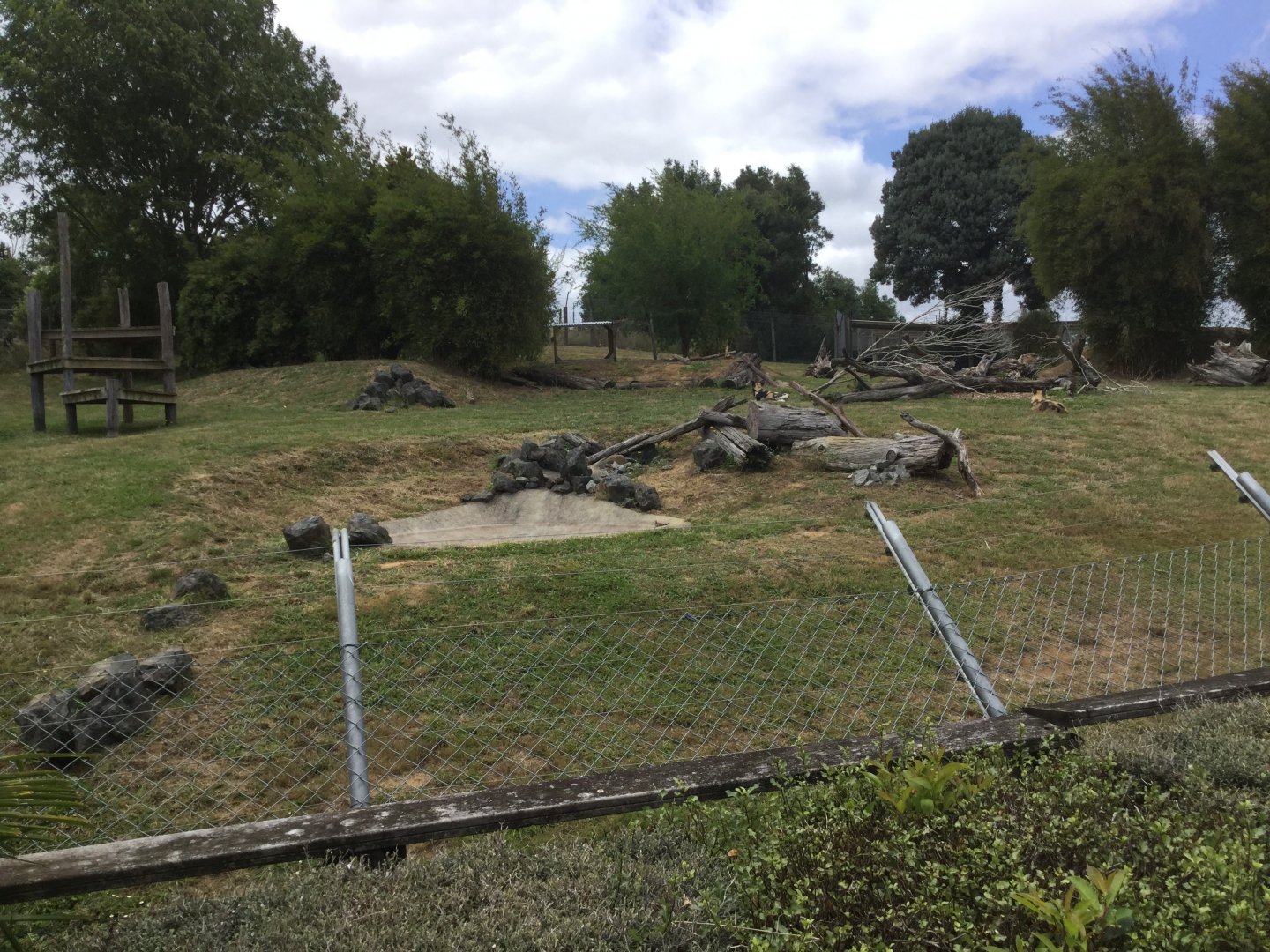
The previously-mentioned Spider Monkeys were next, and then there is another fork in the path, with the right-hand one leading to the African Savannah. At the junction is the "under construction" Cheetah enclosure. The Savannah is very nice, it looks great in itself, but the only viewing is through a fence - or from sort of over the fence from a higher vantage point - which really detracts from it. The species on here are Giraffe, Common Zebra, a herd of male Blackbuck, and (only?) female Ostriches. There weren't any Nyala that I could see and they aren't labelled on the paper map. Adjacent to the Savannah there is also an enclosure for African Hunting Dog, and another large paddock for American Bison and European Fallow Deer.

full


full

[Bison / Fallow Deer paddock]


The Savannah path is a dead-end one, requiring retracing one's steps back up to the junction. You could also take a third path from here to see the White Rhinos and end up back at the zoo entrance. However I took the other option, with the path leading between small paddocks for Goats (and a lone Fallow Deer), Goats and Kunekune, and then more Kunekune. A couple of these enclosures were until recently housing Brazilian Tapir and Brolga (no longer kept).

full


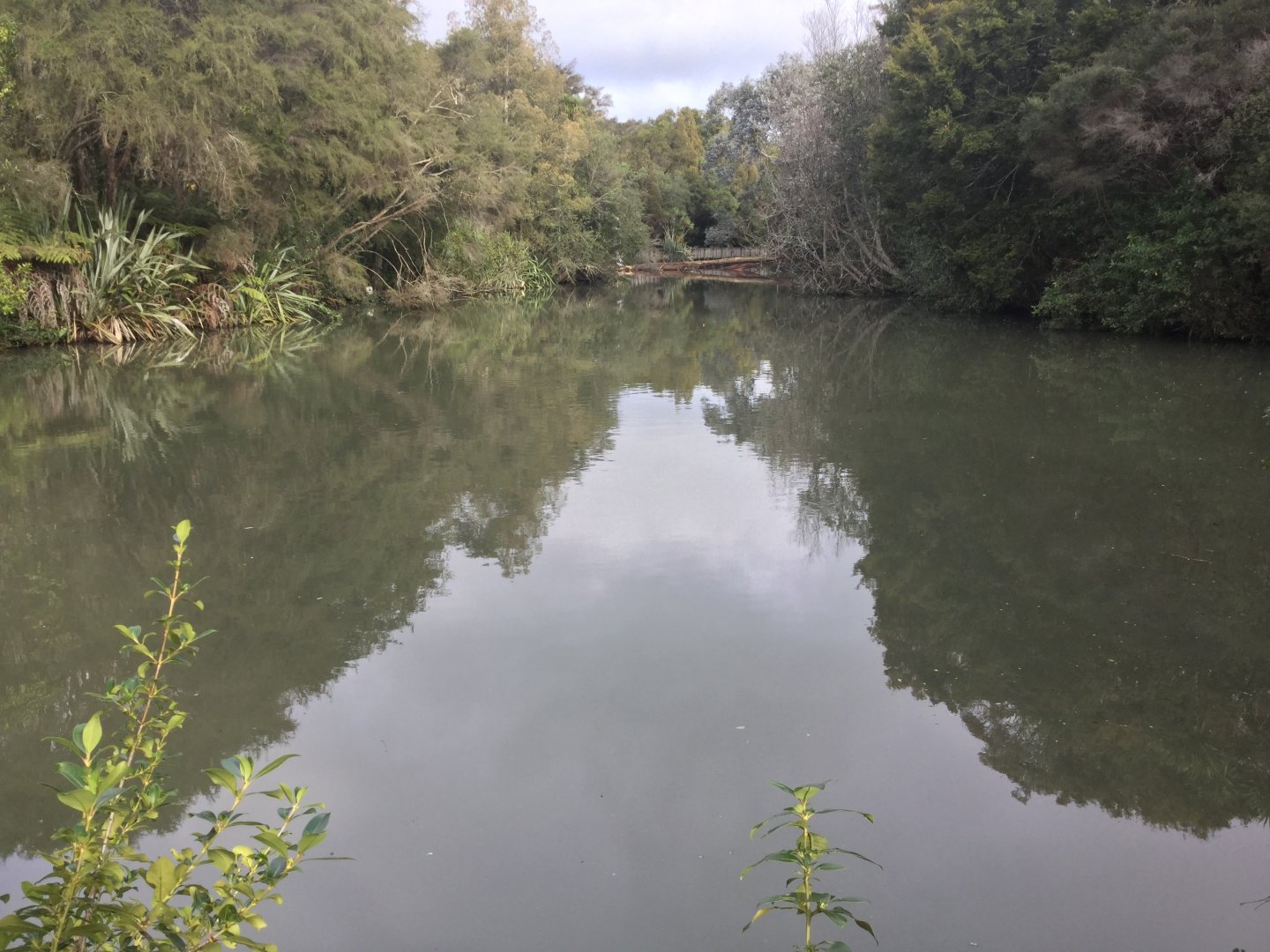
An interesting loop track runs from here through the "Waikato Wetlands", which is basically a large swampy lake. Grey Teal, NZ Shoveller, and Paradise Duck have signboards around the track but I'm not sure if they signify captive birds or wild birds (and I only saw one Grey Teal anyway, out of those three species). There were lots of Mallards though, as well as a pair of Black Swans with leg-bands, and a lone Australian Shelduck. A nice aviary, at one time housing NZ Falcons, now houses Morepork. On the paper map there is a path coming off the loop, showing a Giraffe (on the map-boards it shows Giraffe and Alpaca). I somehow missed this path, so returned to the loop a bit later and discovered the path but it had a locked gate across it. Apparently it leads to a Giraffe viewing area but it is only accessible when the Giraffe aren't out on the Savannah. I did see an Alpaca, the field it is in being right next to the loop-track but inconveniently hidden by trees if one isn't paying enough attention!

full

[Morepork aviary]


Back to the Kunekune and up another dead-end path, passing some cute miniature Donkeys, another Hunting Dog enclosure (nicer than the other one by the Savannah), and finally to the Sumatran Tiger enclosures which have some awkward viewing. I didn't take any photos here because the enclosures can be viewed only from the glass-windowed areas and they were always full of people (it was a Saturday).

full

[Hunting Dog enclosure]


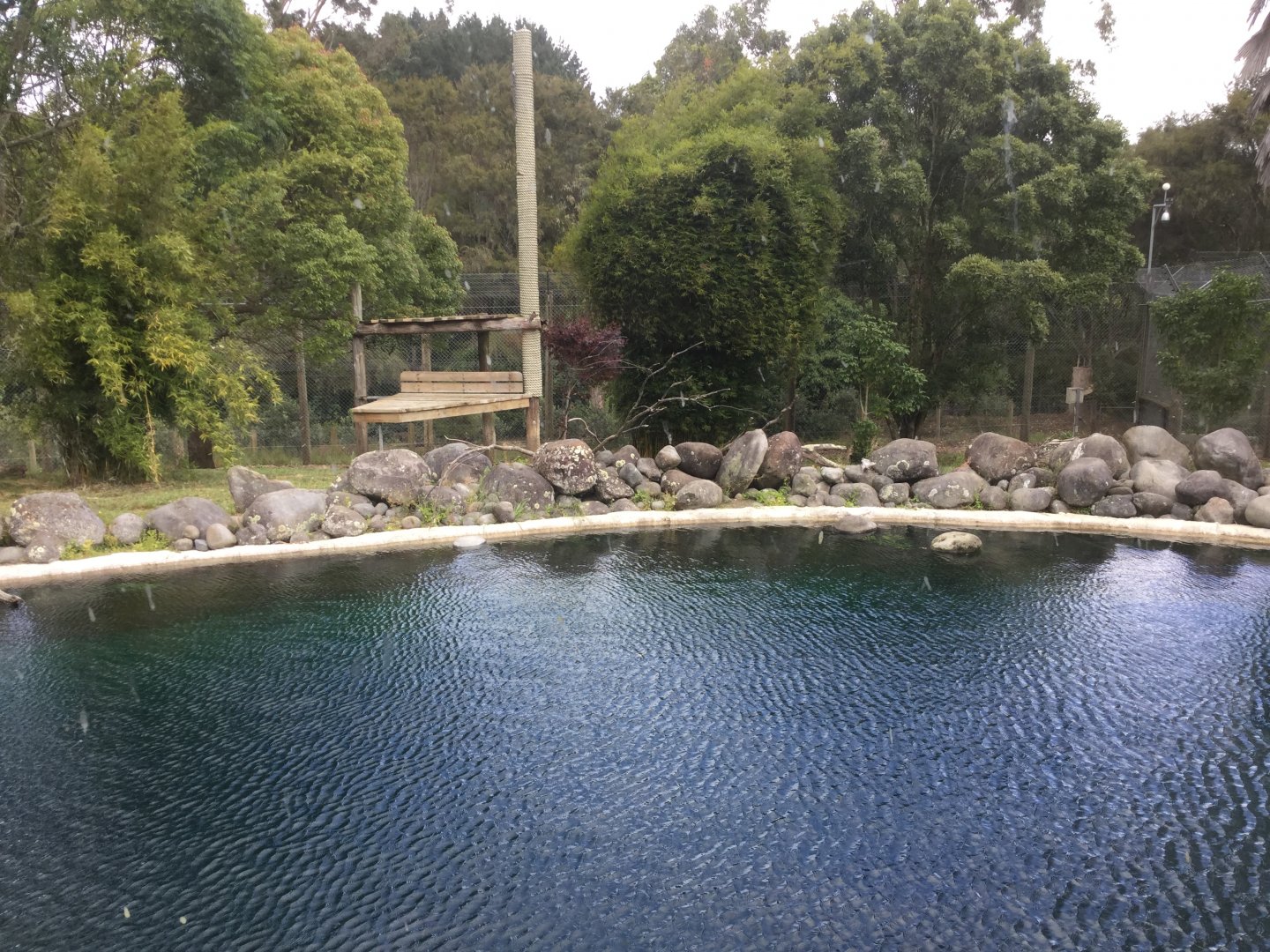
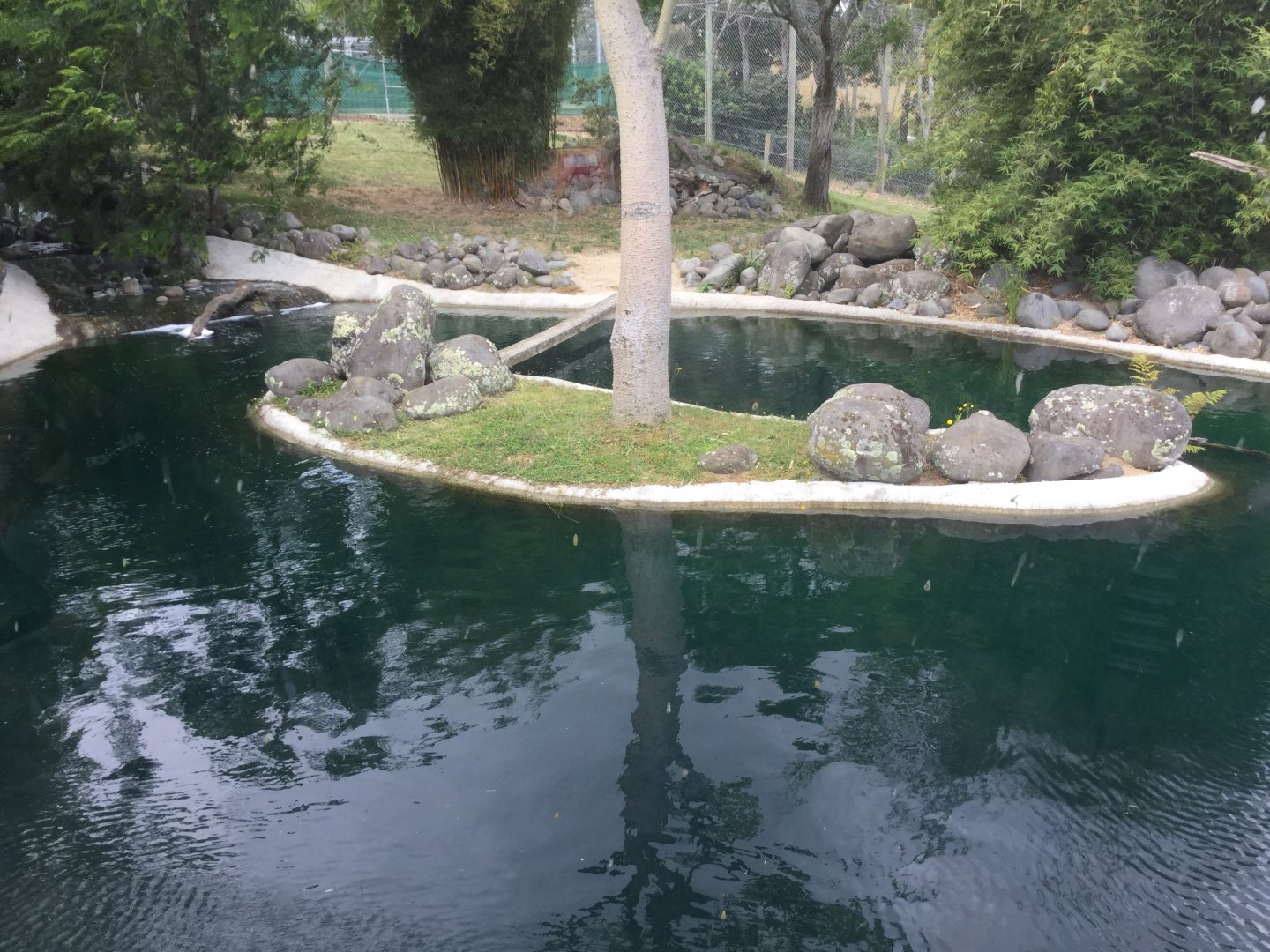
Back-tracking to the Kunekunes and taking yet another path (not a dead-end one this time) leads me to the Siamang on a nice "island" - not an island at all but viewed across a pond. There was a sign here for Mandarin Duck too, but I didn't see any. Passing another duck pond - only wild ducks seen here - I then came across the Fishing Cats, which I'd entirely forgotten Hamilton Zoo kept. They have three cats, in three separate enclosures which are nicely planted but not overly big. I always forget how large Fishing Cats are until I see them again! There are three extra enclosures behind the public ones, which can be seen from a higher viewpoint as the path zigzags up a steep slope past the barren and disappointing (if large) Chimpanzee enclosure.

full

[Siamang enclosure]

full

[Fishing Cat enclosures]


The path then leads back to the Meerkat enclosure. Here I revisited the native birds - still no Banded Rails seen - and then back through the exotic aviaries.
 
Last edited:
Species list, including species signed but not seen.


MAMMALS:

White Rhino
Common Zebra
Miniature Donkey

Giraffe

American Bison
Blackbuck
Nyala (not on display or on the paper map...)
European Fallow Deer
Goat
Kunekune
Alpaca

Ring-tailed Lemur
Black and White Ruffed Lemur
Pigmy Marmoset
Cottontop Tamarin
Geoffroy's Spider Monkey
Black-capped Capuchin
Siamang
Common Chimpanzee

Sumatran Tiger
Fishing Cat
African Hunting Dog
Red Panda
Meerkat

South African Porcupine
Brazilian Agouti


BIRDS:

Ostrich

Black Swan
Blue Duck
Australian Shelduck
Paradise Duck (signed)
New Zealand Shoveller (signed - not sure if captive or wild)
Grey Teal (signed - not sure if captive or wild)
Mandarin Duck

North Island Weka
Banded Rail

Indian Peafowl (free-ranging)
Helmeted Guineafowl (labelled in the White Rhino enclosure but also seen free-ranging)

Musk Lorikeet
Galah
Princess Parrot
Eclectus Parrot
Alexandrine
Moustached Parrot
Antipodes Island Parakeet
Red-crowned Kakariki
Yellow-crowned Kakariki
North Island Kaka
Kea
Scarlet Macaw
Blue and Gold Macaw
Sun Conure
Maroon-bellied Conure

New Zealand Pigeon
Bleeding Heart Pigeon

Morepork

Sacred Kingfisher

Tui
Bellbird

Java Sparrow


REPTILES:
[Presumably there are other species not currently on display]

Tuatara

Cunningham's Skink

Leopard Tortoise
 
Last edited:
Entering the zoo, a visitor can turn to the right which leads past the Tuatara enclosure (apparently the building behind it is a reptile house but it was not able to be entered), on past the White Rhinos, and eventually to the African Savannah; or turn to the left towards the aviaries. I am a lot more interested in birds than rhinos, so I headed left.

The aviaries are pretty large, well-planted, and glass-fronted. Some had the glass white-washed ("for safety reasons" - presumably the birds' safety). In a much-earlier review Zooboy28 says that these aviaries were originally built in the 1960s.

The first aviary is Australian, displaying Galahs, Musk Lorikeets, Princess Parrots, and Cunningham's Skinks (although I did not see the skinks).

The second is mostly Asian birds, with Bleeding Heart Pigeons, Eclectus Parrots, Alexandrines, Moustached Parrots, and Java Sparrows. Only the first two species were signed on the aviary.

The third and fourth (joined) "aviaries" - formerly four separate aviaries if I interpret previous reviews correctly - now house Pigmy Marmosets and Leopard Tortoises in one, and Cottontop Tamarins in the other. The Pigmy Marmoset "aviary" was a great size for these tiny monkeys.

The final aviary is a large one constructed last year, sort of an elongated dome and heavily-planted, which houses South American parrots. There is a pair each of Scarlet Macaw and Blue and Gold Macaw, as well as Sun Conures, and a small flock of unsigned Maroon-bellied Conures. Brazilian Agouti inhabits the floor of the aviary.

The boardwalk past this aviary leads on through the "Rainforest" section with extremely high monkey cages - obviously old and not attractive, but not actually bad either. These would be the worst enclosures at the zoo, and I wouldn't be surprised if this area was completely redeveloped at some point. These cages held Black-capped Capuchins; Ring-tailed Lemurs (Ruffed Lemurs were co-signed with these but not seen); and Geoffroy's Spider Monkeys. On the ground below the boardwalk and between the cages were the breeding groups of Brazilian Agoutis, in what were very large enclosures in comparison to other zoos.

Following the path onwards I passed a very strange glasshouse-style tropically-planted enclosure for Antipodes Island Parakeet - I thought this had to be a repurposed reptile enclosure, but in Zooboy28's older review I discovered it had instead been for Cottontop Tamarins. I guess this would be the worst enclosure actually, rather than the monkey cages, because it was just so out of place and such an inappropriate setting for a subantarctic bird.

It wasn't long before I discovered better housing for the zoo's primates, with the Ruffed Lemurs in two large planted enclosures formerly used for cats (Bobcat and Serval), and a troop of Ring-tailed Lemurs in an enormous enclosure. There was no way to get this enclosure in one photo - or even several photos because the whole of it wasn't visible. This is actually a walk-through enclosure, but only with a keeper as part of a paid "experience" (probably the style of walk-through that Wellington Zoo will be going for). Jumping ahead a bit, there was also another group of Spider Monkeys is a gigantic enclosure which has to have formerly been a tiger enclosure. It is these newer mostly-repurposed enclosures for the primates which make me think the older monkey cages' days are numbered. (I haven't looked at the zoo's masterplan, but I expect it is on there).

Before reaching these Spider Monkeys though, from the Ring-tailed Lemurs I passed a very nice and large Meerkat enclosure (with an unseen South African Porcupine asleep somewhere in there), and an equally nice Red Panda enclosure (not really possible to photograph fully), and came to the native bird section. Most people would probably branch off at the Meerkats and take the path to the Chimps, but birds are better.

The native area is in two parts, firstly a "Weka Walk" and then a walk-through forest aviary. There is some construction going on in the Weka area for an eel pond and hence the only aviary viewable here is for Kea. The Weka remained invisible, assuming they were still in there. Looking at the paper map I seem to have missed a little path which branches around the edge from the zoo's entrance which has Kakariki labelled. On the map-boards around the zoo there is a Morepork aviary inside the Weka Walk, an aviary which I could see but not approach as that path was blocked. The paper map also shows Kaka in this area but there was no aviary for them. I gather that the native reptile enclosures were also supposed to be in this area but there was no sign of them. As earlier mentioned, the native reptile building under construction could be seen from further back along the path (before the Ruffed Lemurs) but was still not finished.

The walk-through forest aviary is huge and exceptionally good. I saw most of the signed species except Yellow-crowned Kakariki, Bellbird, and Banded Rail - the latter was the one I particularly wanted to get photos of! The species I did see were Kaka, Red-crowned Kakariki, NZ Pigeon, Tui, Sacred Kingfisher, and Blue Duck. I got photos of most of them (not sure how well they turned out yet).

The previously-mentioned Spider Monkeys were next, and then there is another fork in the path, with the right-hand one leading to the African Savannah. At the junction is the "under construction" Cheetah enclosure. The Savannah is very nice, it looks great in itself, but the only viewing is through a fence - or from sort of over the fence from a higher vantage point - which really detracts from it. The species on here are Giraffe, Common Zebra, a herd of male Blackbuck, and (only?) female Ostriches. There weren't any Nyala that I could see and they aren't labelled on the paper map. Adjacent to the Savannah there is also an enclosure for African Hunting Dog, and another large paddock for American Bison and European Fallow Deer.

The Savannah path is a dead-end one, requiring retracing one's steps back up to the junction. You could also take a third path from here to see the White Rhinos and end up back at the zoo entrance. However I took the other option, with the path leading between small paddocks for Goats (and a lone Fallow Deer), Goats and Kunekune, and then more Kunekune. A couple of these enclosures were until recently housing Brazilian Tapir and Brolga (no longer kept).

An interesting loop track runs from here through the "Waikato Wetlands", which is basically a large swampy lake. Grey Teal, NZ Shoveller, and Paradise Duck have signboards around the track but I'm not sure if they signify captive birds or wild birds (and I only saw one Grey Teal anyway, out of those three species). There were lots of Mallards though, as well as a pair of Black Swans with leg-bands, and a lone Australian Shelduck. A nice aviary, at one time housing NZ Falcons, now houses Morepork. On the paper map there is a path coming off the loop, showing a Giraffe (on the map-boards it shows Giraffe and Alpaca). I somehow missed this path, so returned to the loop a bit later and discovered the path but it had a locked gate across it. Apparently it leads to a Giraffe viewing area but it is only accessible when the Giraffe aren't out on the Savannah. I did see an Alpaca, the field it is in being right next to the loop-track but inconveniently hidden by trees if one isn't paying enough attention!

Back to the Kunekune and up another dead-end path, passing some cute miniature Donkeys, another Hunting Dog enclosure (nicer than the other one by the Savannah), and finally to the Sumatran Tiger enclosures which have some awkward viewing. I didn't take any photos here because the enclosures can be viewed only from the glass-windowed areas and they were always full of people (it was a Saturday).

Back-tracking to the Kunekunes and taking yet another path (not a dead-end one this time) leads me to the Siamang on a nice "island" - not an island at all but viewed across a pond. There was a sign here for Mandarin Duck too, but I didn't see any. Passing another duck pond - only wild ducks seen here - I then came across the Fishing Cats, which I'd entirely forgotten Hamilton Zoo kept. They have three cats, in three separate enclosures which are nicely planted but not overly big. I always forget how large Fishing Cats are until I see them again! There are three extra enclosures behind the public ones, which can be seen from a higher viewpoint as the path zigzags up a steep slope past the disappointing-but-large Chimpanzee enclosure.

The path then leads back to the Meerkat enclosure. Here I revisited the native birds - still no Banded Rails seen - and then back through the exotic aviaries.

Nice review. Very comprehensive. I’d agree with your assessment of Hamilton being New Zealand’s second best zoo (behind Auckland); and with the masterplan getting started, there’s big changes to come.

From what I can tell from the 2014 masterplan, the plan is to extend the Nepalese red panda exhibit to also encompass the area occupied by the Slender-tailed meerkat exhibit. The current Ring-tailed lemur exhibit will become the site of a new spider monkey exhibit; which will include the area occupied by Small Cat Row (now housing lemurs and Himalayan monal). The lemurs will in turn be exhibited in a walk through exhibit built on the current site of the spider monkey exhibit.

The old tall cages will no doubt be demolished. They don’t feature in the masterplan and the Growing Wild Precinct will partly encroach on their current site.

I could be mistaken, but I don’t believe the spider monkey exhibit was ever used for tigers. I’d always assumed it was purpose built for them during the 90’s, which would tie in with the tapir import around the same time (they shared the exhibit). To my knowledge, the Sumatran tiger siblings transferred from Wellington in 2001 were the first tigers at the zoo; though not the first big cats, as the zoo had previously held Jaguar, Puma and African lion.

Yes, the zoo only has female ostrich. I will ask about the absent nyala on my next visit.

I’ve only ever seen the Mandarin ducks in the lake leading up to the Fishing cat exhibit. Although there’s a sign there, I’ve never seen them in the Siamang moat.

The building behind the Tuatara exhibit was the zoo’s reptile house for many years. It closed a few years ago and has since been refurbished as a room for the zoo’s volunteers. After the new Tuatara House is built, I assume their old exhibit will be repurposed.
 
Small Cat Row (now housing lemurs and Himalayan monal)
When did you last see the Monals? I didn't see any signage for them (hence didn't look for them in the lemur enclosures).

I could be mistaken, but I don’t believe the spider monkey exhibit was ever used for tigers. I’d always assumed it was purpose built for them during the 90’s, which would tie in with the tapir import around the same time (they shared the exhibit).
Ah, that makes sense. Having a large pool in a Spider Monkey enclosure threw me, but if it was originally also housing Tapirs it is more understandable.
 
When did you last see the Monals? I didn't see any signage for them (hence didn't look for them in the lemur enclosures).


Ah, that makes sense. Having a large pool in a Spider Monkey enclosure threw me, but if it was originally also housing Tapirs it is more understandable.

My mistake. They were there on my visit 25/07/2020; but I remember noticing their absence on my visit 21/11/2020 and asking about them as a volunteer said a bird had recently gone to Auckland (they couldn’t remember which species). I later learned they were referring to Brolga; and was told by a different volunteer the Himalayan monal was off display. I assume this is to encourage breeding as they haven’t bred to date.

On my November visit they’d drained the pool in the spider monkey exhibit (possibly because it posed a potential hazard to the new infant); and because it serves no purpose now the tapir have died.

Over the years, they trialled separating the tapir (with one housed in the paddock adjacent to the Cheetah exhibit) in the hope of stimulating reproductive behaviour when they were reunited. The theory was they had become too familiar with each other; but given their age, I’d say it was too little too late.
 
Thanks very much for the review. I find it interesting that New Zealand's 2nd best zoo only has around 60-65 species, which appears to be a very small number. Nevertheless, the photos that I've seen of Hamilton Zoo make it seem that for the most part the exhibits there are of an above average quality.
 
Thanks very much for the review. I find it interesting that New Zealand's 2nd best zoo only has around 60-65 species, which appears to be a very small number. Nevertheless, the photos that I've seen of Hamilton Zoo make it seem that for the most part the exhibits there are of an above average quality.

The size of Hamilton Zoo means they’ve been able to develop large exhibits, which are invariably quite simple; but effective nonetheless.

It’s not uncommon for exhibits to begin looking dated after 20 years, but I would still rank their main exhibits for the Sumatran tiger (constructed 2001) and African wild (constructed 2003) very highly against the ones I have seen in other zoos. New/additional exhibits for both species are part of the masterplan.


My mistake. They were there on my visit 25/07/2020; but I remember noticing their absence on my visit 21/11/2020 and asking about them as a volunteer said a bird had recently gone to Auckland (they couldn’t remember which species). I later learned they were referring to Brolga; and was told by a different volunteer the Himalayan monal was off display. I assume this is to encourage breeding as they haven’t bred to date.

On my November visit they’d drained the pool in the spider monkey exhibit (possibly because it posed a potential hazard to the new infant); and because it serves no purpose now the tapir have died.

Over the years, they trialled separating the tapir (with one housed in the paddock adjacent to the Cheetah exhibit) in the hope of stimulating reproductive behaviour when they were reunited. The theory was they had become too familiar with each other; but given their age, I’d say it was too little too late.
I may be wrong, but I suspect the Himalayan Monal stock in New Zealand is on the way out, if not already extinct.
 
I may be wrong, but I suspect the Himalayan Monal stock in New Zealand is on the way out, if not already extinct.

Both Hamilton and Wellington Zoo held the species on my last visit; though as I mentioned, Hamilton’s are now off display. It’s possible there may be a handful in private hands (though I’m not personally aware of any).

The individuals held at both zoos are getting on in their years, so if the species is to remain in New Zealand zoos, it’s important to achieve breeding success soon. Hopefully Hamilton Zoo will be successful in this. I’ll ask about their progress on my next visit.
 
I have added photos into the review (now split into three posts), which I think will make reading it more interesting for those people who haven't been to the zoo.
 
I have added photos into the review (now split into three posts), which I think will make reading it more interesting for those people who haven't been to the zoo.

It’ll be good to see the Fishing cat exhibits open again on my next visit (the pathway has been closed for the chimpanzee exhibit renovations). I’d hoped the exhibit closure (and the zoo closure during Covid for some of last year) had given them the privacy they needed to successfully breed; but no announcements have been made by the zoo regarding this. I will ask on my next visit.
 
Back
Top