Entering the zoo, a visitor can turn to the right which leads past the Tuatara enclosure (apparently the building behind it is a reptile house but it was not able to be entered), on past the White Rhinos, and eventually to the African Savannah; or turn to the left towards the aviaries. I am a lot more interested in birds than rhinos, so I headed left.
The aviaries are pretty large, well-planted, and glass-fronted. Some had the glass white-washed ("for safety reasons" - presumably the birds' safety). In a much-earlier review Zooboy28 says that these aviaries were originally built in the 1960s.
The first aviary is Australian, displaying Galahs, Musk Lorikeets, Princess Parrots, and Cunningham's Skinks (although I did not see the skinks).
The second is mostly Asian birds, with Bleeding Heart Pigeons, Eclectus Parrots, Alexandrines, Moustached Parrots, and Java Sparrows. Only the first two species were signed on the aviary.
The third and fourth (joined) "aviaries" - formerly four separate aviaries if I interpret previous reviews correctly - now house Pigmy Marmosets and Leopard Tortoises in one, and Cottontop Tamarins in the other. The Pigmy Marmoset "aviary" was a great size for these tiny monkeys.
The final aviary is a large one constructed last year, sort of an elongated dome and heavily-planted, which houses South American parrots. There is a pair each of Scarlet Macaw and Blue and Gold Macaw, as well as Sun Conures, and a small flock of unsigned Maroon-bellied Conures. Brazilian Agouti inhabits the floor of the aviary.
The boardwalk past this aviary leads on through the "Rainforest" section with extremely high monkey cages - obviously old and not attractive, but not actually bad either. These would be the worst enclosures at the zoo, and I wouldn't be surprised if this area was completely redeveloped at some point. These cages held Black-capped Capuchins; Ring-tailed Lemurs (Ruffed Lemurs were co-signed with these but not seen); and Geoffroy's Spider Monkeys. On the ground below the boardwalk and between the cages were the breeding groups of Brazilian Agoutis, in what were very large enclosures in comparison to other zoos.
Following the path onwards I passed a very strange glasshouse-style tropically-planted enclosure for Antipodes Island Parakeet - I thought this had to be a repurposed reptile enclosure, but in Zooboy28's older review I discovered it had instead been for Cottontop Tamarins. I guess this would be the worst enclosure actually, rather than the monkey cages, because it was just so out of place and such an inappropriate setting for a subantarctic bird.
It wasn't long before I discovered better housing for the zoo's primates, with the Ruffed Lemurs in two large planted enclosures formerly used for cats (Bobcat and Serval), and a troop of Ring-tailed Lemurs in an enormous enclosure. There was no way to get this enclosure in one photo - or even several photos because the whole of it wasn't visible. This is actually a walk-through enclosure, but only with a keeper as part of a paid "experience" (probably the style of walk-through that Wellington Zoo will be going for). Jumping ahead a bit, there was also another group of Spider Monkeys is a gigantic enclosure which has to have formerly been a tiger enclosure. It is these newer mostly-repurposed enclosures for the primates which make me think the older monkey cages' days are numbered. (I haven't looked at the zoo's masterplan, but I expect it is on there).
Before reaching these Spider Monkeys though, from the Ring-tailed Lemurs I passed a very nice and large Meerkat enclosure (with an unseen South African Porcupine asleep somewhere in there), and an equally nice Red Panda enclosure (not really possible to photograph fully), and came to the native bird section. Most people would probably branch off at the Meerkats and take the path to the Chimps, but birds are better.
The native area is in two parts, firstly a "Weka Walk" and then a walk-through forest aviary. There is some construction going on in the Weka area for an eel pond and hence the only aviary viewable here is for Kea. The Weka remained invisible, assuming they were still in there. Looking at the paper map I seem to have missed a little path which branches around the edge from the zoo's entrance which has Kakariki labelled. On the map-boards around the zoo there is a Morepork aviary inside the Weka Walk, an aviary which I could see but not approach as that path was blocked. The paper map also shows Kaka in this area but there was no aviary for them. I gather that the native reptile enclosures were also supposed to be in this area but there was no sign of them. As earlier mentioned, the native reptile building under construction could be seen from further back along the path (before the Ruffed Lemurs) but was still not finished.
The walk-through forest aviary is huge and exceptionally good. I saw most of the signed species except Yellow-crowned Kakariki, Bellbird, and Banded Rail - the latter was the one I particularly wanted to get photos of! The species I did see were Kaka, Red-crowned Kakariki, NZ Pigeon, Tui, Sacred Kingfisher, and Blue Duck. I got photos of most of them (not sure how well they turned out yet).
The previously-mentioned Spider Monkeys were next, and then there is another fork in the path, with the right-hand one leading to the African Savannah. At the junction is the "under construction" Cheetah enclosure. The Savannah is very nice, it looks great in itself, but the only viewing is through a fence - or from sort of over the fence from a higher vantage point - which really detracts from it. The species on here are Giraffe, Common Zebra, a herd of male Blackbuck, and (only?) female Ostriches. There weren't any Nyala that I could see and they aren't labelled on the paper map. Adjacent to the Savannah there is also an enclosure for African Hunting Dog, and another large paddock for American Bison and European Fallow Deer.
The Savannah path is a dead-end one, requiring retracing one's steps back up to the junction. You could also take a third path from here to see the White Rhinos and end up back at the zoo entrance. However I took the other option, with the path leading between small paddocks for Goats (and a lone Fallow Deer), Goats and Kunekune, and then more Kunekune. A couple of these enclosures were until recently housing Brazilian Tapir and Brolga (no longer kept).
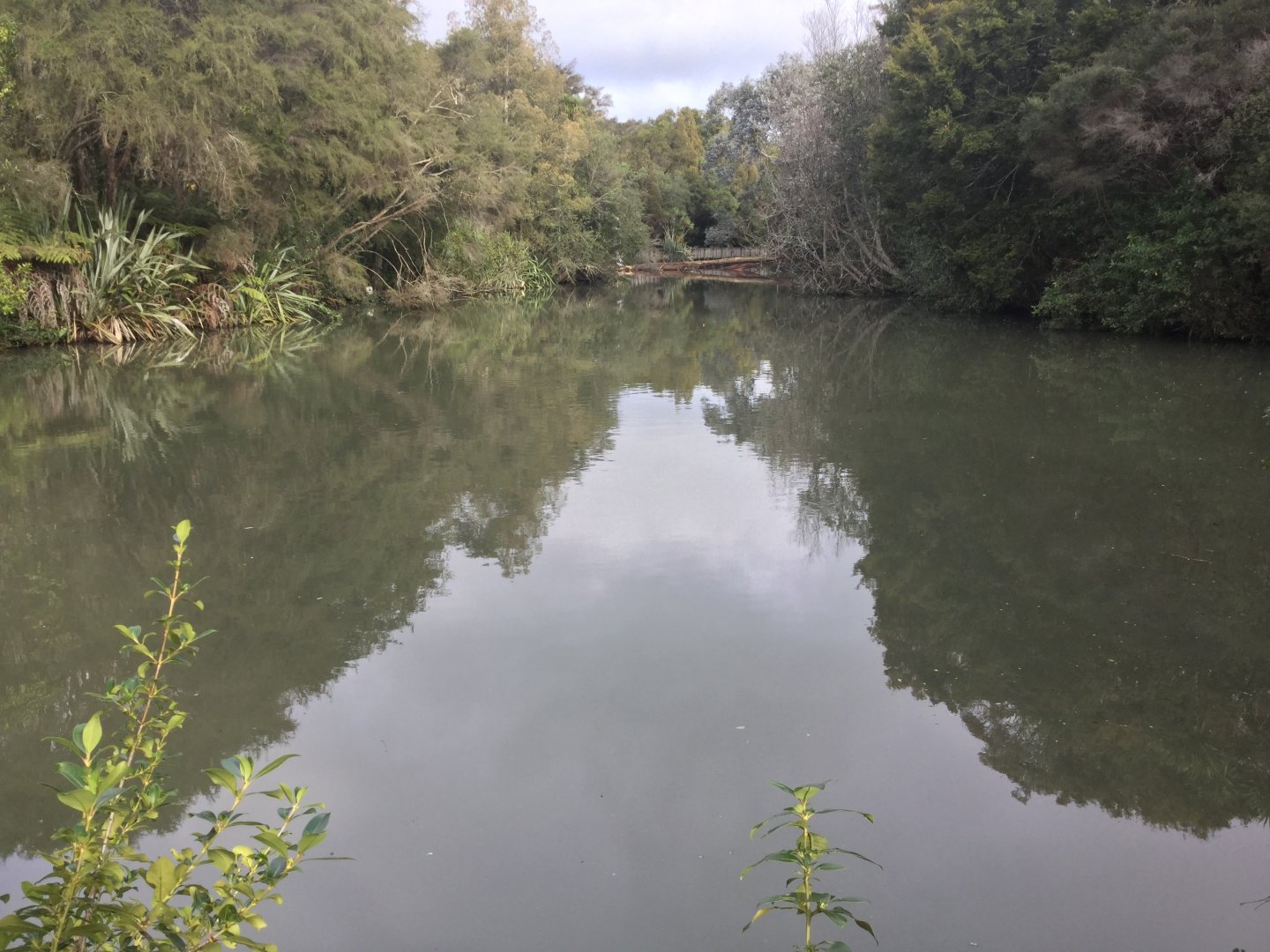
An interesting loop track runs from here through the "Waikato Wetlands", which is basically a large swampy lake. Grey Teal, NZ Shoveller, and Paradise Duck have signboards around the track but I'm not sure if they signify captive birds or wild birds (and I only saw one Grey Teal anyway, out of those three species). There were lots of Mallards though, as well as a pair of Black Swans with leg-bands, and a lone Australian Shelduck. A nice aviary, at one time housing NZ Falcons, now houses Morepork. On the paper map there is a path coming off the loop, showing a Giraffe (on the map-boards it shows Giraffe and Alpaca). I somehow missed this path, so returned to the loop a bit later and discovered the path but it had a locked gate across it. Apparently it leads to a Giraffe viewing area but it is only accessible when the Giraffe aren't out on the Savannah. I did see an Alpaca, the field it is in being right next to the loop-track but inconveniently hidden by trees if one isn't paying enough attention!
Back to the Kunekune and up another dead-end path, passing some cute miniature Donkeys, another Hunting Dog enclosure (nicer than the other one by the Savannah), and finally to the Sumatran Tiger enclosures which have some awkward viewing. I didn't take any photos here because the enclosures can be viewed only from the glass-windowed areas and they were always full of people (it was a Saturday).
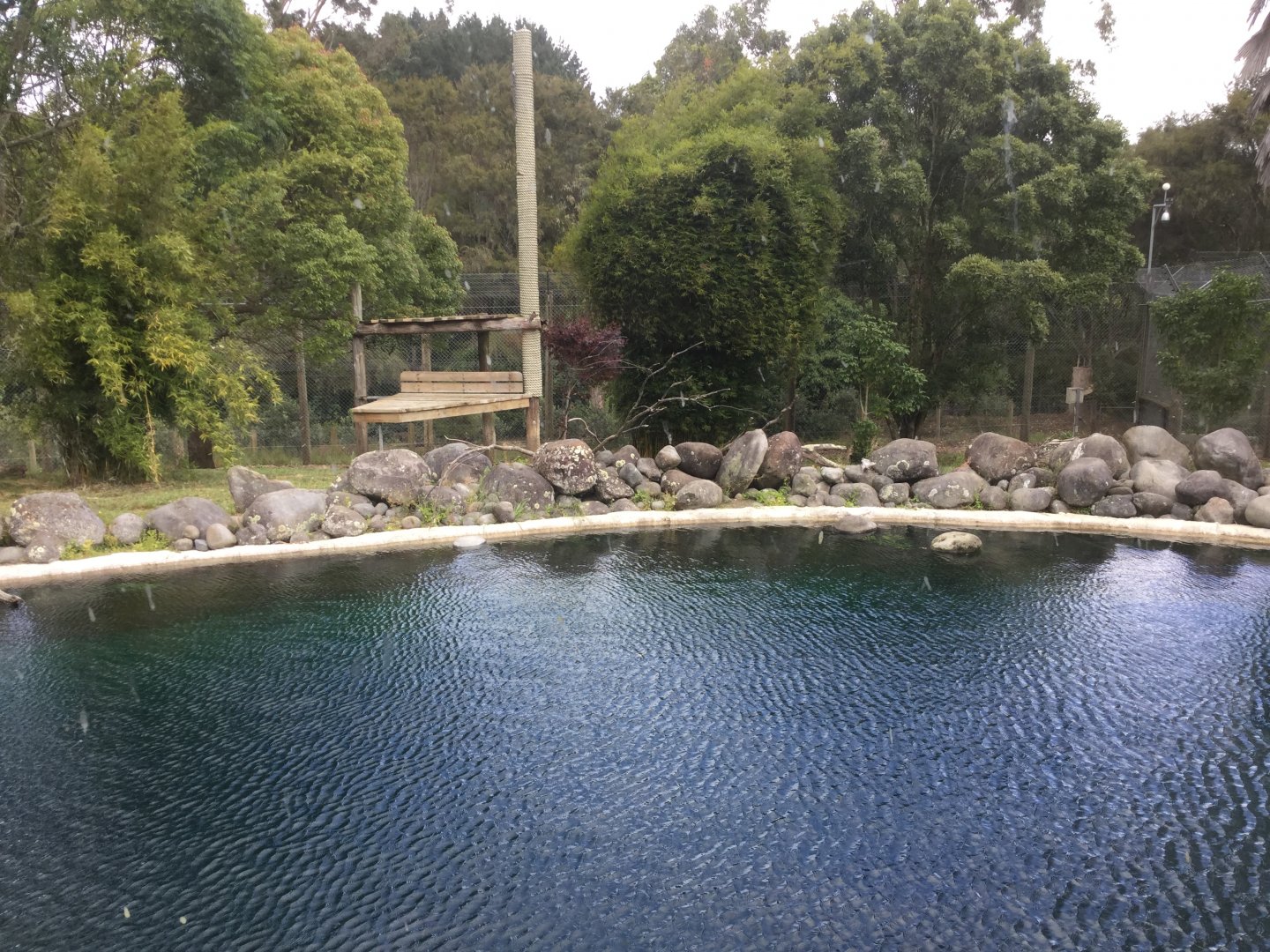
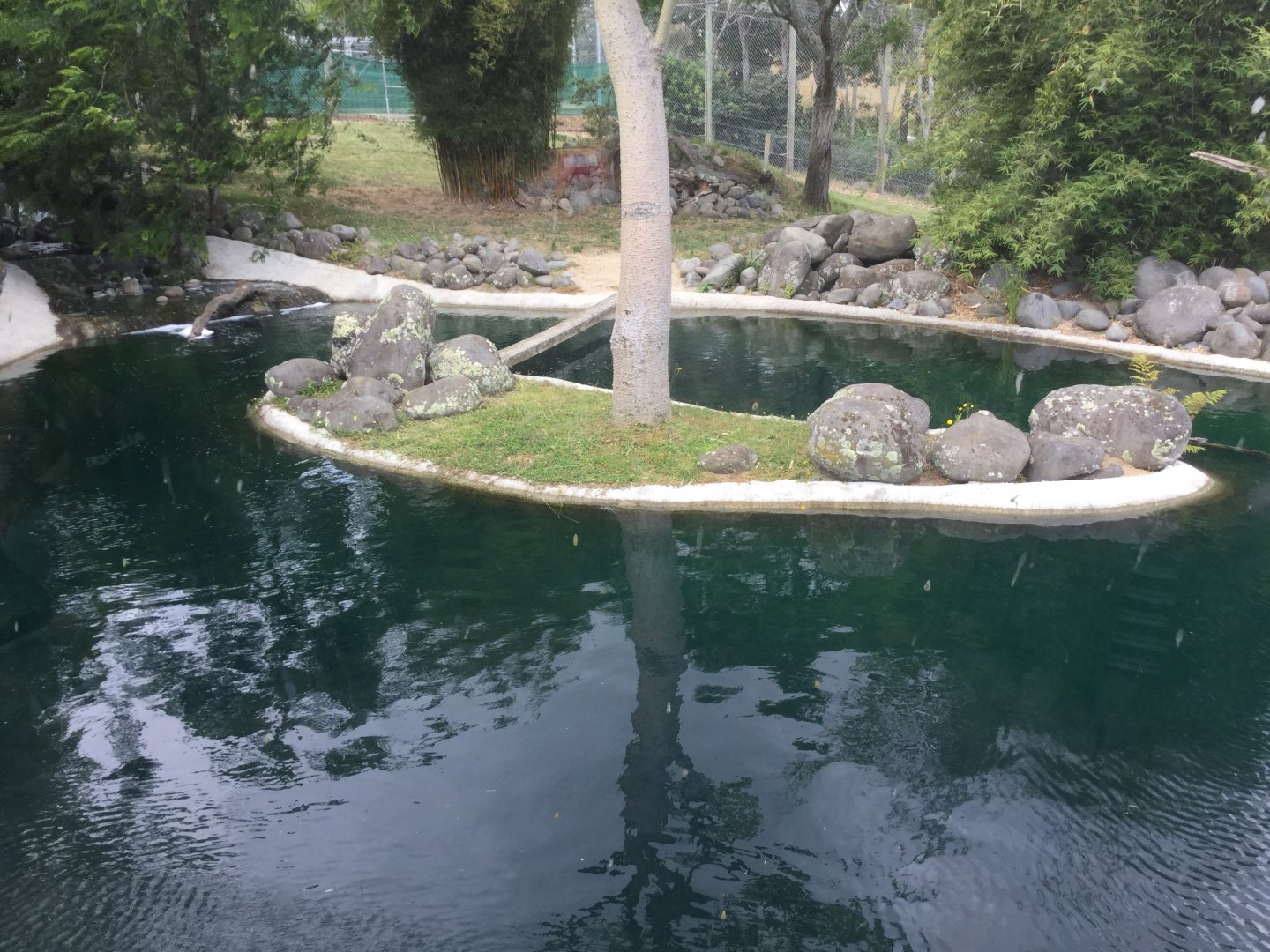
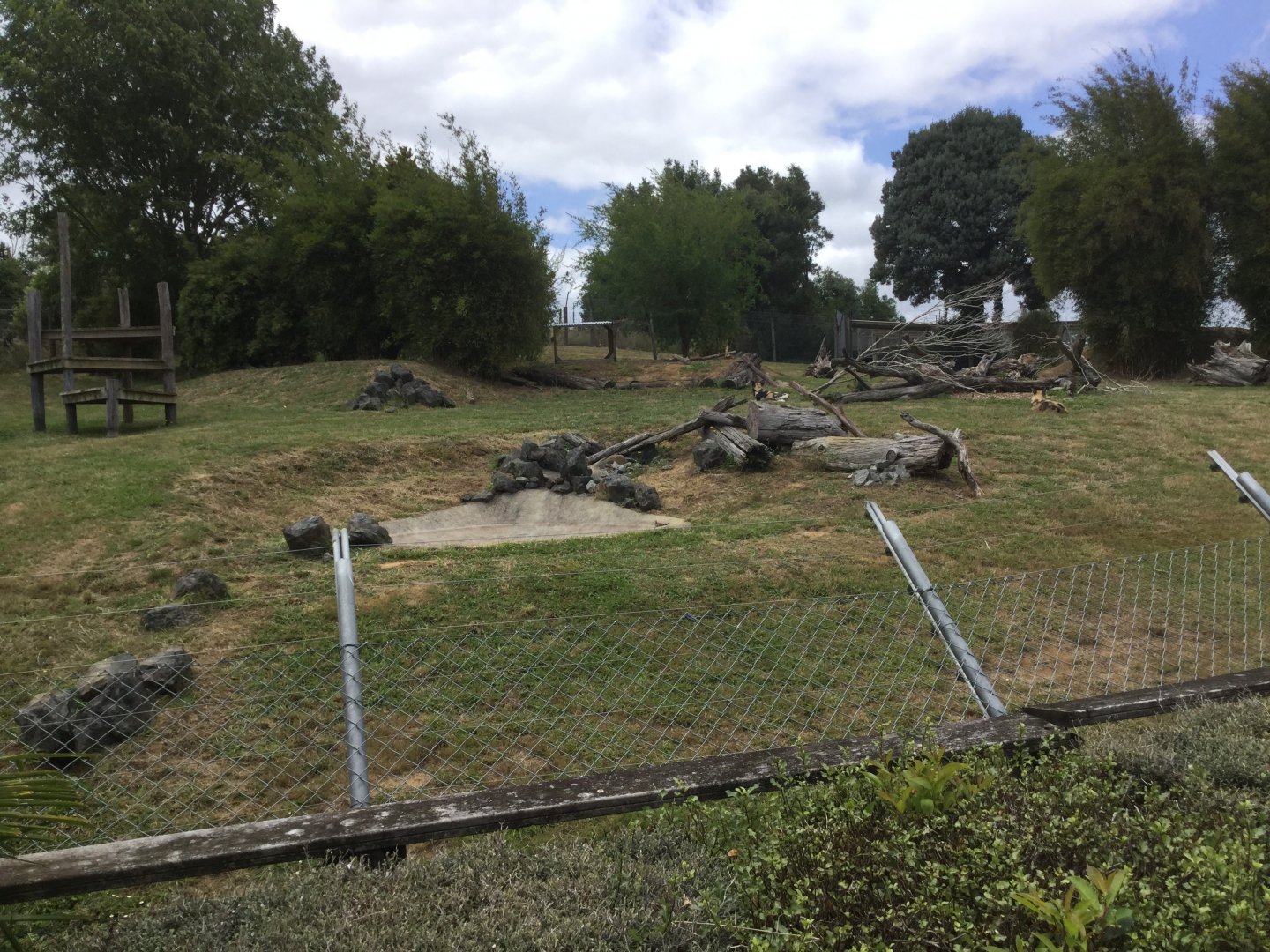
Back-tracking to the Kunekunes and taking yet another path (not a dead-end one this time) leads me to the Siamang on a nice "island" - not an island at all but viewed across a pond. There was a sign here for Mandarin Duck too, but I didn't see any. Passing another duck pond - only wild ducks seen here - I then came across the Fishing Cats, which I'd entirely forgotten Hamilton Zoo kept. They have three cats, in three separate enclosures which are nicely planted but not overly big. I always forget how large Fishing Cats are until I see them again! There are three extra enclosures behind the public ones, which can be seen from a higher viewpoint as the path zigzags up a steep slope past the disappointing-but-large Chimpanzee enclosure.
The path then leads back to the Meerkat enclosure. Here I revisited the native birds - still no Banded Rails seen - and then back through the exotic aviaries.